[This is a draft of a section of a forthcoming study on “A Flexible Governance Framework for Artificial Intelligence,” which I hope to complete shortly. I welcome feedback. I have also cross-posted this essay at Medium.]
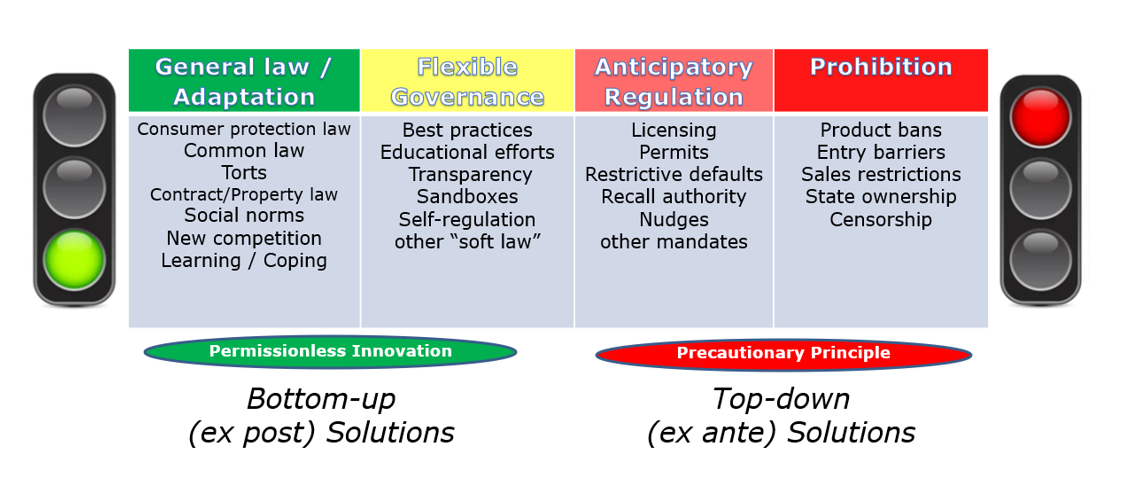
Debates about how to embed ethics and best practices into AI product design is where the question of public policy defaults becomes important. To the extent AI design becomes the subject of legal or regulatory decision-making, a choice must be made between two general approaches: the precautionary principle or the proactionary principle.[1] While there are many hybrid governance approaches in between these two poles, the crucial issue is whether the initial legal default for AI technologies will be set closer to the red light of the precautionary principle (i.e., permissioned innovation) or to the green light of the proactionary principle (i.e., (permissionless innovation). Each governance default will be discussed.
I’ve been working on a new book that explores the rise of evasive entrepreneurialism and technological civil disobedience in our modern world. Following the publication of my last book, Permissionless Innovation: The Continuing Case for Comprehensive Technological Freedom, people started bringing examples of evasive entrepreneurialism and technological civil disobedience to my attention and asked how they were related to the concept of permissionless innovation. As I started exploring and cataloging these cases studies, I realized I could probably write an entire book about these developments and their consequences.
Hopefully that book will be wrapped up shortly. In the meantime, I am going to start rolling out some short essays based on content from the book. To begin, I will state the general purpose of the book and define the key concepts discussed therein. In coming weeks and months, I’ll build on these themes, explain why they are on the rise, explore the effect they are having on society and technological governance efforts, and more fully develop some relevant case studies. Continue reading →
The recently enacted Stop Enabling Sex Trafficking Act (SESTA) has many problems including that it doesn’t achieve its stated purpose ofstopping sex trafficking. It contains a retroactivity clause that appears facially unconstitutional, but this provision would likely be severable by courts if used as the sole basis of a legal challenge. Perhaps more concerning are the potential First Amendment violations of the law.
These concerns go far beyond the rights of websites as speakers, but to the individual users’ content generation. Promoting sex trafficking is already a crime and a lawful restraint on speech. Websites, however, have acted broadly and quickly due to concerns of their new liability under the law and as a result lawful speech has also been stifled.
Given the controversial nature of the law it seems likely that a legal challenge is forthcoming. Here are three ideas about what a First Amendment challenge to the law might look like.
There was horrible news from Tempe, Arizona this week as a pedestrian was struck and killed by a driverless car owned by Uber. This is the first fatality of its type and is drawing widespread media attention as a result. According to both police statements and Uber itself, the investigation into the accident is ongoing and Uber is assisting in the investigation. While this certainly is a tragic event, we cannot let it cost us the life-saving potential of autonomous vehicles.
While any fatal traffic accident involving a driverless car is certainly sad, we can’t ignore the fact that each and every day in the United States letting human beings drive on public roads is proving far more dangerous. This single event has led some critics to wonder why we were allowing driverless cars to be tested on public roads at all before they have been proven to be 100% safe. Driverless cars can help reverse a public health disaster decades in the making, but only if policymakers allow real-world experimentation to continue.
Let’s be more concrete about this: Each day, Americans take 1.1 billion trips driving 11 billion miles in vehicles that weigh on average between 1.5 and 2 tons. Sadly, about 100 people die and over 6,000 are injured each day in car accidents. 94% of these accidents have been shown to be attributable to human error and this deadly trend has been increasing as we become more distracted while driving. Moreover, according to the Center for Disease Control and Prevention, almost 6000 pedestrians were killed in traffic accidents in 2016, which means there was roughly one crash-related pedestrian death every 1.6 hours. In Arizona, the issue is even more pronounced with the state ranked 6th worst for pedestrians and the Phoenix area ranked the 16th worst metro for such accidents nationally. Continue reading →
The success of the Internet and the modern digital economy was due to its open, generative nature, driven by the ethos of “permissionless innovation.” A “light-touch” policy regime helped make this possible. Of particular legal importance was the immunization of online intermediaries from punishing forms of liability associated with the actions of third parties.
As “software eats the world” and the digital revolution extends its reach to the physical world, policymakers should extend similar legal protections to other “generative” tools and platforms, such as robotics, 3D printing, and virtual reality.
As I noted here a few days ago, the Federal Communications Commission held a workshop on Tuesday about “Speech, Democratic Engagement, and the Open Internet.” It was a shockingly one-sided affair with the deck being stacked almost entirely in favor of advocates of Net neutrality regulation. Worse yet, those advocates shamelessly made up spooky stories about a future of “private censorship” that could only be remedied by using the First Amendment as a club to beat private players into submission. The token opposition at this Chicken Little circus was Robert Corn-Revere, a Partner at the law firm of Davis Wright Tremaine LLP in Washington, D.C. Bob set the record straight–both in terms of baseless accusations that were flying that day as well as the revisionist histories of the First Amendment that were being put forward. I’m happy to report that Bob allowed PFF to reprint his remarks as a new white paper entitled, “The First Amendment, the Internet & Net Neutrality: Be Careful What You Wish For.”
In his essay, Corn-Revere discusses the relationship between the First Amendment and regulatory policy, particularly the treatment of new communications technologies, and he warns that government regulation of broadband networks could “provide the vehicle for advancing new First Amendment theories for media regulation” and online speech and expression more generally. “It should not be forgotten,” he argues, “that the federal government’s initial impulse was to censor the Internet and to subject it to a far lower level of First Amendment protection. It pursued this agenda for more than a decade but was blocked by a series of First Amendment rulings.” The Communications Decency Act and the Child Online Protection Act are just two notable examples. Luckily, the courts determined that “the open Internet would be at great risk if the government is allowed to exercise such power,” he notes, and they struck down such laws.
In an earlier post, I mentioned an important new online child safety task force report that has just been released from the “Point Smart. Click Safe.” Blue Ribbon Working Group. It’s a great report and I encourage you to read the whole thing. It was my great pleasure to serve on this task force, and as we started finalizing our conclusions and recommendations, I started thinking about how much of what we were finding and recommending was consistent with what past online safety task forces had also concluded.
By way of background, over the past decade, five major online safety task forces or blue ribbon commissions have been convened to study online safety issues. Two of these task forces were convened in the United States and issued reports in 2000 (“COPA Commission”) and 2002 (“Thornburgh Commission“). Another was commissioned by the British government in 2007 and issued in a major report in March 2008 (“Byron Review“). Finally, two additional online safety task forces were formed in the U.S. in 2008 and concluded their work, respectively, in January (“Internet Safety Technical Task Force“) and July (“Point Smart. Click Safe.“) of 2009. [And yet another task force — the Online Safety Technology Working Group — was recently formed and has now gotten underway.]
Conversations about how the Internet can be used to increase the openness and accountability of government usually focuses on the Executive and Legislative branches of the Federal government. But on this week’s episode of Technology Policy Weekly, I hosted a discussion of the equally vital issue of public access to court records, joined by:
The TLF’s own Tim Lee, who’s written about the problems with PACER , the arcane and expensive system by which court documents are currently made publicly available—with a separate system for each of the 100+ Federal courts!
Why lay people should care—this is ultimately about reducing the legal profession’s monopoly over access to the courts!
The philosophical reasons why better access to court records is important – little things like democracy, fairness, consistency, equality, the rule of law, etc.
The copyrightability of legal records
The history of the problem & what can be done about it
There are several ways to listen to the TLF Podcast. You can press play on the player below to listen right now, or download the MP3 file. You can also subscribe to the podcast by clicking on the button for your preferred service. And do us a favor, Digg this podcast!
Microsoft’s share of the browser market across all versions of Internet Explorer has dropped, by one estimate, dropped from 78.58% in December 2007 to 68.15% in December 2008 (or by just under 8% in another estimate).
[IE’s] share dropped from 69.77% in November to 68.15% in December. [During the same period,] Firefox gained more than half a point and ended up at 21.34%, Safari approaches the [10%] hurdle with 7.93% and Chrome came in at 1.04%, the first time Google was able to cross the 1% mark.
Since IE6 is used primarily within corporations, its market share is much higher during the week than it is on weekends. As a result, all other browsers gain on weekends and especially during a holiday. Because of that circumstance, Net Applications noted that the December numbers should be taken with a grain of salt. However, it is worth the note that IE6 achieved … market share numbers of about 28% during the week and about 21% on weekends in early 2008. In December, these numbers were down to about 20% during the week and 15% on weekends.
So, Microsoft still has an established base among corporate users, where IT administrators generally prevent employees from installing new applications (including browsers) and the sysadmins often don’t roll out alternative browsers across a corporate network for any one of several possible reasons, including:
They just don’t want to bother having to install, regularly upgrade and support another piece of software;
They may overestimate the security vulnerability of such alternative browsers compared to Internet Explorer;
The crustier sysadmins may not realize that today’s browsers are not only free for individual users, but also for corporate users–unlike the old Netscape Navigator; and
Corporate intranets may be designed for IE, in which case rolling out an alternative browser might cause confusion among less tech-savvy employees.
Microsoft may still have an advantage that could be considered “unfair,” but so what? Continue reading →
The Technology Liberation Front is the tech policy blog dedicated to keeping politicians' hands off the 'net and everything else related to technology. Learn more about TLF →




 The Technology Liberation Front is the tech policy blog dedicated to keeping politicians' hands off the 'net and everything else related to technology.