The FCC appears to be dragging the TV industry, which is increasingly app- and Internet-based, into years of rulemakings, unnecessary standards development and oversight, and drawn-out lawsuits. The FCC hasn’t made a final decision but the general outline is pretty clear. T
he FCC wants to use a 20 year-old piece of corporate welfare, calculated to help a now-dead electronics retailer, as authority to regulate today’s TV apps and their licensing terms. Perhaps they’ll succeed in expanding their authority over set top boxes and TV apps. But as TV is being revolutionized by the Internet the legacy providers are trying to stay ahead of the new players (Netflix, Amazon, Layer 3), regulating TV apps and boxes will likely impede the competitive process and distract the FCC from more pressing matters, like spectrum and infrastructure. Continue reading →
For decades Congress has gradually deregulated communications and media. This poses a significant threat to the FCC’s jurisdiction because it is the primary regulator of communications and media. The current FCC, exhibiting alarming mission creep, has started importing its legacy regulations to the online world, like Title II common carrier regulations for Internet providers. The FCC’s recent proposal to “open up” TV set top boxes is consistent with the FCC’s reinvention as the US Internet regulator, and now the White House has supported that push.
There are a lot of issues with the set top box proposal but I’ll highlight a few. I really don’t even like referring to it as “the set top box proposal” because the proposal is really aimed at the future of TV–video viewing via apps and connected devices. STBs are a sideshow and mostly just provide the FCC a statutory hook to regulate TV apps. Even that “hook” is dubious–the FCC arbitrarily classifies apps and software as “navigation devices” but concludes that actual TV devices like Chromecast, Roku, smartphones, and tablets aren’t navigation devices. And, despite what activists say, this isn’t about “cable” either but all TV distributors (“MVPDs”) like satellite and telephone companies and Google Fiber, most of whom are small TV players. Continue reading →
The Mercatus Center at George Mason University has just released my new white paper, “The Perils of Classifying Social Media Platforms as Public Utilities.” [PDF] I first presented a draft of this paper last November at a Michigan State University conference on “The Governance of Social Media.” [Video of my panel here.]
In this paper, I note that to the extent public utility-style regulation has been debated within the Internet policy arena over the past decade, the focus has been almost entirely on the physical layer of the Internet. The question has been whether Internet service providers should be considered “essential facilities” or “natural monopolies” and regulated as public utilities. The debate over “net neutrality” regulation has been animated by such concerns.
While that debate still rages, the rhetoric of public utilities and essential facilities is increasingly creeping into policy discussions about other layers of the Internet, such as the search layer. More recently, there have been rumblings within academic and public policy circles regarding whether social media platforms, especially social networking sites, might also possess public utility characteristics. Presumably, such a classification would entail greater regulation of those sites’ structures and business practices.
Proponents of treating social media platforms as public utilities offer a variety of justifications for regulation. Amorphous “fairness” concerns animate many of these calls, but privacy and reputational concerns are also frequently mentioned as rationales for regulation. Proponents of regulation also sometimes invoke “social utility” or “social commons” arguments in defense of increased government oversight, even though these notions lack clear definition.
Social media platforms do not resemble traditional public utilities, however, and there are good reasons why policymakers should avoid a rush to regulate them as such. Continue reading →
Today the Federal Trade Commission released a new report entitled, “Mobile Apps for Kids: Current Privacy Disclosures Are Disappointing,” which concludes that “confusing and hard-to-find disclosures do not give parents the control that they need in this area. The FTC argues that “parents need consistent, easily accessible, and recognizable disclosures regarding in-app purchase capabilities so that they can make informed decisions about whether to allow their children to use apps with such capabilities.”
It’s hard to be against the FTC’s “the more disclosure, the better” policy recommendation and I’m not about to come out against it here. But the question is:
how much disclosure is enough? Reading through the report and seeing how hard the FTC hammers this point home makes me think the agency wants our app store checkout process to be littered with the pages of fine print disclosure policies that now accompany our credit card statements and home mortgage payments! Seriously, would that make us better off?
As a parent of two kids who both download countless apps on my Android phone, my wife’s iPhone, and our family’s Android tablet, I appreciate a certain amount of disclosure about what sort of information apps are collecting and how they are using it. I think Google’s Android marketplace strikes a nice balance here, providing us with the most crucial facts about what the application will access or share. Apple could do more on disclosure but the company also prides itself (to the dismay of some!) on its rigorous pre-screening process to make sure the apps in the App Store are safe and don’t violate certain privacy and security policies. Yet, as the FTC correctly points out, “the details of this screening process are not clear.” Of course, most Apple users simply don’t give a damn. They’re all too happy to let Apple just take care of it for them even if they’re not really sure what’s happening to their data behind the scenes. The more privacy-sensitive crowd wants greater disclosure and control, of course, and I’m sympathetic to that plea. But again, how much disclosure is enough? Are you going to wade through pages of disclosure policies and privacy opt-ins before downloading that latest iteration of “Angry Birds” or “Cut the Rope”? Yeah, I didn’t think so.
Anyway, I don’t want to dwell on that. The more interested findings in the survey relate to price and market dynamics and I am hoping people don’t ignore them. Continue reading →
I posted a rant here over the weekend about those who were engaging in what I believed was excessive whining about Apple’s moves to restrict pornographic content in the Apple Apps Store. (see: “Apple’s App Store, Porn & ‘Censorship‘”) It received a surprising number of comments and featured a back and forth between me and our old TLF blogging colleague Tim Lee. Tim has continued the discussion over on his personal blog and argued that:
[T]he key thing to focus on isn’t the abstract question of whether porn on iPhones is good or bad. The key thing to recognize is how fundamentally broken the process itself is. “Overtly sexual content” is a concept that seems clear in the abstract but gets leaky once you have to actually classify tens of thousands of applications. Apple is going to make mistakes, and when they do hapless developers are going to find their apps blocked, often with little explanation or recourse. Also, Apple is going to change its mind periodically, and when they do the affected developers are going to find their hard-earned apps rendered worthless overnight. This is no way to run a technology platform. It’s unfair to developers and it doesn’t scale. And this is precisely why it would be better for everyone if Apple could come up with an application distribution scheme that didn’t require so much central planning.
I followed up with a comment over there, but just thought I would repost it here, in which I argue that Tim is underestimating how difficult this task of defining acceptable content is and that he is also downplaying Apple’s legitimate editorial discretion to establish standards for the community platform they provide. I’m also uncomfortable with Tim’s constant use of “central planning” rhetoric to describe almost any private, proprietary model of institutional governance or platform development he doesn’t seem to agree with, but I have not elaborated on that point here. Anyway, here’s how I responded over on his blog: Continue reading →

Tim Wu: Not Looking Happy about Being So Wrong
Three years ago this month, Columbia University Law School professor Tim Wu released a controversial white paper in conjunction with the New America Foundation entitled, “Wireless Net Neutrality: Cellular Carterfone and Consumer Choice in Mobile Broadband.” It contained a litany of accusations regarding supposed corporate shenanigans in the mobile marketplace, including: intentional crippling of features and functionality; refusal to allow 3rd party attachments or intentional curtailment of a market for 3rd party application developers; and various concerns about “discrimination” of one sort or another.
Here at the TLF, we responded quite forcefully. I think every one of us piled on this study in one way or another. (ex: Hance, Jerry, James, Tim Lee, me x 2, + a podcast). I called his proposal “a declaration of surrender” since Prof. Wu was essential calling the game early and raising the white flag on mobile competition. Further, I argued he was essentially asking for “the forced commoditization of cellular networks” which “would necessitate at return to the rate-of-return regulatory methods of the past.” Others were a bit more kind to him, but we were all pretty skeptical of his gloomy claims. However, each of us here also argued that the wireless market (especially the applications side of the market) was still developing and that we’d have to check back in a few years to see how well the hands-off approach worked out.
Well, thankfully, we now know for certain that Tim Wu’s was much too lugubrious in his outlook and far too quick to call for regulatory intervention to solve a non-crisis. On the occasion of the 3rd anniversary of the release of Prof. Wu’s paper, CTIA-The Wireless Association filed a short paper with the FCC taking stock of just how far the mobile marketplace has come in just three short years. The results are really quite remarkable, as CTIA’s letter notes: Continue reading →
Arik Hesseldahl has an interesting piece in
Business Week about Apple’s control of the iPhone App approval process in which he asks: “Is a smartphone gatekeeper needed?” Plenty of people don’t think so and have raised a stink about Apple trying to play that role for the iPhone. It certainly could be true, as some critics suggest, that Apple is being too heavy-handed on occasion when rejecting apps, but it’s always easy for those of us on the outside of the process to think that. Hesseldahl notes that:
it’s tempting to consider the implications of a less hands-on approach, as is the case with Macs, Microsoft (MSFT) Windows PCs, or other smartphones, including those running the Google (GOOG)-backed Android operating system. The software market for personal computing has existed in this way for nearly three decades, and while there have certainly been some problems along the way, I’d argue that overall we’re better off without Microsoft or Apple or some other organization approving software applications before they’re released to the market. PC users have learned to be careful about what they put on their computers through unhappy trial and error.
But he also notes that there is another side to the story: Continue reading →
 Seems like everywhere I turn someone is gushing about their new Droid phone, including my TLF colleagues Berin Szoka, Braden Cox, and Ryan Radia, who all had great fun rubbing their new toys in my nose over the past couple of days. And why not, it’s a very cool little device. It makes my HTC Touch seems positively archaic in some ways, and it’s only a year old. Apparently, 100,000 people already picked up a Droid in just its first weekend on the market.
But here’s the first thing that pops in my mind every time I see someone showing off their new Droid: How can a device like this even exist when America’s leading cyberlaw experts have been telling us that the whole digital world is increasingly going to hell because of “closed” devices, proprietary code, and managed networks? I’m speaking, of course, about the lamentations of Harvard professors Lawrence Lessig, Jonathan Zittrain, and their many disciples. As faithful readers will recall, I have relentlessly hammered this crew for their unwarranted cyber-Chicken Little-ism and hyper techno-pessimism. (See my many battles with Zittrain [1, 2, 3, 4, 5, 6 + video] and my 2-part debate with Lessig earlier this year).
“Left to itself,” Lessig warned in Code, “cyberspace will become a perfect tool of control.” He went on to forecast a dystopian future in which nefarious corporate schemers would quash our digital liberties unless benevolent public philosopher kings stepped in to save our poor souls. Code was the Old Testament of cyber-collectivism. The New Testament arrived last year with Zittrain’s
The Future of the Internet and How to Stop It. In it, we hear the grim prediction that “sterile and tethered” digital technologies and networks will triumph over the more “open and generative” devices and systems of the past. The iPhone and TiVo are cast as villains in Zittrain’s drama since they apparently represent the latest manifestations of Lessig’s “perfect control” paranoia.
Apple’s “Angel of Death”
How completely out-of-control has this thinking gotten? Well, here’s David Weinberger — another Harvard Berkman Center worrywart — talking about that supposed satanic font of all evil, the Apple AppStore: Continue reading →
by Berin Szoka & Adam Thierer, Progress Snapshot 5.11 (PDF)
Ten years ago, Nobel Prize-winning economist Milton Friedman lamented the “Business Community’s Suicidal Impulse:” the persistent propensity to persecute one’s competitors through regulation or the threat thereof. Friedman asked: “Is it really in the self-interest of Silicon Valley to set the government on Microsoft?” After yesterday’s FCC vote’s to open a formal “Net Neutrality” rule-making, we must ask whether the high-tech industry—or consumers—will benefit from inviting government regulation of the Internet under the mantra of “neutrality.”
The hatred directed at Microsoft in the 1990s has more recently been focused on the industry that has brought broadband to Americans’ homes (Internet Service Providers) and the company that has done more than any other to make the web useful (Google). Both have been attacked for exercising supposed “gatekeeper” control over the Internet in one fashion or another. They are now turning their guns on each other—the first strikes in what threatens to become an all-out, thermonuclear war in the tech industry over increasingly broad neutrality mandates. Unless we find a way to achieve “Digital Détente,” the consequences of this increasing regulatory brinkmanship will be “mutually assured destruction” (MAD) for industry and consumers.
New Fronts in the Neutrality Wars
The FCC’s proposed rules would apply to all broadband providers, including wireless, but not to Google or many other players operating in other layers of the Net who favor such broadband-specific rules. With this rulemaking looming, AT&T came after Google with letters to the FCC in late September and then another last week accusing the company of violating neutrality principles in their business practices and arguing that any neutrality rules that apply to ISPs should apply equally to Google’s panoply of popular services. In particular, AT&T accused Google of “search engine bias,” suggesting that only government-enforced neutrality mandates could protect consumers from Google’s supposed “monopolist” control.
The promise made yesterday by the FCC—to only apply neutrality principles to the infrastructure layer of the Net—is hollow and will ultimately prove unenforceable. Continue reading →
FCC Chairman Julius Genachowski suggested at an FCC field hearing this week that the federal government might create its own “version of iTunes.” Multichannel News reports:
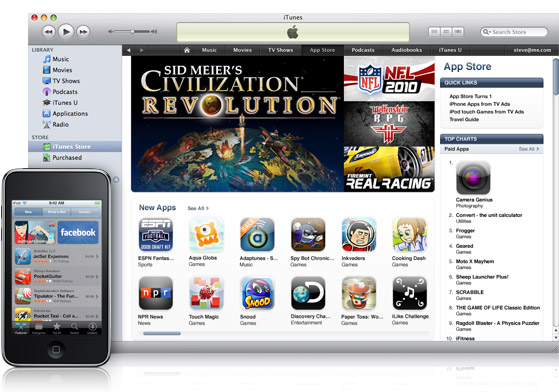
The chairman asked panelists to think about the value of a clearinghouse where best practices could be shared. He suggested that might be a way to spur the spin-off of public-sector apps from private sector initiatives and to prevent reinventing the wheel, rather than tapping into what is already being done. There is not a lot of shared info out there, he said.
If all we’re talking about is a clearinghouse that provides easy access to apps for government-developed apps, Google Code or SourceForge may be a better model than iTunes—though perhaps without the instant name recognition by ordinary consumers. Like SourceForge, Google Code allows hosting and management of open source projects, including Google’s own products. iTunes, by contrast, essentially offers consumers finished apps. Also, iTunes is a stand-alone piece of software, of which the Apps Store is just one part, while I can’t imagine why Genachowski’s “store” need be anything more than a website.
Whatever the analogy, such a “store” could well be a valuable tool for sharing the benefits of software development by government employees, both with the private sector and among federal agencies as well as state, local and even foreign governments. But what, exactly, Genachowski had in mind for the store remains awfully vague: Multichannel News mentions, as examples, “applications that do everything from monitoring heart rates and blood sugar to checking for greenhouse gas levels.” If the idea ever goes anywhere, it should be based on two principles:
- All apps should be open source and available to all users to use as they see fit.
- The store should be limited to apps developed by government employees to meet the needs of government agencies.
Continue reading →

 The Technology Liberation Front is the tech policy blog dedicated to keeping politicians' hands off the 'net and everything else related to technology.