Over at Discourse magazine I’ve posted my latest essay on how conservatives are increasingly flirting with the idea of greatly expanding regulatory control of private speech platforms via some sort of common carriage regulation or new Fairness Doctrine for the internet. It begins:
Conservatives have traditionally viewed the administrative state with suspicion and worried about their values and policy prescriptions getting a fair shake within regulatory bureaucracies. This makes their newfound embrace of common carriage regulation and media access theory (i.e., the notion that government should act to force access to private media platforms because they provide an essential public service) somewhat confusing. Recent opinions from Supreme Court Justice Clarence Thomas as well as various comments and proposals of Sen. Josh Hawley and former President Trump signal a remarkable openness to greater administrative control of private speech platforms.
Given the takedown actions some large tech companies have employed recently against some conservative leaders and viewpoints, the frustration of many on the right is understandable. But why would conservatives think they are going to get a better shake from state-regulated monopolists than they would from today’s constellation of players or, more importantly, from a future market with other players and platforms?
I continue on to explain why conservatives should be skeptical of the administrative state being their friend when it comes to the control of free speech. I end by reminding conservatives what President Ronald Reagan said in his 1987 veto of legislation to reestablish the Fairness Doctrine: “History has shown that the dangers of an overly timid or biased press cannot be averted through bureaucratic regulation, but only through the freedom and competition that the First Amendment sought to guarantee.”
Read more at
Discourse, and down below you will find several other recent essays I’ve written on the topic.
If there are two general principles that unify my recent work on technology policy and innovation issues, they would be as follows. To the maximum extent possible:
- We should avoid preemptive and precautionary-based regulatory regimes for new innovation. Instead, our policy default should be innovation allowed (or “permissionless innovation”) and innovators should be considered “innocent until proven guilty” (unless, that is, a thorough benefit-cost analysis has been conducted that documents the clear need for immediate preemptive restraints).
- We should avoid rigid, “top-down” technology-specific or sector-specific regulatory regimes and/or regulatory agencies and instead opt for a broader array of more flexible, “bottom-up” solutions (education, empowerment, social norms, self-regulation, public pressure, etc.) as well as reliance on existing legal systems and standards (torts, product liability, contracts, property rights, etc.).
I was very interested, therefore, to come across two new essays that make opposing arguments and proposals. The first is this recent
Slate oped by John Frank Weaver, “We Need to Pass Legislation on Artificial Intelligence Early and Often.” The second is Ryan Calo’s new Brookings Institution white paper, “The Case for a Federal Robotics Commission.”
Weaver argues that new robot technology “is going to develop fast, almost certainly faster than we can legislate it. That’s why we need to get ahead of it now.” In order to preemptively address concerns about new technologies such as driverless cars or commercial drones, “we need to legislate early and often,” Weaver says. Stated differently, Weaver is proposing “precautionary principle”-based regulation of these technologies. The precautionary principle generally refers to the belief that new innovations should be curtailed or disallowed until their developers can prove that they will not cause any harms to individuals, groups, specific entities, cultural norms, or various existing laws, norms, or traditions.
Calo argues that we need “the establishment of a new federal agency to deal with the novel experiences and harms robotics enables” since there exists “distinct but related challenges that would benefit from being examined and treated together.” These issues, he says, “require special expertise to understand and may require investment and coordination to thrive.
I’ll address both Weaver and Calo’s proposals in turn. Continue reading →
Yesterday it was my privilege to speak at a Free State Foundation (FSF) event on “Ideas for Communications Law and Policy Reform in 2013.” It was moderated by my friend and former colleague Randy May, who is president of FSF, and the event featured opening remarks from the always-excellent FCC Commissioner Robert McDowell.
During the panel discussing that followed, I offered my thoughts about the problem America continues to face in cleaning up communications and media law and proposed a few ideas to get reform done right once and for all. I don’t have time to formally write-up my remarks, but I thought I would just post the speech notes that I used yesterday and include links to the relevant supporting materials. (I’ve been using a canned version of this same speech at countless events over the past 15 years. Hopefully lawmakers will take up some of these reforms some time soon so I’m not using this same set of remarks in 2027!)
Continue reading →
 It is unlikely there has ever been a more important figure in the history of regulatory policy than Alfred Kahn. As I noted in this appreciation upon his passing in December 2010, his achievements as both an academic and a policymaker in this arena where monumental. His life was the very embodiment of the phrase “ideas have consequences.” His ideas changed the world profoundly and all consumers owe him a massive debt of gratitude for reversing the anti-consumer regulatory policies that stifled competition, choice, and innovation. It was also my profound pleasure to get to know Fred personally over the last two decades of his life and to enjoy his spectacular wit and unparalleled charm. He was the most gracious and entertaining intellectual I have ever interacted with and I miss him dearly.
As I noted in my earlier appreciation, Fred was a self-described “good liberal Democrat” who was appointed by President Jimmy Carter to serve as Chairman of the Civil Aeronautics Board in the mid-1970s and promptly set to work with other liberals, such as Sen. Ted Kennedy, Stephen Breyer, and Ralph Nader, to dismantle anti-consumer airline cartels that had been sustained by government regulation. These men achieved a veritable public policy revolution in just a few short years. Not only did they comprehensively deregulate airline markets but they also got rid of the entire regulatory agency in the process. Folks, that is how you end crony capitalism once and for all! Continue reading →
This week, my colleague Jerry Brito asked me to guest lecture to his George Mason University law school class on regulatory process. He asked me to talk about one of my favorite topics: the sad, sordid history of regulatory capture. Regular readers will recall the compendium I posted here a few months ago [and that I continue to update] of selected passages from books and papers penned by various economists and political scientists who have studied this issue.
Again, it doesn’t make for pretty reading, but the lesson that history teaches is vital: No matter how noble the “public interest” goals of regulatory advocates or their specific proposals, the only thing that really counts is what regulation means in practice. Regrettably, all too often, regulation is “captured” by various interests and used to their advantage, or at least to the
disadvantage of potential competitors, new entrants, and innovation.
While I was gathering some materials for the case study portion of my lecture — which incorporates the history of telecommunications monopolization, broadcast industry regulatory shenanigans, and transportation / airlines fiascos — I figured I had to post a passage from one of my favorite books on regulation of all-time: Thomas K. McCraw’s brilliant Pulitzer Prize-winning 1984 book, Prophets of Regulation. In his chapter on the late great Alfred Kahn, the father of airline deregulation, McCraw recounts the history of the Civil Aeronautics Board (CAB) from its creation in the 1940s up until the time of Kahn’s ascendency to CAB chairman in the Carter Administration (and then the CAB’s eventual deregulation and abolition). Here’s the key passage from that history: Continue reading →
 I was very sad to learn this morning of the death of Alfred Kahn, the brilliant economist known as “the father of airline deregulation.” He was 93. He was a brilliant, gracious and gregarious man who never failed to have a smile on his face and make those around him smile even more. He will be missed.
Kahn has been an inspiration to an entire generation of regulatory analysts and economists. His 2-volume masterwork, The Economics of Regulation, has served as our bible and provided us with a framework to critically analyze the efficacy of government regulation. I have cited it in more of my papers and essays than any other book or article. The book was that big of a game-changer, as was Kahn’s time in government. A self-described “good liberal Democrat,” Kahn was appointed by President Jimmy Carter to serve as Chairman of the Civil Aeronautics Board in the mid-1970s and promptly set to work with other liberals, such as Sen. Ted Kennedy, Stephen Breyer, and Ralph Nader, to dismantle anti-consumer cartels that had been sustained by government regulation. These men understood that consumer welfare was better served by innovative, competitive markets than by captured regulators, who talked a big game about serving “the public interest” but were typically busy stifling innovation and market entry.
His academic and policy achievements were significant, but what I will most remember about him is that, in a field not known for lively personalities or exciting discussions, Kahn was a consistent source of great wit and entertainment. He always managed to make even the most dreadfully boring of regulatory topics interesting and entertaining. Everyone would go away happy from a Fred Kahn talk. Moreover, in a policy arena characterized by bitter intellectual bickering and endless bad-mouthing, Kahn always rose above the fray and held himself out to be a model of maturity and respectfulness. I have never heard a single person say a bad word about Alfred Kahn. Not one. That’s saying something in the field of regulatory policy! Continue reading →
by Adam Thierer & Berin Szoka
Move over, health care reform, climate change, and the economy. Judging by White House visits by various government agency heads, the Obama administration instead appears preoccupied with the re-regulation of communications, media, and the Internet. The Administration has just released logs of all visitors to the White House and Executive Office Buildings from Obama’s inauguration through August—including a staggering 47 visits by Federal Communications Commission (FCC) Chairman Julius Genachowski. By contrast, no other major agency head logged more than five visits. Chairman Genachowski obviously has an audience with those at the highest levels of power, including the President himself, but this raises questions about just how “independent” this particular regulator and his agency really are.
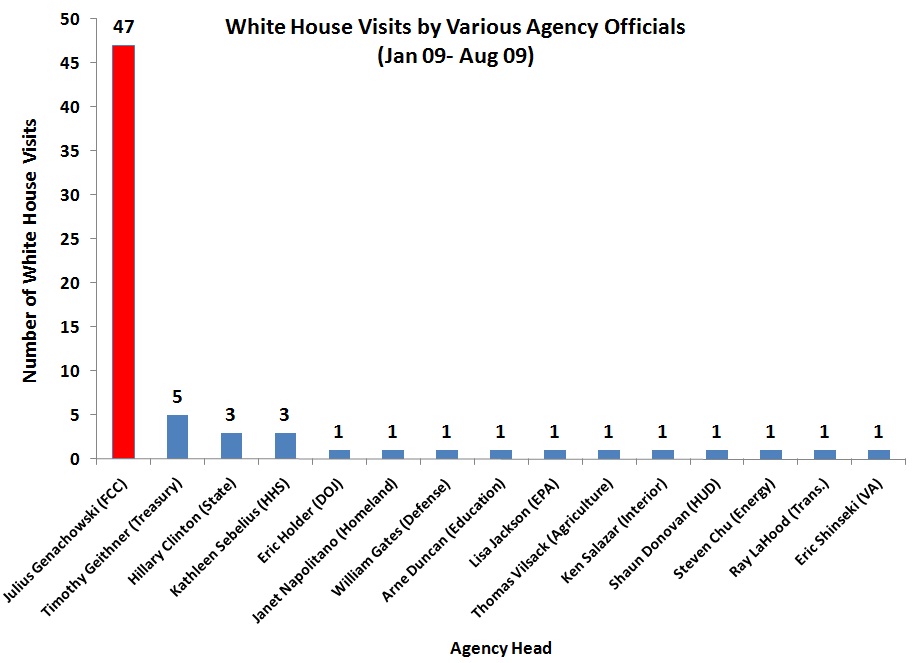
Unprecedented Transparency by White House
The Administration deserves credit for releasing these visitor logs, which offer unprecedented transparency into the White House’s workings. Unfortunately, the logs lack visitors’ affiliation and title, making it difficult to discern subtle patterns. Furthermore, each entry indicates only one “visitee” and the total number of people involved. Full disclosure requires identifying all meeting participants. Nonetheless, President Obama’s gesture is a great first step toward improved government accountability.
This openness allows us to ask questions we couldn’t pose for previous administrations—such as why the FCC head seems to have unparalleled access to the White House. Lacking data from previous administrations, it’s difficult to make direct comparisons with previous FCC Chairmen, but the sheer number of visits by Chairman Genachowski leaves no doubt about his uniquely close involvement with the White House. Continue reading →
by Berin Szoka & Adam Thierer, Progress Snapshot 5.11 (PDF)
Ten years ago, Nobel Prize-winning economist Milton Friedman lamented the “Business Community’s Suicidal Impulse:” the persistent propensity to persecute one’s competitors through regulation or the threat thereof. Friedman asked: “Is it really in the self-interest of Silicon Valley to set the government on Microsoft?” After yesterday’s FCC vote’s to open a formal “Net Neutrality” rule-making, we must ask whether the high-tech industry—or consumers—will benefit from inviting government regulation of the Internet under the mantra of “neutrality.”
The hatred directed at Microsoft in the 1990s has more recently been focused on the industry that has brought broadband to Americans’ homes (Internet Service Providers) and the company that has done more than any other to make the web useful (Google). Both have been attacked for exercising supposed “gatekeeper” control over the Internet in one fashion or another. They are now turning their guns on each other—the first strikes in what threatens to become an all-out, thermonuclear war in the tech industry over increasingly broad neutrality mandates. Unless we find a way to achieve “Digital Détente,” the consequences of this increasing regulatory brinkmanship will be “mutually assured destruction” (MAD) for industry and consumers.
New Fronts in the Neutrality Wars
The FCC’s proposed rules would apply to all broadband providers, including wireless, but not to Google or many other players operating in other layers of the Net who favor such broadband-specific rules. With this rulemaking looming, AT&T came after Google with letters to the FCC in late September and then another last week accusing the company of violating neutrality principles in their business practices and arguing that any neutrality rules that apply to ISPs should apply equally to Google’s panoply of popular services. In particular, AT&T accused Google of “search engine bias,” suggesting that only government-enforced neutrality mandates could protect consumers from Google’s supposed “monopolist” control.
The promise made yesterday by the FCC—to only apply neutrality principles to the infrastructure layer of the Net—is hollow and will ultimately prove unenforceable. Continue reading →
I’ve spent a lot of time here deconstructing and criticizing the proposals set forth by the Free Press, the radical media “reformista” group founded by the prolific Marxist media theorist Robert McChesney. I have been trying to shine more light on their proposals and activities because I believe they are antithetical to freedom of speech and a free society. That’s because, as media scholar Ben Compaine has noted, “What the hard core reformistas really want, it seems, is not diversity or an open debate but a media that promotes their own vision of society and the world.” That’s exactly right and, more specifically, as I argued in my 2005 Media Myths book, the media reformistas want to impose this control by taking the fantasy that “the public owns the [broadcast] airwaves” and extending it to ALL media platforms and outlets. In other words, McChesney and the Free Press want an UnFree Press. To cast things in neo-Marxist terms that they could appreciate, they want to take control of the information means of production. And it begins, McChesney argues, by all of us having to give up this “sort of religious attachment to the idea of a ‘free-press'” from which we all suffer.
Some people accuse me of “red-baiting” or “McCarthyite” tactics when I use the “M-word” (Marxism) or the “S-Word” (socialism) to describe McChesney, the Free Press, and the movement they have spawned. But these are labels with real meaning and ones that McChesney himself embraces in his work. In his 1999 book
Rich Media, Poor Media, he says that “Media reform cannot win without widespread support and such support needs to be organized as part of a broad anti-corporate, pro-democracy movement.” He casts everything in “social justice” terms and speaks of the need “to rip the veil off [corporate] power, and to work so that social decision making and power may be made as enlightened and as egalitarian as possible.” What exactly would all that mean in practice for media? In his 2002 book Our Media, Not Theirs: The Democratic Struggle against Corporate Media with John Nichols of The Nation, McChesney argues that media reform efforts must begin with “the need to promote an understanding of the urgency to assert public control over the media.” They go on to state that, “Our claim is simply that the media system produces vastly less of quality than it would if corporate and commercial pressures were lessened.”
If you want additional proof of his intentions, then I encourage you to read this lengthy interview with McChesney that appears in the new edition of The Bullet, an online newsletter produced by the Canada-based “Socialist Project.” (If you ask me, there’s something strangely appropriate about a socialist newsletter named “The Bullet” in light of the millions of people who died while living under socialist tyranny!) Anyway, let’s ignore that and focus on what neo-Marxist media reform entails according to McChesney. Because never before has he laid his cards on the table as clearly as he does in this interview. Continue reading →
Writing at Slate, Tim Wu tries to make Obama out to be the real Big Government candidate on media policy, who will deliver “if not a chicken in every pot, a fiber-optic cable in every home.” By contrast, Wu implies that McCain is just another pro-big business lackey who doesn’t understand “that the media and information industries are special—that like the transportation, energy, or financial industries, they are deeply entwined with the public interest.” Wu goes on to say:
Ultimately, most of the difference in Obama’s and McCain’s media policies boils down to questions about whether the media is special and a dispute over how much to trust the private sector. Camp McCain would tend to leave the private sector alone, with faith that it will deliver to most Americans what they want and deserve. The Obama camp would probably administer a more frequent kick in the pants, in the belief that good behavior just isn’t always natural.
First, as a factual matter, Wu is just wrong about McCain being some sort of a radical hands-off, pro-market liberalizer on media policy issues. Oh, if only that were true! But for those of us who have been in DC covering telecom and media policy for many years, it is widely understood there is no nailing down John McCain on any tech, telecom or media policy issue. He’s been all over the board. While he has sponsored or supported
some deregulatory initiatives on the telecom front in the past, he’s also been a supporter of other regulatory causes. His battles with broadcasters and cable, for example, are well-known. Most recently, McCain has been leading the effort to impose a la carte mandates on cable and satellite operators.
Continue reading →

 The Technology Liberation Front is the tech policy blog dedicated to keeping politicians' hands off the 'net and everything else related to technology.