My response to Free State Foundation’s blog post, “Understanding the Un-Free Market for Retrans Consent Is the First Step for Reforming It”
The Free State Foundation (FSF) questioned my most recent blog post at RedState, which noted that the American Television Alliance’s (ATVA) arguments supporting FCC price regulation of broadcast television content are inconsistent with the arguments its largest members make against government intervention proposed by net neutrality supporters. FSF claimed that my post created a “false equivalency” between efforts to modify an existing regulatory regime and efforts to impose new regulations in a previously free market.
FSF’s “false equivalence” theory is a red herring that is apparently intended to distract from the substantive issues I raised. The validity of the economic arguments related to two-sided markets discussed in my blog doesn’t depend on the regulatory status of the two-sided markets those arguments address. The notion that the existence of regulation in the video marketplace gives ATVA a free pass to say anything it wants without heed for intellectual consistency is absurd.
I suspect FSF knows this. Its blog post does not dispute that ATVA’s arguments at the FCC are inconsistent with the arguments its largest members make against net neutrality; in fact, FSF failed to address the ATVA petition at all. Though the FSF blog was ostensibly prompted by my post at RedState, FSF decided to “leave the merits of ATVA’s various proposals to others” (except me, apparently).
FSF’s decision to avoid the merits of ATVA’s arguments at the FCC (the subject of my blog post), begs the question: What was the FSF blog actually about? It appears FSF wrote the blog to (1) reiterate its previous (and misleading) analyses of the video programing market, and (2) argue that the Next Generation Television Marketplace Act “represents the proper direction” for reforming it.
To be clear, I haven’t previously addressed either issue. But, in the spirit of collegial dialogue initiated by FSF, I discuss them briefly in this blog. Continue reading →
Join TechFreedom on Thursday, December 19, the 100th anniversary of the Kingsbury Commitment, AT&T’s negotiated settlement of antitrust charges brought by the Department of Justice that gave AT&T a legal monopoly in most of the U.S. in exchange for a commitment to provide universal service.
The Commitment is hailed by many not just as a milestone in the public interest but as the bedrock of U.S. communications policy. Others see the settlement as the cynical exploitation of lofty rhetoric to establish a tightly regulated monopoly — and the beginning of decades of cozy regulatory capture that stifled competition and strangled innovation. Continue reading →
 There are few things more likely to get constituents to call their representative than TV programming blackouts, and the increase in broadcasting disruptions arising from licensing disputes in recent years means Congress may be forced to once again fix television and copyright laws. As Jerry Brito explains at Reason, the current standoff between CBS and Time Warner Cable is the result of bad regulations, which contribute to more frequent broadcaster blackouts. While each type of TV distributor (cable, satellite, broadcasters, telcos) is both disadvantaged and advantaged through regulation, broadcasters are particularly favored. As the US Copyright Office has said, the rule at issue in CBS-TWC is “part of a thicket of communications law requirements aimed at protecting and supporting the broadcast industry.”
But as we approach a damaging tipping point of rising programming costs and blackouts, Congress’ potential rescuer–Aereo–appears on the horizon, possibly buying more time before a major regulatory rewrite. Aereo, for the uninitiated, is a small online company that sets up tiny antennas in certain cities to capture broadcast television station signals–like CBS, NBC, ABC, Fox, the CW, and Univision–and streams those signals online to paying customers, who can watch live or record the local signals captured by their own “rented” Aereo antenna. Broadcasters hate this because the service deprives them of lucrative retransmission fees and unsuccessfully sued to get Aereo to cease operations. Continue reading →
 CBS and Time Warner Cable have been embroiled in a heated contractual battle over the past week that has resulted in viewers in some major markets losing access to CBS programming. When disputes like these go nuclear and signal blackouts occur, it is inevitable that some folks will call for policy interventions since nobody likes it when the content they love goes dark.
While some policy responses are warranted in this matter, policymakers should proceed with caution. Heated contractual negotiations are a normal part of any capitalist marketplace. We shouldn’t expect lawmakers to intervene to speed up negotiations or set content prices because that would disrupt the normal allocation of programming by placing a regulatory thumb too heavily on one side of the scale. This is why I am somewhat sympathetic to CBS in this fight. In an age when content creators struggle to protect their copyrighted content and get compensation for it, the last thing we need is government intervention that undermines the few distribution schemes that actually work well.
On the other hand, Time Warner Cable deserves sympathy here, too, since CBS currently enjoys some preexisting regulatory benefits. As I noted in this 2012
Forbes oped, “Toward a True Free Market in Television Programming,” many layers of red tape still encumber America’s video marketplace and prevent a truly free market in video programming from developing. The battle here revolves around the “retransmission consent” rules that were put in place as part of the Cable Act of 1992 and govern how video distributors carry signals from TV broadcasters, which includes CBS.
But those “retrans” rules are not the only part of the regulatory mess here. Continue reading →
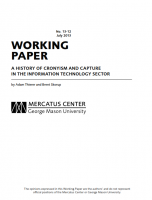 The Mercatus Center at George Mason University has just released a new paper by Brent Skorup and me entitled, “A History of Cronyism and Capture in the Information Technology Sector.” In this 73-page working paper, which we hope to place in a law review or political science journal shortly, we document the evolution of government-granted privileges, or “cronyism,” in the information and communications technology marketplace and in the media-producing sectors. Specifically, we offer detailed histories of rent-seeking and regulatory capture in: the early history of the telephony and spectrum licensing in the United States; local cable TV franchising; the universal service system; the digital TV transition in the 1990s; and modern video marketplace regulation (i.e., must-carry and retransmission consent rules, among others.
Our paper also shows how cronyism is slowly creeping into new high-technology sectors.We document how Internet companies and other high-tech giants are among the fastest-growing lobbying shops in Washington these days. According to the Center for Responsive Politics, lobbying spending by information technology sectors has almost doubled since the turn of the century, from roughly $200 million in 2000 to $390 million in 2012. The computing and Internet sector has been responsible for most of that growth in recent years. Worse yet, we document how many of these high-tech firms are increasingly seeking and receiving government favors, mostly in the form of targeted tax breaks or incentives. Continue reading →
Gina Keating, author of Netflixed: The Epic Battle for America’s Eyeballs, discusses the startup of Netflix and their competition with Blockbuster.
Keating begins with the history of the company and their innovative improvements to the movie rental experience. She discusses their use of new technology and marketing strategies in DVD rental, which inspired Blockbuster to adapt to the changing market.
Keating goes on to describe Netflix’s transition to internet streaming and Blockbuster’s attempts to retain their market share.
Download
Related Links
 I’ve written posts today for both CNET and Forbes on legislation introduced yesterday by Senators Olympia Snowe and John Kerry that would require the FCC and NTIA to complete inventories of existing spectrum allocations. These inventories were mandated by President Obama last June (after Congress failed to pass legislation), but got lost at the FCC in the net neutrality armageddon.
Everyone believes that without relatively quick action to make more spectrum available, the mobile Internet could seize up. Given the White House’s showcasing of wireless as a leading source of new jobs, investment, and improved living conditions for all Americans, both Congress and President Obama, along with the FCC and just about everyone else, knows this is a crisis that must be avoided.
Indeed, the National Broadband Plan estimates conservatively that mobile users will need 300-500 mhz of new spectrum over the next 5-10 years. Continue reading →
 For CNET, I posted a long piece describing a full day at CES’s Tech Policy Summit largely devoted to spectrum issues. Conference attendees in several packed sessions heard from FCC Chairman Julius Genachowski and three of the four other FCC Commissioners (Commissioner Copps was absent due to illness), as well as former Congressman Rick Boucher and industry representatives.
The message was as clear as it is worrisome. The tremendous popularity of wireless broadband, on view in a remarkable range of new devices and gizmos on display at the Vegas Convention Center, is rapidly outpacing the radio frequencies available to handle the data.
The mobile Internet needs more spectrum, and there isn’t any to give it. The app revolution is in danger of hitting a hard stop, perhaps as soon as 2015.
As the exclusive manager of America’s radio waves, only the FCC can reallocate spectrum. And the good news is that the agency recognizes the crisis as well as its role in solving it. Chairman Genachowski told the audience that spectrum reform will be the agency’s top priority for 2011.
Reading the Chairman’s prepared comments, however, I was struck by the sense that I’d heard something similar before. Perhaps in the very same room. Perhaps by the very same speaker. Continue reading →
I’ve grown increasingly tired of the fight over not just retransmission consent, but almost all TV regulation in general. Seriously, why is our government still spending time fretting over a market that is more competitive, diverse and fragmented than most other economic sectors? It’s almost impossible to keep track of all the innovation happening on this front, although I’ve tried here before. Every metric — every single one — is not just improving but exploding. Just what’s happening on the kids’ TV front is amazing enough, but the same story is playing out across other programming genres and across multiple distribution platforms.
More proof of just how much more diverse and fragmented content and audiences are today comes in this excellent new guest editorial over at GigaOm, “The Golden Age of Choice and Cannibalization in TV,” by Mike Hudack, CEO of Blip.tv. Hudack notes that, compared to the Scarcity Era, when we had fewer choices and were all forced to watch pretty much the same thing, today’s media cornucopia is overflowing, and audiences are splintering as a result. “Media naturally trends towards fragmentation,” he notes. “As capacity increases so does choice. As choice increases audiences fragment. When given a choice people generally prefer media that speaks to them as individuals over media that speaks to the ‘masses.’”
Indeed, he cites Nielsen numbers I’ve used here before illustrating how the top shows of the 50’s (like Texaco Star Theater) netted an astonishing 60-80% of U.S. television households while more recent hits, like American Idol is lucky if it can manage over 15% audience share. He concludes, therefore, that: Continue reading →
As part of its excellent “Room for Debate” series, the New York Times has an interesting new online symposium up now asking, “Will Networks Go Wild, With No Decency Rules?” It was in response to last week’s Second Circuit decision, which again slapped down an effort by the Federal Communications Commission to defend the agency’s indecency enforcement regime. I was honored to be asked to contribute a short essay on the subject. Here are the other contributors and their essays. Take the time to check them out:
I was particularly interested in former FCC’s Chairman Michael Powell’s admission that “The [FCC’s] fleeting expletive policy was a mistake,” and that “the real problem is the now-flawed constitutional foundation on which the law is built.” Powell goes on to argue that, “We cannot have one First Amendment for broadcasting and another one for every other medium. This vestige of a bygone era provides fertile ground for mischief — culture wars, political agenda and moral mandates. It’s high time for the high court to bring our laws into the 21st century.”
I wholeheartedly agree, and I wrote a lengthy law review article on just that topic back in 2007 entitled,“
Why Regulate Broadcasting: Toward a Consistent First Amendment Standard for the Information Age.” If you find it too boring, just watch this video I made summarizing the key points, which I called “America’s First Amendment Twilight Zone.”



 The Technology Liberation Front is the tech policy blog dedicated to keeping politicians' hands off the 'net and everything else related to technology.