 Better late than never, I’ve finally given a close read to the Notice of Inquiry issued by the FCC on June 17th. (See my earlier comments, “FCC Votes for Reclassification, Dog Bites Man”.) In some sense there was no surprise to the contents; the Commission’s legal counsel and Chairman Julius Genachowski had both published comments over a month before the NOI that laid out the regulatory scheme the Commission now has in mind for broadband Internet access.
Chairman Genachowski’s “Third Way” comments proposed an option that he hoped would satisfy both extremes. The FCC would abandon efforts to find new ways to meet its regulatory goals using “ancillary jurisdiction” under Title I (an avenue the D.C. Circuit had wounded, but hadn’t actually exterminated, in the Comcast decision), but at the same time would not go as far as some advocates urged and put broadband Internet completely under the telephone rules of Title II.
Continue reading →
 I had a long interview this morning with the Christian Science Monitor. Like many of the interviews I’ve had this year, the subject was Google. At the increasingly congested intersection of technology and the law, Google seems to be involved in most of the accidents.
Just to name a few of the more recent pileups, consider the Google books deal, net neutrality and the National Broadband Plan, Viacom’s lawsuit against YouTube for copyright infringement, Google’s very public battle with the nation of China, today’s ruling from the European Court of Justice regarding trademarks, adwords, and counterfeit goods, the convictions of Google executives in Italy over a user-posted video, and the reaction of privacy advocates to the less-than-immaculate conception of Buzz.
In some ways, it should come as no surprise to Google’s legal counsel that the company is involved in increasingly serious matters of regulation and litigation. After all, Google’s corporate goal is the collection, analysis, and distribution of as much of the world’s information as possible, or, as the company puts it,” to organize the world’s information and make it universally accessible and useful.” That’s a goal it has been wildly successful at in its brief history, whether you measure success by use (91 million searches a day) or market capitalization ($174 billion).
As the world’s economy moves from one based on physical goods to one driven by information flow, the mismatch between industrial law and information behavior has become acute, and Google finds itself a frequent proxy in the conflicts.
Continue reading →
Today I am testifying at an FCC hearing on “Serving the Public Interest in the Digital Era.” [Speaker lineup here.] The purpose of the workshop is to explore:
- A brief history and overview of policies involving “public interest” requirements for commercial media and telecommunications companies;
- The state of local commercial broadcast TV and radio news and information; and
- The impact of media convergence and the emergence of the Internet, mobile technologies, and digital media on FCC media policy.
In my remarks, I focused on “Why Expansion of the FCC’s Public Interest Regulatory Regime is Unwise, Unneeded, Unconstitutional, and Unenforceable.” Down below I have attached my written remarks. Continue reading →
by Adam Thierer & Berin Szoka, Progress Snaphot 6.1
Stephanie Clifford of the
New York Times posted a very interesting article this week summarizing a recent “on-the-record chat” the Times staff had with Federal Trade Commission (FTC) chairman Jon Leibowitz and FTC Bureau of Consumer Protection chief David Vladeck. The interview [discussed by Braden here] is profoundly important in that it reveals an alarming disconnect regarding the relationship between “privacy” regulation and the future of media, which were the subjects of their discussion with Times staff. Namely, Leibowitz and Vladeck apparently fail to appreciate how the delicate balance between commercial advertising and journalism is at risk precisely because of the sort of regulations they apparently are ready to adopt. Because the value of online advertising depends on data about its effectiveness and consumers’ likely interests, and because advertising is indispensable to funding media, what’s ultimately at stake here is nothing short of the future of press freedom.
The “Day of Reckoning” Is Upon Us
Leibowitz and Vladeck spend the first half of
The Times interview wringing their hands about “privacy policies,” the declarations made by websites and advertising networks about their data collection and use practices (for which the FTC can and must hold them accountable). But the two feel that privacy policies don’t adequately inform consumers. Chairman Leibowitz claims that online companies “haven’t given consumers effective notice, so they can make effective choices.” And Mr. Vladeck states that advise-and-consent models “depended on the fiction that people were meaningfully giving consent.” But he and the FTC seem ready to abandon the notice and choice model because the “literature is clear” that few people read privacy policies, Vladeck told the Times. He and Leibowitz continue:
“Philosophically, we wonder if we’re moving to a post-disclosure era and what that would look like,” Mr. Vladeck said. “What’s the substitute for it?” He said the commission was still looking into the issue, but it hoped to have an answer by June or July, when it plans to publish a report on the subject. Mr. Leibowitz gave a hint as to what might be included: “I have a sense, and it’s still amorphous, that we might head toward opt-in,” Mr. Leibowitz said.
This clearly foreshadows the regulatory endgame we have long suspected was coming. When the FTC released its “Self-Regulatory Principles for Online Behavioral Advertising” eleven months ago, we asked: “What’s the Harm & Where Are We Heading?” Their answers to both questions have become clearer with each new calculated comment—all apparently intended to slowly “turn up the heat” on the advertising industry so that the proverbial frog will stay in the pot until the water finally boils. Leibowitz’s FTC has simply dodged the “harm” question with a four-part strategy: Continue reading →
PFF has just released the transcript of an excellent panel discussion I moderated last week entitled, “Let’s Make a Deal: Broadcasters, Mobile Broadband, and a Market in Spectrum.” As I’ve mentioned here before, one of the hottest issues in DC right now is the question of broadcast TV spectrum reallocation. Blair Levin, who serves as the Executive Director of the Omnibus Broadband Initiative at the Federal Communications Commission, recently raised the possibility of reallocating a portion of broadcast television spectrum for alternative purposes, namely, mobile broadband. Such a “cash-for-spectrum” swap would give mobile broadband providers to spectrum they need to roll out next generation wireless broadband networks while making sure broadcaster receive compensation for any spectrum they hand over. The FCC just recently released a public notice on “Data Sought on Users of Spectrum,” (NBP Public Notice # 26) that looks into the matter. “This inquiry,” the agency says,” takes into account the value that the United States puts on free, over-the-air television, while also exploring market-based mechanisms for television broadcasters to contribute to the broadband effort any spectrum in excess of that which they need to meet their public interest obligations and remain financially viable.” Meanwhile, the House Energy and Commerce Communications Subcommittee is set to hold a hearing on the issue next Tuesday.
PFF’s panel discussion on this issue featured an all-star cast of characters, including opening remarks by Blair Levin, and a terrific discussion ensued. [You can hear the full audio from the event here.] Down below I have highlighted some of the major points each speaker made during the discussion and also embedded the complete transcript in a Scribd reader. Also, just a reminder that my PFF colleague Barbara Esbin and I authored a short paper on this issue recently: “An Offer They Can’t Refuse: Spectrum Reallocation That Can Benefit Consumers, Broadcasters & the Mobile Broadband Sector.”
Continue reading →
 In a recent PFF paper I argued that “We Are Living in the Golden Age of Children’s Programming,” and showed how, despite incessant complaints by many policymakers:
the overall market for family and children’s programming options continues to expand quite rapidly. Thirty years ago, families had a limited number of children’s television programming options at their disposal on broadcast TV. Today, by contrast, there exists a broad and growing diversity of children’s television options from which families can choose.
I then documented there and in my book, Parental Controls & Online Child Protection:
- the many excellent family- or child-oriented networks available on cable, telco, and satellite television today;
- the growing universe of religious / spiritual television networks;
- the many family or educational programs that traditional TV broadcasters offer; or
- the massive market for interactive computer software or Internet websites for children.
And every time I turn around I find another great show, service, or site for families to choose from. Continue reading →
The Parents Television Council (PTC) released a new report today entitled Women in Peril: A Look at TV’s Disturbing New Storyline Trend. The report argues that “by depicting violence against women with increasing frequency, or as a trivial, even humorous matter, the broadcast networks may ultimately be contributing to a desensitized atmosphere in which people view aggression and violence directed at women as normative, even acceptable,” said PTC President Tim Winter. As evidence the report cites… Nicole Kidman. OK, it cites more than Nicole Kidman, but the 7-page report and accompanying press release does seem to place a lot of stock in the fact that, while being questioning by a House Foreign Affairs subcommittee hearing about violence against women overseas, “Ms. Kidman conceded that Hollywood has probably contributed to violence against women by portraying them as weak sex objects, according to the Associated Press.” I’m not sure what Ms. Kidman was doing testifying before Congress on the matter of violence against women overseas — dare I suggest some congressmen were out for another photo-op with a Hollywood celeb? — but the better question is whether Ms. Kidman’s opinion has any bearing on the question of what relationship, if any, there is between televised violence and real-world violence against women. (Incidentally, if she really feels passionately about all this, is she prepared to go back and recut some of her old scenes in “Dead Calm,” “To Die For,” and “Eyes Wide Shut“?)
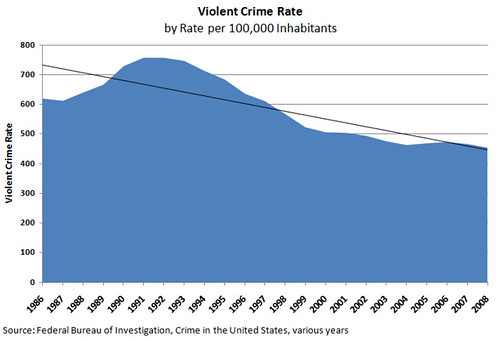
But let’s not nitpick about the credentials Ms. Kidman brings to the table or whether it makes any sense for PTC to elevate her opinions to proof of theory when it comes to a supposed connection between depictions of violence against women in film or television and real world acts of violence against women. PTC, however, suggests that’s exactly what is going on today. They allude to a few lab studies which are of the “monkey see, monkey do” variety — where the results of artificial lab experiments are used to claim that watching depictions of violence will turn us all into killing machines, rapists, robbers, or just plain ol’ desensitized thugs.
There’s just one problem with such studies, and the PTC report: Reality. Continue reading →
 When the government tells someone to shut up, we call it censorship and the First Amendment requires the government to defend its regulation. But what if the government just says, “Shhhh… could you please turn that down?” Rep. Anna Eshoo’s Commercial Advertisement Loudness Mitigation Act (“CALM Act” – HR 1084) would do just that: require the FCC to issue rules that broadcast and cable TV ads:
(1) … shall not be excessively noisy or strident;
(2) … shall not be presented at modulation levels substantially higher than the program material that such advertisements accompany; and
(3) [their] average maximum loudness… shall not be substantially higher than the average maximum loudness of the program material that such advertisements accompany.
Now, I understand where Ms. Eshoo is coming from: I have a very low tolerance for noise in general and for television in particular—and it’s not just about commercials. (I find TV news at least as “noisy” and “strident” as commercials. That’s why I opted-out from the whole TV thing in about 2000. Yup, that’s right: I found better things to do with my time and the supposedly all-powerful “gatekeepers” of Hollywood couldn’t do a damn thing about it. You should try it if you don’t like what’s on TV! To paraphrase Voltaire, “I disapprove of what you say watch, but I will defend to the death your right to say watch it! You can get most of what’s worth watching on DVD or online anyway.) But do we really need bureaucrats in Washington micromanaging volume levels? Maybe Congressmen would have a little more time to read the bills they vote for if they they weren’t so busy fiddling with everyone else’s remote!
Eshoo’s bill has passed the House Energy & Commerce Committee’s Communications Subcommittee just as the TV industry is completing work on voluntary standards of their own. That’s one “less restrictive” alternative to regulation. What about technological empowerment? If Americans really hate loud commercials so much, why don’t they demand TVs with built-in volume normalization features? But this bill isn’t merely unnecessary, it would also set a disturbing precedent in at least six ways.
Continue reading →
The Tennis Channel and ESPN have teamed up to offer live coverage of the US Open online. Not only is this a wonderful thing for consumers, but it also demonstrates just how easily content creators (including traditional television programming networks) can completely bypass cable companies, who once supposedly used their “bottleneck” power to act as “gatekeepers” over the content Americans could receive. If this was ever true, it certainly isn’t true in the era of Internet video!
The venture will, of course, be ad-supported. But just how much content such a model can support will depend heavily on whether Internet video programming distributors like this venture (or Hulu.com) will be able to personalize the ads shown on their videos based on the likely interests of users. Ad industry observer David Hallerman has predicted that spending on behavioral advertising:
is projected to reach $1.1 billion in 2009 and $4.4 billion in 2012 [a quarter of U.S. display advertising].The prime mover behind this rapid increase will be the mainstream adoption of online video advertising, which will increasingly require targeting to make it cost-effective.
The problem isn’t just the expense involved in streaming online video, it’s that contextually targeting advertising (based on keywords) is easy when the content is text but far more difficult when the content is video.
So if you’re hoping to cut the cord to cable and save the expense of a monthly cable subscription, you’d better hope the privacy zealots don’t wipe out advertising model necessary to make Internet video a true substitute for traditional subscription video sources!
The D.C. Circuit has struck down as arbitrary and capricious the FCC’s “cable cap.” The cap prevented a single cable operator from serving more than 30% of U.S. homes—precisely the same percentage limit struck down by the court in 2001. The court ruled that the FCC had failed to demonstrate that “allowing a cable operator to serve more than 30% of all cable subscribers would threaten to reduce either competition or diversity in programming.”
The court’s decision rested on the two critical charts (both generated by my PFF colleague Adam Thierer in his excellent
Media Metrics special report) at the heart of the PFF amicus brief I wrote with our president, Ken Ferree:
First, the record is replete with evidence of ever increasing competition among video providers: Satellite and fiber optic video providers have entered the market and grown in market share since the Congress passed the 1992 Act, and particularly in recent years. Cable operators, therefore, no longer have the bottleneck power over programming that concerned the Congress in 1992.
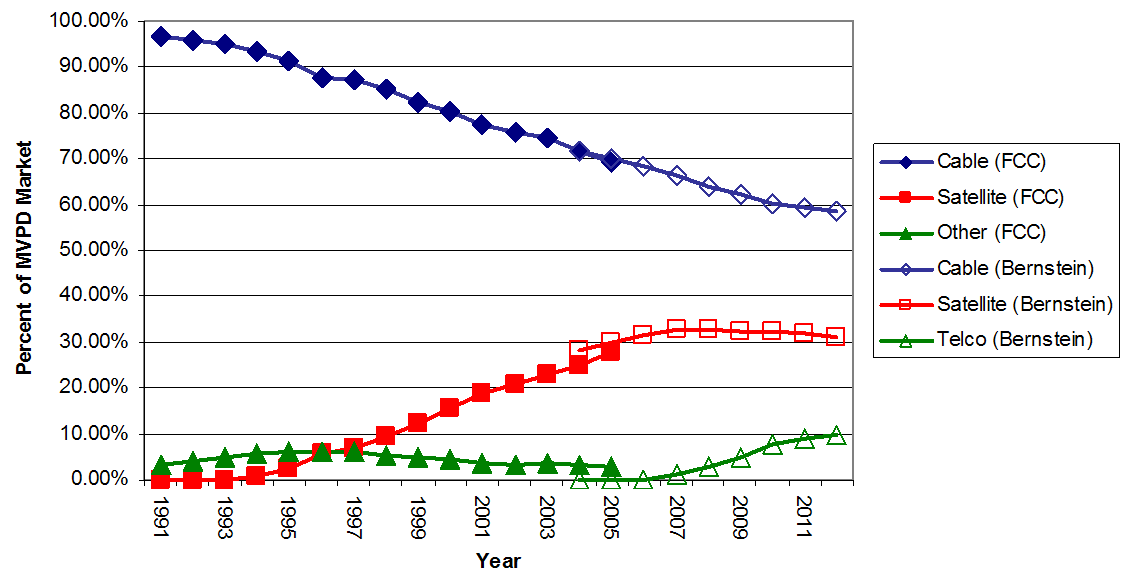
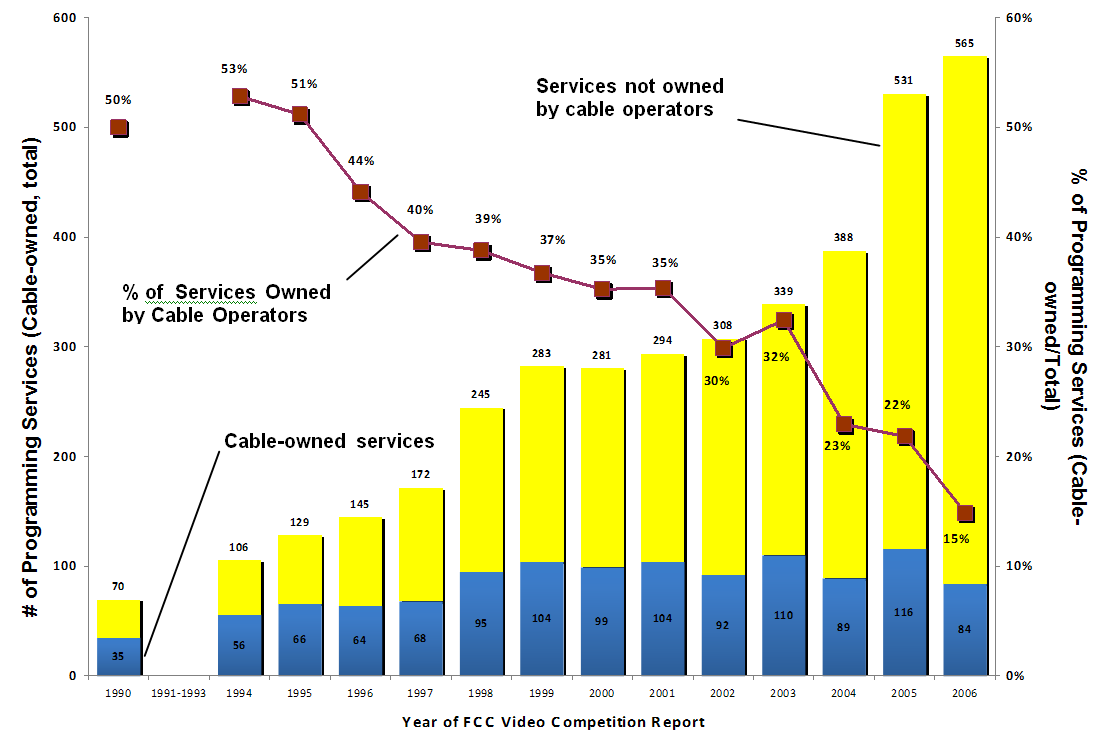
Second, over the same period there has been a dramatic increase both in the number of cable networks and in the programming available to subscribers.
Our chart shows the explosion in the number of programmers (though not the total amount of programming), as well as the falling rate of affiliation between cable operators and programmers, which was among the prime factors motivating Congress when it authorized a cable cap in the 1992 Cable Act:
Continue reading →


 The Technology Liberation Front is the tech policy blog dedicated to keeping politicians' hands off the 'net and everything else related to technology.