I have been covering telecom and Internet policy for almost 30 years now. During much of that time – which included a nine year stint at the Heritage Foundation — I have interacted with conservatives on various policy issues and often worked very closely with them to advance certain reforms.
If I divided my time in Tech Policy Land into two big chunks of time, I’d say the biggest tech-related policy issue for conservatives during the first 15 years I was in the business (roughly 1990 – 2005) was preventing the resurrection of the so-called Fairness Doctrine. And the biggest issue during the second 15-year period (roughly 2005 – present) was stopping the imposition of “Net neutrality” mandates on the Internet. In both cases, conservatives vociferously blasted the notion that unelected government bureaucrats should sit in judgment of what constituted “fairness” in media or “neutrality” online.
Many conservatives are suddenly changing their tune, however. President Trump and Sen. Ted Cruz, for example, have been increasingly critical of both traditional media and new tech companies in various public statements and suggested an openness to increased regulation. The President has gone after old and new media outlets alike, while Sen. Cruz (along with others like Sen. Lindsay Graham) has suggested during congressional hearings that increased oversight of social media platforms is needed, including potential antitrust action.
Meanwhile, during his short time in office, Sen. Josh Hawley (R-Mo.) has become one of the most vocal Internet critics on the Right. In a shockingly-worded USA Today editorial in late May, Hawley said, “social media wastes our time and resources” and is “a field of little productive value” that have only “given us an addiction economy.” He even referred to these sites as “parasites” and blamed them for a long list of social problems, leading him to suggest that, “we’d be better off if Facebook disappeared” along with various other sites and services.
Hawley’s moral panic over social media has now bubbled over into a regulatory crusade that would unleash federal bureaucrats on the Internet in an attempt to dictate “fair” speech on the Internet. He has introduced an astonishing piece of legislation aimed at undoing the liability protections that Internet providers rely upon to provide open platforms for speech and commerce. If Hawley’s absurdly misnamed new “Ending Support for Internet Censorship Act” is implemented, it would essentially combine the core elements of the Fairness Doctrine and Net Neutrality to create a massive new regulatory regime for the Internet. Continue reading →
Slate recently published an astonishing piece of revisionist history under the title, “Bring Back the Golden Age of Broadcast Regulation,” which suggested that the old media regulatory model of the past would be appropriate for modern digital media providers and platforms. In the essay, April Glaser suggests that policymakers should resurrect the Fairness Doctrine and a host of old Analog Era content controls to let regulatory bureaucrats address Digital Age content moderation concerns.
In a tweetstorm, I highlighted a few examples of why the so-called Golden Era wasn’t so golden in practice. I began by noting that the piece ignores the troubling history of FCC speech controls and unintended consequences of regulation. That regime gave us limited, bland choices–and a whole host of First Amendment violations. We moved away from that regulatory model for very good reasons.
FCC Chairman Ajit Pai recently delivered an excellent speech at the Resurgent Conference, Austin, TX. In it, he stressed the importance of adopting a permissionless innovation policy vision to ensure a bright future for technology, economic growth, and consumer welfare. The whole thing is worth your time, but the last two paragraphs make two essential points worth highlighting.
Pai correctly notes that we should reject the sort of knee-jerk hysteria or technopanic mentality that sometimes accompanies new technologies. Instead, we should have some patience and humility in the face of uncertainty and be open to new ideas and technologies creations.
“Here’s the bottom line,” Pai concludes:
Whenever a technological innovation creates uncertainty, some will always have the knee-jerk reaction to presume it’s bad. They’ll demand that we do whatever’s necessary to maintain the status quo. Strangle it with a study. Call for a commission. Bemoan those supposedly left behind. Stipulate absolute certainty. Regulate new services with the paradigms of old.
But we should resist that temptation. “Guilty until proven innocent” is not a recipe for innovation, and it doesn’t make consumers better off. History tells us that it is not preemptive regulation, but permissionless innovation made possible by competitive free markets that best guarantees consumer welfare. A future enabled by the next generation of technology can be bright, if only we choose to let the light in.
Read the whole thing here. Good stuff. I also appreciate him citing my work on the topic, which you can find in my last book and other publications.
[originally published on Plaintext on June 21, 2017.]
This summer, we celebrate the 20th anniversary of two developments that gave us the modern Internet as we know it. One was a court case that guaranteed online speech would flow freely, without government prior restraints or censorship threats. The other was an official White House framework for digital markets that ensured the free movement of goods and services online.
The result of these two vital policy decisions was an unprecedented explosion of speech freedoms and commercial opportunities that we continue to enjoy the benefits of twenty years later.
While it is easy to take all this for granted today, it is worth remembering that, in the long arc of human history, no technology or medium has more rapidly expanded the range of human liberties — both speech and commercial liberties — than the Internet and digital technologies. But things could have turned out much differently if not for the crucially important policy choices the United States made for the Internet two decades ago. Continue reading →
I wanted to draw your attention to yet another spectacular speech by Maureen K. Ohlhausen, a Commissioner with the Federal Trade Commission (FTC). I have written here before about Commissioner Ohlhausen’s outstanding speeches, but this latest one might be her best yet.
On Tuesday, Ohlhausen was speaking at U.S. Chamber of Commerce Foundation day-long event on “The Internet of Everything: Data, Networks and Opportunities.” The conference featured various keynote speakers and panels discussing, “the many ways that data and Internet connectiviting is changing the face of business and society.” (It was my honor to also be invited to deliver an address to the crowd that day.)
As with many of her other recent addresses, Commissioner Ohlhausen stressed why it is so important that policymakers “approach new technologies and new business models with regulatory humility.” Building on the work of the great Austrian economist F.A. Hayek, who won a Nobel prize in part for his work explaining the limits of our knowledge to plan societies and economies, Ohlhausen argues that: Continue reading →
On Thursday, it was my great pleasure to participate in a Washington Legal Foundation (WLF) event on “Online Privacy Regulation: The Challenge of Defining Harm.” The entire event video can be found on YouTube here, but down below I pasted the clip of just my remarks. Other speakers at the event included: FTC Commissioner Maureen K. Ohlhausen, Commissioner; John B. Morris, Jr., the Associate Administrator and Director of Internet Policy athe U.S. Department of Commerce’s National Telecommunications and Information Administration; and Katherine Armstrong, Counsel at the law firm of Hogan Lovells. Glenn Lammi of the WLF moderated the session.
My remarks drew upon a few recent law review articles I have published relating digital privacy debates to previous debates over free speech and online child safety issues. (Here are those articles: 1, 2, 3).
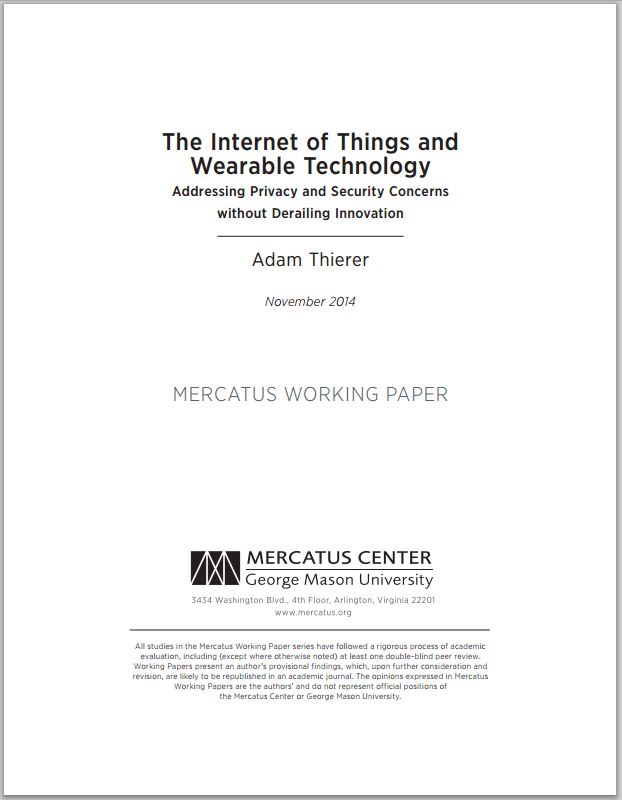
The Mercatus Center at George Mason University has just released my latest working paper, “The Internet of Things and Wearable Technology: Addressing Privacy and Security Concerns without Derailing Innovation.” The “Internet of Things” (IoT) generally refers to “smart” devices that are connected to both the Internet and other devices. Wearable technologies are IoT devices that are worn somewhere on the body and which gather data about us for various purposes. These technologies promise to usher in the next wave of Internet-enabled services and data-driven innovation. Basically, the Internet will be “baked in” to almost everything that consumers own and come into contact with.
Some critics are worried about the privacy and security implications of the Internet of Things and wearable technology, however, and are proposing regulation to address these concerns. In my new 93-page article, I explain why preemptive, top-down regulation would derail the many life-enriching innovations that could come from these new IoT technologies. Building on a recent book of mine, I argue that “permissionless innovation,” which allows new technology to flourish and develop in a relatively unabated fashion, is the superior approach to the Internet of Things.
As I note in the paper and my earlier book, if we spend all our time living in fear of the worst-case scenarios — and basing public policies on them — then best-case scenarios can never come about. As the old saying goes: nothing ventured, nothing gained. Precautionary principle-based regulation paralyzes progress and must be avoided. We instead need to find constructive, “bottom-up” solutions to the privacy and security risks accompanying these new IoT technologies instead of top-down controls that would limit the development of life-enriching IoT innovations. Continue reading →
The use of unmanned aircraft systems, or “drones,” for private and commercial uses remains the subject of much debate. The issue has been heating up lately after Congress ordered the Federal Aviation Administration (FAA) to integrate UASs into the nation’s airspace system by 2015 as part of the FAA Modernization and Reform Act of 2012.
The debate has thus far centered mostly around the safety and privacy-related concerns associated with private use of drones. The FAA continues to move slowly on this front based on a fear that private drones could jeopardize air safety or the safety of others on the ground. Meanwhile, some privacy advocates are worried that private drones might be used in ways that invade private spaces or even public areas where citizens have a reasonable expectation of privacy. For these and other reasons, the FAA’s current ban on private operation of drones in the nation’s airspace remains in place.
But what about the
speech-related implications of this debate? After all, private and commercial UASs can have many peaceful, speech-related uses. Indeed, to borrow Ithiel de Sola Pool’s term, private drones can be thought of as “technologies or freedom” that expand and enhance the ability of humans to gather and share information, thus in turn expanding the range of human knowledge and freedom.
A new Mercatus Center at George Mason University working paper, “News from Above: First Amendment Implications of the Federal Aviation Administration Ban on Commercial Drones,” deals with these questions. This 59-page working paper was authored by Cynthia Love, Sean T. Lawson, and Avery Holton. (Love is currently a Law Clerk for Judge Carolyn B. McHugh in 10th Circuit U.S. Court of Appeals. Lawson and Holton are affliated with the Department of Communication at the University of Utah.)
“To date, little attention has been paid to the First Amendment implications of the [FAA] ban,” note Love, Lawson, and Holton. Their article argues that “aerial photography with UASs, whether commercial or not, is protected First Amendment activity, particularly for news-gathering purposes. The FAA must take First Amendment-protected uses of this technology into account as it proceeds with meeting its congressional mandate to promulgate rules for domestic UASs.” They conclude by noting that “The dangers of [the FAA’s] regulatory approach are no mere matter of esoteric administrative law. Rather, as we have demonstrated, use of threats to enforce illegally promulgated rules, in particular a ban on journalistic use of UASs, infringes upon perhaps our most cherished constitutional right, that of free speech and a free press.” Continue reading →
On Thursday, it was my great pleasure to present a draft of my forthcoming paper, “The Internet of Things & Wearable Technology: Addressing Privacy & Security Concerns without Derailing Innovation,” at a conference that took place at the Federal Communications Commission on “Regulating the Evolving Broadband Ecosystem.” The 3-day event was co-sponsored by the American Enterprise Institute and the University of Nebraska College of Law.
The 65-page working paper I presented is still going through final peer review and copyediting, but I posted a very rough first draft on SSRN for conference participants. I expect the paper to be released as a Mercatus Center working paper in October and then I hope to find a home for it in a law review. I will post the final version once it is released. [UPDATE:The final version of this working paper was released on November 19, 2014.]
In the meantime, however, I thought I would post the 46 slides I presented at the conference, which offer an overview of the nature of the Internet of Things and wearable technology, the potential economic opportunities that exist in this space, and the various privacy and security challenges that could hold this technological revolution back. I also outlined some constructive solutions to those concerns. I plan to be very active on these issues in coming months.
Anupam Chander, Director of the California International Law Center and Martin Luther King, Jr. Hall Research Scholar at the UC Davis School of Law, discusses his recent paper with co-author Uyen P. Lee titled The Free Speech Foundations of Cyberlaw. Chander addresses how the first amendment promotes innovation on the Internet; how limitations to free speech vary between the US and Europe; the role of online intermediaries in promoting and protecting the first amendment; the Communications Decency Act; technology, piracy, and copyright protection; and the tension between privacy and free speech.
The Technology Liberation Front is the tech policy blog dedicated to keeping politicians' hands off the 'net and everything else related to technology. Learn more about TLF →



 The Technology Liberation Front is the tech policy blog dedicated to keeping politicians' hands off the 'net and everything else related to technology.