 I’m pleased to announce the release of my latest law review article, “A Framework for Benefit-Cost Analysis in Digital Privacy Debates.” It appears in the new edition of the George Mason University Law Review. (Vol. 20, No. 4, Summer 2013)
This is the second of two complimentary law review articles I am releasing this year dealing with privacy policy. The first, “The Pursuit of Privacy in a World Where Information Control is Failing,” was published in Vol. 36 of the Harvard Journal of Law & Public Policy
this Spring. (FYI: Both articles focus on privacy claims made against private actors — namely, efforts to limit private data collection — and not on privacy rights against governments.)
My new article on benefit-cost analysis in privacy debates makes a seemingly contradictory argument: benefit-cost analysis (“BCA”) is extremely challenging in online child safety and digital privacy debates, yet it remains essential that analysts and policymakers attempt to conduct such reviews. While we will never be able to perfectly determine either the benefits or costs of online safety or privacy controls, the very act of conducting a regulatory impact analysis (“RIA”) will help us to better understand the trade-offs associated with various regulatory proposals. Continue reading →
Jane Yakowitz Bambauer, associate professor of law at the University of Arizona, discusses her forthcoming paper in the Stanford Law Review titled Is Data Speech? How do we define “data” and can it be protected in the same way as free speech? She examines current privacy laws and regulations as they pertain to data creation and collection, including whether collecting data should be protected under the First Amendment.
Download
Related Links
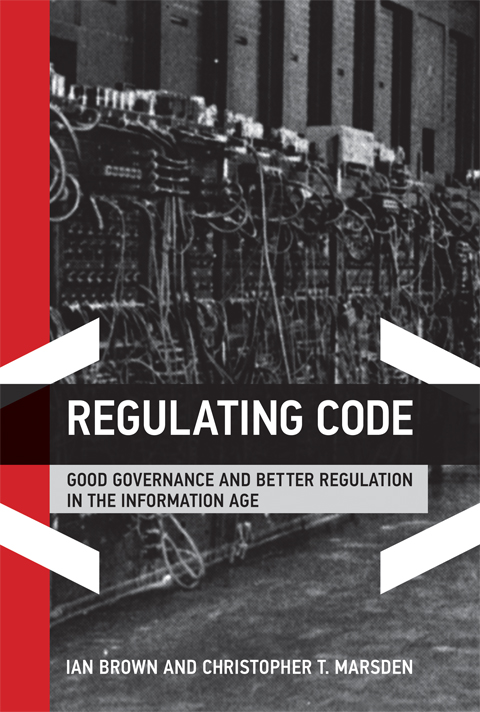
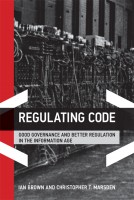 Ian Brown and Christopher T. Marsden’s new book, Regulating Code: Good Governance and Better Regulation in the Information Age, will go down as one of the most important Internet policy books of 2013 for two reasons. First, their book offers an excellent overview of how Internet regulation has unfolded on five different fronts: privacy and data protection; copyright; content censorship; social networks and user-generated content issues; and net neutrality regulation. They craft detailed case studies that incorporate important insights about how countries across the globe are dealing with these issues. Second, the authors endorse a specific normative approach to Net governance that they argue is taking hold across these policy arenas. They call their preferred policy paradigm “prosumer law” and it envisions an active role for governments, which they think should pursue “smarter regulation” of code.
In terms of organization, Brown and Marsden’s book follows the same format found in Milton Mueller’s important 2010 book Networks and States: The Global Politics of Internet Governance; both books feature meaty case studies in the middle bookended by chapters that endorse a specific approach to Internet policymaking. (Incidentally, both books were published by MIT Press.) And, also like Mueller’s book, Brown and Marsden’s Regulating Code does a somewhat better job using case studies to explore the forces shaping Internet policy across the globe than it does making the normative case for their preferred approach to these issues. Continue reading →
 The Internet’s greatest blessing — its general openness to all speech and speakers — is also sometimes its biggest curse. That is, you cannot expect to have the most widely accessible, unrestricted communications platform the world has ever known and not also have some imbeciles who use it to spew insulting, vile, and hateful comments.
It is important to put things in perspective, however. Hate speech is not the norm online. The louts who spew hatred represent a small minority of all online speakers. The vast majority of online speech is of a socially acceptable — even beneficial — nature.
Still, the problem of hate speech remains very real and a diverse array of strategies are needed to deal with it. The sensible path forward in this regard is charted by Abraham H. Foxman and Christopher Wolf in their new book, Viral Hate: Containing Its Spread on the Internet. Their book explains why the best approach to online hate is a combination of education, digital literacy, user empowerment, industry best practices and self-regulation, increased watchdog / press oversight, social pressure and, most importantly, counter-speech. Foxman and Wolf also explain why — no matter how well-intentioned — legal solutions aimed at eradicating online hate will not work and would raise serious unintended consequences if imposed.
In striking this sensible balance, Foxman and Wolf have penned the definitive book on how to constructively combat viral hate in an age of ubiquitous information flows. Continue reading →
Declan McCullagh, chief political correspondent for CNET and former Washington bureau chief for Wired News, discusses recent leaks of NSA surveillance programs. What do we know so far, and what more might be unveiled in the coming weeks? McCullagh covers legal challenges to the programs, the Patriot Act, the fourth amendment, email encryption, the media and public response, and broader implications for privacy and reform.
Download
Related Links
Alexander Howard has put together this excellent compendium of comments on Mike Rosenwald’s new Washington Post editorial, “Will the Twitter Police make Twitter boring?” I was pleased to see that so many others had the same reaction to Rosenwald’s piece that I did.
For the life of me, I cannot understand how anyone can equate counter-speech with “Twitter Police,” but that’s essentially what Rosenwald does in his essay. The examples he uses in his essay are
exactly the sort of bone-headed and generally offensive comments that I would hope we would call out and challenge robustly in a deliberative democracy. But when average folks did exactly that, Rosenwald jumps to the preposterous conclusion that it somehow chilled speech. Stranger yet is his claim that “the Twitter Police are enforcing laws of their own making, with procedures they have authorized for themselves.” Say what? What laws are you talking about, Mike? This is just silly. These people are SPEAKING not enforcing any “laws.” They are expressing opinions about someone else’s (pretty crazy) opinions. This is what a healthy deliberative democracy is all about, bud!
Moreover, Rosenwald doesn’t really explain what a better world looks like. Is it one in which we all just turn a blind eye to what many regard as offensive or hair-brained commentary? I sure hope not!
I’m all for people vigorously expressing their opinions but I am just as strongly in favor of people pushing back with opinions of their own. You have no right to be free of social sanction if your speech offends large swaths of society. Speech has consequences and the more speech it prompts, the better.
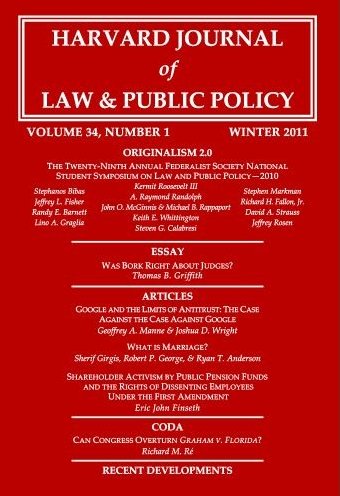
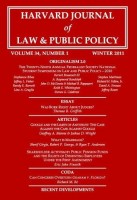 I’m excited to announce the release of my latest law review article, “The Pursuit of Privacy in a World Where Information Control is Failing,” which appears in the next edition (vol. 36) of the Harvard Journal of Law & Public Policy. This is the first of two complimentary law review articles that I will be releasing this year dealing with privacy policy. The second, which will be published later this summer by the George Mason University Law Review, is entitled, “A Framework for Benefit-Cost Analysis in Digital Privacy Debates.” (FYI: Both articles focus on privacy claims made against private actors — namely, efforts to limit private data collection — and not on privacy rights against governments.)
The new
Harvard Journal article is divided into three major sections. Part I focuses on some of normative challenges we face when discussing privacy and argues that there may never be a widely accepted, coherent legal standard for privacy rights or harms here in the United States. It also explores the tensions between expanded privacy regulation and online free speech. Part II turns to the many enforcement challenges that are often ignored when privacy policies are being proposed or formulated and argues that legislative and regulatory efforts aimed at protecting privacy must now be seen as an increasingly intractable information control problem. Most of the problems policymakers and average individuals face when it comes to controlling the flow of private information online are similar to the challenges they face when trying to control the free flow of digitalized bits in other information policy contexts, such as online safety, cybersecurity, and digital copyright.
If the effectiveness of law and regulation is limited by the normative considerations discussed in Part I and the practical enforcement complications discussed in Part II, what alternatives remain to assist privacy-sensitive individuals? I address that question in Part III of the paper and argue that the approach America has adopted to deal with concerns about objectionable online speech and child safety offers a path forward on the privacy front as well. Continue reading →
In a New York Times op-ed this weekend entitled “You Can’t Say That on the Internet,” Evgeny Morozov, author of The Net Delusion, worries that Silicon Valley is imposing a “deeply conservative” “new prudishness” on modern society. The cause, he says, are “dour, one-dimensional algorithms, the mathematical constructs that automatically determine the limits of what is culturally acceptable.” He proposes that some form of external algorithmic auditing be undertaken to counter this supposed problem. Here’s how he puts it in the conclusion of his essay:
Quaint prudishness, excessive enforcement of copyright, unneeded damage to our reputations: algorithmic gatekeeping is exacting a high toll on our public life. Instead of treating algorithms as a natural, objective reflection of reality, we must take them apart and closely examine each line of code.
Can we do it without hurting Silicon Valley’s business model? The world of finance, facing a similar problem, offers a clue. After several disasters caused by algorithmic trading earlier this year, authorities in Hong Kong and Australia drafted proposals to establish regular independent audits of the design, development and modifications of computer systems used in such trades. Why couldn’t auditors do the same to Google?
Silicon Valley wouldn’t have to disclose its proprietary algorithms, only share them with the auditors. A drastic measure? Perhaps. But it’s one that is proportional to the growing clout technology companies have in reshaping not only our economy but also our culture.
It should be noted that in a Slate
essay this past January, Morozov had also proposed that steps be taken to root out lies, deceptions, and conspiracy theories on the Internet. Morozov was particularly worried about “denialists of global warming or benefits of vaccination,” but he also wondered how we might deal with 9/11 conspiracy theorists, the anti-Darwinian intelligent design movement, and those that refuse to accept the link between HIV and AIDS.
To deal with that supposed problem, he recommended that Google “come up with a database of disputed claims” or “exercise a heavier curatorial control in presenting search results,” to weed out such things. He suggested that the other option “is to nudge search engines to take more responsibility for their index and exercise a heavier curatorial control in presenting search results for issues” that someone (he never says who) determines to be conspiratorial or anti-scientific in nature.
Taken together, these essays can be viewed as a preliminary sketch of what could become a comprehensive information control apparatus instituted at the code layer of the Internet. Continue reading →
[UPDATE
4/30/13: This article was subsequently published in Volume 65, Issues 2 of the Federal Communications Law Journal in April 2013. The links below now point to the final FCLJ version.]
The Mercatus Center at George Mason University has just released a new paper by Brent Skorup and me entitled, “Uncreative Destruction: The War on Vertical Integration in the Information Economy.” Brent, who is the research director for the Information Economy Project at the George Mason University School of Law, and I have been working on this paper since the Spring and we are looking forward to getting it published in a law review shortly. The paper focuses on Tim Wu’s “separations principle” for the digital economy, something I’ve spent some time critiquing here in the past. Here’s the introduction from the 44-page paper that Brent and I just released:
Are information sectors sufficiently different from other sectors of the economy such that more stringent antitrust standards should be applied to them preemptively? Columbia Law School professor Tim Wu responds in the affirmative in his book The Master Switch: The Rise and Fall of Information Empires. Having successfully pushed net-neutrality regulation into the policy spotlight, Wu has turned his attention to what he regards as excessive market concentration and threats to free speech throughout the entire information economy.To support his call for increased antitrust intervention, Wu explains his view of competition in the information economy—a view that deviates substantially from current mainstream antitrust theory.
Continue reading →
 I’m pleased to announce the release of my latest law review article, “A Framework for Benefit-Cost Analysis in Digital Privacy Debates.” It appears in the new edition of the George Mason University Law Review. (Vol. 20, No. 4, Summer 2013)

 The Technology Liberation Front is the tech policy blog dedicated to keeping politicians' hands off the 'net and everything else related to technology.