Posts tagged as:

WP coverThe Mercatus Center at George Mason University has just released a new paper by Brent Skorup and me entitled, “A History of Cronyism and Capture in the Information Technology Sector.” In this 73-page working paper, which we hope to place in a law review or political science journal shortly, we document the evolution of government-granted privileges, or “cronyism,” in the information and communications technology marketplace and in the media-producing sectors. Specifically, we offer detailed histories of rent-seeking and regulatory capture in: the early history of the telephony and spectrum licensing in the United States; local cable TV franchising; the universal service system; the digital TV transition in the 1990s; and modern video marketplace regulation (i.e., must-carry and retransmission consent rules, among others.

Our paper also shows how cronyism is slowly creeping into new high-technology sectors.We document how Internet companies and other high-tech giants are among the fastest-growing lobbying shops in Washington these days. According to the Center for Responsive Politics, lobbying spending by information technology sectors has almost doubled since the turn of the century, from roughly $200 million in 2000 to $390 million in 2012.  The computing and Internet sector has been responsible for most of that growth in recent years. Worse yet, we document how many of these high-tech firms are increasingly seeking and receiving government favors, mostly in the form of targeted tax breaks or incentives. Continue reading →

There is renewed interest in unlicensed spectrum as the FCC approaches the TV white space issue (again). Tim B. Lee reports on some of the unlicensed supporters,

Activists at the South by Southwest Interactive festival in Austin, TX, built a free wireless network to help publicize the power of unlicensed “white spaces” technology. The project is part of a broader campaign to persuade the FCC not to auction off this spectrum for the exclusive use of wireless carriers.

Unlicensed spectrum for high-powered devices has been called Super Wifi (“wifi” in this context is used loosely; Super Wifi is a PR term and has nothing to do with the wifi technical standard). Frankly, there are many reasons to be cautious about assigning more unlicensed spectrum, especially given the confusing information out there about the technology. (For instance, despite a popular rumor, Super Wifi would not provide free Internet access to everyone with a device, as Matt Yglesias and Jon Brodkin point out.) Continue reading →

On Forbes today, I have a long article on the progress being made to build gigabit Internet testbeds in the U.S., particularly by Gig.U.

Gig.U is a consortium of research universities and their surrounding communities created a year ago by Blair Levin, an Aspen Institute Fellow and, recently, the principal architect of the FCC’s National Broadband Plan.  Its goal is to work with private companies to build ultra high-speed broadband networks with sustainable business models .

Gig.U, along with Google Fiber’s Kansas City project and the White House’s recently-announced US Ignite project, spring from similar origins and have similar goals.  Their general belief is that by building ultra high-speed broadband in selected communities, consumers, developers, network operators and investors will get a clear sense of the true value of Internet speeds that are 100 times as fast as those available today through high-speed cable-based networks.  And then go build a lot more of them.

Google Fiber, for example, announced last week that it would be offering fully-symmetrical 1 Gbps connections in Kansas City, perhaps as soon as next year.  (By comparison, my home broadband service from Xfinity is 10 Mbps download and considerably slower going up.)

US Ignite is encouraging public-private partnerships to build demonstration applications that could take advantage of next generation networks and near-universal adoption.  It is also looking at the most obvious regulatory impediments at the federal level that make fiber deployments unnecessarily complicated, painfully slow, and unduly expensive.

I think these projects are encouraging signs of native entrepreneurship focused on solving a worrisome problem:  the U.S. is nearing a dangerous stalemate in its communications infrastructure.  We have the technology and scale necessary to replace much of our legacy wireline phone networks with native IP broadband.  Right now, ultra high-speed broadband is technically possible by running fiber to the home.  Indeed, Verizon’s FiOS network currently delivers 300 Mbps broadband and is available to some 15 million homes.

Continue reading →

Better late than never, I’ve finally given a close read to the Notice of Inquiry issued by the FCC on June 17th.  (See my earlier comments, “FCC Votes for Reclassification, Dog Bites Man”.)  In some sense there was no surprise to the contents; the Commission’s legal counsel and Chairman Julius Genachowski had both published comments over a month before the NOI that laid out the regulatory scheme the Commission now has in mind for broadband Internet access.

Chairman Genachowski’s “Third Way” comments proposed an option that he hoped would satisfy both extremes.  The FCC would abandon efforts to find new ways to meet its regulatory goals using “ancillary jurisdiction” under Title I (an avenue the D.C. Circuit had wounded, but hadn’t actually exterminated, in the Comcast decision), but at the same time would not go as far as some advocates urged and put broadband Internet completely under the telephone rules of Title II.

Continue reading →

Back on St. Paddy’s Day, I offered a few comments on the “funding gap” identified in the FCC’s just-released national broadband plan. Since then, the FCC has put out a notice of proposed rulemaking and notice of inquiry seeking public comment on reforms that would allow its universal service fund to subsidize broadband. The FCC has also released a 137-page technical paper that details how the staff calculated the broadband “availability gap” and funding gap.

So, now there’s more to chew on, and another round of online mastication would be timely given the open FCC proceeding.  Here are three big issues:

  1. Definition of broadband

The plan announced a goal of making broadband with actual download speeds of 4 mbps available to all Americans.  In the plan, this goal appeared to be based on the actual average speed of broadband service (4 mbps), even though the median speed is just 3.1 mbps (p. 21). The technical paper, however, also projects that, based on past growth rates in broadband speed, “the median will likely be higher than 4 mbps by the end of 2010.” (p. 43)  Contrary to what I thought back in March, it appears the FCC is justifying the 4 mbps goal based on the median speed, not the average. 

The technical report also argues that 4 mbps is necessary to run high-speed video, which a “growing portion of subscribers” (not including me) apparently use. (p. 43) So, if the broadband plan achieves its goals, every Amercian will have the opportunity to subscribe to Internet access capable of delivering high-quality porn! Fortunately, the technical report uses a different and more productive example — streamed classroom lectures. 

Reasonable people could still question whether the median is the appropriate benchmark to guide government actions intended to equalize broadband access opportunities.  The technical report includes a helpful graphic that shows the most common broadband speed users actually buy is 2 mbps, and 38 percent of all subscribers have speeds of 2 mbps or less. (p. 43) The FCC staff’s model calculates that if the goal were set at 1.5 mbps, the number of “unserved” households would fall from 7 million to 6.3 million, and the required subsidy would fall from $18.6 billion to $15.3 billion. (p. 45) 

If almost half of broadband subscribers have decided that something less than 4 mbps is perfectly adequate, that suggests 4 mbps may go far beyond what is necessary to ensure that all Americans have access to basic broadband service. So, that 4 mbps goal is still questionable.

  1. Omission of 3G wireless

The 4 mbps goal allowed the FCC to ignore third generation wireless when it estimated the “availability gap.” The technical paper shows that 95 percent of households have 4 mbps broadband available. About 3 percent of households have no broadband available, while 2 percent have broadband available at speeds ranging from 384 kbps – 3 mbps. (p. 17)  That 2 percent probably includes households with slow DSL and 3G wireless.

The technical paper also revealed that it did not include service from fixed Wireless Internet Service Providers due to data availability. (p. 25) These serve 2 million subscribers in rural areas (p. 66), so the omission potentially accounts for a large chunk of the households considered “unserved.” No telling how many, since apparently the data aren’t available.

Back in March, I guesstimated that the 7 million household “availability gap” might overstate the size of the problem by more than half, simply because 3G wireless is available to 98 percent of American households. Looks like my guesstimate is pretty much in line with the more detailed figures in the FCC technical paper.

 3. Role of satellite

The broadband plan did not count satellite broadband when assessing availability. The technical paper (pp. 89-94)provides a much more detailed explanation of the capacity constraints the FCC staff believes will prevent satellite broadband from serving more than a couple million subscribers.   (The current satellite subscriber base is approximately 900,000.)

The technical paper pointed out that satellites are expensive and take three years to build. (p. 92) To put the time frame in perspective, that’s about as long as the FCC and the Federal-State Joint Board on Universal Service have been discussing universal service subsidies for broadband. Lord knows we shouldn’t make consumers wait that long!

There is, however, something a little asymmetrical about the way the FCC staff treated satellite and other forms of broadband. The point of estimating the broadband availability gap was to determine how much of a subsidy would be required to induce the private sector to build the infrastructure to close the gap. But while the study assumed that the subsidies would call forth the requisite cable, DSL, and wireless infrastructure within some unnamed but acceptable time frame, it decided that three years is just too long to wait for satellite infrastructure to expand. So, satellite plays a minimal role in the FCC’s plan.

Yet even this minimal role has a big impact. To its credit, the technical paper calculated how satellite broadband could dramatically slash the cost of serving the most expensive 250,000 homes. It estimated (pp. 91-92) that the net present value of subsidies required to serve these homes with satellite would range between $800 million and $2 billion — compared to a $13.4 billion subsidy required to serve these homes with terrestrial broadband. (This implies an annual subsidy of $105-255 million, which is pretty close to my March 17 guesstimate of $100-200 million.)

So, satellite broadband could help prevent costs from skyrocketing, even assuming it plays only the limited role envisioned in the FCC staff’s analysis.
I testified this morning in the House Energy and Commerce Committee’s Subcommittee on Communications, Technology, and the Internet at a hearing titled, “An Examination of the Proposed Combination of Comcast and NBC Universal.” Among those testifying were Comcast Chairman and CEO Brian L. Roberts, and NBC Universal President and CEO Jeff Zucker.  Down below I have attached my brief remarks (we only had 5 minutes), but see the Scribd doc at the very bottom to also see the embedded charts. I also wrote a paper about the proposed deal back in December entitled, “A Brief History of Media Merger Hysteria: From AOL-Time Warner to Comcast-NBC” as well as this editorial for Forbes.

____________

Mr. Chairman and members of the Committee, thank you for inviting me here today. My name is Adam Thierer and I am the President of The Progress & Freedom Foundation (PFF).

Although we are still early in this process, there has already been a great deal of hand-wringing and even some dire predictions about the pending merger of Comcast and NBC Universal. I hope to put this proposed marriage in some historical context and explain why the deal certainly won’t have the detrimental impact some critics fear, and also explain why it might even be one potential model for how to sustain traditional media going forward.

Beware Media Merger Hysteria

First, let’s remember that we’ve been here before. Paranoid predictions of a media apocalypse have accompanied the announcements of many previous media mergers, from AOL-Time Warner to News Corp.-DirecTV to XM-Sirius.[i] In these cases and almost all others, however, the “sky is falling” claims proved to be greatly overstated.[ii] The only “harm” that one could reasonably claim came from those mergers was not to consumers or content providers, but to the merging firms themselves and their shareholders. That’s because many mergers simply fail to create the sort of synergies and benefits originally hoped for and consequently die of natural causes over time.

Other firms, however, have found ways to make deals work and deliver important new services that previously were unimaginable or simply too expensive to offer alone.[iii] Regardless, the point here is that we’ll never know what works unless we permit marketplace experimentation with new and innovative business models. Continue reading →

I’ve just released a new PFF white paper looking at the hysteria that has often accompanied major media mergers and then taking a look at the marketplace reality years after the fact.  Here‘s the PDF, but I have also pasted the entire thing down below.

_____________________________

A Brief History of Media Merger Hysteria: From AOL-Time Warner to Comcast-NBC

by Adam Thierer

Although the pending union of Comcast and NBC Universal has not yet made it to the altar, Chicken Little-esque wails about the marriage have already begun in earnest. For example, the pro-regulatory media organization Free Press has already set up a website to complain about the deal.[1] And Jeff Chester, executive director of the Center for Digital Democracy, has called it “an unholy marriage.”[2] The fever only promises to spread once the deal is formally announced, and a lengthy fight over the deal is expected at the Federal Communications Commission (FCC) and whichever antitrust agency reviews the deal.[3]

But reality tends to play out somewhat less dramatically than the script penned by the media worrywarts. It’s worth looking back at some of the more prominent examples of media merger hysteria in recent years to understand why such panic is unwarranted, and why a deal between Comcast and NBC Universal is unlikely to lead to the sort of problems that the pessimists suggest.[4] Continue reading →

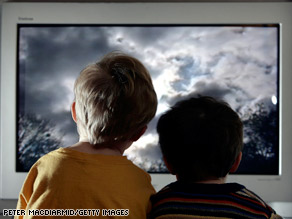
kids watching TVIn a recent PFF paper I argued that “We Are Living in the Golden Age of Children’s Programming,” and showed how, despite incessant complaints by many policymakers:

the overall market for family and children’s programming options continues to expand quite rapidly. Thirty years ago, families had a limited number of children’s television programming options at their disposal on broadcast TV. Today, by contrast, there exists a broad and growing diversity of children’s television options from which families can choose.

I then documented there and in my book, Parental Controls & Online Child Protection:

  • the many excellent family- or child-oriented networks available on cable, telco, and satellite television today;
  • the growing universe of religious / spiritual television networks;
  • the many family or educational programs that traditional TV broadcasters offer; or
  • the massive market for interactive computer software or Internet websites for children.

And every time I turn around I find another great show, service, or site for families to choose from.  Continue reading →

The Tennis Channel and ESPN have teamed up to offer live coverage of the US Open online. Not only is this a wonderful thing for consumers, but it also demonstrates just how easily content creators (including traditional television programming networks) can completely bypass cable companies, who once supposedly used their “bottleneck” power to act as “gatekeepers” over the content Americans could receive. If this was ever true, it certainly isn’t true in the era of Internet video!

The venture will, of course, be ad-supported. But just how much content such a  model can support will depend  heavily on whether Internet video programming distributors like this venture (or Hulu.com) will be able to personalize the ads shown on their videos based on the likely interests of users.  Ad industry observer David Hallerman has predicted that spending on behavioral advertising:

is projected to reach $1.1 billion in 2009 and $4.4 billion in 2012 [a quarter of U.S. display advertising].The prime mover behind this rapid increase will be the mainstream adoption of online video advertising, which will increasingly require targeting to make it cost-effective.

The problem isn’t just the expense involved in streaming online video, it’s that contextually targeting advertising (based on keywords) is easy when the content is text but far more difficult when the content is video.

So if you’re hoping to cut the cord to cable and save the expense of a monthly cable subscription, you’d better hope the privacy zealots don’t wipe out advertising model necessary to make Internet video a true substitute for traditional subscription video sources!

The D.C. Circuit has struck down as arbitrary and capricious the FCC’s “cable cap.”  The cap prevented a single cable operator from serving more than 30% of U.S. homes—precisely the same percentage limit struck down by the court in 2001.  The court ruled that the FCC had failed to demonstrate that “allowing a cable operator to serve more than 30% of all cable subscribers would threaten to reduce either competition or diversity in programming.”

The court’s decision rested on the two critical charts (both generated by my PFF colleague Adam Thierer in his excellent Media Metrics special report) at the heart of the PFF amicus brief I wrote with our president, Ken Ferree:

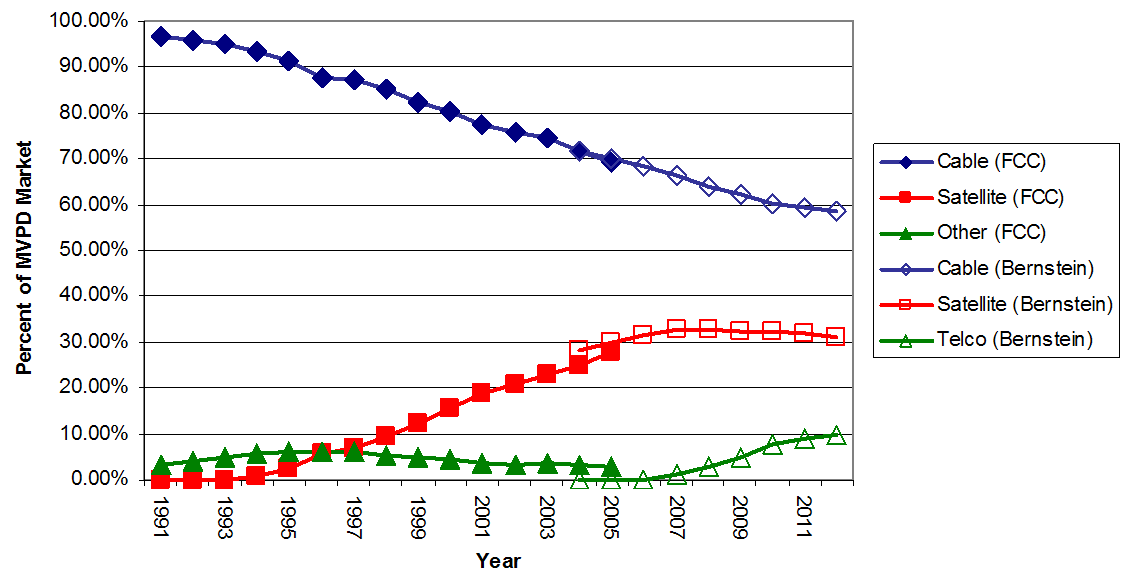
First, the record is replete with evidence of ever increasing competition among video providers: Satellite and fiber optic video providers have entered the market and grown in market share since the Congress passed the 1992 Act, and particularly in recent years. Cable operators, therefore, no longer have the bottleneck power over programming that concerned the Congress in 1992.

Increasing Competition in the MVPD Marketplace

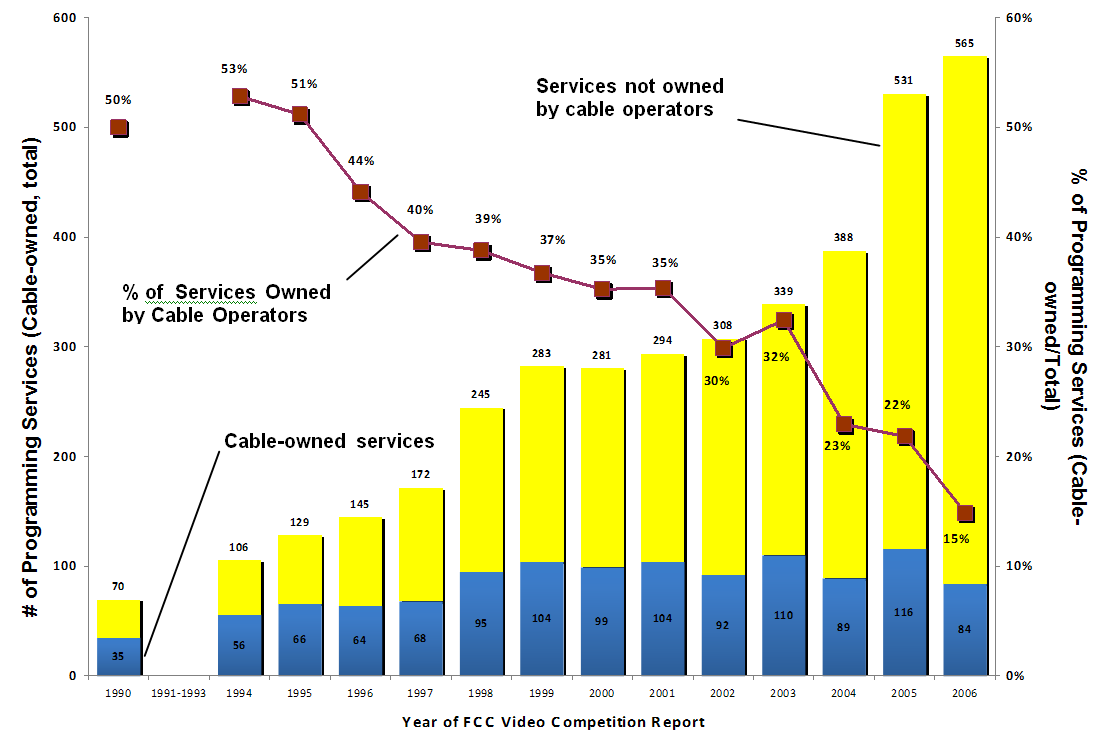
Second, over the same period there has been a dramatic increase both in the number of cable networks and in the programming available to subscribers.

Our chart shows the explosion in the number of programmers (though not the total amount of programming), as well as the falling rate of affiliation between cable operators and programmers, which was among the prime factors motivating Congress when it authorized a cable cap in the 1992 Cable Act:

Video Choices & Vertical Integration in the Multichannel Video Marketplace

Continue reading →