Posts tagged as:

I’m going to close out my series of essays about Tim Wu’s new book, The Master Switch: The Rise and Fall of Information Empires, by discussing his proposed solutions.  In the first five essays in the series, [1, 2, 3, 4, 5] I’ve critiqued Wu’s look at information history as well as his use of terms like “market failure,” “laissez-faire” and “open” vs. “closed.”  I argued there’s a great deal of over-simplification, even outright distortion, in his use of those terms throughout the book.

Anyway, let’s run through the basics of the book once more before getting to Wu’s proposed solutions.  By my reading of The Master Switch, Wu’s argument essentially goes something like this:

  • Information industries go through cycles. After a period of “openness” and competition, they tend to drift toward “closed,” corporate-controlled, anti-consumer models and outcomes.
  • The resulting “monopolists” then block much innovation, competition, and free speech.
  • Consequently, “the purely economic laissez-faire approach… is no longer feasible.”
  • Moreover, information industries are more important than all others (“information industries… can never be properly understood as ‘normal’ industries”) and even traditional forms of regulation, including antitrust, “are clearly inadequate for the regulation of information industries.” (p. 303).
  • Thus, special rules should apply to information-related sectors of our economy.

Again, I’ve challenged some of these assertions in my previous essays, specifically, Wu’s incomplete history of cycles and the fact that he greatly underplays the role of governments in “locking-in” sub-optimal market structures or, worse yet, creating those structures through misguided public policies or regulatory capture.  Wu discusses some of those factors in his book, but he tends to regard them as secondary to the inquiry, whereas I believe they are crucial to understanding how most “closed” or anti-competitive scenarios develop or endure. Instead, Wu simplistically suggests that “the purely economic laissez-faire approach… is no longer feasible,” even though no such state of affairs has ever existed within communications or media industries. They have been subjected to varying levels of indirect influence or direct control almost since their inception.

Regardless, what does Tim Wu want done about the problems he has (mis-)diagnosed? Continue reading →


How many times can FCC Commissioner Michael Copps declare the Internet dead?  Like a fire-and-brimstone preacher bombastically bellowing sermons warning of the impending End Times, Commissioner Copps has made a hobby out of declaring the Internet dead and buried unless drastic steps are taken right now to save cyberspace! The problem is, he’s being saying this for the past decade and yet, despite generally laissez-faire policy in this arena, the Internet is still very much alive and well.

His biggest beef, of course, is Net Neutrality regulation—or the current lack thereof.  He fears that without such a “Mother, May Iregulatory regime in place, the whole cyber-world is heading for eternal damnation.  Echoing the fears of other Internet hyper-pessimists, Copps concocts grand conspiracy stories of nefarious corporate schemers hell-bent on quashing our digital liberties and foreclosing all Internet freedom.

Way back in 2003, for example, Comm. Copps delivered a doozy of a sermon at the New America Foundation entitled, “The Beginning of the End of the Internet.” In the speech, Copps lamented that the “Internet may be dying” and only immediate action by regulators can save the day. Copps laid on the sky-is-falling rhetoric fairly thick: “I think we are teetering on a precipice . . . we could be on the cusp of inflicting terrible damage on the Internet. If we embrace closed networks, if we turn a blind eye to discrimination, if we abandon the end-to-end principle and decide to empower only a few, we will have inflicted upon one of history’s most dynamic and potentially liberating technologies shackles that make a mockery of all the good things that might have been.”

But that’s hardly the only such fire-and-brimstone sermon that Rev. Comm. Copps has delivered about the death of the Internet. Continue reading →

C-SPAN is really quite incredible when you think about it.  When I was growing up in the 70s, there was nothing like it. Like most other Americans, my informational inputs about national news and politics were limited to what a couple of old white dudes in bad suits delivered each night around 6:30 on the three VHF channels I had access to. And no national newspapers were delivered to my small town in rural Illinois, so I had to rely on crummy local papers to fill the void via whatever national reporting they offered, which wasn’t much.

And then came C-SPAN.  C-SPAN alone covers more political and civic-minded activity in the course of a week than most of us probably came into contact with in our entire lives just 30 years ago. Consider these data points, which Peter Kiley, Vice President of C-SPAN Networks was kind enough to help me aggregate. In the 2009 calendar year, C-SPAN provided the following amount of first run programming across their three channels:

  • 8,438 overall hours of programming;
  • 2,709 hours of House & Senate floor activity; and,
  • 1,222 hours of House & Senate committee hearings.

Moreover, C-SPAN recently created the C-SPAN Video Library, which archives 23 years worth (1987-on) of fully searchable (and free) video content, including: Continue reading →

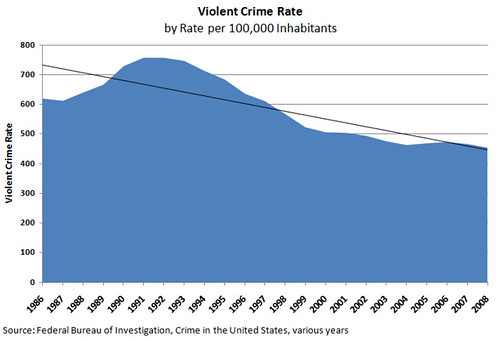
The Parents Television Council (PTC) released a new report today entitled Women in Peril: A Look at TV’s Disturbing New Storyline Trend. The report argues that “by depicting violence against women with increasing frequency, or as a trivial, even humorous matter, the broadcast networks may ultimately be contributing to a desensitized atmosphere in which people view aggression and violence directed at women as normative, even acceptable,” said PTC President Tim Winter.  As evidence the report cites… Nicole Kidman.  OK, it cites more than Nicole Kidman, but the 7-page report and accompanying press release does seem to place a lot of stock in the fact that, while being questioning by a House Foreign Affairs subcommittee hearing about violence against women overseas, “Ms. Kidman conceded that Hollywood has probably contributed to violence against women by portraying them as weak sex objects, according to the Associated Press.”  I’m not sure what Ms. Kidman was doing testifying before Congress on the matter of violence against women overseas — dare I suggest some congressmen were out for another photo-op with a Hollywood celeb? — but the better question is whether Ms. Kidman’s opinion has any bearing on the question of what relationship, if any, there is between televised violence and real-world violence against women. (Incidentally, if she really feels passionately about all this, is she prepared to go back and recut some of her old scenes in “Dead Calm,” “To Die For,” and “Eyes Wide Shut“?)

Violent Crime Rate

But let’s not nitpick about the credentials Ms. Kidman brings to the table or whether it makes any sense for PTC to elevate her opinions to proof of theory when it comes to a supposed connection between depictions of violence against women in film or television and real world acts of violence against women. PTC, however, suggests that’s exactly what is going on today. They allude to a few lab studies which are of the “monkey see, monkey do” variety — where the results of artificial lab experiments are used to claim that watching depictions of violence will turn us all into killing machines, rapists, robbers, or just plain ol’ desensitized thugs.

There’s just one problem with such studies, and the PTC report:  Reality.  Continue reading →

Oxford UniversityI’ll be heading to Oxford University this week to participate in an Oxford Internet Institute (OII) forum on the subject of “Child Protection, Free Speech and the Internet: Mapping the Territory and Limitations of Common Ground.”  It’s being led by several experts from the OII as well as my good friends John Morris and Leslie Harris of the Center for Democracy & Technology (CDT).  The aims of this forum are:

  • To facilitate a dialogue between NGOs campaigning to protect respectively, child protection and children’s rights online, and freedom of speech and other civil liberties online.
  • To promote a better understanding of each others’ positions, to share perspectives and information with a view to identifying areas of common ground and areas of disagreement.
  • To identify any shared policy goals, and possible tools to support the achievement of those goals.
  • To publicize the findings of the forum in international policy debates about Internet governance and regulation.

Conference participants were asked to submit a 2-3 pg summary of their views on a couple of questions that will be discussed at this event.  I have listed those questions, and my answers, down below the fold.  It’s my best attempt to date to succinctly outline my views about how to balance content concerns and free speech issues going forward.  Continue reading →

Whatever you think about this messy dispute between AT&T and Google about how to classify web-based telephony apps for regulatory purposes — in this case, Google Voice — the key issue not to lose site of here is that we are inching ever closer to FCC regulation of web-based apps!  Again, this is the point we have stressed here again and again and again and again when opposing Net neutrality mandates: If you open the door to regulation of one layer of the Net, you open up the door to the eventual regulation of all layers of the Net.

You might not buy that story initially but if you doubt it then I invite you to read just about any history of American broadcast media regulation over the course of the past seven decades. (You might want to start with Krattenmaker & Powe’s Regulating Broadcast Programming or Jonathan Emord’s Freedom, Technology, and the First Amendment). In such histories you will find a common theme: Once regulation of media and communications platforms gets underway, the natural progression of things is uni-directional — Up!  That is, when new questions arise about how to “deal with” a new service, network, platform, or technology, the general tendency is the “regulate up” instead of “deregulating down.”  When regulators are given a greater say about the contours of markets as technologies evolve and/or converge, we shouldn’t be surprised that their first instinct is to “bring them into the fold.”

And, sadly, that is exactly what is likely to occur eventually with Google Voice. The only really interesting question is what else regulators start mucking with in the search and applications layer once they get their hands on it.  And if you still insist that I am being overly paranoid about “regulatory creep” and the prospect of the FCC gradually transforming into the Federal Information Commission, then consider what the agency had to say about cloud computing in paragraph 60 (pg. 21) of the FCC’s recent Wireless Innovation and Investment Notice of Inquiry, which was launched on August 27th: Continue reading →

What Unites Advocates of Speech Controls & Privacy Regulation? [pdf]

by Adam Thierer & Berin Szoka The Progress & Freedom Foundation, Progress on Point No. 16.19

Anyone who has spent time following debates about speech and privacy regulation comes to recognize the striking parallels between these two policy arenas. In this paper we will highlight the common rhetoric, proposals, and tactics that unite these regulatory movements. Moreover, we will argue that, at root, what often animates calls for regulation of both speech and privacy are two remarkably elitist beliefs:

  1. People are too ignorant (or simply too busy) to be trusted to make wise decisions for themselves (or their children); and/or,
  2. All or most people share essentially the same values or concerns and, therefore, “community standards” should trump household (or individual) standards.

While our use of the term “elitism” may unduly offend some understandably sensitive to populist demagoguery, our aim here is not to launch a broadside against elitism as Time magazine culture critic William H. Henry once defined it: “The willingness to assert unyieldingly that one idea, contribution or attainment is better than another.”[1] Rather, our aim here is to critique that elitism which rises to the level of political condescension and legal sanction. We attack not so much the beliefs of some leaders, activists, or intellectuals that they have a better idea of what it in the public’s best interest than the public itself does, but rather the imposition of those beliefs through coercive, top-down mandates.

That sort of elitism—elitism enforced by law—is often the objective of speech and privacy regulatory advocates. Our goal is to identify the common themes that unite these regulatory movements, explain why such political elitism is unwarranted, and make it clear how it threatens individual liberty as well as the future of free and open Internet. As an alternative to this elitist vision, we advocate an empowerment agenda: fostering an environment in which users have the tools and information they need to make decisions for themselves and their families. Continue reading →

Adam Thierer noted in mid-December that the FCC was considering allowing the experimental use of cellphone jammers in prison.  The FCC just issued (PDF) a Special Temporary Authorization to allow the DC Department of Corrections to test a cell phone jamming technology.

This technology sounds like an excellent solution to a serious problem:  The illicit use of cell phones inside correctional facilities by prisoners across the country.  In particular, the technology appears to be “directional,” meaning that unlike traditional jammers, which simply block signals within a certain radius around the jammer, this technology appears to be capable of blocking signals inside the confines of a particular room or building.  In fact, I’m sure millions of Americans would love to see such technologies implemented in cinemas, theatres, and other performing arts venues across the country.  I, for one, am tired of having the exquisite acoustic delicacies of Bach interrupted by annoying ring tones, such as  the (painfully) immortal “Who Let the Dogs Out?”

So Much for The Rule of Law

But there’s one important problem: The FCC isn’t waiving a rule here against cell phone jammer. unless I’m missing some subtle statutory quirk, they’re essentially “waiving” a statute—specifically 47 U.S.C. 333:

No person shall willfully or maliciously interfere with or cause interference to any radio communications of any station licensed or authorized by or under this chapter or operated by the United States Government.

You don’t need to be an administrative lawyer to know that agencies can’t just ignore acts of Congress—no matter how good the policy reason for the waiver is. That’s a big part of what the “rule of law” means.  Period.  Do not pass ‘Go’.  Do not collect $3,101.09 (today’s equivalent of $200 in 1935, when Monopoly debuted).

Fortunately, as noted in the WSJ article Adam cited, at least one legislator realizes this and thinks it’s worth fixing:  U.S. Rep. Kevin Brady (R., Texas) told the Journal that his office is “drafting the necessary legislation to remove this outdated FCC roadblock.”  The FCC, of course, sped right past that particular roadblock.  But then, what should we expect from an agency that has, under its outgoing (and none-too-soon!) chairman Kevin Martin, simply disregarded statutory limits on its authority when it found Comcast in violation of the agency’s non-binding net neutrality principles this summer?  (My PFF colleague Barbara Esbin has eloquently condemned this violation of the rule of law in, “The Law is Whatever the Nobles Do: Undue Process at the FCC” (PDF).)

Now, when Congress considers this question, let us hope that they draw the right lesson from this episode:   Whatever the wisdom of outright bans on particular technologies, writing such bans into statutes is a really bad idea.  At least if such decisions were left up to regulatory agencies, they would have the flexibility to decide when to depart from a general ban.  Thus, the best approach would be to repeal the ban altogether.   Continue reading →

The introduction below was originally written by Berin Szoka, but now that I (Adam Marcus) am a full-fledged TLF member, I have taken authorship.


Adam Marcus, our exceptionally tech-savvy new research assistant at PFF, has published his first piece at the PFF blog, which I reprint here for your edification.

Today Google’s DC office hosted an interesting panel on cloud computing.  What was missing was a good definition of what “cloud computing” actually is.

While Wikipedia has its own broad definition of cloud computing, many think of cloud computing more narrowly as strictly web-based for which clients need nothing but a web browser. But that definition doesn’t cover things like Skype and SETI@home.  And just because PFF has implemented Outlook Web Access so we can access the Exchange server via the Web, doesn’t necessarily mean we’ve implemented what most people might think of as “cloud computing.”  Yet these are all variations on a common theme, which leads me to propose my own basic definition: any client/server system that operates over the Internet.

To understand the potential policy and legal issues raised by cloud computing so-defined, one must break down the discussion into a 4-part grid.  One axis is divided into private data ( e.g., email) and public data (e.g., photo sharing).  The other axis is divided into data hosted on a single server or centralized server farm and data hosted on multiple computers in a dynamic peer-to-peer network (e.g., BitTorrent file sharing).

Examples User Data is Public User Data is Private
Centralized Server(s) Blogs Discussion boards Flickr Web-based email servers Windows Terminal Services
Peer-to-Peer BitTorrent FreeNet (article) Skype Wuala

Continue reading →