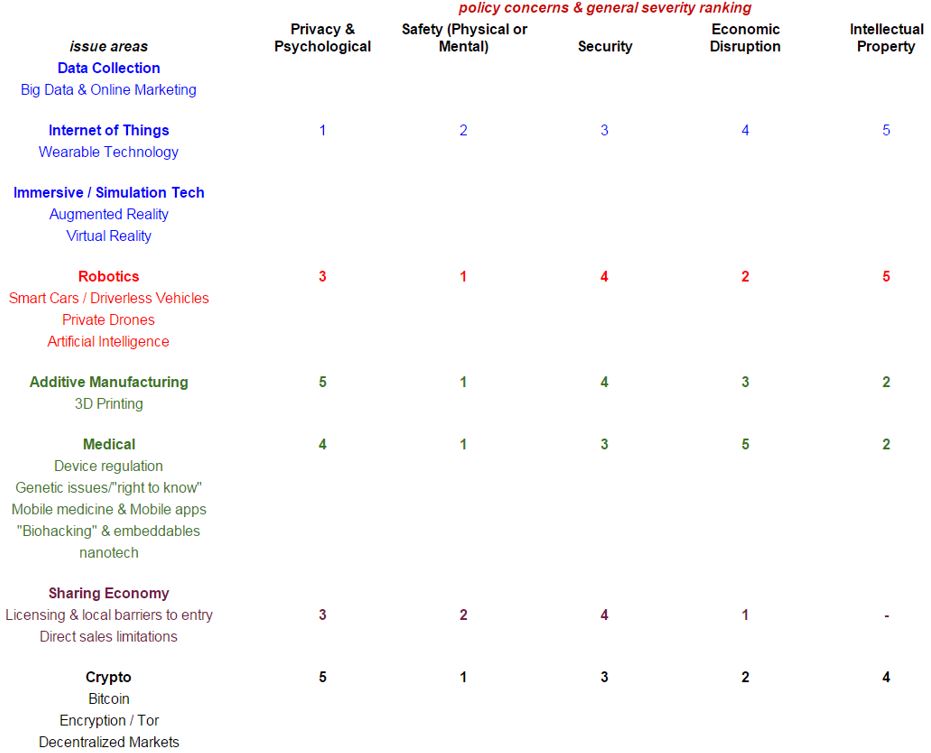
On the whiteboard that hangs in my office, I have a giant matrix of technology policy issues and the various policy “threat vectors” that might end up driving regulation of particular technologies or sectors. Along with my colleagues at the Mercatus Center’s Technology Policy Program, we constantly revise this list of policy priorities and simultaneously make an (obviously quite subjective) attempt to put some weights on the potential policy severity associated with each threat of intervention. The matrix looks like this: [Sorry about the small fonts. You can click on the image to make it easier to see.]
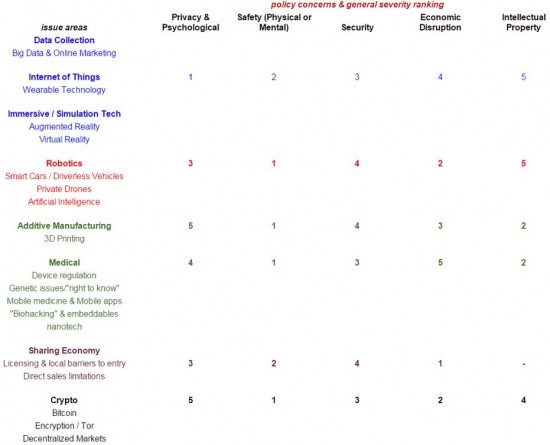
I use 5 general policy concerns when considering the likelihood of regulatory intervention in any given area. Those policy concerns are:
- privacy (reputation issues, fear of “profiling” & “discrimination,” amorphous psychological / cognitive harms);
- safety (health & physical safety or, alternatively, child safety and speech / cultural concerns);
- security (hacking, cybersecurity, law enforcement issues);
- economic disruption (automation, job dislocation, sectoral disruptions); and,
- intellectual property (copyright and patent issues).
Continue reading →
With each booth I pass and presentation I listen to at the 2014 International Consumer Electronics Show (CES), it becomes increasingly evident that the “Internet of Things” era has arrived. In just a few short years, the Internet of Things (IoT) has gone from industry buzzword to marketplace reality. Countless new IoT devices are on display throughout the halls of the Las Vegas Convention Center this week, including various wearable technologies, smart appliances, remote monitoring services, autonomous vehicles, and much more.
This isn’t vaporware; these are devices or services that are already on the market or will launch shortly. Some will fail, of course, just as many other earlier technologies on display at past CES shows didn’t pan out. But many of these IoT technologies will succeed, driven by growing consumer demand for highly personalized, ubiquitous, and instantaneous services.
But will policymakers let the Internet of Things revolution continue or will they stop it dead in its tracks? Interestingly, not too many people out here in Vegas at the CES seem all that worried about the latter outcome. Indeed, what I find most striking about the conversation out here at CES this week versus the one about IoT that has been taking place in Washington over the past year is that there is a large and growing disconnect between consumers and policymakers about what the Internet of Things means for the future.
When every device has a sensor, a chip, and some sort of networking capability, amazing opportunities become available to consumers. And that’s what has them so excited and ready to embrace these new technologies. But those same capabilities are exactly what raise the blood pressure of many policymakers and policy activists who fear the safety, security, or privacy-related problems that might creep up in a world filled with such technologies.
But at least so far, most consumers don’t seem to share the same worries. Continue reading →
Tomorrow, the Federal Trade Commission (FTC) will host an all-day workshop entitled, “Internet of Things: Privacy and Security in a Connected World.” [Detailed agenda here.] According to the FTC: “The workshop will focus on privacy and security issues related to increased connectivity for consumers, both in the home (including home automation, smart home appliances and connected devices), and when consumers are on the move (including health and fitness devices, personal devices, and cars).”
Where is the FTC heading on this front? This Politico story by Erin Mershon from last week offers some possible ideas. Yet, it still remains unclear whether this is just another inquiry into an exciting set of new technologies or if it is, as I worried in my recent comments to the FTC on this matter, “the beginning of a regulatory regime for a new set of information technologies that are still in their infancy.”
First, for those not familiar with the “Internet of Things,” this short new report from Daniel Castro & Jordan Misra of the Center for Data Innovation offers a good definition:
The “Internet of Things” refers to the concept that the Internet is no longer just a global network for people to communicate with one another using computers, but it is also a platform or devices to communicate electronically with the world around them. The result is a world that is alive with information as data flows from one device to another and is shared and reused for a multitude of purposes. Harnessing the potential of all of this data for economic and social good will be one of the primary challenges and opportunities of the coming decades.
The report continues on to offer a wide range of examples of new products and services that could fulfill this promise.
What I find somewhat worrying about the FTC’s sudden interest in the Internet of Things is that it opens to the door for some regulatory-minded critics to encourage preemptive controls on this exciting new wave of digital age innovation, based almost entirely on hypothetical worst-case scenarios they have conjured up. Continue reading →
 I’m pleased to announce the release of my latest law review article, “A Framework for Benefit-Cost Analysis in Digital Privacy Debates.” It appears in the new edition of the George Mason University Law Review. (Vol. 20, No. 4, Summer 2013)
This is the second of two complimentary law review articles I am releasing this year dealing with privacy policy. The first, “The Pursuit of Privacy in a World Where Information Control is Failing,” was published in Vol. 36 of the Harvard Journal of Law & Public Policy
this Spring. (FYI: Both articles focus on privacy claims made against private actors — namely, efforts to limit private data collection — and not on privacy rights against governments.)
My new article on benefit-cost analysis in privacy debates makes a seemingly contradictory argument: benefit-cost analysis (“BCA”) is extremely challenging in online child safety and digital privacy debates, yet it remains essential that analysts and policymakers attempt to conduct such reviews. While we will never be able to perfectly determine either the benefits or costs of online safety or privacy controls, the very act of conducting a regulatory impact analysis (“RIA”) will help us to better understand the trade-offs associated with various regulatory proposals. Continue reading →
Last week on his personal blog, Peter Fleischer, Global Privacy Counsel for Google, posted an interesting essay entitled “We Need a Better, Simpler Narrative of US Privacy Laws.” Fleischer says that Europe has done a better job marketing its privacy regime to the world than the United States and argues that “The US has to figure out how to explain its privacy laws on the global stage” since “Europe is convincing many countries around the world to implement privacy laws that follow the European model.” He notes that “in the last year alone, a dozen countries in Latin America and Asia have adopted euro-style privacy laws [while] not a single country, anywhere, has followed the US model.” Fleischer argues that this has ramifications for long-term trade policy and global Internet regulation more generally.
I found this essay very interesting because I deal with some of these issues in my latest law review article, “The Pursuit of Privacy in a World Where Information Control is Failing” (Harvard Journal of Law & Public Policy, vol. 36, no. 2, Spring 2013). In the article, I suggest that the U.S. does have a unique privacy regime and it is one that is very similar in character to the regime that governs online child safety issues. Whether we are talking about online safety or digital privacy, the defining characteristics of the U.S. regime are that it is bottom-up, evolutionary, education-based, empowerment-focused, and resiliency-centered. It focuses on responding to safety and privacy harms after exhausting other alternatives, including market responses and the evolution of societal norms.
The EU regime, by contrast, is more top-down in character and takes a more static, inflexible view of privacy rights. It tries to impose a one-size-fits-all model on a diverse citizenry and it attempts to do so through heavy-handed data directives and ongoing “agency threats.” It is a regime that makes more sweeping pronouncements about rights and harms and generally recommends a “precautionary principle” approach to technological change in which digital innovation is more “permissioned.”
Put simply, the U.S. regime is
reactive in character while the E.U. regime is more preemptive. The U.S. system focuses on responding to safety and privacy problems using a more diverse toolbox of solutions, some of which are governmental in character while others are based on evolving social and market norms and responses. To be clear, law does enter the picture here in the U.S., but it does so in a very different way than it does in the E.U. Continue reading →
Here’s a presentation I’ve been using lately for various audiences about “Cronyism: History, Costs, Case Studies and Solutions.” In the talk, I offer a definition of cronyism, explain its origins, discuss how various academics have traditionally thought about it, outline a variety of case studies, and then propose a range of solutions. Readers of this blog might be interested because I briefly mention the rise of cronyism in the high-tech sector. Brent Skorup and I have a huge paper in the works on that topic, which should be out early next year.
[UPDATE
4/30/13: This article was subsequently published in Volume 65, Issues 2 of the Federal Communications Law Journal in April 2013. The links below now point to the final FCLJ version.]
The Mercatus Center at George Mason University has just released a new paper by Brent Skorup and me entitled, “Uncreative Destruction: The War on Vertical Integration in the Information Economy.” Brent, who is the research director for the Information Economy Project at the George Mason University School of Law, and I have been working on this paper since the Spring and we are looking forward to getting it published in a law review shortly. The paper focuses on Tim Wu’s “separations principle” for the digital economy, something I’ve spent some time critiquing here in the past. Here’s the introduction from the 44-page paper that Brent and I just released:
Are information sectors sufficiently different from other sectors of the economy such that more stringent antitrust standards should be applied to them preemptively? Columbia Law School professor Tim Wu responds in the affirmative in his book The Master Switch: The Rise and Fall of Information Empires. Having successfully pushed net-neutrality regulation into the policy spotlight, Wu has turned his attention to what he regards as excessive market concentration and threats to free speech throughout the entire information economy.To support his call for increased antitrust intervention, Wu explains his view of competition in the information economy—a view that deviates substantially from current mainstream antitrust theory.
Continue reading →
 This may be the best speech by a regulator that you will read in your entire life. Federal Communications Commission (FCC) Commissioner Robert McDowell delivered an address in Rome today entitled, “The Siren Call of “Please Regulate My Rival”: A Recipe for Regulatory Failure.” I highly recommend it (and not just because I’m cited in it!) It is infused with important insights about the ugly downsides of excessive regulation of technology markets.
McDowell is an astute student of regulatory history and he documents how, despite the best of intentions, economic regulation has often been turned into a tool that industry exploits for their own narrow interests. Sadly, examples of such “regulatory capture” are rampant, as I have documented here before. McDowell notes that many telecom and media companies “suffer from the ‘please regulate my rival’ malady of an industry that has been regulated too much and for too long. History is replete with such scenarios,” he says, “and the desire for more regulation for competitors always ends badly for the incumbent regulated industry in the form of unintended and harmful consequences.” That is exactly right.
I strongly encourage you to read the entire speech, but if you only have time to read one thing, make it the powerful and poetic closing paragraphs, which I have reprinted below:
Continue reading →
This week I will again be attending the Family Online Safety Institute’s excellent annual summit. The 2-day affair brings together some of the world’s leading experts on online safety and privacy issues. It’s a great chance to learn about major developments in the field. As I was preparing for the session I am moderating on Thursday, I thought back to the first FOSI annual conference, which took place back in 2007. What is remarkable about that period compared to now is that there was a flurry of legislative and regulatory activity related to online child safety then that we simply do not see today.
In fact, just 3 1/2 years ago, John Morris of the Center for Democracy and Technology and I compile a legislative index [summary here] that cataloged the more than 30 legislative proposals that had been introduced in the the 110th session of Congress. There was also a great deal of interest in these issues within the regulatory community. Finally, countless state and local measures related to online safety and speech issues had been floated. Today, by contrast, it is hard for me to find any legislative measures focused on online safety regulation at the federal level, and I don’t see much activity at the agency level either. I haven’t surveyed state and local activity, but it seems like it has also died down.
Generally speaking, I think this is a good development since I am opposed to most proposals to regulate online speech, expression, or conduct. But let’s ignore the particular wisdom of such measures and ask a simple question:
What explains the decline in Internet safety legislation and online content regulation? I believe there are three possible explanations: Continue reading →
I absolutely loved this quote about the dangers of regulatory capture from Holman Jenkins in today’s Wall Street Journal in a story (“Let’s Restart the Green Revolution“) about how misguided agricultural / environmental policies are hurting consumers:
When some hear the word “regulation,” they imagine government rushing to the defense of consumers. In the real world, government serves up regulation to those who ask for it, which usually means organized interests seeking to block a competitive threat. This insight, by the way, originated with the left, with historians who went back and reconstructed how railroads in the U.S. concocted federal regulation to protect themselves from price competition. We should also notice that an astonishingly large part of the world has experienced an astonishing degree of stagnation for an astonishingly long time for exactly such reasons.
I’ve just added it to my growing compendium of notable quotations about regulatory capture. It’s essential that we not ignore how — despite the very best of intentions — regulation often has unintended and profoundly anti-consumer / anti-innovation consequences.


 The Technology Liberation Front is the tech policy blog dedicated to keeping politicians' hands off the 'net and everything else related to technology.