 I am pleased to announce the release of my latest book, “Permissionless Innovation: The Continuing Case for Comprehensive Technological Freedom.” It’s a short manifesto (just under 100 pages) that condenses — and attempts to make more accessible — arguments that I have developed in various law review articles, working papers, and blog posts over the past few years. I have two goals with this book.
First, I attempt to show how the central fault line in almost all modern technology policy debates revolves around “the permission question,” which asks:
Must the creators of new technologies seek the blessing of public officials before they develop and deploy their innovations? How that question is answered depends on the disposition one adopts toward new inventions. Two conflicting attitudes are evident.
One disposition is known as the “precautionary principle.” Generally speaking, it refers to the belief that new innovations should be curtailed or disallowed until their developers can prove that they will not cause any harms to individuals, groups, specific entities, cultural norms, or various existing laws, norms, or traditions.
The other vision can be labeled “permissionless innovation.” It refers to the notion that experimentation with new technologies and business models should generally be permitted by default. Unless a compelling case can be made that a new invention will bring serious harm to society, innovation should be allowed to continue unabated and problems, if they develop at all, can be addressed later.
I argue that we are witnessing a grand clash of visions between these two mindsets today in almost all major technology policy discussions today. Continue reading →
Last week, it was my great pleasure to be invited on NPR’s “On Point with Tom Ashbrook,” to debate Jeffrey Rosen, a leading privacy scholar and the president and chief executive of the National Constitution Center. In an editorial in the previous Sunday’s New York Times (“Madison’s Privacy Blind Spot”), Rosen proposed “constitutional amendment to prohibit unreasonable searches and seizures of our persons and electronic effects, whether by the government or by private corporations like Google and AT&T.” He said his proposed amendment would limit “outrageous and unreasonable” collection practices and would even disallow consumers from sharing their personal information with private actors even if they saw an advantage in doing so.
I responded to Rosen’s proposal in an essay posted on the IAPP
Privacy Perspectives blog, “Do We Need A Constitutional Amendment Restricting Private-Sector Data Collection?” In my essay, I argued that there are several legal, economic, and practical problems with Rosen’s proposal. You can head over to the IAPP blog to read my entire response but the gist of it is that “a constitutional amendment [governing private data collection] would be too sweeping in effect and that better alternatives exist to deal with the privacy concerns he identifies.” There are very good reasons we treat public and private actors differently under the law and there “are all far more practical and less-restrictive steps that can be taken without resorting to the sort of constitutional sledgehammer that Jeff Rosen favors. We can protect privacy without rewriting the Constitution or upending the information economy,” I concluded.
But I wanted to elaborate on one particular thing I found particularly interesting about Rosen’s comments when we were on NPR together. During the show, Rosen kept stressing how we needed to adopt a more European construction of privacy as “dignity rights” and he even said his proposed privacy amendment would even disallow individuals from surrendering their private data or their privacy because he viewed these rights as “unalienable.” In other words, from Rosen’s perspective, privacy pretty much trumps
everything, even if you want to trade it off against other values. Continue reading →
 What works well as an ethical directive might not work equally well as a policy prescription. Stated differently, what one ought to do it certain situations should not always be synonymous with what they must do by force of law.
I’m going to relate this lesson to tech policy debates in a moment, but let’s first think of an example of how this lesson applies more generally. Consider the Ten Commandments. Some of them make excellent ethical guidelines (especially the stuff about not coveting neighbor’s house, wife, or possessions). But most of us would agree that, in a free and tolerant society, only two of the Ten Commandments make good law:
Thou shalt not kill and Thou shalt not steal.
In other words, not every sin should be a crime. Perhaps
some should be; but most should not. Taking this out of the realm of religion and into the world of moral philosophy, we can apply the lesson more generally as: Not every wise ethical principle makes for wise public policy. Continue reading →
 Few modern intellectuals gave more serious thought to forecasting the future than Herman Kahn. He wrote several books and essays imagining what the future might look like. But he was also a profoundly humble man who understood the limits of forecasting the future. On that point, I am reminded of my favorite Herman Kahn quote:
History is likely to write scenarios that most observers would find implausible not only prospectively but sometimes, even in retrospect. Many sequences of events seem plausible now only because they have actually occurred; a man who knew no history might not believe any. Future events may not be drawn from the restricted list of those we have learned are possible; we should expect to go on being surprised.
[1]
I have always loved that phrase, “a man who knew no history might not believe any.” Indeed, sometimes the truth (how history actually unfolds) really is stranger than fiction (or the hypothetical forecasts that came before it.)
This insight has profound ramifications for public policy and efforts to “plan progress,” something that typically ends badly. Continue reading →
My colleague Eli Dourado brought to my attention this XKCD comic and when tweeting it out yesterday he made the comment that “Half of tech policy is dealing with these people”:
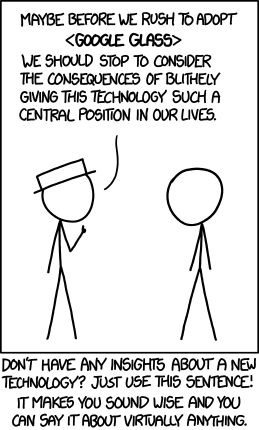
The comic and Eli’s comment may be a bit snarky, but something about it rang true to me because while conducting research on the impact of new information technologies on society I often come across books, columns, blog posts, editorials, and tweets that can basically be summed up with the line from that comic: “we should stop to consider the consequences of [this new technology] before we …” Or, equally common is the line: “we need to have a conversation about [this new technology] before we…”
But what does that really mean? Certainly “having a conversation” about the impact of a new technology on society is important. But what is the nature of that “conversation”? How is it conducted? How do we know when it is going on or when it is over? Continue reading →
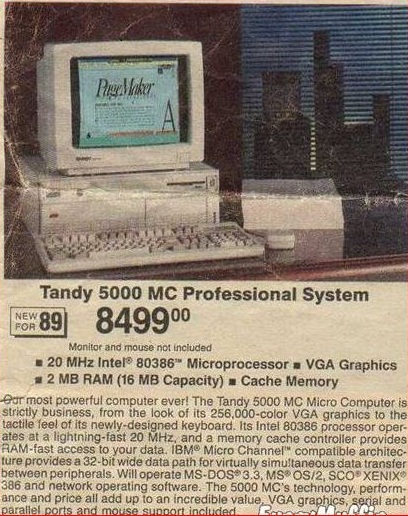
Kudos to Mashable for collecting these “10 Hilarious Vintage Cellphone Commercials” from the past two decades. Strangely, I don’t remember ever seeing any of these when they originally aired [although some are foreign], but it might have been because I flipped the channel when they came on. Most of really horrendous. My favorite is the Radio Shack ad shown below, not just because of the phone, but because of the Bill Gates-looking kid at the end. And speaking of Radio Shack, check out the ad down below, which I originally posted here a few years ago, for a 1989 Tandy machine, then billed as its “Most Powerful Computer Ever.” Accordingly, you would have had to practically mortgage your house to own it with a price tag of $8500! Whether its phones or computers — which are increasingly one in the same, of course — it’s amazing how much progress we’ve seen in such a short period of time.
http://www.youtube.com/v/rWfqkrAM8IY&rel=0&hl=en_US&feature=player_embedded&version=3
 I’m very excited to announce that I now have a regular Forbes column that will fly under the banner, “Technologies of Freedom.” My first essay for them is already live and it addresses a topic I’ve dealt with here extensively through the years: Irrational fears about tech monopolies and “information empires.” Jump over to Forbes to read the whole thing.
Regular readers of this blog will understand why I chose “Technologies of Freedom” as the title for my column, but I thought it was worth reiterating. No book has had a more formative impact on my thinking about technology policy than Ithiel de Sola Pool’s 1983 masterpiece,
Technologies of Freedom: On Free Speech in an Electronic Age. As I noted in my short Amazon.com review, Pool’s technological tour de force is simply breathtaking in its polemical power and predictive capabilities. Reading this book almost three decades after it was published, one comes to believe that Pool must have possessed a crystal ball or had a Nostradamus-like ability to foresee the future.
For example, long before anyone else had envisioned what we now refer to as “cyberspace,” Pool was describing it in this book. “Networked computers will be the printing presses of the twenty-first century,” he argued in his remarkably prescient chapter on electronic publishing. “Soon most published information will disseminated electronically,” and “there will be networks on networks on networks,” he predicted. “A panoply of electronic devices puts at everyone’s hands capacities far beyond anything that the printing press could offer.” Few probably believed his prophecies in 1983, but no one doubts him now! Continue reading →
 Last night, Declan McCullagh of CNet posted two tweets related to the concerns already percolating in the privacy community about a new Apple and Android app called “Color,” which allows those who use it to take photos and videos and instantaneously share them with other people within a 150-ft radius to create group photo/video albums. In other words, this new app marries photography, social networking, and geo-location.
 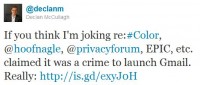 And because the app’s default setting is to share every photo and video you snap openly with the world, Declan wonders “How long will it take for the #privacy fundamentalists to object to Color.com’s iOS/Android apps?” After all, he says facetiously, “Remember: market choices can’t be trusted!” He then reminds us that there’s really nothing new under the privacy policy sun and that we’ve seen this debate unfold before, such as when Google released its GMail service to the world back in 2004.
Indeed, for me, this debate has a “Groundhog Day” sort of feel to it. I feel like I’ve been fighting the same fight with many privacy fundamentalists for the past decade. The cycle goes something like this: Continue reading →
Over at Silicon Alley Insider, Gregory Galant has a wonderful post about “18 Awesome Tech Things We Didn’t Have 10 Years Ago.” It serves as another great example of the amazing technological progress we have witnessed over the past decade. He’s asking people for suggestions for what else should be on the list, so head over there and let him know. Seems like wi-fi technologies should be on there somehow. FiOS deserves a shout-out, too. And where’s Firefox & Chrome? Also, I’ll put in a special word for some amazing new home theater technologies: high-def flat-screens and projectors; media servers & Windows Media Center; BluRay; and 3 incredible gaming / media consoles (Wii, PS3, & XBox). Anyway, here’s Galant’s list:
Wikipedia
Gmail
Facebook
YouTube
Twitter
AdWords
Amazon AWS
RSS (started in ‘99 but didn’t catch on till the ’00s)
Meetup
iPod
Google Maps
Podcasts
Mint
Skype/VOIP
iPhone
Google Docs
Creative Commons
Flickr
My friend Larry Magid, a technology columnist for CBS News.com and others, has a wonderful new column out about “The Decade in Technology.” You have to read it to appreciate just how far we have come in such a short time. Larry notes:
[T]he past 10 years were a momentous period for technology. Not only was there no iPhone a decade ago, there was hardly anything that could be considered a smartphone. The BlackBerry was introduced in 1999, when the well-heeled techno-savvy were carrying around flip phones. That year, 1999, was the height of the dot-com boom. But when you look back at it, the online world was nothing like it is today. There was no Facebook (founded in 2004) or Twitter (2007). Even MySpace wasn’t founded until 2003. The term Web 2.0 hadn’t been coined and most people who were online used the Web mostly to consume information. Those with the skills and resources to post to the Web were called “Webmasters.” Today, everyone with a Facebook account is a master of his or her own Web.
I tried to document the incredible technological changes in my own life over the past decade in this essay I penned on Super Bowl Sunday last February: “10 Years Ago Today… (Thinking About Technological Progress).”
Larry also notes that giants came and went as technology continued to evolve in unexpected ways:
Ten years ago AOL was the most popular Internet service provider and was so successful that it was able to purchase media giant Time Warner in January 2000 for $182 billion in stock. But the marriage didn’t make it through the decade. The two companies formally split up this month, with AOL, once again, being traded on the New York Stock Exchange as a separate company. AOL thrived in the ’90s because people were using the service to go online via phone. Today most American homes have broadband.
That’s something I wrote about at length in my recent paper on “A Brief History of Media Merger Hysteria.” Anyway, read Larry’s entire piece. It really drives home how lucky we are to be living in the midst of such at technological renaissance and information cornucopia.
 I am pleased to announce the release of my latest book, “Permissionless Innovation: The Continuing Case for Comprehensive Technological Freedom.” It’s a short manifesto (just under 100 pages) that condenses — and attempts to make more accessible — arguments that I have developed in various law review articles, working papers, and blog posts over the past few years. I have two goals with this book.



 The Technology Liberation Front is the tech policy blog dedicated to keeping politicians' hands off the 'net and everything else related to technology.