Posts tagged as:

Marc Andreessen is interviewed by Sriram Krishan in his new newsletter, The Observer Effect, and asked what motivates him to support technological innovation and “to go read up on a new topic every day” related to tech and progress. His answer is inspirational and perfectly encapsulates why I also have made technological progress the focus of my life’s work:

I am a deep believer in – after learning a lot over the years about economic history and of cultural history – that technology really is the driver. There were basically millennia of just subsistence farming industry and all of a sudden, there was this vertical takeoff a few hundred years ago. And quality of life exploded around the world. Not evenly but starting in Europe and expanding out. It’s basically all technology. It’s always the printing press, it’s the internet and on and on. And you get this incredible upward trajectory. We have the potential over the course of the next century or over the next few centuries to really dramatically advance and have life be better for virtually everybody. Technology is quite literally the lever for being able to take natural resources and able to make something better out of them. And so it’s just it’s the most interesting and by far the most useful and the most beneficial thing I can think of doing.

Amen, brother! I devoted my last two books (Permissionless Innovation and Evasive Entrepreneurs) and all my life’s work, to proving that exact point. Also, I really like Andreessen’s definition of technology as, “the lever for being able to take natural resources and able to make something better out of them.” I’ve added that to my running compendium, “Defining Technology,” which features various definitions of technology.


 

Matt RidleyThere are few things more exciting to innovation policy geeks that than the week a new Matt Ridley book drops. Thankfully, that time is upon us once again. This week, Ridley’s latest book, How Innovation Works: And Why It Flourishes in Freedom, is being released. I can’t wait to dig in.

This weekend, the Wall Street Journal published an essay condensed from the book entitled, “Innovation Can’t Be Forced, but It Can Be Quashed.” Here are some of the highlights from Ridley’s piece:

Innovation relies upon freedom to experiment and try new things, which requires sensible regulation that is permissive, encouraging and quick to give decisions. By far the surest way to rediscover rapid economic growth when the pandemic is over will be to study the regulatory delays and hurdles that have now been hastily swept aside to help innovators in medical devices and therapies, and to see whether such reforms could be applied to other parts of the economy too. … Dealing with Covid-19 has forcibly reminded governments of the value of innovation. But if we are to get faster vaccines and treatments—and better still, more innovation across all fields in the future—then innovators need to be freed from the shackles that hold them back.

These are crucial point, and ones I discuss in the launch essay and the afterward of my new book, Evasive Entrepreneurs and the Future of Governance. Alas, as I pointed out in that launch essay and my last book on Permissionless Innovation, a great many barriers stand in the way of the freedom to experiment and try new things. As Ridley points out: Continue reading →

[First published by AIER on April 20, 2020 as “Innovation and the Trouble with the Precautionary Principle.”]

In a much-circulated new essay (“It’s Time to Build”), Marc Andreessen has penned a powerful paean to the importance of building. He says the COVID crisis has awakened us to the reality that America is no longer the bastion of entrepreneurial creativity it once was. “Part of the problem is clearlyforesight, a failure of imagination,” he argues. “But the other part of the problem is what we didn’t do in advance, and what we’re failing to do now. And that is a failure of action, and specifically our widespread inability to build.”The Mind of Marc Andreessen | The New Yorker

Andreessen suggests that, somewhere along the line, something changed in the DNA of the American people and they essentially stopped having the desire to build as they once did. “You don’t just see this smug complacency, this satisfaction with the status quo and the unwillingness to build, in the pandemic, or in healthcare generally,” he says. “You see it throughout Western life, and specifically throughout American life.” He continues:

“The problem is desire. We need to want these things. The problem is inertia. We need to want these things more than we want to prevent these things. The problem is regulatory capture. We need to want new companies to build these things, even if incumbents don’t like it, even if only to force the incumbents to build these things.”

Accordingly, Andreessen continues on to make the case to both the political right and left to change their thinking about building more generally. “It’s time for full-throated, unapologetic, uncompromised political support from the right for aggressive investment in new products, in new industries, in new factories, in new science, in big leaps forward.”

What’s missing in Andreessen’s manifesto is a concrete connection between America’s apparent dwindling desire to build these things and the political realities on the ground that contribute to that problem. Put simply, policy influences attitudes. More specifically, policies that frown upon entrepreneurial risk-taking actively disincentivize the building of new and better things. Thus, to correct the problem Andreessen identifies, it is essential that we must first remove political barriers to productive entrepreneurialism or else we will never get back to being the builders we once were.     Continue reading →

commissioner-ohlhausenI wanted to draw your attention to yet another spectacular speech by Maureen K. Ohlhausen, a Commissioner with the Federal Trade Commission (FTC). I have written here before about Commissioner Ohlhausen’s outstanding speeches, but this latest one might be her best yet.

On Tuesday, Ohlhausen was speaking at U.S. Chamber of Commerce Foundation day-long event on “The Internet of Everything: Data, Networks and Opportunities.” The conference featured various keynote speakers and panels discussing, “the many ways that data and Internet connectiviting is changing the face of business and society.” (It was my honor to also be invited to deliver an address to the crowd that day.)

As with many of her other recent addresses, Commissioner Ohlhausen stressed why it is so important that policymakers “approach new technologies and new business models with regulatory humility.” Building on the work of the great Austrian economist F.A. Hayek, who won a Nobel prize in part for his work explaining the limits of our knowledge to plan societies and economies, Ohlhausen argues that: Continue reading →

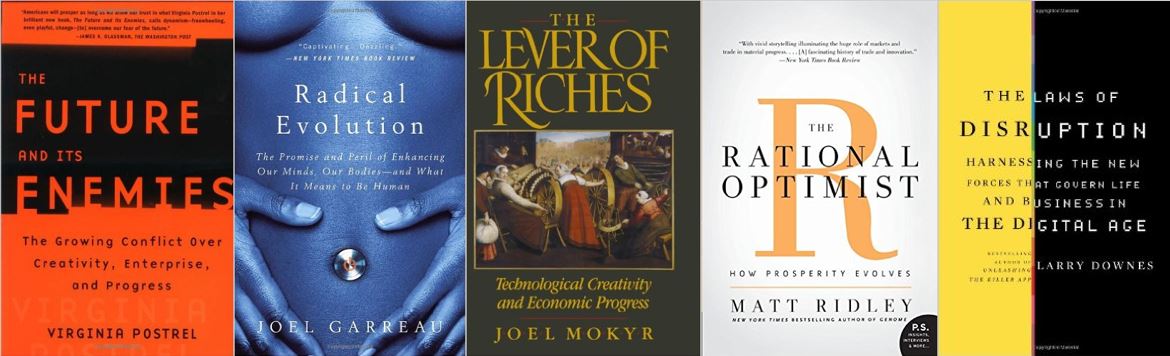
I was delivering a lecture to a group of academics and students out in San Jose recently [see the slideshow here] and someone in the crowd asked me to send them a list of some of the many books I had mentioned during my talk, which was about future policy clashes over various emerging technologies. I cut the list down to the five books that I believe best frame the nature of debates over innovation and technology policy. They are:

If you haven’t read these amazing books yet, add them to your collection  right now! They are worth reading again and again. They will forever change the way you think about debates over technology and innovation.

5 innovation book covers

Cory BookerLast Wednesday, it was my great pleasure to testify at a Senate Commerce Committee hearing entitled, “The Connected World: Examining the Internet of Things.” The hearing focused “on how devices… will be made smarter and more dynamic through Internet technologies. Government agencies like the Federal Trade Commission, however, are already considering possible changes to the law that could have the unintended consequence of slowing innovation.”

But the session went well beyond the Internet of Things and became a much more wide-ranging discussion about how America can maintain its global leadership for the next-generation of Internet-enabled, data-driven innovation. On both sides of the aisle at last week’s hearing, one Senator after another made impassioned remarks about the enormous innovation opportunities that were out there. While doing so, they highlighted not just the opportunities emanating out of the IoT and wearable device space, but also many other areas, such as connected cars, commercial drones, and next-generation spectrum.

I was impressed by the energy and nonpartisan vision that the Senators brought to these issues, but I wanted to single out the passionate statement that Sen. Cory Booker (D-NJ) delivered when it came his turn to speak because he very eloquently articulated what’s at stake in the battle for global innovation supremacy in the modern economy. (Sen. Booker’s remarks were not published, but you can watch them starting at the 1:34:00 mark of the hearing video.) Continue reading →

In my previous essay, I discussed a new white paper by my colleague Robert Graboyes, Fortress and Frontier in American Health Care, which examines the future of medical innovation. Graboyes uses the “fortress vs frontier” dichotomy to help explain different “visions” about how public policies debates about technological innovation in the health care arena often play out.  It’s a terrific study that I highly recommend for all the reasons I stated in my previous post.

As I was reading Bob’s new report, I realized that his approach shared much in common with a couple of other recent innovation policy paradigms I have discussed here before from Virginia Postrel (“Stasis” vs. “Dynamism”), Robert D. Atkinson (“Preservationists” vs. “Modernizers”), and myself (“Precautionary Principle” vs. “Permissionless Innovation”). In this essay, I will briefly relate Bob’s’ approach to those other three innovation policy paradigms and then note a deficiency with our common approaches. I’ll conclude by briefly discussing another interesting framework from science writer Joel Garreau. Continue reading →

How is it that we humans have again and again figured out how to assimilate new technologies into our lives despite how much those technologies “unsettled” so many well-established personal, social, cultural, and legal norms?

In recent years, I’ve spent a fair amount of time thinking through that question in a variety of blog posts (“Are You An Internet Optimist or Pessimist? The Great Debate over Technology’s Impact on Society”), law review articles (“Technopanics, Threat Inflation, and the Danger of an Information Technology Precautionary Principle”), opeds (“Why Do We Always Sell the Next Generation Short?”), and books (See chapter 4 of my new book, “Permissionless Innovation: The Continuing Case for Comprehensive Technological Freedom”).

It’s fair to say that this issue — how individuals, institutions, and cultures adjust to technological change — has become a personal obsession of mine and it is increasingly the unifying theme of much of my ongoing research agenda. The economic ramifications of technological change are part of this inquiry, of course, but those economic concerns have already been the subject of countless books and essays both today and throughout history. I find that the social issues associated with technological change — including safety, security, and privacy considerations — typically get somewhat less attention, but are equally interesting. That’s why my recent work and my new book narrow the focus to those issues. Continue reading →

[Last updated July 2021.]

I spend a lot of time reading books and essays about technology; more specifically, books and essays about technology history and criticism. Yet, I am often struck by how few of the authors of these works even bother defining what they mean by “technology.” I find that frustrating because, if you are going to make an attempt to either study or critique a particular technology or technological practice or development, then you probably should take the time to tell us how broadly or narrowly you are defining the term “technology” or “technological process.”

Photo: David HartsteinOf course, it’s not easy. “In fact, technology is a word we use all of the time, and ordinarily it seems to work well enough as a shorthand, catch-all sort of word,” notes the always-insightful Michael Sacasas in his essay “Traditions of Technological Criticism.” “That same sometimes useful quality, however, makes it inadequate and counter-productive in situations that call for more precise terminology,” he says.

Quite right, and for a more detailed and critical discussion of how earlier scholars, historians, and intellectuals have defined or thought about the term “technology,” you’ll want to check out Michael’s other recent essay, “What Are We Talking About When We Talk About Technology?” which preceded the one cited above. We don’t always agree on things — in fact, I am quite certain that most of my comparatively amateurish work must make his blood boil at times! — but you won’t find a more thoughtful technology scholar alive today than Michael Sacasas. If you’re serious about studying technology history and criticism, you should follow his blog and check out his book, The Tourist and The Pilgrim: Essays on Life and Technology in the Digital Age, which is a collection of some of his finest essays.

Anyway, for what it’s worth, I figured I would create this post to list some of the more interesting definitions of “technology” that I have uncovered in my own research. I suspect I will add to it in coming months and years, so please feel free to suggest other additions since I would like this to be a useful resource to others. Continue reading →

This past week I posted two new essays related to my new book, “Permissionless Innovation: The Continuing Case for Comprehensive Technological Freedom.” Just thought I would post quick links here.

First, my old colleague Dan Rothschild was kind enough to ask me to contribute a post to the R Street Blog entitled, “Bucking the ‘Mother, May I?’ Mentality.” In it, I offered this definition and defense of permissionless innovation as a policy norm:

Permissionless innovation is about the creativity of the human mind to run wild in its inherent curiosity and inventiveness, even when it disrupts certain cultural norms or economic business models. It is that unhindered freedom to experiment that ushered in many of the remarkable technological advances of modern times. In particular, all the digital devices, systems and networks that we now take for granted came about because innovators were at liberty to let their minds run wild. Steve Jobs and Apple didn’t need a permit to produce the first iPhone. Jeff Bezos and Amazon didn’t need to ask anyone for the right to create a massive online marketplace. When Sergey Brin and Larry Page wanted to release Google’s innovative search engine into the wild, they didn’t need to get a license first. And Mark Zuckerberg never had to get anyone’s blessing to launch Facebook or let people freely create their own profile pages. All of these digital tools and services were creatively disruptive technologies that altered the fortunes of existing companies and challenged various social norms. Luckily, however, nothing preemptively stopped that innovation from happening. Today, the world is better off because of it, with more and better information choices than ever before.

I also posted an essay over on Medium entitled, ” Why Permissionless Innovation Matters.” It’s a longer essay that seeks to answer the question: Why does economic growth occur in some societies & not in others? I build on the recent comments of venture capitalist Fred Wilson of Union Square Ventures noted during recent testimony: “If you look at the countries around the world where the most innovation happens, you will see a very high, I would argue a direct, correlation between innovation and freedom. They are two sides of the same coin.” Continue reading →