Posts tagged as:

Both parties of Congress has been increasingly critical of federal agencies’ inefficient use of spectrum in the past few years and it seems like agencies are getting the message. The NTIA, which is the official manager of federal agency spectrum, released a letter yesterday announcing that the Department of Defense would be relocating some of its systems. Defense had reached an agreement with broadcasters that Defense systems will share spectrum in the Broadcast Auxiliary Service (BAS) band.

The soon-to-be vacated band held by Defense will eventually be auctioned off–hopefully in 2014–for billions of dollars and likely used for mobile broadband provided by wireless carriers like AT&T, Verizon, Sprint, and T-Mobile. These carriers face serious congestion problems because of government-created scarcity of spectrum.

The carriers actually had targeted some of BAS spectrum because they weren’t convinced Defense would be willing to move their systems. The broadcaster deal reached with Defense means everyone’s apparently happy–the broadcasters can keep their BAS spectrum, the feds get new equipment and Congress off their back (temporarily), and the carriers get new spectrum for auction.

The deal is welcome news because the spectrum will be put to a higher-valued use once auctioned. The federal government pays almost nothing for its own spectrum and is a poor steward of the resource. Transferring spectrum from agencies to carriers means lower phone bills and more mobile broadband coverage. Government agencies are notoriously resistant to moving their systems or sharing with others, so entering into a sharing pact with the broadcasters indicates some of the resistance is thawing.

It’s not unequivocal good news, though.

The government is clearing out from a 25 MHz band of spectrum and occupying the larger, 85 MHz BAS band that will be shared with broadcasters. The military will need a larger band because sharing imposes some capacity constraints necessitating new, agile systems that search the airwaves to make sure they don’t interfere with existing broadcast users. Dynamic sharing like this only adds to the cost and complexity and may imperil next years’ planned auction.

Further, the BAS band is unavailable for auction only because of the antiquated command-and-control regime the FCC uses to award spectrum licenses. BAS is mostly used for electronic news gathering, which relays local and national newscasts from reporters on the scene to broadcast studios. Broadcasters have used BAS spectrum since the 1960s when it was allocated to them for free.

In a market, broadcasters likely would not have as much BAS spectrum as they currently have. In fact, because of technology changes and squeezed newsroom budgets, broadcasters are finding cheaper alternatives. Increasingly, journalists are using carriers’ LTE technology to transmit their breaking newscasts since the technology costs a fraction of the cost of news vans and equipment needed for BAS transmissions. That is to say, there are alternative business models in the absence of Soviet-style allocations.

So despite these industry changes, BAS spectrum cannot be auctioned for its highest-valued use (probably mobile broadband) under current FCC rules. Further, it will be even more difficult to bring the benefits of auctions to the airwaves if federal users are intermingling with existing users, broadcasters in this case. It’s a trend to be wary of. Let’s just hope that next year’s planned auctions occur on time so that more consumers can benefit from mobile broadband.

“Permitting voluntary spectrum transactions between federal and commercial users would harness the power of market forces to put both commercial and federal spectrum to its highest and best uses.”

The House Energy and Commerce Committee’s Subcommittee on Communications and Technology is holding a hearing today to ask, “How can Congress meet the needs of Federal agencies while addressing carriers’ spiraling demand for spectrum in the age of the data-intensive smartphone?” In my view, the answer requires a flexible approach that permits experimentation among multiple approaches.

There are challenges and opportunities for  both (1) clearing and reallocating federal spectrum for commercial use and (2) sharing spectrum among federal and commercial users. Economic and technical issues may require different strategies for different spectrum bands and different uses. Experience indicates that voluntary negotiations among interested parties – not bureaucratic fiat – are likely to produce the most efficient strategy in any particular instance. Unfortunately, current law does not provide market incentives or mechanisms for the relevant parties (federal and commercial spectrum users and spectrum regulators) to achieve efficient outcomes.

Congressional action creating markets for spectrum transactions between federal and commercial users would provide the relevant parties with an opportunity to maximize their spectrum use through voluntary negotiation. A market-oriented approach would permit experimentation, encourage innovation, and promote investment while increasing the efficiency of spectrum use. The result would benefit consumers, federal agencies, and the economy. Continue reading →

A few days ago, the big news in the telecom world was that President Obama again ordered federal agencies to share and sell their spectrum to expand commercial mobile broadband use. This effort is premised on the fact that agencies use their gifted airwaves poorly while demand for mobile broadband is surging. While the presidential memorandum half-heartedly supports clearing out agencies from some bands and selling it off, the focus of the memo is shared access, whereby federal agencies agree to allow non-federal users to use the same spectrum bands with non-interfering technologies.

The good news is that there is no mention of PCAST’s 2012 recommendation to the president to create a 1000 MHz “superhighway” of unlicensed federal spectrum accessed by sensing devices. This radical proposal would replace the conventional clearing-and-auction process with a spectrum commons framework reliant on unproven sensing technologies. Instead of consumers relying on carriers’ spectrum for mobile broadband, this plan would crudely imitate (in theory) wifi on steroids, where devices would search out access over a huge portion of valuable spectrum, avoiding federal users. Its omission in the recent memo likely means the unlicensed superhighway won’t be pursued.

Still, this doubling-down on other forms of dynamic spectrum sharing is unfortunate for several reasons. Continue reading →

Few dispute that mobile carriers are being squeezed by the relative scarcity of radio spectrum. This scarcity is a painful artifact of regulatory decisions made decades ago, when the regulators gave valuable spectrum away for free to government agencies and to commercial users via so-called “beauty contests.” As more Americans purchase tablets and smartphones (as of a year ago, smartphones comprise a majority of phone plans in the US), many fear that consumers will be hurt by higher prices, stringent data limits, and less wireless innovation.

In the face of this demand, freeing up more airwaves for mobile broadband became a bipartisan effort and many scholars and policymakers have turned their hungry eyes to the ample spectrum possessed by federal agencies, which hold around 1500 MHz of the most valuable bands. The scholarly consensus–confirmed by government audits–is that federal agencies use their spectrum poorly. Because many licensees use spectrum under the old rules (free spectrum) and use it inefficiently, President Obama directed the FCC and NTIA to find 500 MHz of spectrum for mobile broadband use by 2020. Continue reading →

Earlier today the Commerce Department’s Internet Policy Task Force issued its expected privacy report. Commerce waded into shark-filled privacy waters and produced a report that overall is thoughtful, comprehensive and has lots of meat for strengthening the nation’s privacy framework. Of course, we have our quibbles too. On first read, here’s what I like and what concerns me:

Like:

  • “Dynamic policies”. The report appropriately proposes what it calls “dynamic policies.” We agree that technology and information flows are constantly changing, so a privacy policy regulatory framework should not be static, nor should it be proscriptive.
  • Privacy Policy Office. Because it would be located within Commerce, the office would be a vital advocate for online companies doing business overseas. It could help outreach with European regulators and coordinate certification procedures to enable cross-border data flows.
  • Transparency through purpose specification and use limitation (NOT collection limitation and data minimization). The report proposes consumer assurances principles that would require data collectors to specify all the reasons for collecting personal information and then specify limits on the use of that information. This is a flexible approach compared to proscriptive regulations limiting data collection and requiring data minimization.
  • Encourage Global Interoperability. In our comments, NetChoice advocated strongly for international privacy reciprocation, and where appropriate, harmonization.
  • ECPA Review. We like how the report calls for a review of the Electronic Communications Privacy Act (ECPA). The law is outdated and doesn’t do a good job of clarifying the roles of online companies when responding to law enforcement requests.

Concerns: Continue reading →

At today FTC’s “Exploring Privacy” roundtable event at Berkeley Law School, were heard a lunchtime address from Daniel J. Weitzner, Associate Administrator for Policy, National Telecommunications and Information Administration (NTIA) at the Department of Commerce. Down below is a brief summary of his remarks. (Berin Szoka and have been live-tweeting the event at @AdamThierer and @BerinSzoka). You can view all our tweets here.

  • Obama Administration is looking at nexus between privacy & innovation
  • Success of Internet has depended upon creative use of information
  • Predictability and certainty is imp for both consumers and companies on this front
  • Believes we CAN have both innovation and privacy protection; but there will be some tensions
  • Challenge of the 3rd decade of Internet policymaking = to get together set of policies to bring security to Net while preserving freedom
  • Does domestic & global patchwork of #privacy policies hurt or help innovation?
  • Need to take a hard look at the traditional notice & choice framework
  • Rules for COLLECTION or USE of data is key question
  • Concepts of “accountability” … to what or whom?
  • a Notice of Inquiry coming from NTIA about privacy to help shape privacy policy for Obama Admin

Here’s something that may appeal to transparency enthusiasts, as well as to environmental skeptics…

WASHINGTON, November 9, 2009 – BroadbandCensus.com has been investigating broadband stimulus projects and focusing on the preferred projects from the states. We still lack letters to the National Telecommunications and Information Administration – or notices that states are demanding confidentiality for their letters – from 13 states and territories.

The first person to send any letters from the following states will get a complimentary seat at the November 10 Broadband Breakfast Club at Clyde’s of Gallery Place at 707 7th Street NW, Washington, DC. The breakfast runs from 8 a.m. to 10 a.m., and the topic is “Setting the Table for the National Broadband Plan: The Environment.” Information about the event, and registration, is available at http://broadbandbreakfast.eventbrite.com.

Continue reading →

Louis XVI

Louis XVI

Americans often quote, or allude to, the French expression ” Le Roi est mort, vive le Roi!” But few realize that this apparent paradox was meant quite literally by the French:From its first official proclamation in 1422 upon the coronation of Charles VII to 1774, when Louis XV finally died, the term expressed the abstract constitutional concept that sovereignty transfered from the old king (the first “Le Roi“) to the new king (the second  “Le Roi“) the very instant the old king died. Thus, France was literally never without a king until until the monarchy was finally dis-established in early 1793. When Louis XVI was guillotined later that year, his death was acclaimed simply with “Le Roi est mort!

Tomorrow, September 30, ICANN’s Joint Project Agreement with the Department of Commerce finally terminates. Le JPA est mort!” But a new agreement (the “Affirmation”) will take its place, apparently providing more accountability than the JPA ever did. Vive l’Affirmation! There may come a day when, like Louis XVI, ICANN’s JPA-like agreement with Commerce terminates and nothing is there to replace it, but that day has not yet come.

Grant Gross has a great piece on this new agreement. Grant extensively quotes my PFF Adjunct Fellow (my ICANN mentor and former ICANN board member) Mike Palage, who explained that the JPA’s successor (JPA II?):

will tell [ICANN] what it should do, but it can’t legally bind them [much like past agreements]… It gives the appearance in the global community that the U.S. government has recognized that ICANN has done what is was supposed to do. What it’s also doing is … it’s putting in some accountability mechanisms.”

Continue reading →

On July 27th, The Progress & Freedom Foundation hosted a Capitol Hill panel discussion entitled “Online Child Safety, Privacy, and Free Speech: An Overview of Challenges in Congress & the States.” The event featured remarks from:

  • Parry Aftab, Executive Director, WiredSafety.org
  • Todd Haiken, Senior Manager of Policy, Common Sense Media
  • Jim Halpert, Partner, DLA Piper
  • Berin Szoka, Senior Fellow, The Progress & Freedom Foundation

We’ve just released the transcript of the event, which I have also pasted down below the fold in a Scribd document reader. Also, the audio for this event can be heard by clicking below:

Download mp3

Here is the full event description: Continue reading →

In an earlier post, I mentioned an important new online child safety task force report that has just been released from the “Point Smart. Click Safe.” Blue Ribbon Working Group. It’s a great report and I encourage you to read the whole thing. It was my great pleasure to serve on this task force, and as we started finalizing our conclusions and recommendations, I started thinking about how much of what we were finding and recommending was consistent with what past online safety task forces had also concluded.

By way of background, over the past decade, five major online safety task forces or blue ribbon commissions have been convened to study online safety issues. Two of these task forces were convened in the United States and issued reports in 2000 (“COPA Commission”) and 2002 (“Thornburgh Commission“). Another was commissioned by the British government in 2007 and issued in a major report in March 2008 (“Byron Review“). Finally, two additional online safety task forces were formed in the U.S. in 2008 and concluded their work, respectively, in January (“Internet Safety Technical Task Force“) and July (“Point Smart. Click Safe.“) of 2009. [And yet another task force — the Online Safety Technology Working Group — was recently formed and has now gotten underway.]

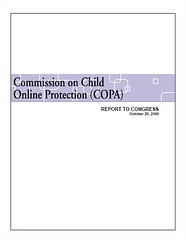
In a new PFF white paper, ” Five Online Safety Task Forces Agree: Education, Empowerment & Self-Regulation Are the Answer,” I walk through a chronological summary of each of these past task forces [click on covers of each report below to read them in their entirety] and highlight some of the similar themes and recommendations from them.

COPA Commission cover Thornburgh Commission cover Byron Commission report cover

ISTTF cover Point Smart Click Safe report cover Continue reading →