Posts tagged as:

Thirteen years ago I penned an essay entitled, “Your Soapbox is My Soapbox!” It was condensed from a 2005 book I had released at the same time called Media Myths. My research and writing during that period and for fifteen years prior to that was focused on the dangers associated with calls by radical Left-leaning media scholars and policy activists for a veritable regulatory revolution in the way information and communication technology (ICT) platforms were operated. They pushed this revolution using noble-sounding rhetoric like “fairness in coverage,” “right of reply,” “integrity of public debate,” “preserving the public square,” and so on. Their advocacy efforts were also accompanied by calls for a host of new regulatory controls including a “Bill of Media Rights” to grant the public a litany of new affirmative rights over media and communications providers and platforms.

But no matter how much the so-called “media access” movement sought to sugarcoat their prescriptions, in the end, what those Left-leaning scholars and advocates were calling for was sweeping state control of media and communications technologies and platforms. In essence, they wanted to socialize private soapboxes and turn them into handmaidens of the state.

Here’s the way I began my old “soapbox” essay:

Imagine you built a platform in your backyard for the purpose of informing or entertaining your friends of neighbors. Now further imagine that you are actually fairly good at what you do and manage to attract and retain a large audience. Then one day, a few hecklers come to hear you speak on your platform. They shout about how it’s unfair that you have attracted so many people to hear you speak on your soapbox and they demand access to your platform for a certain amount of time each day. They rationalize this by arguing that it is THEIR rights as listeners that are really important, not YOUR rights as a speaker or the owner of the soapbox. That sort of scenario could never happen in America, right? Sadly, it’s been the way media law has operated for several decades in this country. This twisted “media access” philosophy has been employed by federal lawmakers and numerous special interest groups to justify extensive and massively unjust regime of media regulation and speech redistributionism. And it’s still at work today.

That was 2005. What’s amazing today is that this same twisted attitude is still on display, but it is conservatives who are now the ring-leaders of the push to socialize soapboxes! Continue reading →

On March 19th, I had the chance to debate Franklin Foer at a Patrick Henry College event focused on the question, “Is Big Tech Big Brother?” It was billed as a debate over the role of technology in American society and whether government should be regulating media and technology platforms more generally.  [The full event video is here.] Foer is the author of the new book, World Without Mind: The Existential Threat of Big Tech, in which he advocates a fairly expansive regulatory regime for modern information technology platforms. He is open to building on regulatory ideas from the past, including broadcast-esque licensing regimes, “Fairness Doctrine”-like mandates for digital intermediaries, “fiduciary” responsibilities, beefed-up antitrust intervention, and other types of controls. In a review of the book for Reason, and then again during the debate at Patrick Henry University, I offered some reflections on what we can learn from history about how well ideas like those worked out in practice.

My closing statement of the debate, which lasted just a little over three minutes, offers a concise summation of what that history teaches us and why it would be so dangerous to repeat the mistakes of the past by wandering down that disastrous path again. That 3-minute clip is posted below. (The audience was polled before and after the event and asked the same question each time: “Do large tech companies wield too much power in our economy, media and personal lives and if so, should government(s) intervene?” Apparently at the beginning, the poll was roughly Yes – 70% and No – 30%, but after the debated ended it has reversed, with only 30% in favor of intervention and 70% against. Glad to turn around some minds on this one!)

via ytCropper

With Facebook CEO Mark Zuckerberg in town this week for a political flogging, you might think that this is darkest hour for the social networking giant. Facebook stands at a regulatory crossroads, to be sure. But allow me to offer a cynical take, and one based on history: Facebook is potentially poised to score its greatest victory ever as it begins the transition to regulated monopoly status, solidifying its market power, and limiting threats from new rivals.

By slowly capitulating to critics (both here and abroad) who are thirsty for massive regulation of the data-driven economy, Facebook is setting itself up as a servant of the state. In the name of satisfying some amorphous political “public interest” standard and fulfilling a variety of corporate responsibility objectives, Facebook will gradually allow itself to be converted into a sort of digital public utility or electronic essential facility.

That sounds like trouble for the firm until you realize that Facebook is one of the few companies who will be able to sacrifice a pound of flesh like that and remain alive. As layers of new regulatory obligations are applied, barriers to new innovations will become formidable obstacles to the very competitors that the public so desperately needs right now to offer us better alternatives. Gradually, Facebook will recognize this and go along with the regulatory schemes. And then eventually they will become the biggest defender of all of it.

Welcome to Facebook’s broadcast industry moment. The firm is essentially in the same position the broadcast sector was about a century ago when it started cozying up to federal lawmakers. Over time, broadcasters would warmly embrace an expansive licensing regime that would allow all parties—regulatory advocates, academics, lawmakers, bureaucrats, and even the broadcasters themselves—to play out the fairy tale that broadcasters would be good “public stewards” of the “public airwaves” to serve the “public interest.”

Alas, the actual listening and viewing public got royally shafted in this deal. Continue reading →

The FCC’s transaction reviews have received substantial scholarly criticism lately. The FCC has increasingly used its license transaction reviews as an opportunity to engage in ad hoc merger reviews that substitute for formal rulemaking. FCC transaction conditions since 2000 have ranged from requiring AOL-Time Warner to make future instant messaging services interoperable, to price controls for broadband for low-income families, to mandating merging parties to donate $1 million to public safety initiatives.

In the last few months alone,

  • Randy May and Seth Cooper of the Free State Foundation wrote a piece that the transaction reviews contravene rule of law norms.
  • T. Randolph Beard et al. at the Phoenix Center published a research paper about how the FCC’s informal bargaining during mergers has become much more active and politically motivated in recent years.
  • Derek Bambauer, law professor at the University of Arizona, published a law review article that criticized the use of informal agency actions to pressure companies to act in certain ways. These secretive pressures “cloak what is in reality state action in the guise of private choice.”

This week, in the Harvard Journal of Law and Public Policy, my colleague Christopher Koopman and I added to this recent scholarship on the FCC’s controversial transaction reviews. Continue reading →

Congress is considering reforming television laws and solicited comment from the public last month. On Friday, I submitted a letter encouraging the reform effort. I attached the paper Adam and I wrote last year about the current state of video regulations and the need for eliminating the complex rules for television providers.

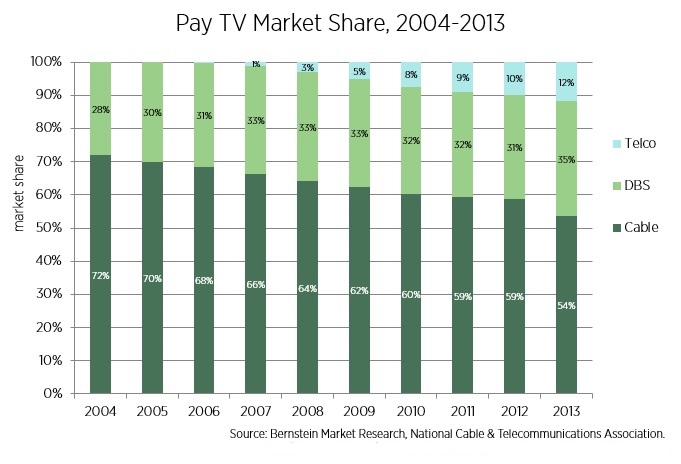
As I say in the letter, excerpted below, pay TV (cable, satellite, and telco-provided) is quite competitive, as this chart of pay TV market share illustrates. In addition to pay TV there is broadcast, Netflix, Sling, and other providers. Consumers have many choices and the old industrial policy for mass media encourages rent-seeking and prevents markets from evolving.

Pay TV Market Share

Continue reading →

If there is one thing I have learned in almost 23 years of covering communications and media regulation it is this: No matter how well-intentioned, regulation often has unintended consequences that hurt the very consumers the rules are meant to protect. Case in point: “universal service” mandates that require a company to serve an entire area as a condition of offering service at all. The intention is noble: Get service out to everyone in the community, preferably at a very cheap rate. Alas, the result of mandating that result is clear: You get less competition, less investment, less innovation, and less consumer choice. And often you don’t even get everyone served.

Consider this Wall Street Journal article today, “Google Fiber Is Fast, but Is It Fair? The Company Provides Neighborhoods With Faster and Cheaper Service, but Are Some Being Left Behind?” In the story, Alistair Barr notes that:

U.S. policy long favored extending service to all. AT&T touted its “universal service” in advertisements more than a century ago. The concept was codified in a 1934 law requiring nationwide “wire and radio services” to reach everyone at “reasonable charges.” In exchange for wiring a community, telecommunications providers often gained a monopoly. Cities made similar deals with cable-TV providers beginning in the 1960s.

The problem, of course, is that while this model allowed for the slow spread of service to most communities, it came at a very steep cost: Monopoly and plain vanilla service. I documented this in a 1994 essay entitled, “Unnatural Monopoly: Critical Moments in the Development of the Bell System Monopoly.” As well-intentioned regulatory mandates started piling up, competition slowly disappeared. And a devil’s deal was eventually cut between regulators and AT&T to adopt the company’s advertising motto — “One Policy, One System, Universal Service” — as the de facto law of the land. Continue reading →

There’s a small but influential number of tech reporters and scholars who seem to delight in making the US sound like a broadband and technology backwater. A new Mercatus working paper by Roslyn Layton, a PhD fellow at a research center at Aalborg University, and Michael Horney a researcher at the Free State Foundation, counter that narrative and highlight data from several studies that show the US is at or near the top in important broadband categories.

For example, per Pew and ITU data, the vast majority of Americans use the Internet and the US is second in the world in data consumption per capita, trailing only South Korea. Pew reveals that for those who are not online the leading reasons are lack of usability and the Internet’s perceived lack of benefits. High cost, notably, is not the primary reason for infrequent use.

I’ve noted before some of the methodological problems in studies claiming the US has unusually high broadband prices. In what I consider their biggest contribution to the literature, Layton and Horney highlight another broadband cost frequently omitted in international comparisons: the mandatory media license fees many nations impose on broadband and television subscribers.

These fees can add as much as $44 to the monthly cost of broadband. When these fees are included in comparisons, American prices are frequently an even better value. In two-thirds of European countries and half of Asian countries, households pay a media license fee on top of the subscription fees to use devices such as connected computers and TVs. …When calculating the real cost of international broadband prices, one needs to take into account media license fees, taxation, and subsidies. …[T]hese inputs can materially affect the cost of broadband, especially in countries where broadband is subject to value-added taxes as high as 27 percent, not to mention media license fees of hundreds of dollars per year.

US broadband providers, the authors point out, have priced broadband relatively efficiently for heterogenous uses–there are low-cost, low-bandwidth connections available as well as more expensive, higher-quality connections for intensive users.

Further, the US is well-positioned for future broadband use. Unlike many wealthy countries, Americans typically have access, at least, to broadband from telephone companies (like AT&T DSL or UVerse) as well as from a local cable provider. Competition between ISPs has meant steady investment in network upgrades, despite the 2008 global recession. The story is very different in much of Europe, where broadband investment, as a percentage of the global total, has fallen noticeably in recent years. US wireless broadband is also a bright spot: 97% of Americans can subscribe to 4G LTE while only 26% in the EU have access (which partially explains, by the way, why Europeans often pay less for mobile subscriptions–they’re using an inferior product).

There’s a lot to praise in the study and it’s necessary reading for anyone looking to understand how US broadband policy compares to other nations’. The fashionable arguments that the US is at risk of falling behind technologically were never convincing–the US is THE place to be if you’re a tech company or startup, for one–but Layton and Horney show the vulnerability of that narrative with data and rigor.

How is it that we humans have again and again figured out how to assimilate new technologies into our lives despite how much those technologies “unsettled” so many well-established personal, social, cultural, and legal norms?

In recent years, I’ve spent a fair amount of time thinking through that question in a variety of blog posts (“Are You An Internet Optimist or Pessimist? The Great Debate over Technology’s Impact on Society”), law review articles (“Technopanics, Threat Inflation, and the Danger of an Information Technology Precautionary Principle”), opeds (“Why Do We Always Sell the Next Generation Short?”), and books (See chapter 4 of my new book, “Permissionless Innovation: The Continuing Case for Comprehensive Technological Freedom”).

It’s fair to say that this issue — how individuals, institutions, and cultures adjust to technological change — has become a personal obsession of mine and it is increasingly the unifying theme of much of my ongoing research agenda. The economic ramifications of technological change are part of this inquiry, of course, but those economic concerns have already been the subject of countless books and essays both today and throughout history. I find that the social issues associated with technological change — including safety, security, and privacy considerations — typically get somewhat less attention, but are equally interesting. That’s why my recent work and my new book narrow the focus to those issues. Continue reading →

I’ve spent a lot of time here through the years trying to identify the factors that fuel moral panics and “technopanics.” (Here’s a compendium of the dozens of essays I’ve written here on this topic.) I brought all this thinking together in a big law review article (“Technopanics, Threat Inflation, and the Danger of an Information Technology Precautionary Principle”) and then also in my new booklet, “Permissionless Innovation: The Continuing Case for Comprehensive Technological Freedom.”

One factor I identify as contributing to panics is the fact that “bad news sells.” As I noted in the book, “Many media outlets and sensationalist authors sometimes use fear-based tactics to gain influence or sell books. Fear mongering and prophecies of doom are always effective media tactics; alarmism helps break through all the noise and get heard.”

In line with that, I want to highly recommend you check out this excellent new oped by John Stossel of Fox Business Network on “Good News vs. ‘Pessimism Porn‘.”  Stossel correctly notes that “the media win by selling pessimism porn.” He says:

Are you worried about the future? It’s hard not to be. If you watch the news, you mostly see violence, disasters, danger. Some in my business call it “fear porn” or “pessimism porn.” People like the stuff; it makes them feel alive and informed. Of course, it’s our job to tell you about problems. If a plane crashes — or disappears — that’s news. The fact that millions of planes arrive safely is a miracle, but it’s not news. So we soak in disasters — and warnings about the next one: bird flu, global warming, potential terrorism. I won Emmys hyping risks but stopped winning them when I wised up and started reporting on the overhyping of risks. My colleagues didn’t like that as much.

He continues on to note how, even though all the data clearly proves that humanity’s lot is improving, the press relentlessly push the “pessimism porn.” Continue reading →

Shortly after Tom Wheeler assumed the Chairmanship at the Federal Communications Commission (FCC), he summed up his regulatory philosophy as “competition, competition, competition.” Promoting competition has been the norm in communications policy since Congress adopted the Telecommunications Act of 1996 in order to “promote competition and reduce regulation.” The 1996 Act has largely succeeded in achieving competition in communications markets with one glaring exception: broadcast television. In stark contrast to the pro-competitive approach that is applied in other market segments, Congress and the FCC have consistently supported policies that artificially limit the ability of TV stations to compete or innovate in the communications marketplace. Continue reading →