Ongoing Series: Moral Panics / Techno-Panics
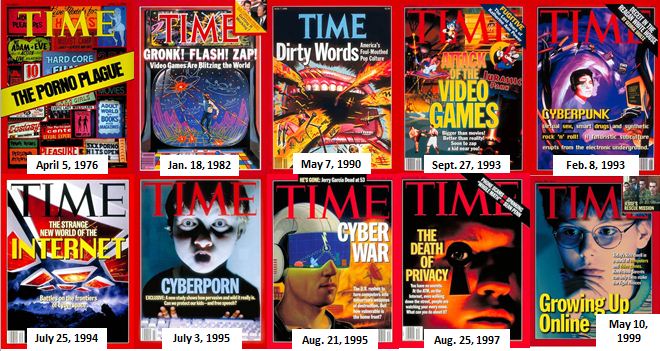
Several TLF posts have sought to address and/or debunk various “moral panics” or “techno-panics.” Christopher Ferguson, a professor at Texas A&M’s Department of Behavioral, Applied Sciences and Criminal Justice, offers the following definition: “A moral panic occurs when a segment of society believes that the behavior or moral choices of others within that society poses a significant risk to the society as a whole.” By extension, a “techno-panic” is simply a moral panic that centers around societal fears about a specific contemporary technology (or technological activity) instead of merely the content flowing over that technology or medium.
While protection of youth is typically a motivating factor, some techno-panics transcend the old “It’s For the Children” rationales for action. What all panics share in common, however, is a general desire by the public, media pundits, and policymakers to “do something” to rid ourselves of the apparent menace. Thus, an effort to control the particular content or technology in question is what really defines a true “panic.”
Many “panic” theories are driven by a psychological phenomenon known as “third-person-effect hypothesis.” First formulated by psychologist W. Phillips Davison in 1983, “this hypothesis predicts that people will tend to overestimate the influence that mass communications have on the attitudes and behavior of others. More specifically, individuals who are members of an audience that is exposed to a persuasive communication (whether or not this communication is intended to be persuasive) will expect the communication to have a greater effect on others than on themselves.” While originally formulated as an explanation for how people convinced themselves of “media bias” where there was none, the third-person-effect hypothesis has provided an explanation for other phenomenon and forms of regulation, especially media censorship. Indeed, one of the most intriguing aspects about censorship efforts historically is that it is apparent that many censorship advocates desire regulation to protect others, not themselves, from what they perceive to be persuasive or harmful content. That is, many people imagine themselves immune from ill effects of “indecent” material, or even just persuasive communications or viewpoints they do not agree with, but claim it will have a corrupting influence on others.
Here are some essays on these topics. (Adam Thierer was the author of the post unless otherwise noted):
Posts on Moral Panic / Techno-Panics:
- 6 Ways Conservatives Betray Their First Principles with Online Child Safety Regulations (9/20/22)
- Again, We Should Not Ban All Teens from Social Media (7/5/22)
- Black Mirror Episodes from Medieval Times (7/2/19)
- An Epic Moral Panic over Social Media (5/30/19)
- The Great Facial Recognition Technopanic of 2019 (5/17/19)
- The Radicalization of Modern Tech Criticism (4/19/19)
- On Isolation & Inattention Panics (11/26/18)
- Is It “Techno-Chauvinist” & “Anti-Humanist” to Believe in the Transformative Potential of Technology? (9/18/18)
- How to Sell a Book about Tech Policy: Turn the Technopanic Dial Up to 11 (1/2/18)
- What a 1911 Silent Movie Tells Us about the Technopanic Mentality (6/21/17)
- New ITIF Study on “Privacy Panics” (9/11/15)
- Regarding the Use of Apocalyptic Rhetoric in Policy Debates (10/29/14)
- Muddling Through: How We Learn to Cope with Technological Change (6/14/14)
- The Problem with “Pessimism Porn” (5/23/14)
- BOOK: “Permissionless Innovation: The Continuing Case for Comprehensive Technological Freedom”
- Robert Samuelson Engages in a Bit of Argumentum in Cyber-Terrorem (7/1/13)
- What Does It Mean to “Have a Conversation” about a New Technology? (5/23/13)
- ‘Technopanics’ Paper Published in Minn. Jour. of Law, Science & Tech (2/14/13)
- Journalists, Technopanics & the Risk Response Continuum (7/15/12)
- How & Why the Press Sometimes “Sells Digital Fear” (4/8/12)
- danah boyd’s “Culture of Fear” Talk (3/26/12)
- Cybersecurity Threat Inflation Watch: Blood-Sucking Weapons! (3/22/12)
- new paper: Technopanics, Threat Inflation & an Info-Tech Precautionary Principle (2/28/12)
- Why Do We Always Sell the Next Generation Short? (Forbes, 1/8/12)
- On Nostalgia (12/28/11)
- Information Revolutions & Cultural / Economic Tradeoffs (12/23/11)
- 10 Things Our Kids Will Never Worry About Thanks to the Information Revolution (Forbes, 12/18/11)
- [Humor] It’s For the Children: A Template for Hill Testimony on Child Safety Issues (10/5/11)
- Threat Inflation in Cybersecurity Policy – by Jerry Brito (4/26/11)
- The Precautionary Principle in Information Technology Debates (4/4/11)
- Lessons from the Gmail Privacy Scare of 2004 (3/25/11)
- Techno-Panic Cycles (and How the Latest Privacy Scare Fits In) (2/24/11)
- Against Techno-Panics (7/15/09)
- Collier on “Why Technopanics are Bad” (4/23/09)
- “Adventure Windows” Revisited: Why We Struggle with New Trends & Technologies (6/13/11)
- Excellent Slate Article on Techno-Panics & Fears of Info Overload (2/16/10)
- Sarkozy, Facebook, Moral Panics & the Third-Person Effect Hypothesis (5/29/11)
- Prophecies of Doom & the Politics of Fear in Cybersecurity Debates (8/8/11)
- Fear Sells: Cybersecurity Chicken Littlism edition (10/14/11)
- Facebook’s Photo Tagging Auto-Suggestion Feature: Another Silly Privacy Moral Panic – by Berin Szoka (6/8/11)
- Kids, Media, Commercialism & Moral Panic (6/7/10)
- The Next Great Technopanic: Wireless Geo-Location / Social Mapping (7/12/08)
- Technopanics and the Great Social Networking Scare (7/10/08)
- Sen. Klobuchar Stirs Up Facebook Child Safety Technopanic – by Berin Szoka (7/15/10)
- A Rarity: Newspaper Argues Against Techno-panic, Cites Constitution – by Jim Harper (11/17/09)
- Google Street View/Wi-Fi Privacy Technopanic Continues – by Berin Szoka (7/8/10)
- Digital Sensors, Darknets, Hyper-Transparency & the Future of Privacy (1/28/11)
- More on Monkey See-Monkey Do Theories about Media Violence & Real-World Crime (5/24/10)
- Video Games and “Moral Panic” (1/23/09)
Posts on Third-Person Effect Hypothesis:
- A Psychological Explanation for Censorship and Claims of “Media Bias (7/24/06)
- What Unites Advocates of Speech Controls & Privacy Regulation? – by Adam Thierer & Berin Szoka (8/11/09)
- PFF filing in FCC product placement / embedded advertising inquiry (11/18/08)
 The Technology Liberation Front is the tech policy blog dedicated to keeping politicians' hands off the 'net and everything else related to technology.