I need not remind anyone here about FCC Chairman Kevin Martin’s ongoing “war on cable.” Even if you hate the cable industry or capitalism in general, there’s just no way I can see how anyone who believes in the rule of law and good government can support Martin’s incessant abuse of power in his Moby Dick-like crusade against the cable industry. A crusade, incidentally, which happens to be motivated by Chairman Ahab’s desire to control speech on cable television, as I’ll note below.
Anyway, the latest chapter in this miserable saga of government-gone-mad is Martin’s recent effort to begin a far-ranging data gathering effort concerning cable prices and analog-to-digital channel movements under the guise of individual complaint enforcement. In a new paper entitled “Der Undue Prozess at the FCC: Part Deux,” my PFF colleague Barbara Esbin shows, once again, how the FCC’s regular processes and procedures are being perverted by Martin to achieve ends not within the agency’s delegated authority. And the results, in this case, will be profoundly anti-consumer.
Esbin documents the four flaws in the FCC’s investigation as follows:
Continue reading →
Wow, I am really blown away by CancelCable.com. Earlier today, I mentioned how I discovered it thanks to Mike Musgrove’s Washington Post story about how more and more people are canceling their cable and satellite subscriptions altogether and using alternative video platforms — Hulu, iTunes, Netflix, XBox, etc. — to watch their favorite shows. Anyway, if you go to CancelCable.com’s “Show Finder” site, you will find a complete inventory of all the major television programs you can find online right now. Go to the site to see the complete list, but down below I cut just the first 15 shows listed to give you a feel for how it works. And that list just continues to grow and grow in both directions — in terms of the number of shows and the number of platforms where you can get them.
OK, so why again do we need to mandate a la carte regulation for cable and satellite?
SAN JOSE, Nov. 7 – This morning I’ve posted two articles on BroadbandCensus.com about the Wireless Communications Association’s conference here.
SAN JOSE, November 7 – Emboldened by their summertime victory against Comcast, advocates of network neutrality said Thursday that the next front in battle for the principle would be against wireless carriers who make “unreasonable” network management decisions.
read more
SAN JOSE, November 6 – It was Kevin Martin’s day to suck up praise from Silicon Valley. The chairman of the Federal Communications Commission – for about two more months – came to the Wireless Communications Association’s annual conference here on Thursday to be feted by many Googlers, including company co-founder Larry Page.
read more
Today was a big day — and not just because there was an election going on! As I mentioned yesterday, the other big news was that the U.S. Supreme Court was hearing oral arguments in the potentially historic free speech case of Federal Communications Commission v. Fox Television Stations, Inc. Again, all the background you need can be found in my post yesterday, so here I will just be summarizing my general thoughts about how the oral arguments played out this morning.
Unfortunately, because no electronic devices or even notepads are allowed in the courtroom, much of what I am relaying here is from memory or from the notes that I surreptitiously scribbled on a tiny piece of scrap paper when the guards weren’t looking. (And yes, I have been reprimanded before for taking notes in the Court!) The transcript has just been released, however, so you can read it through and judge for yourself. Anyway, here are some general thoughts:
Continue reading →
 Tomorrow morning, the U.S. Supreme Court will hear oral arguments in the potentially historic free speech case of Federal Communications Commission v. Fox Television Stations, Inc. I plan on attending and will try to post some thoughts about how the arguments played out here later tomorrow afternoon or evening. [I won’t be able to live blog of Twitter it because no electronic devices are allowed in the courtroom, which I’ve always thought is outrageous.] In the meantime, here again is the background of the case.
The
FCC v. Fox case is the indecency case involving the FCC’s new policy for “fleeting expletives.” I wrote about the Second Circuit Court of Appeals decision here and the full 2nd Circuit decision is here. [By contrast, the so-called “Janet Jackson case” — CBS v. FCC — took place in the Third Circuit Court of Appeals and that court recently handed down a decision that also went against the FCC. I wrote about the Third Circuit’s decision here.]
In a 2-1 decision, the Second Circuit ruled that “the FCC’s new policy sanctioning “fleeting expletives” is arbitrary and capricious under the Administrative Procedure Act for failing to articulate a reasoned basis for its change in policy.” The decision demonstrates how, over just the past few years, the FCC has arbitrarily thrown out 30+ years worth of precedent and greatly expand the scope of its regulatory authority over speech on broadcast TV and radio. As a result, the FCC’s order was vacated and remanded to the agency. The agency appealed the decision, however, and the Supreme Court accepted it for review.
Continue reading →
In a City Journal article earlier this year, I wondered “how long some local papers have left when they are barred from restructuring their businesses or partnering with other local media operators to stem the bleeding and reinvent their business models.” I was responding to the Senate’s smack-down of a half-hearted reform effort that FCC chairman Kevin Martin pushed through in November 2007, which proposed relaxing the FCC’s newspaper/broadcast cross-ownership rule. That rule, unrevised since going into effect in 1975, prohibits a newspaper operator from also owning a radio or television station in the same media market. However, waivers were granted to grandfather in some combined newspaper and broadcast operations that had existed long before the ban took effect. Martin’s proposal was to simply tweak the rule to permit similar combinations in just the nation’s 20 largest media markets.
Martin’s limited liberalization proposal, however, led to howls of disapproval from FCC democrats like Michael Copps and many folks on both side of the aisle in Congress. Supposedly, this was nothing more than a “giveaway” to the newspaper industry, which critics said was doing just fine. It really makes you wonder if any of those critics even both reading the news about newspapers today.
As I have documented here on many occasions, as well as in my big Media Metrics report, the newspaper industry is in huge trouble with every financial variable of importance rapidly heading south. Alan Mutter does a good job here of summarizing “the secular forces dragging down newspapers: Declining readership, shrinking advertising, high fixed costs and growing online competition that makes it increasingly difficult to charge the premium ad rates that were possible prior to the Internet.” As a result of these forces, everyday brings another headline like this one today in the New York Times: “The Star-Ledger of Newark Plans 40% Cut,” or this one in the Wall Street Journal: “Some Newspapers Shed Unprofitable Readers.” The numbers are just miserable, and they just get worse and worse.
Continue reading →
Over at DrewClark.com, earlier today I reported today that television networks – which in recent years have had a strained relationship with local broadcasters on a variety of fronts – joined with the National Association of Broadcasters in calling for a time out on the politically simmering issue of “white spaces.” Here’s the start of the story, and you can read the full post at DrewClark.com
WASHINGTON, October 23 – The top executives of the four major broadcast networks on Thursday urged the head of the Federal Communications Commission to delay a vote on a politically simmering issue that pits broadcasters against Google and high-tech executives.
In the letter, the CEOs of CBS Corp., NBC Universal and Walt Disney, and the chief operating officer of News Corp., urge that the FCC exercise caution before taking irreparable action with regard to the vacant television channels known as “white spaces.”
Google and the other technology executives, including Microsoft, Motorola, Philips and others, want the FCC to authorize electronic devices that capable of transmitting internet signals over vacant television bands.
The network executives – CBS’s Leslie Moonves, Disney’s Robert Iger, NBC’s Jeffrey Zucker and Peter Chernin of News Corp. – want a time out.
They join their local broadcasting colleagues, as well as manufacturers and users of wireless microphones, like the National Football League and Boadway theater owners, who have been actively lobbying the issue.
[…]
Read the rest of the story at my blog, DrewClark.com – The Politics of Telecom, Media and Technology
I’ve been trying to catch up after a week-long cruise with my kids down in the Caribbean and as I was doing my best to sort through thousands of e-mails and articles in my RSS reader, I stopped and did a double-take when I saw some headlines from last week about how the Federal Communications Commission is spending $350,000 taxpayer dollars to sponsor a NASCAR team. For that money, NASCAR driver David Gilliland “has agreed to use his No. 38 car as a high-speed billboard promoting the February 2009 national transition to digital television,” according to Multichannel News.
In the annuls of idiotic government spending initiatives this one has to be a potential hall of fame entry. Over on the PFF Blog, my PFF colleague Barbara Esbin has a humorous piece explaining why:
what signal does FCC sponsorship of a stock car racer send to the beleaguered American public in this autumn of our discontent? The FCC Chairman claims that this sponsorship is an “extremely effective way for the FCC to raise DTV awareness among people of all ages and income levels across the United States who loyally follow one of the most popular sports in America.” Well, those loyal sports fans will have to be following No. 38 at the three sponsored races with some pretty high-speed binoculars to catch the DTV message. Although the $350,000 does get the government posting of its informational website URL, www.dtv.gov, along the track — doubtless not the only advertisement to lure spectator eyeballs — it is primarily receiving posting on the car’s sides and on the driver’s helmet and suit. Let’s just hope No. 38 has a large fan base, does exceeding well in the three races, and, more importantly, avoids accidents, injuries, and fleeting expletives.
Maybe this is just another federal government bailout. On the same day that the FCC announced its investment in NASCAR, the Raleigh News & Observer ran an article entitled, “Global crisis threatens NASCAR.” It seems that “motor sport” team sponsorship has been down this year, “with sinking auto showroom sales, declining attendance and rising operating costs.” And let’s not even talk about the carbon footprint of stock car racing.
Of course, what’s even more pathetic about this move is that FCC Chairman Kevin Martin’s likely motivation for doing this is probably political: He probably thinks this is a good way to win blue collar votes with all the NASCAR fans down in North Carolina for a future run for office. [It’s widely rumored that he will seek some office down in his home state after his tenure at the FCC is up.] After all, NASCAR is hugely popular in that state. I don’t know about you, but I’m none too happy subsidizing a get-out-the-NASCAR-vote effort for one of the most regulatory-minded FCC Chairmen in history.
When the definitive history of Kevin Martin’s regulatory reign of terror against the cable industry is finally written, I have a feeling that Ted Hearn of Multichannel News will be the man who pens it. There is no one who has been reporting on these issues longer or with more investigative vigor than Ted. In an absolutely scathing piece today about a former Martin staffer, Ted does a nice job summarizing the major elements of Martin’s war on cable. It reads like the list of grievances against King George found in the Declaration. (Think: “He has erected a multitude of New Offices, and sent hither swarms of Officers to harrass our people, and eat out their substance.”) Anyway, I just thought I’d throw Ted’s list up here for those keeping score at home:
— He secretly rewrote an FCC study issued in November 2004 that had concluded that cable a la carte was a bad idea.
— He walked away from a handshake agreement with NCTA, Comcast and Time Warner that the rollout of family programming packages would end his a la carte jihad.
— He stripped cable’s control over critical wiring in apartment buildings, affirming the identical policy that a court had previously struck down.
— He voided exclusive contracts between cable operators and apartment building owners just a few years after the FCC gave the green light to such deals.
— He required cable operators to carry must carry TV stations in analog and digital for three years after voting against such a policy in February 2005.
— He extended program access rules for five years, a gift to DirecTV and Dish Network even though the two satellite providers are larger than every cable company in the U.S. except Comcast and Time Warner.
— He imposed expensive set-top box equipment mandates on cable, making it vastly more costly for Comcast and Time Warner to reach the goal of all-digital platforms.
— He capped cable ownership at 30% of pay-TV subscribers nationally—the same limit that a federal court kicked back to the FCC as unlawful—while letting AT&T and Verizon basically divide the country’s phone market.
— He slashed cable leased access rates to zero in an act of bureaucratic malice that a federal appeals court has now blocked and that the Office of Management and Budget has rejected as a violation of the Paperwork Reduction Act.
— He decided to brand Comcast an Internet outlaw when all the company did was occasionally frustrate a tiny minority of customers whose massive consumption of Web porn and pirated Hollywood films was destroying the service for others.
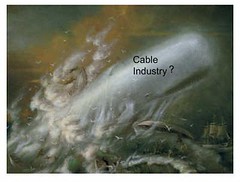 Well, another four months have passed since I last asked this question, but let me pose it again: Where exactly is the FCC’s Video Competition Report and why is it taking so long to get it out the door? It wouldn’t have anything to do with a certain Chairman Ahab still trying to get his cable whale, would it? No, of course not. I’m sure there’s a perfectly rational reason that this 13th Annual report is now something like 18 months past due altogether. Right.
And keep in mind that the data in the 13th report is for a period ending on June 30, 2006, so whenever the report finally comes out the data in it will be well over two years old! That won’t exactly reflect the true state of the video programming market considering the significant changes we have since that time, especially the continued explosive growth of online video, VOD, and DVRs.
The reason that I have been making a big deal out of this issue is because this gets to the question of just how “scientific” and “independent” of an agency the FCC really is. We are talking about facts here. Basic data. This is stuff the FCC should be routinely collecting and reporting on a timely basis — indeed that is what Congress
requires the agency to do in this specific case. And yet the agency can’t do it because its Chairman is on this Moby Dick-like crusade against the cable industry. By the time this 13th annual report finally sees the light of day, the 15th annual report might be due! Outrageous. (And you wonder why many of us here are so skeptical about empowering the FCC regulating the Internet via Net neutrality mandates! If an over-zealous Chairman can politicize this issue, just think what might happen once we give the agency the authority to regulate the Net.)
Anyway, down below you will find the paper that Barbara Esbin and I wrote about the issue four months ago. Perhaps we should place a little ticker somewhere here on the site that counts each day that passes as we wait for the Commission to produce this report. We can take bets on when the agency’s data holdout will end.
Continue reading →

 The Technology Liberation Front is the tech policy blog dedicated to keeping politicians' hands off the 'net and everything else related to technology.