Tim Wu has an absurd piece in today’s New York Times comparing America’s broadband marketplace to OPEC. This really is quite outrageous, beginning with the fact that OPEC is a GOVERNMENT-RUN cartel. Wu also had a comment in the Washington Post today saying that he didn’t think broadband metering was an outrage. Well, that’s nice. I’m happy that we have Tim’s permission to experiment with new business models for financing broadband networks going forward!
This is indicative of what we can expect in the future once Net neutrality laws get on the books: A world of incessant “Mother may I?” permission-based forms of preemptive Internet regulation. Tim and his radical band of regulatory advocates over at Free Press will incessantly petition the FCC to review each and every business model decision and encourage the unelected bureaucrats at the agency to manage the Internet to their heart’s content.
And what does Tim offer for an alternative vision of the way the world should work since he doesn’t believe private markets can handle the job? Well, it’s back to the Big Government drawing board for more tax-spend-and-subsidize solutions! “Amsterdam and some cities in Utah have deployed their own fiber to carry bandwidth as a public utility,” he says. Yeah, that’s the promised land. After all, it’s working out soooooo well at the municipal level. Please.
The Australian government has been running a trial of ISP-level filtering products to determine whether network-based filtering could be implemented by the government to censor certain forms of online content without a major degradation of overall network performance. The government’s report on the issue was released today: Closed-Environment Testing of ISP-Level Internet Content Filtering. It was produced by the Australian Communications & Media Authority (ACMA), which is the rough equivalent of the Federal Communications Commission here in the U.S., but with somewhat broader authority.
The Australian government has been investigating Internet filtering techniques for many years now and even gone so far to offered subsidized, government-approved PC-based filters through the Protecting Australian Families Online program. That experiment did not end well, however, as a 16-year old Australian youth cracked the filter within a half hour of its release. The Australian government next turned its attention to ISP-level filtering as a possible solution and began a test of 6 different network-based filters in Tasmania.
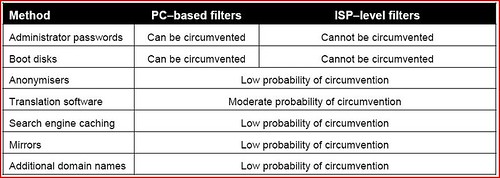
What makes ISP-level (network-based) filtering an attractive approach for many policymakers is that, at least in theory, it could solve the problem the Australian government faced with PC-based (client-side) filters: ISP-level filters are more difficult, if not impossible, to circumvent. That is, if you can somehow filter content and communications at the source–or within the network–then you have a much greater probability of stopping that content from getting through. Here’s a chart from the ACMA’s new report that illustrates what they see as the advantage of ISP-level filters:
 Continue reading →
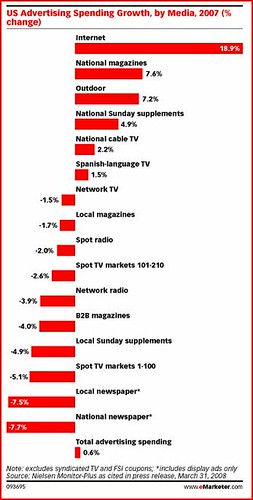 As we’ve discussed here before, newspapers are struggling. We all know that. The question is what, if anything, will save them? Most pundits tend to point to a two-fold solution: (1) get serious about leveraging the natural local advantages newspapers hold; (2) and find away to do so online as quickly as possible before they lose the bulk of the local online ad market to other competitors. This is why there’s a lot of talk these days about turning traditional papers into “hyper-local” web portals for their communities. Of course, there’s no guarantee that will work, especially in light of changing attitudes about “media localism.”
But let’s assume that that is indeed the best path forward. Will it really save newspapers? As eMarketer reports in today’s newsletter on “Can Local Web Ads Save Newspapers,” it’s a bit of a good news–bad news story:
The good news is that newspaper site ad revenues are growing along with other online ad spending, especially for local news sites. Local newspaper online ad revenues are predicted to reach $3.7 billion this year, according to eMarketer calculations based on Borrell Associates data.
The bad news is that this spending will not make up for print ad losses for some time, according to Lisa Phillips, senior analyst at eMarketer. Ms. Phillips noted that advertisers still pay more for print readers than for online readers. “This is a transition that will take several years,” she said. “Local advertisers are paying attention to the shift in reader behavior, but it will take a while for everyone to adjust.”
And so we will have to wait to see how it all plays out. But I am highly skeptical that traditional newspapers operators will be able to make up anywhere near the amount of revenue online that they are hemorrhaging over on the print side of the business. There’s just too much other competition out there online already for our eyes and ears. The age of “protectable scarcity” is dead and that means newspapers just don’t have the lock on local or regional markets they once did.
 In a new
PFF
essay, my colleague Barbara Esbin and I address a recent petition filed by the Rural Cellular Association (RCA) asking the FCC to prohibit exclusive arrangements between wireless handset producers and carriers. The RCA petition claims that large wireless companies have an unfair market advantage by giving their customers exclusive access to certain advanced smart phones, such as the Apple/AT&T iPhone—and that this anticompetitive practice is harmful to rural consumers served by RCA members.
In a new
PFF
essay, my colleague Barbara Esbin and I address a recent petition filed by the Rural Cellular Association (RCA) asking the FCC to prohibit exclusive arrangements between wireless handset producers and carriers. The RCA petition claims that large wireless companies have an unfair market advantage by giving their customers exclusive access to certain advanced smart phones, such as the Apple/AT&T iPhone—and that this anticompetitive practice is harmful to rural consumers served by RCA members.
In the piece, we debunk RCA’s arguments premised on a supposed lack of competition in wireless markets. RCA will likely now redouble these arguments by pointing to Verizon’s planned acquisition of Alltel (by far the smallest of the “Big 5” carriers), which was announced the day our piece was published. But even with four large carriers instead of five, the wireless market remains vibrantly competitive—especially as compared to 1992, when the FCC decided that even the two-carrier market was “extremely competitive,” and rejecting arguments that it ban exclusive handset arrangements. Continue reading →
I have just released a new PFF white paper on “The Perils of Mandatory Parental Controls and Restrictive Defaults.” It points out the dangers of government mandating that parental controls be defaulted to their most restrictive position. I’ve gone ahead and just pasted the entire text below (but without the footnotes):
During ongoing debates about parental controls, ratings, and online child safety, there have occasionally been rumblings about the possibility of requiring that media, computing and communications devices: (1) be shipped to market with parental controls embedded, and possibly, (2) those controls being defaulted to their most restrictive position, forcing users to opt out of the controls later if they wanted to consume media rated above a certain threshold.
Imagine, for example, a law requiring that every television, TV set-top box, and video game console be shipped with on-board screening technologies that were set to block any content rated above “G” for movies, “TV-Y” for television, or “E” for video games, which are the most restrictive rating designations for each type of media. Similarly, all personal computers or portable media devices sold to the public could be forced to have filters embedded that were set to block all “objectionable” content, however defined.
If “default” requirements such as this were mandated by law, parents would be forced to opt out of the restrictions by granting their children selective permission to media content or online services. In theory, this might help limit underage access to objectionable media or online content. Such a mandate might be viewed as less intrusive than direct government censorship and, therefore, less likely to run afoul of the constitution.
For these reasons, such a proposal would likely have great appeal among some policymakers, “family” groups, child safety advocates, and parents. But mandating parental controls and restrictive defaults is a dangerous and elitist idea that must be rejected because it will have many unintended consequences and not likely achieve the goal of better protecting our kids.
Continue reading →
[Note: You might want to first read my review of Jonathan Zittrain’s book to give this essay some context.]
Jonathan Zittrain must have been smiling as he read Leander Kahney’s excellent Wired cover story this month, “How Apple Got Everything Right By Doing Everything Wrong.” In a sense, the article vindicates Zittrain’s thesis in The Future of the Internet–And How to Stop It.
 Again, in his provocative book, Zittrain argues that, for a variety of reasons, the glorious days of the generative, open Internet and general-purpose PCs are supposedly giving way to closed networks and a world of what he contemptuously calls “sterile, tethered devices.” And Apple products such as the iPhone, the iPod, and iTunes serve as prime examples of the troubling world that await us. And Kahney’s article confirms that Apple is every bit as closed and insular as Zittrain suggests. Kahney nicely contrasts Apple with Google, a company that “embraces openness,” trusts “the wisdom of crowds,” and has its famous “Don’t be evil” philosophy:
It’s ironic, then, that one of the Valley’s most successful companies ignored all of these tenets. Google and Apple may have a friendly relationship — Google CEO Eric Schmidt sits on Apple’s board, after all — but by Google’s definition, Apple is irredeemably evil, behaving more like an old-fashioned industrial titan than a different-thinking business of the future. Apple operates with a level of secrecy that makes Thomas Pynchon look like Paris Hilton. It locks consumers into a proprietary ecosystem. And as for treating employees like gods? Yeah, Apple doesn’t do that either.
Continue reading →
Back in 2005, I threw away a book I was writing. Well, I didn’t exactly toss it in a garbage can or take a match to the manuscript; I just abandoned the project to work on other things, including a different book and a big law review article. I’m still mad at myself for never finishing it up because I think it put forward a provocative thesis: Censorship is dead. Specifically, as I argued in the first lines of the book, “A confluence of social, legal and, most importantly, technological developments is slowly undermining the ability of legislators and regulators, at all levels of government, to control the nature or quality of speech or media programming.” Accordingly, the running title for the book was: “The End of Censorship?: The Future of Content Controls in a World of Media Convergence.”
Anyway, I recently unearthed an old draft of this discarded manuscript and thought I might as well at least throw the introduction online. In it, I outline my thesis and the “5 Reasons Content Controls Will Break Down.” I also highlight how governments will fight back and discuss what alternatives are out there to address concerns about objectionable content. Someone out there might be interested in all this even though much of what I say here is now widely accepted or been said better by others. I’ve stripped out all the footnotes and cut out significant sections to make what follows more readable. So, here it goes…
“The End of Censorship? The Future of Content Controls in a World of Media Convergence.”
Content regulation–at least as it has been traditionally defined and enforced in the United States–is doomed. A confluence of social, legal and, most importantly, technological developments is slowly undermining the ability of legislators and regulators, at all levels of government, to control the nature or quality of speech or media programming. Specifically, it is the
distribution channel-based system of content regulation employed in the U.S. and many other nations that is breaking down. That is, the ability of governments to regulate speech and expression by regulating its distribution channel or provider (such as broadcasting), represents in increasingly ineffective and illogical method of policing content flows.
The demise of traditional content controls may take many years–potentially even decades–to play out, but signs of the impending death of the old regulatory regime are already evident.
Continue reading →
In a previous essay, I critiqued Andrew Keen’s thesis that our culture was better off in the age of scarcity than it is in today’s world of media and cultural abundance. In this essay, I want to make a few comments about his latest anti-Web 2.0 rant regarding how, in addition to destroying art and culture, the age of abundance and “amateur” content creation is going to result in the death of advertising.
In an AdWeek guest editorial this week, Keen argues that:
Web 2.0 is, in truth, the very worst piece of news for the advertising industry since the birth of mass media. In the short term, the Web 2.0 hysteria marks the end of the golden age of advertising; in the long term, it might even mark the end of advertising itself.
[…]
[F]or the advertiser, media content is indeed losing its value, a value historically derived from its scarcity. This devaluation of media isn’t hard to quantify: It can be measured everywhere, in falling CPM and the failure of social networks to develop viable business models. No new technology—neither the false dawn of mobile, nor the holy grail of personalized, targeted advertising—is going to save the advertising business now. No, the truth is that advertising can only be saved if we can re-create media scarcity. That means less user-generated content and more professionally created information and entertainment, less technology and more creativity. The advertising community desperately needs more gatekeepers, more professional creative authorities, more so-called media “elites” who will curate, filter and organize content. That’s the way to re-establish the value of the message. It’s the one commercial antidote to Web 2.0’s radically destructive cultural democracy.
Oh my, where to begin…
Continue reading →
A few weeks ago, I outlined the amazing keynote address that Harvard University law professor Laurence H. Tribe delivered at PFF’s annual Aspen Summit. Now you can read it for yourself. PFF has just published the transcript of his speech, which was entitled, “Freedom of Speech and Press in the 21st Century: New Technology Meets Old Constitutionalism.”
Professor Tribe provides a 14-part indictment of new government proposals to regulate “excessively violent” content. But he also speaks more broadly about the importance of defending the First Amendment from attacks on many different platforms, and for many different types of content. Here’s one of my favorite passages from the concluding section of his remarks:
The broad lesson of this discussion of television violence is the centrality of the First Amendment’s opposition to having government as big brother regulate who may provide what information content to whom, whether or not for a price. The large problem that this exposes is that especially in a post-9/11 world, where grownups understandably fear for themselves and for their children and worry about the brave new world of online cyber reality that their kids can navigate more fluently than they can, it is enormously tempting to forget or to subordinate the vital principles of constitutional liberty. Even if, after years of litigation and expenditure, the First Amendment prevails, it can be worn down dramatically by having to wage that fight over and over and over.
Amen to that. And that, in a nutshell, describes what much of my research agenda at PFF has been focused on. It is a pleasure to add Prof. Tribe’s address to our growing body of research on the sanctity of freedom of speech and centrality of the First Amendment to our democratic republic as we continue “to wage that fight over and over and over.”
The Parents Television Council has a new report out this week about the supposed decline of the TV “Family Hour.” The City Journal has just posted my response to that PTC report here. It begins as follows…
Who Killed TV’s “Family Hour”?
It’s not who you think.
by Adam D. Thierer
7 September 2007
The nonprofit Parents Television Council (PTC) released a report this week lamenting the supposed death of broadcast television’s “family hour.” Though neither the Federal Communications Commission nor Congress ever mandated it, 8 to 9 PM Monday through Saturday (Eastern time), and 7 to 9 PM on Sunday, have traditionally been devoted to family-friendly programming. But the PTC’s new report claims that these blocks of time are now “no place for children,” because “corporate interests have hijacked the family hour” and “have pushed more and more adult-oriented programming to the early hours of the evening.”
One might respond to this claim by questioning the PTC’s methodology, particularly its definitions of foul language. Simon Vozick-Levinson of Entertainment Weekly’s “PopWatch Blog” takes this approach, accusing the PTC of “cooking the numbers” to suit its cultural agenda. But I don’t want to engage in methodological nit-picking, since it quickly devolves into a subjective squabble about acceptable language and appropriate programming. Instead, I want to point out the fundamental flaw in the report’s premise. The family hour may well be dead—but parents, not broadcasters, were the ones who killed it.
… read the rest at the City Journal’s website.

 The Technology Liberation Front is the tech policy blog dedicated to keeping politicians' hands off the 'net and everything else related to technology.