Posts tagged as:

ISTTF coverThe Internet Safety Technical Task Force (ISTTF), which was formed a year ago to study online safety concerns and technologies, today issued its final report to the U.S. Attorneys General who authorized its creation. It was a great honor for me to serve as a member of the ISTTF and I believe this Task Force and its report represent a major step forward in the discussion about online child safety in this country.

The ISTTF was very ably chaired by John Palfrey, co-director of Harvard University’s Berkman Center for Internet & Society, and I just want to express my profound thanks here to John and his team at Harvard for doing a great job herding cats and overseeing a very challenging process. I encourage everyone to examine the full ISTTF report and all the submissions, presentations, and academic literature that we collected. [It’s all here.] It was a comprehensive undertaking that left no stone unturned.

Importantly, the ISTTF convened (1) a Research Advisory Board (RAB),which brought together some of the best and brightest academic researchers in the field of child safety and child development and (2) a Technical Advisory Board (TAB), which included some of America’s leading technologists, who reviewed child safety technologies submitted to the ISTTF. I strongly recommend you closely examine the RAB literature review and TAB assessment of technologies because those reports provide very detailed assessments of the issues. They both represent amazing achievements in their respective arenas.

There are a couple of key takeaways from the ISTTF’s research and final 278-page report that I want to highlight here. Most importantly, like past blue-ribbon commissions that have studied this issue, the ISTTF has generally concluded there is no silver-bullet technical solution to online child safety concerns. The better way forward is a “layered approach” to online child protection. Here’s how we put it on page 6 of the final report:

The Task Force remains optimistic about the development of technologies to enhance protections for minors online and to support institutions and individuals involved in protecting minors, but cautions against overreliance on technology in isolation or on a single technological approach. Technology can play a helpful role, but there is no one technological solution or specific combination of technological solutions to the problem of online safety for minors. Instead, a combination of technologies, in concert with parental oversight, education, social services, law enforcement, and sound policies by social network sites and service providers may assist in addressing specific problems that minors face online. All stakeholders must continue to work in a cooperative and collaborative manner, sharing information and ideas to achieve the common goal of making the Internet as safe as possible for minors.


Continue reading →

I’ve been working closely with PFF’s new Adjunct Fellow Michael Palage on ICANN issues.  Here is his latest note , from the PFF blog.

ICANN recently proclaimed that the “Joint Project Agreement” (one of two contractual arrangements that ICANN has with the U.S. Department of Commerce (DoC) governing ICANN’s operations) will come to an end in September 2009. ICANN’s insistence on this point first became clear back in October 2008 at ICANN’s Washington, D.C. public forum on Improving Institutional Confidence when Peter Dengate Thrush, Chair of ICANN’s Board declared:

the Joint Project Agreement will conclude in September 2009. This is a legal fact, the date of expiry of the agreement. It’s not that anyone’s declared it or cancelled it; it was set up to expire in September 2009.

ICANN’s recently published 2008 Annual Report stuck to this theme:

“As we approach the conclusion of the Joint Project Agreement between the United States Department of Commerce and ICANN in September 2009…” – His Excellency Dr. Tarek Kamel, Minister of Communications and Information Technology, Arab Republic of Egypt
“Concluding the JPA in September 2009 is the next logical step in transition of the DNS to private sector management.” – ICANN Staff
“This consultation’s aim was for the community to discuss possible changes to ICANN in the lead-up to the completion of the JPA in September 2009.” – ICANN Staff

ICANN’s effort to make the termination of the JPA seem inevitable is concerning on two fronts. First, ICANN fails to mention that the current JPA appears to be merely an extension/revision of the original 1998 Memorandum of Understand (MoU) with DoC, which was set to expire in September 2000. Thus, because the JPA does not appear to be a free-standing agreement, but merely a continuation of MOU-as Bret Fausset argues in his excellent analysis of the relationship between the MoU and the JPA (also discussed by Milton Mueller). Therefore, it would be more correct to talk about whether the “MoU/JPA”-meaning the entire agreement as modified by the most current JPA-will expire or be extended. Continue reading →

NozickI haven’t been blogging much lately because, along with my PFF colleagues Berin Szoka and Adam Marcus, I’m working on a lengthy paper about the importance of Section 230 to Internet freedom. Section 230 is the sometimes-forgotten portion of the Communications Decency Act of 1996 that shielded Internet Service Providers (ISP) from liability for information posted or published on their systems by users or other third parties. It was enshrined into law with the passage of the historic Telecommunications Act of 1996. Importantly, even though the provisions of the CDA seeking to regulate “indecent” speech on the Internet were struck down as unconstitutional, Sec. 230 was left untouched.

Section 230 of the CDA may be the most important and lasting legacy of the Telecom Act and it is indisputable that it has been remarkably important to the development of the Internet and online free speech and expression in particular. In many ways, Section 230 is the cornerstone of “Internet freedom” in its truest and best sense of the term.

In recent years, however, Sec. 230 has come under fire from some academics, judges, and other lawmakers. Critics raise a variety of complaints — all of which we will be cataloging and addressing in our forthcoming PFF paper. But what unifies most of the criticisms of Sec. 230 is the belief that Internet “middlemen” (which increasingly includes almost any online intermediary, from ISPs, to social networking sites, to search engines, to blogs) should do more to police their networks for potentially “objectionable” or “offensive” content. That could include many things, of course: cyberbullying, online defamation, harassment, privacy concerns, pornography, etc. If the online intermediaries failed to engage in that increased policing role, they would open themselves up to lawsuits and increased liability for the actions of their users.

The common response to such criticisms — and it remains a very good one — is that the alternative approach of strict secondary liability on ISPs and other online intermediaries would have a profound “chilling effect” on online free speech and expression. Indeed, we should not lose sight of what Section 230 has already done to create vibrant, diverse online communities. Brian Holland, a visiting professor at Penn State University’s Dickinson School of Law, has written a brilliant paper that does a wonderful job of doing just that. It’s entitled “In Defense of Online Intermediary Immunity: Facilitating Communities of Modified Exceptionalism” and it can be found on SSRN here. I cannot recommend it highly enough. It is a masterpiece. Continue reading →

SunsteinPresident-elect Barack Obama will soon be naming Cass Sunstein, an old friend of his from their University of Chicago Law School days together, the new head the White House Office of Information and Regulatory Affairs (OIRA). OIRA oversees regulation throughout the U.S. government. Basically, Sunstein’s position is the equivalent of the federal regulatory czar.

Sunstein certainly possess excellent qualifications for the job. During his time at the University of Chicago and Harvard Law School, Sunstein has established himself as a leading liberal thinker in the field of law and economics. And, as I have joked in writing about him before, he is so insanely prolific that it seems every time I finish reading one of his new books a new title by him lands on my desk. I am quite convinced that both he and Richard Posner are actually cyborgs. I just don’t understand how two humans can compose words so rapidly!

Anyway, Professor Sunstein’s new position as head of OIRA gives him the ability influence federal regulatory decisions in both a procedural and substantive way. In terms of substance, it gives him an important platform to subtly “nudge” the regulatory philosophy and direction of the Obama Administration on many matters, including Internet policy. So, what has Professor Sunstein had to say about Internet policy in his recent work? Sunstein has developed his thinking about these issues primarily in his two recent books: Republic.com (2000) and Infotopia: How Many Minds Produce Knowledge (2006). But he’s also had a few relevant things to say about Internet issues in his recent book with Richard Thaler, Nudge: Improving Decisions About Health, Wealth, and Happiness (2008).

There are 3 Internet policy-related things from his work that I’d like to focus on here because I find them all quite troubling. Continue reading →

Microsoft’s share of the browser market across all versions of Internet Explorer has dropped, by one estimate, dropped from 78.58%  in December 2007 to 68.15% in December 2008 (or by just under 8% in another estimate).

[IE’s] share dropped from 69.77% in November to 68.15% in December. [During the same period,] Firefox gained more than half a point and ended up at 21.34%, Safari approaches the [10%] hurdle with 7.93% and Chrome came in at 1.04%, the first time Google was able to cross the 1% mark.

This is particularly interesting: 

Since IE6 is used primarily within corporations, its market share is much higher during the week than it is on weekends. As a result, all other browsers gain on weekends and especially during a holiday. Because of that circumstance, Net Applications noted that the December numbers should be taken with a grain of salt. However, it is worth the note that IE6 achieved … market share numbers of about 28% during the week and about 21% on weekends in early 2008. In December, these numbers were down to about 20% during the week and 15% on weekends.    

So, Microsoft still has an established base among corporate users, where IT administrators  generally prevent employees from installing new applications (including browsers) and the sysadmins often don’t roll out alternative browsers across a corporate network for any one of several possible reasons, including:

  • They just don’t want to bother having to install, regularly upgrade and support another piece of software;
  • They may overestimate the security vulnerability of such alternative browsers compared to Internet Explorer;
  • The crustier sysadmins may not realize that today’s browsers are not only free for individual users, but also for corporate users–unlike the old Netscape Navigator; and
  • Corporate intranets may be designed for IE, in which case rolling out an alternative browser might cause confusion among less tech-savvy employees.

Microsoft may still have an advantage that could be considered “unfair,” but so what?   Continue reading →

The intrepid Chris Soghoian has turned up an important wrinkle in Google’s services. Google pulled his AdWords ad pointing out AT&T’s campaign contributions to an Indiana politician after AT&T lodged a trademark complaint about it.

Trademark law is for preventing confusion about the source of goods and services. There is no possibility that Chris’ ad would confuse consumers in this way. He’s not providing telecommunications services, and his ad didn’t suggest it. Chris’ use of “AT&T” did not violate AT&T’s trademarks.

The subject matter of Chris’ ad is an important part of our national discourse, and something people should be able to run ads about on a platform like Google. It would be, well, evil, to kick small public policy advocates to the curb in favor of big corporations.

A company like Google is in a tough spot, of course, trying to adjudicate trademark claims at scale. But it is not acceptable to treat trademark complaints as proven just for having been submitted.

Google should take some steps to make its process more fair, such as by allowing advertisers to respond to a trademark complaint before Google acts on it. Much of the process could be automated, and it could explain to both sides what trademark rights include – and what they don’t. If after a few automated steps, the two remained at loggerheads, Google employees could take a look to see whether the claim or the response were meritorious. (A trained monkey could have determined that Chris’ ad is not a trademark violation.)

In close cases, Google should leave it to the parties to resolve, while it works in the courts to generate a substantive body of law that service providers in the position of Google are not properly liable for the trademark infringements of users. (My brief pitch for common law findings of “no liability” in such situations – as opposed to statutory protections like CDA section 230 – starts at minute 22 of this video.)

Would these ideas increase Google’s cost and potential liability? Yes, some. But Google should embrace those costs as it educates its users, employees, courts, and – most important – trademark holders about what trademark does and does not do.

Kudos to Chris for his tenacity. Google, fix this.

This is just a listing of the installments of my ongoing “Media Deconsolidation Series.” I needed to create a single repository of all the essays so I could point back to them in future articles and papers. For those not familiar with it, this series represents an effort to set the record straight regarding the many myths surrounding the media marketplace. These myths are usually propagated by a group of radical anti-media regulatory activists who I call the “media reformistas.” Sadly, however, many policymakers, journalists, and members of the public are buying into some of these myths, too.

In particular, I have spent much time here debunking the notion that rampant consolidation is taking place and that media operators are only growing larger and devouring more and more companies. In fact, nothing could be further from the truth. Over the past several years, traditional media operators and sectors have been coming apart at the seams in the face of unprecedented innovation and competition. The volume of divestiture activity has been quite intense, and most traditional media operators have been getting smaller, not bigger. As a result, America’s media marketplace is growing more fragmented and atomistic with each passing day.

Anyway, here’s the series so far…

Continue reading →

censored-pornChairman Mao–er… Martin–has canceled (WSJ) the FCC’s December 18 meeting, when the Commission was set to vote on Martin’s proposal to rig an auction to give away a valuable piece of spectrum (“AWS-3”) to M2Z networks.  In exchange for a sweetheart deal on the spectrum, the company would have been required to use a quarter of it to provide a free (but very slow) wireless broadband service.  Martin had initially proposed to require that the service be made porn-free, but eventually suggested that users over 18 would be able to opt-out of network-level filtering.

Two weeks ago, when it became clear that Martin would attempt to ram this proposal through while he still could, I asked how the ascendant Left would respond:

Will the defenders of free expression triumph over those who see ensuring free broadband as a social justice issue?  Or will those on the Left who usually joining us in opposing censorship simply remain silent as the government extends the architecture of censoring the “public airways” onto the Net (where the underlying rationale of traditional broadcast regulation–that parents are powerless–does not apply)?

I’m glad to see that the deathblow to this unconstitutional proposal did indeed come from the political Left–specifically, from Sen. John Rockefeller, (D-W.Va.) and Rep. Henry Waxman, (D-Calif.), who will be responsible for overseeing the FCC in the new Congress.  (The Bush administration had already opposed the proposal, as with so many of Martin’s abuses, had failed to stop it.)

With President-elect Obama having declared that, “Here in the country that invented the Internet, every child should have the chance to get online,” it seems almost certain that the Administration will press ahead with some kind of universal broadband proposal of its own.  But what would such a proposal look like?  If it’s another public broadband utility, would it include network-level filtration like Martin’s proposal?  If so, will the Democratic opponents of government censorship stick by their principles and fight that, too?

I suspect we may find that what’s constitutional is politically impossible (unfiltered free Internet) and what’s politically possible (filtered free Internet) is unconstitutional. Continue reading →

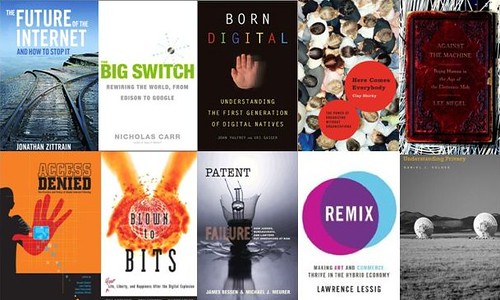
It’s been a big year for tech policy books. Several important titles were released in 2008 that offer interesting perspectives about the future of the Internet and the impact digital technologies are having on our lives, culture, and economy. Back in September, I compared some of the most popular technology policy books of the past five years and tried to group them into two camps: “Internet optimists” vs. “Internet pessimists.” That post generated a great deal of discussion and I plan on expanding it into a longer article soon. In this post, however, I will merely list what I regard as the most important technology policy books of the past year. Best Tech Books of 2008 (covers)

What qualifies as an “important” tech policy book? Basically, it’s a title that many people in this field are currently discussing and that we will likely be talking about for many years to come. I want to make it clear, however, that merely because a book appears on this list it does not necessarily mean I agree with everything said in it. In fact, I found much with which to disagree in my picks for the two most important books of 2008, as well as many of the other books on the list. [Moreover, after reading all these books, I am more convinced than ever that libertarians are badly losing the intellectual battle of ideas over Internet issues and digital technology policy. There’s just very few people defending a “Hands-Off-the-Net” approach anymore. But that’s a subject for another day!]

Another caveat: Narrowly focused titles lose a few points on my list. For example, as was the case in past years, a number of important IP-related books have come out this year. If a book deals exclusively with copyright or patent issues, it does not exactly qualify as the same sort of “tech policy book” as other titles found on this list since it is a narrow exploration of just one set of issues that have a bearing on digital technology policy. The same could be said of a book that deals exclusively with privacy policy, like Solove’s Understanding Privacy. It’s an important book with implications for the future of tech policy, but I demoted it a bit because of its narrow focus.

With those caveats in mind, here are my Top 10 Most Important Tech Policy Books of 2008 (and please let me know about your picks for book of the year):

Continue reading →

Today, President Bush signed S. 602, “The Child Safe Viewing Act.”(CNet story here). The measure requires the Federal Communications Commission (FCC) to conduct an inquiry to examine the availability of, and methods of encouraging the use of, advanced blocking technologies that help parents protect their children from transmitted video and audio programming that the parents determine to be indecent or objectionable. The FCC has 270 days to complete the report.

I wrote about the measure more extensively when it passed the Senate back in October. As I noted in then, the measure was modified slightly when it passed through the Commerce Committee last year, but it still contains some provision that could be problematic. Specifically, as part of the FCC’s required study, the bill commands the FCC to “consider advanced blocking technologies” that:

  • may be appropriate across a wide variety of distribution platforms, including wired, wireless, and Internet platforms;
  • operate independently of ratings pre-assigned by the creator of such video or audio programming.

Those two provisions are cause for concern since they raise the specter of what I referred to as “convergence-era content regulation” in a PFF paper about the bill last year. It does so in two ways. First, it opens the door to FCC bureaucrats investigating media content controls for wireless and Internet platforms, something it has never been empowered to do before. Second, by specifying that these new advanced content blocking technologies should “operate independently of ratings pre-assigned by the creator,” the law seems to imply that existing voluntary rating and labeling systems cannot be trusted. That is a dangerous presumption that suggests the FCC might be able to come up with better media ratings on its own.

Continue reading →