2009 was not as big of a year for Internet and information technology (“info-tech”) policy books as 2008 was, but there were still some notable titles released that offered interesting perspectives about the future of the Net and the impact the Digital Revolution is having on our lives, culture, and economy. So, like last year, I figured I would throw together my list of the 10 most important info-tech policy books of the year.
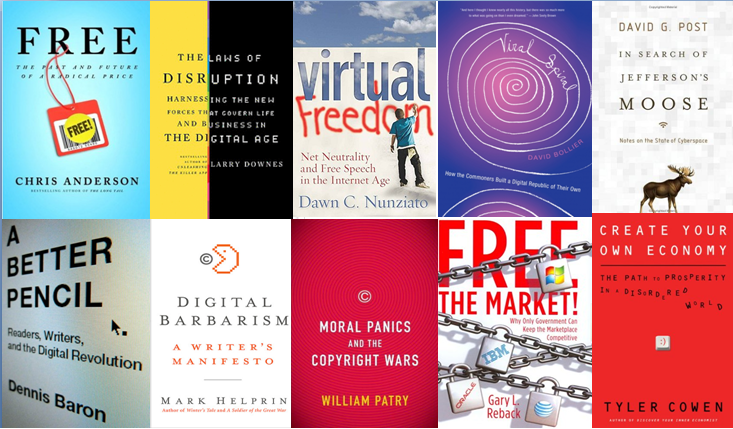 First, let me repeat a few of the same caveats and disclaimers that I set forth last year. What qualifies as an “important” info-tech policy book? Simply put, it’s a title that many people are currently discussing and that we will likely be referencing for many years to come. However, I want to be clear that merely because a book appears on my list it does not necessarily mean I agree with everything said in it. In fact, as was the case in previous years, I found much with which to disagree in my picks for the most important books of 2009 and I find that the cyber-libertarianism I subscribe to has very few fans out there.
Another caveat: Narrowly-focused titles lose a few points on my list. For example, if a book deals mostly with privacy issues, copyright law, or antitrust policy, it does not exactly qualify as the same sort of “tech policy book” as other titles found on this list since it is a narrow exploration of just one set of issues with a bearing on technology policy.
With those caveats in mind, here are my choices for the Most Important Info-Tech Policy Books of 2009. Continue reading →
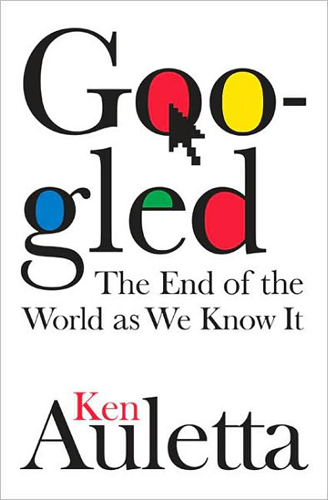 I just finished Ken Auletta’s latest book,
Googled: The End of the World As We Know It, and I highly recommend it. Auletta is an amazingly gifted journalist and knows how put together a hell of good story. It helps in this case that he was granted unprecedented access to the Google team and their day-to-day workings at the Googleplex. I’m really shocked by the level of access he was granted to important meetings and officials–over 150 interviews with Googlers, including 11 with CEO Eric Schmidt and several with founders Sergey Brin and Larry Page. That’s impressive.
I just finished Ken Auletta’s latest book,
Googled: The End of the World As We Know It, and I highly recommend it. Auletta is an amazingly gifted journalist and knows how put together a hell of good story. It helps in this case that he was granted unprecedented access to the Google team and their day-to-day workings at the Googleplex. I’m really shocked by the level of access he was granted to important meetings and officials–over 150 interviews with Googlers, including 11 with CEO Eric Schmidt and several with founders Sergey Brin and Larry Page. That’s impressive.
The book shares much in common with Randall Stross’s excellent Planet Google: One Company’s Audacious Plan to Organize Everything We Know, which I reviewed here earlier this year. Both books recount the history of Google from its early origins to present. And both survey a great deal of ground in terms of the challenges that Google faces as it matures and the policy issues that are relevant to the company (privacy, free speech, copyright law, etc).
What makes Auletta’s book unique is the way we taps his extensive “old media” world contacts and integrates such a diverse cast of characters into the narrative — Mel Karmazin (former Viacom, now Sirius XM), Bob Iger (Disney), Howard Stringer (Sony), Martin Sorrrell (WPP), Irwin Gotlieb (Group M), and even the Internet’s “inventor”–Al Gore! Auletta interviews them or recounts stories about their interactions with Google to show the growing tensions being created by this disruptive company and its highly disruptive technologies. There are some terrifically entertaining anecdotes in the book, but the bottom line is clear: Google has made a lot of enemies in a very short time.
Indeed, the book is as much about the decline of old media as it is about Google’s ascendancy. What Auletta has done so brilliantly here is to tell their stories together and ask how much old media’s recent woes can be blamed on Google and digital disintermediation in general. “If Google is destroying or weakening old business models,” Auletta argues, “it is because the Internet inevitably destroys old ways of doing things, spurs ‘creative destruction.’ This does not mean that Google is not ambitious to grow, and will not grow at the expense of others. But the rewards, and the pain, are unavoidable,” he concludes. Continue reading →
One of the more troubling aspects of the contentious debate over Net neutrality regulation is the way some proponents have sought to cast Net neutrality as “the Internet’s First Amendment.” As a die-hard free speech advocate, I find this truly outrageous and a complete contortion of the true purpose of the First Amendment. As I have argued here before, it is incredibly dangerous thinking that puts our real First Amendment liberties at stake by empowering a regulatory agency with more means of controlling online speech and expression. Simply stated, the Internet’s First Amendment is the First Amendment, not some new, top-down, heavy-handed regulatory regime that puts the Federal Communications Commission in control of the Digital Economy.
On this point, I wanted to bring two things to your attention. The first is an outstanding address delivered today by Kyle McSlarrow, President & CEO of the National Cable & Telecommunications Association, at a Media Institute event here in Washington, DC. And the second is this new paper by my PFF colleague Barbara Esbin.
McSlarrow’s speech was entitled, “Net Neutrality: First Amendment Rhetoric in Search of the Constitution” and it squarely addressed the fundamental fallacy set forth by the Net neutralitistas when it comes to the First Amendment. “Whatever our present-day policy disagreements about net neutrality, or even differing politics, let’s not forget that the First Amendment is framed as a shield for citizens, not a sword for government,” he argued. “By its plain terms and history, the First Amendment is a limitation on government power, not an empowerment of government,” McSlarrow said. “And… if there’s one thing the Supreme Court has made clear, it’s that rules that directly restrict protected speech cannot be justified by a government interest that is merely hypothetical.”
Absolutely correct. And these views are buttressed by the comments of Barbara Esbin in her new paper, in which she argues that “Net Neutrality is not the First Amendment for the Internet.” She continues: Continue reading →
I’ve just released a new PFF white paper looking at the hysteria that has often accompanied major media mergers and then taking a look at the marketplace reality years after the fact. Here‘s the PDF, but I have also pasted the entire thing down below.
_____________________________
A Brief History of Media Merger Hysteria:
From AOL-Time Warner to Comcast-NBC
by Adam Thierer
Although the pending union of Comcast and NBC Universal has not yet made it to the altar, Chicken Little-esque wails about the marriage have already begun in earnest. For example, the pro-regulatory media organization Free Press has already set up a website to complain about the deal.[1] And Jeff Chester, executive director of the Center for Digital Democracy, has called it “an unholy marriage.”[2] The fever only promises to spread once the deal is formally announced, and a lengthy fight over the deal is expected at the Federal Communications Commission (FCC) and whichever antitrust agency reviews the deal.[3]
But reality tends to play out somewhat less dramatically than the script penned by the media worrywarts. It’s worth looking back at some of the more prominent examples of media merger hysteria in recent years to understand why such panic is unwarranted, and why a deal between Comcast and NBC Universal is unlikely to lead to the sort of problems that the pessimists suggest.[4] Continue reading →
The Internet is massive. That’s the ‘no-duh’ statement of the year, right? But seriously, the sheer volume of transactions (both economic and non-economic) is simply staggering. Consider a few factoids to give you a flavor of just how much is going on out there:
- In 2006, Internet users in the United States viewed an average of 120.5 Web pages each day.
- There are over 1.4 million new blog posts every day.
- Social networking giant Facebook reports that each month, its over 300 million users upload more than 2 billion photos, 14 million videos, and create over 3 million events. More than 2 billion pieces of content (web links, news stories, blog posts, notes, photos, etc.) are shared each week. There are also roughly 45 million active user groups on the site.
- YouTube reports that 20 hours of video are uploaded to the site every minute.
- Amazon reported that on December 15, 2008, 6.3 million items were ordered worldwide, a rate of 72.9 items per second.
- Every six weeks, there are 10 million edits made to Wikipedia.
Now, let’s think about how some of our lawmakers and media personalities talk about the Internet. If we were to judge the Internet based upon the daily headlines in various media outlets or from the titles of various Congressional or regulatory agency hearings, then we’d be led to believe that the Internet is a scary, dangerous place. That ‘s especially the case when it comes to concerns about online privacy and child safety. Everywhere you turn there’s a bogeyman story about the supposed dangers of cyberspace.
But let’s go back to the numbers. While I certainly understand the concerns many folks have about their personal privacy or their child’s safety online, the fact is
the vast majority of online transactions that take place online each and every second of the day are of an entirely harmless, even socially beneficial nature. I refer to this disconnect as the “problem of proportionality” in debates about online safety and privacy. People are not just making mountains out of molehills, in many cases they are just making the molehills up or blowing them massively out of proportion. Continue reading →
 In a recent PFF paper I argued that “We Are Living in the Golden Age of Children’s Programming,” and showed how, despite incessant complaints by many policymakers:
the overall market for family and children’s programming options continues to expand quite rapidly. Thirty years ago, families had a limited number of children’s television programming options at their disposal on broadcast TV. Today, by contrast, there exists a broad and growing diversity of children’s television options from which families can choose.
I then documented there and in my book, Parental Controls & Online Child Protection:
- the many excellent family- or child-oriented networks available on cable, telco, and satellite television today;
- the growing universe of religious / spiritual television networks;
- the many family or educational programs that traditional TV broadcasters offer; or
- the massive market for interactive computer software or Internet websites for children.
And every time I turn around I find another great show, service, or site for families to choose from. Continue reading →
Let’s give thanks for the miracle of the modern Internet, which makes darn near any bit of fine literature or obscure doggerel available at our fingertips. A case in point: My search for Larry the Cable Guy’s “The Story of the First Thanksgiving as Told by my Drunk Grandpa” immediately returned a readable link:
Grandpa’s Thanksgiving Story Lyrics
Please do not click on that if you are offended by crude or politically incorrect humor. Oops, too late!
Happy Thanksgiving!
It’s truly amazing how fast mobile broadband demand is expanding. A couple of things caught my eye yesterday that really drove that home. First, I was reading Bernstein Research’s weekly (subscription-only) newsletter and Craig Moffett, one of America’s top media and communications analysts, summarized the growing mobile bandwidth crunch as follows:
To fully grasp the challenge facing wireless providers as we make the transition from wireless voice to wireless data, it is helpful to put some ballpark numbers around current usage levels. Today, the average voice-only customer consumes something like 50 megabytes of data every month. For that, they pay about $40, or about $0.80 per megabyte. That’s 70% of wireless industry revenues. Text messaging generates another $10 per month for a minuscule amount of data (in fact, arguably no throughput at all, since text messaging travels in a signaling band rather than in the carrier band itself). Let’s call it $1,000 per megabyte. That’s another 15% of industry revenues. On a blended basis, then, that’s $1.00 per megabyte for 85% of industry revenues.
And then there’s the iPhone. By some estimates, the average iPhone user consumes as much as 800 megabytes per month. Take out their 50 Mb for voice and you’re looking at 750 Mb of data… for an additional $30. For the mathematically challenged, that’s a princely sum of… wait for it… four cents per megabyte. Worse, we noted that the FCC’s wireless net neutrality policies posed the risk of “bandwidth arbitrage,” where low bandwidth services (at $1.00 per megabyte) would be replaced with free or almost free applications that ride on $0.04 per megabyte data plans, and where carriers’ hands would be tied to prevent it. Taking a business that is currently getting $1.00 per megabyte down to just $0.04 per megabyte is, well, hard. And lest anyone think that this threat is idle fear-mongering, Google’s acquisition last week of Gizmo5, a wireless VoIP specialist, should give one pause.
Those are stunning numbers. And then I saw this new filing by CTIA listing some other statistics about growing mobile broadband demand:
Continue reading →
Yo people, help me build this list of the best Internet and digital technology (“Info-Tech”) policy reporters on Twitter:
http://twitter.com/AdamThierer/infotech-policy-reporters/members
I’m trying to make sure I’m following the best reporters out there who cover public policy developments related to the Internet, cyberlaw, digital media, and so on. I’ve got just under 50 reporters on there currently, but I’m sure I’m missing some. I would love to get some other suggestions about who is missing from my list, and I encourage others to follow my list if they find it a useful way to keep track of some of the best reporters on this beat.
Incidentally, I do understand it is hard to define exactly who counts as a “reporter” these days, but my general rule of thumb here is that (I think) almost everybody on my list actually gets paid to write about these issues. In other words, I kept tech policy bloggers off this list. There’s just too many of them to count.
by Berin Szoka & Adam Thierer, Progress Snapshot 5.11 (PDF)
Ten years ago, Nobel Prize-winning economist Milton Friedman lamented the “Business Community’s Suicidal Impulse:” the persistent propensity to persecute one’s competitors through regulation or the threat thereof. Friedman asked: “Is it really in the self-interest of Silicon Valley to set the government on Microsoft?” After yesterday’s FCC vote’s to open a formal “Net Neutrality” rule-making, we must ask whether the high-tech industry—or consumers—will benefit from inviting government regulation of the Internet under the mantra of “neutrality.”
The hatred directed at Microsoft in the 1990s has more recently been focused on the industry that has brought broadband to Americans’ homes (Internet Service Providers) and the company that has done more than any other to make the web useful (Google). Both have been attacked for exercising supposed “gatekeeper” control over the Internet in one fashion or another. They are now turning their guns on each other—the first strikes in what threatens to become an all-out, thermonuclear war in the tech industry over increasingly broad neutrality mandates. Unless we find a way to achieve “Digital Détente,” the consequences of this increasing regulatory brinkmanship will be “mutually assured destruction” (MAD) for industry and consumers.
New Fronts in the Neutrality Wars
The FCC’s proposed rules would apply to all broadband providers, including wireless, but not to Google or many other players operating in other layers of the Net who favor such broadband-specific rules. With this rulemaking looming, AT&T came after Google with letters to the FCC in late September and then another last week accusing the company of violating neutrality principles in their business practices and arguing that any neutrality rules that apply to ISPs should apply equally to Google’s panoply of popular services. In particular, AT&T accused Google of “search engine bias,” suggesting that only government-enforced neutrality mandates could protect consumers from Google’s supposed “monopolist” control.
The promise made yesterday by the FCC—to only apply neutrality principles to the infrastructure layer of the Net—is hollow and will ultimately prove unenforceable. Continue reading →

 The Technology Liberation Front is the tech policy blog dedicated to keeping politicians' hands off the 'net and everything else related to technology.