In theory, the Food & Drug Administration (FDA) exists to save lives and improve health outcomes. All too often, however, that goal is hindered by the agency’s highly bureaucratic, top-down, command-and-control orientation toward drug and medical device approval.
Today’s case in point involves families of children with diabetes, many of whom are increasingly frustrated with the FDA’s foot-dragging when it comes to approval of medical devices that could help their kids. Writing today in
The Wall Street Journal, Kate Linebaugh discusses how “Tech-Savvy Families Use Home-Built Diabetes Device” to help their kids when FDA regulations limit the availability of commercial options. She documents how families of diabetic children are taking matters into their own hands and creating their own home-crafted insulin pumps, which can automatically dose the proper amount of proper amount of the hormone in response to their child’s blood-sugar levels. Families are building, calibrating, and troubleshooting these devices on their own. And the movement is growing. Linebaugh reports that:
More than 50 people have soldered, tinkered and written software to make such devices for themselves or their children. The systems—known in the industry as artificial pancreases or closed loop systems—have been studied for decades, but improvements to sensor technology for real-time glucose monitoring have made them possible.
The Food and Drug Administration has made approving such devices a priority and several companies are working on them. But the yearslong process of commercial development and regulatory approval is longer than many patients want, and some are technologically savvy enough to do it on their own.
Linebaugh notes that this particular home-built medical project (known as OpenAPS), was created by Dana Lewis, a 27-year-old with Type 1 diabetes in Seattle. Linebaugh says that: Continue reading →
As “software eats the world,” the reach of the Digital Revolution continues to expand to far-flung fields and sectors. The ramifications of this are tremendously exciting but at times can also be a little bit frightening.
Consider this recent
Washington Post headline: “A College Kid Spends $60 to Straighten His Own Teeth. What Could Possibly Go Wrong?” Matt McFarland of the Post reports that, “A college student has received a wealth of interest in his dental work after publishing an account of straightening his own teeth for $60.” The student at the New Jersey Institute of Technology, “had no dentistry experience when he decided to create plastic aligners to improve his smile,” but was able to use a 3D printer and laser scanner on campus to accomplish the job. “After publishing before-and-after pictures of his teeth this month, [the student] has received hundreds of requests from strangers, asking him to straighten their teeth.”
McFarland cites many medical professionals who are horrified at the prospect of patients taking their health decisions into own hands and engaging in practices that could be dangerous to themselves and others. Some of the licensed practitioners cited in the story come across as just being bitter losers as they face the potential for the widespread disintermediation of their profession. After all, they currently charge thousands of dollars for various dental procedures and equipment. Thanks to technological innovations, however, those costs could soon plummet, which could significantly undercut their healthy margins on dental services and equipment. On the other hand, these professionals have a fair point about untrained citizens doing their own dental work or giving others the ability to do so. Things certainly could go horribly wrong.
This is another interesting case study related to the subject of a forthcoming Mercatus paper as well as an upcoming law review article on 3D printing of mine, both of which pose the following question: What happens when radically decentralized technological innovation (such as 3D printing) gives people a
de facto “right to try” new medicines and medical devices? Continue reading →
Last week while I was visiting the Silicon Valley area, it was my pleasure to visit the venture capital firm of Andreessen Horowitz. While I was there, Sonal Chokshi was kind enough to invite me on the a16z podcast, which was focused on “Making the Case for Permissionless Innovation.” We had a great discussion on a wide range of disruptive technology policy issues (robotics, drones, driverless cars, medical technology, Internet of Things, crypto, etc.) and also talked about how innovators should approach Washington and public policymakers more generally. Our 23-minute conversation follows:
And for more reading on permissionless innovation more generally, see my book page.
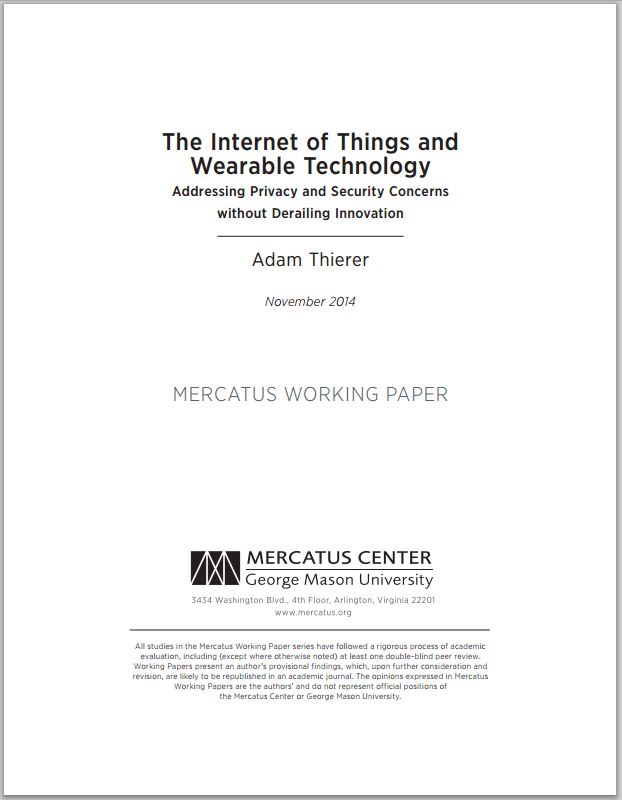
The Mercatus Center at George Mason University has just released my latest working paper, “The Internet of Things and Wearable Technology: Addressing Privacy and Security Concerns without Derailing Innovation.” The “Internet of Things” (IoT) generally refers to “smart” devices that are connected to both the Internet and other devices. Wearable technologies are IoT devices that are worn somewhere on the body and which gather data about us for various purposes. These technologies promise to usher in the next wave of Internet-enabled services and data-driven innovation. Basically, the Internet will be “baked in” to almost everything that consumers own and come into contact with.
Some critics are worried about the privacy and security implications of the Internet of Things and wearable technology, however, and are proposing regulation to address these concerns. In my new 93-page article, I explain why preemptive, top-down regulation would derail the many life-enriching innovations that could come from these new IoT technologies. Building on a recent book of mine, I argue that “permissionless innovation,” which allows new technology to flourish and develop in a relatively unabated fashion, is the superior approach to the Internet of Things.
As I note in the paper and my earlier book, if we spend all our time living in fear of the worst-case scenarios — and basing public policies on them — then best-case scenarios can never come about. As the old saying goes: nothing ventured, nothing gained. Precautionary principle-based regulation paralyzes progress and must be avoided. We instead need to find constructive, “bottom-up” solutions to the privacy and security risks accompanying these new IoT technologies instead of top-down controls that would limit the development of life-enriching IoT innovations. Continue reading →
On Thursday, it was my great pleasure to present a draft of my forthcoming paper, “The Internet of Things & Wearable Technology: Addressing Privacy & Security Concerns without Derailing Innovation,” at a conference that took place at the Federal Communications Commission on “Regulating the Evolving Broadband Ecosystem.” The 3-day event was co-sponsored by the American Enterprise Institute and the University of Nebraska College of Law.
The 65-page working paper I presented is still going through final peer review and copyediting, but I posted a very rough first draft on SSRN for conference participants. I expect the paper to be released as a Mercatus Center working paper in October and then I hope to find a home for it in a law review. I will post the final version once it is released. [UPDATE:The final version of this working paper was released on November 19, 2014.]
In the meantime, however, I thought I would post the 46 slides I presented at the conference, which offer an overview of the nature of the Internet of Things and wearable technology, the potential economic opportunities that exist in this space, and the various privacy and security challenges that could hold this technological revolution back. I also outlined some constructive solutions to those concerns. I plan to be very active on these issues in coming months.
Jane Yakowitz Bambauer, associate professor of law at the University of Arizona, discusses her forthcoming paper in the Stanford Law Review titled Is Data Speech? How do we define “data” and can it be protected in the same way as free speech? She examines current privacy laws and regulations as they pertain to data creation and collection, including whether collecting data should be protected under the First Amendment.
What Unites Advocates of Speech Controls & Privacy Regulation? [pdf]
by Adam Thierer & Berin Szoka
The Progress & Freedom Foundation,
Progress on Point No. 16.19
Anyone who has spent time following debates about speech and privacy regulation comes to recognize the striking parallels between these two policy arenas. In this paper we will highlight the common rhetoric, proposals, and tactics that unite these regulatory movements. Moreover, we will argue that, at root, what often animates calls for regulation of both speech and privacy are two remarkably elitist beliefs:
People are too ignorant (or simply too busy) to be trusted to make wise decisions for themselves (or their children); and/or,
All or most people share essentially the same values or concerns and, therefore, “community standards” should trump household (or individual) standards.
While our use of the term “elitism” may unduly offend some understandably sensitive to populist demagoguery, our aim here is not to launch a broadside against elitism as
Time magazine culture critic William H. Henry once defined it: “The willingness to assert unyieldingly that one idea, contribution or attainment is better than another.”[1] Rather, our aim here is to critique that elitism which rises to the level of political condescension and legal sanction. We attack not so much the beliefs of some leaders, activists, or intellectuals that they have a better idea of what it in the public’s best interest than the public itself does, but rather the imposition of those beliefs through coercive, top-down mandates.
That sort of elitism—elitism enforced by law—is often the objective of speech and privacy regulatory advocates. Our goal is to identify the common themes that unite these regulatory movements, explain why such political elitism is unwarranted, and make it clear how it threatens individual liberty as well as the future of free and open Internet. As an alternative to this elitist vision, we advocate an empowerment agenda: fostering an environment in which users have the tools and information they need to make decisions for themselves and their families. Continue reading →
The Technology Liberation Front is the tech policy blog dedicated to keeping politicians' hands off the 'net and everything else related to technology. Learn more about TLF →


 The Technology Liberation Front is the tech policy blog dedicated to keeping politicians' hands off the 'net and everything else related to technology.