Over on the Cato@Liberty blog, I’ve done a fairly lengthy write-up of the Google Flu Trends privacy issue. It’s an important problem that I think deserves a little more than dismissal.
My conclusion: “The heart of the problem lies not with the current leader in search, or any other Internet innovator. The problem lies with our unconstrained government.”
If you’re inclined to dismiss this conclusion as libertarian boilerplate, please read the post.
SAN JOSE, Nov. 7 – This morning I’ve posted two articles on BroadbandCensus.com about the Wireless Communications Association’s conference here.
SAN JOSE, November 7 – Emboldened by their summertime victory against Comcast, advocates of network neutrality said Thursday that the next front in battle for the principle would be against wireless carriers who make “unreasonable” network management decisions.
read more
SAN JOSE, November 6 – It was Kevin Martin’s day to suck up praise from Silicon Valley. The chairman of the Federal Communications Commission – for about two more months – came to the Wireless Communications Association’s annual conference here on Thursday to be feted by many Googlers, including company co-founder Larry Page.
read more
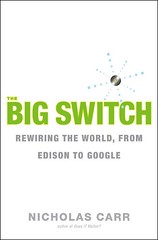 I just finished reading through The Economist’s new 14-page special report on cloud computing, “Let It Rise” in which Ludwig Siegele provides an outstanding overview of cloud computing and why it is so important:
The rise of the cloud is more than just another platform shift that gets geeks excited. It will undoubtedly transform the information technology (IT) industry, but it will also profoundly change the way people work and companies operate. It will allow digital technology to penetrate every nook and cranny of the economy and of society, creating some tricky political problems along the way.
Even if you are very familiar with cloud computing, I recommend you take a look at the article. Anyway, while I was reading it, I was unsurprised to come across some comments from Nicholas Carr, whose new book
The Big Switch: Rewiring the World, from Edison to Google, is essentially an early history of cloud computing and an investigation into its effects on our economy, culture, and society. And that also reminded me that, even though I have mentioned Carr’s book here several times since it was released earlier this year, I have failed to give it a dedicated review. And it certain deserves one because “The Big Switch” is easily one of the most important technology policy books of 2008.
Continue reading →
At first glance, it seems to me that this big settlement announced today between Google and the book publishers regarding Google Book Search sounds a lot like an ASCAP model for online book transactions. Specifically, of the key provisions of the agreement, it’s this last one about the Book Rights Registry that makes me think of ASCAP:
Compensation to Authors and Publishers and Control Over Access to Their Works – Distributing payments earned from online access provided by Google and, prospectively, from similar programs that may be established by other providers, through a newly created independent, not-for-profit Book Rights Registry that will also locate rightsholders, collect and maintain accurate rightsholder information, and provide a way for rightsholders to request inclusion in or exclusion from the project.
That’s basically what ASCAP does today, and I think this sounds like a pretty good plan for books going forward. But I also find myself wondering: Could this be the beginning of a move toward a more comprehensive online collective licensing system for other types of content as
everything moves online. For example, could this model work for music? EFF has argued it could. And some in the music industry appear to be moving in that direction. (Talk about your strange bedfellows… EFF and the RIAA potentially on the same side of an issue!)
Of course, you’d need to get a lot more companies than just Google to play ball to make it work for music — specifically, you’d need all the ISPs on board. For books, by contrast, the reason today’s deal will likely work is because Google has been the only online operator with the scale and interest in putting the entire contents of so many books online. But all music is already online and much video is heading online, too. So, I think it would be much, much more challenging to make collective licensing work for music and video the way it appears it might work for books. (We’d probably need
compulsory licensing instead, which I am no fan of). The key to these voluntary collective licensing systems is large, trusted intermediaries that can clear a massive volume of transactions. Google can do that for books as today’s deal makes clear. It will be interesting to see if others suggest that music and video can and should work the same way. I’m skeptical, and I’m also a bit hung up on some fairness issues about how it would work, which I might touch upon in a future essay.
But I’m no copyright expert so I’d be interested in hearing what my colleagues and others think.
Update: Looks like someone beat me to the punch with the ASCAP comparison. I just starting reading through my RSS feed and finding reaction from others and came across Mathew Ingram’s post arguing that, “In effect, Google is setting up a body that does what ASCAP and similar groups do for musicians.”
Should U.S. businesses involved in Internet commerce do business in nations governed by oppressive regimes? This is a question that many libertarians—including some of us on TLF—have grappled with for some time.
Now Yahoo, Google, and Microsoft have signed on to a set of principles for conducting business in countries that disregard human rights. Today’s Wall Street Journal reports:
Under the new principles, which were crafted over two years, the technology titans promise to protect the personal information of their users wherever they do business and to “narrowly interpret and implement government demands that compromise privacy,” according to the code.
It’s welcome news for defenders of liberty that U.S. Web giants plan to play hardball with foreign governments who would use information gleaned from Internet firms to violate their citizens’ human rights.
Several troubling reports have surfac
 ed in the past few years about American companies abetting egregious actions by oppressive governments. In January, Indian police beat a man whose arrest stemmed from Google’s cooperation with the Indian government. And in 2005, Yahoo gave information to the Chinese government that led to the arrest of a journalist accused of giving out state secrets (the case was later overturned).
Continue reading →
 The Progress & Freedom Foundation has just launched the new Center for Internet Freedom. CIF offers an alternative to the proliferation of advocacy groups calling for government intervention online by offering timely analyses and critiques of proposals that diminish the vital role of free markets, free speech and property rights. We aim to drive the Internet policy debate in new directions by emphasizing a layered approach of technological innovation, user education, user self-help, industry self-regulation, and the enforcement of existing laws consistent with the First Amendment. Such an approach is a less restrictive—and generally more effective—alternative to increased regulation.
Here are some of the issues I’ll be working on as CIF’s Director in conjunction with my esteemed colleagues Adam Thierer, Adam Marcus, and adjunct fellows:
- Defending online advertising as the lifeblood of online content & services, especially in the “Long Tail”;
- Emphasizing market solutions to problems of privacy protection, especially regarding the use of cookies and packet inspection data;
- Protecting online speech and expression both in the U.S. and abroad;
- Defending Section 230 immunity for Internet intermediaries;
- Opposing online taxation and legal barriers to e-commerce and digital payments, especially at the state and local levels; and
- Ensuring that Internet governance remains transparent and accountable without hampering the evolution of the Internet.
Over at DrewClark.com, earlier today I reported today that television networks – which in recent years have had a strained relationship with local broadcasters on a variety of fronts – joined with the National Association of Broadcasters in calling for a time out on the politically simmering issue of “white spaces.” Here’s the start of the story, and you can read the full post at DrewClark.com
WASHINGTON, October 23 – The top executives of the four major broadcast networks on Thursday urged the head of the Federal Communications Commission to delay a vote on a politically simmering issue that pits broadcasters against Google and high-tech executives.
In the letter, the CEOs of CBS Corp., NBC Universal and Walt Disney, and the chief operating officer of News Corp., urge that the FCC exercise caution before taking irreparable action with regard to the vacant television channels known as “white spaces.”
Google and the other technology executives, including Microsoft, Motorola, Philips and others, want the FCC to authorize electronic devices that capable of transmitting internet signals over vacant television bands.
The network executives – CBS’s Leslie Moonves, Disney’s Robert Iger, NBC’s Jeffrey Zucker and Peter Chernin of News Corp. – want a time out.
They join their local broadcasting colleagues, as well as manufacturers and users of wireless microphones, like the National Football League and Boadway theater owners, who have been actively lobbying the issue.
[…]
Read the rest of the story at my blog, DrewClark.com – The Politics of Telecom, Media and Technology
Congress has very wisely cancelled the National Reconnaissance Office’s proposed Broad Area Space-Based Imagery Collection (BASIC) satellite system. The proposal to build two new imaging satellites at a cost to taxpayers of $1.7 billion would have represented a major break from what is possibly the U.S. government’s most successful effort to promote space commercialization to date: buying the imagery it needs from commercial providers, who can also sell imagery to other buyers.
Five years ago, the idea that Internet users could pull up a satellite image of just about any location on the planet at a whim would have seemed ludicrous. Yet that’s precisely what websites like Google Maps and Microsoft’s Live Search offer today—for free! Desktop applications like Microsoft’s Virtual Earth and Google Earth offer even more advanced geospatial tools—again, for free. But of course this library of incredibly rich imagery didn’t just “fall out of the sky,” as they say. It was collected by a handful of expensive commercial remote sensing satellites whose construction was made possible by the National Geospatial-Intelligence Agency‘s (Wikipedia) extraordinarily successful “Nextview” program implemented under the Commercial Remote Sensing Policy of 2003. Rather than having the Federal government build its own satellites—and pay for the entire cost of the satatellites—the NGA very wisely chose to buy imagery from commercial providers in two ~$500 million, 4-year contracts with U.S. satellite imagery companies: DigitalGlobe in 2003 and OrbImage (now GeoEye) in 2004.
These long-term purchase agreements essentially made the U.S. Government the “anchor tenant” in a new class of remote sensing satellites, providing the initial funding for both companies to build and operate their satellites. But because the companies sell roughly half of imagery to foreign governments and commercial buyers like Google and Microsoft, these deals have saved U.S taxpayers money for the purchase of imagery for a wide variety of needs, ranging from agricultural monitoring to military intelligence. At the same time, the Nextview contracts have given birth to a vibrant geospatial industry whose immediate benefits should be obvious to anyone who’s ever pulled up a satellite map online and whose macroeconomic impact is potentially enormous.
So why mess with success? Continue reading →
 I’ve been re-reading Nicholas Negroponte’s brilliant and extraordinarily prescient 1995 book Being Digital this week, and I just came to the famous section in Chapter 12 about “The Daily Me.” It’s his visionary discussion of a future of personalized filters for all things digital to perfectly tune news and entertainment to your personal preferences. Here’s the key passage (again, remember that he wrote this in 1995, long before most of the digital things we take for granted today existed):
Imagine a future in which your interface agent can read every newswire and newspaper and catch every TV and radio broadcast on the planet, and then construct a personalized summary. This kind of newspaper is printed in an edition of one. […]
Imagine a computer display of news stories with a knob that, like a volume control, allows you to crank personalization up or down. You could have many of these controls, including a slider that moves both literally and politically from left to right to modify stories about public affairs.
These cotnrols change your window onto the news, both in terms of size and its editorial tone. In the distant future, interface agents will read, listen to, and look at each story in its entirety. In the near future, the filtering process will happen by using headers, those bits about bits.
Well, that future came about sooner than even Negroponte could have predicted. We all have a “Daily Me” now; it’s called our RSS feed. And there are other components to the “Daily Me,” such as iGoogle and Google Alerts, which provide automated search results served up instantaneously. And there are many other digital tools and services out there today that help us personalize our media experience.
You really gotta hand it to Negroponte for being way ahead of the curve in foreseeing all of this at a time when most of us where still using Trumpet Winsock and 14.4 modems. Hell, Al Gore hadn’t even built the Internet yet!

 Google has just
  The Technology Liberation Front is the tech policy blog dedicated to keeping politicians' hands off the 'net and everything else related to technology.
