[Note: This is the third in a series of essays about the legacy of the Supreme Court’s FCC v. Pacifica Foundation decision, which celebrates its 30th anniversary on July 3rd. Part 1, presented a general overview of the issue. Part 2 sketched a short history of FCC indecency regulation. This installment will examine the misguided logic of the Court’s reasoning in Pacifica as it stood in 1978. Part 4 will then examine why that logic is even more misguided in light of modern developments.]
For the past three decades, regulation of television programming has been premised on the “pervasiveness rationale” as articulated in the landmark Supreme Court case
FCC v. Pacifica Foundation. In Pacifica, in a 5-4 plurality decision, the Court held:
Of all forms of communication, broadcasting has the most limited First Amendment protection. Among the reasons for specially treating indecent broadcasting is the uniquely pervasive presence that medium of expression occupies in the lives of our people. Broadcasts extend into the privacy of the home and it is impossible completely to avoid those that are patently offensive. Broadcasting, moreover, is uniquely accessible to children.
In one portion of the decision, Justice John Paul Stevens, who authored the majority opinion, even referred to broadcast signals as an “intruder” into the home.
There were always serious problems with the “media-as-invader” logic of Pacifica.
Continue reading →
Next Thursday, July 3rd will mark the 30th anniversary of the Supreme Court’s landmark First Amendment decision, FCC v. Pacifica Foundation. Sadly, but somewhat ironically, the anniversary of this decision comes just a few days after we lost America’s greatest modern social satirist George Carlin, whose infamous “seven dirty words” monologue prompted the Supreme Court’s Pacifica decision. After a Pacifica Foundation radio station aired Carlin’s monologue and the FCC took action against that station, a court battle ensued regarding whether the agency had the authority to censor “indecent” content on broadcast radio and television stations.
Unfortunately, when the Supreme Court handed down its
Pacifica decision 30 years ago, the First Amendment lost. By a narrow 5-4 vote, the court held that the FCC could impose fines on broadcasters who aired indecent content during daytime and early evening hours. The Court used some rather tortured reasoning to defend the proposition that broadcast platforms deserved lesser First Amendment treatment than all other media platforms. The lynchpin of the decision was the so-called “pervasiveness theory,” which held that broadcast speech was “uniquely pervasive” and an “intruder” in the home, and therefore demanded special, artificial content restrictions.
Over the course of the next week, I plan on posting some thoughts about that twisted logic and the legacy of the
Pacifica decision in general. In part 2, I’ll sketch out the broad outlines of FCC indecency enforcement over the past 70 years. In part 3, I’ll be highlighting some of the original deficiencies of the “pervasiveness doctrine.” Part 4 will highlight the irrelevancy of Pacifica and the pervasiveness doctrine in light of recent technological developments. These (and potentially other) installments will highlight why Pacifica was always bad law and is even more misguided and unjust in light of recent marketplace developments.
Berin Szoka and I just released a short article on the FCC’s proposed follow-up to the failed 700 mhz D Block auction: a
free,
nationwide wireless service that would serve public safety users as well as consumers. It’s attached down below or the PDF can be found here.
What’s Worse Than Rigged Auctions & Internet Censorship?
How About Both in One Package!
a PFF
Progress Snapshot
Release 4.12 June 2008
by Adam Thierer and Berin Szoka
The big spectrum policy debate in town these days continues to be the fight about how to redo the botched D block auction. As we all know, FCC Chairman Kevin Martin’s previous effort to micro-manage that auction failed miserably. Sadly, the follow-up plan isn’t much better, as the Wall Street Journal notes in an editorial today:
You’d think Chairman Martin would have learned from this experience. It’s not the role of regulators to pick winners and losers to achieve their preferred social outcomes. Private competition and the price mechanism can most fairly and efficiently find the best use for scarce spectrum. The FCC’s clumsy attempt at social engineering resulted in a failed auction that has prevented otherwise desirable spectrum from being put to commercial use.
Alas, Mr. Martin has now proposed another wireless auction for a separate piece of spectrum. And this time he wants to require the winner to offer free Internet access that filters out pornography–conditions that obviously would decrease the value of the license and turn off potential bidders. It just so happens that Mr. Martin’s proposed auction seems tailor-made for the business plan put forward by M2Z, another politically connected Silicon Valley start-up looking to enter the wireless broadband telecom market.
Continue reading →
Bruce Owen, America’s preeminent media economist–with apologies to Harold Vogel, who at least deserves an honorable mention–has written another splendid piece for Cato’s Regulation magazine, this one entitled, “The Temptation of Media Regulation.”
This latest essay deals primarily with the many fallacies surrounding so-called “a la carte” regulation of the video marketplace, and I encourage you to read it to see Owen’s powerful refutation of the twisted logic behind that regulatory crusade. But I wanted to highlight a different point that Bruce makes right up front in his essay because it is something I am always stressing in my work too.
In some of my past work on free speech and media marketplace regulation, I have argued that there is very little difference between Republicans and Democrats when it comes to these issues. They are birds of feather who often work closely together to regulate speech and media. Whether it is broadcast ‘indecency’ controls; proposals to extend those controls to cable & satellite TV; campaign finance laws; efforts to limit or rollback ownership regulations; or even must carry and a la carte, the story is always the same: It’s one big bipartisan regulatory love fest. [And the same goes for regulation of the Internet, social networking sites, and video games.]
Owen explains why that is the case:
Continue reading →
I have just released a new PFF white paper on “The Perils of Mandatory Parental Controls and Restrictive Defaults.” It points out the dangers of government mandating that parental controls be defaulted to their most restrictive position. I’ve gone ahead and just pasted the entire text below (but without the footnotes):
During ongoing debates about parental controls, ratings, and online child safety, there have occasionally been rumblings about the possibility of requiring that media, computing and communications devices: (1) be shipped to market with parental controls embedded, and possibly, (2) those controls being defaulted to their most restrictive position, forcing users to opt out of the controls later if they wanted to consume media rated above a certain threshold.
Imagine, for example, a law requiring that every television, TV set-top box, and video game console be shipped with on-board screening technologies that were set to block any content rated above “G” for movies, “TV-Y” for television, or “E” for video games, which are the most restrictive rating designations for each type of media. Similarly, all personal computers or portable media devices sold to the public could be forced to have filters embedded that were set to block all “objectionable” content, however defined.
If “default” requirements such as this were mandated by law, parents would be forced to opt out of the restrictions by granting their children selective permission to media content or online services. In theory, this might help limit underage access to objectionable media or online content. Such a mandate might be viewed as less intrusive than direct government censorship and, therefore, less likely to run afoul of the constitution.
For these reasons, such a proposal would likely have great appeal among some policymakers, “family” groups, child safety advocates, and parents. But mandating parental controls and restrictive defaults is a dangerous and elitist idea that must be rejected because it will have many unintended consequences and not likely achieve the goal of better protecting our kids.
Continue reading →
PFF has just releasing an updated edition of my booklet on “Parental Controls and Online Child Protection: A Survey of Tools & Methods.” The new version, Version 3.0, includes two new appendixes and updates to each section to reflect new parental control tools and programs developed in the last nine months.
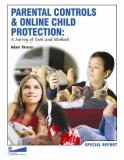
The updated report is timely as it comes on the heels of the recently-announced Internet Safety Technical Task Force, which is being chaired by the Berkman Center for Internet & Society at Harvard Law School. I am privileged to serve as a member of the Task Force, which is evaluating various online safety technologies and strategies and then reporting back to state attorneys general with our findings.
Those issues and much more are covered in the latest edition of my report. The report explores the market for parental control tools, rating schemes, education efforts, and initiatives aimed at promoting online child safety. I believe that the parental controls and content management tools cataloged in the report represent a better, less restrictive alternative to government regulation. As I conclude after evaluating that state of the market: “There has never been a time in our nation’s history when parents have had more tools and methods at their disposal to help them decide what constitutes acceptable media content in their homes and in the lives of their children.”
Version 3.0 of the special report, now over 200 pages, contains over fifty exhibits and numerous updates in all five sections of the book. Major updates have been made to the Internet, social networking, and mobile media sections, reflecting the growing importance of those sectors and issues. A greatly expanded section on video empowerment technologies has also been included. Finally, two appendices have also been added: a comprehensive legislative index cataloging over thirty bills introduced in Congress on these issues (complied with John Morris of Center for Democracy & Technology), and a glossary of 35 relevant terms and cases.
The report is available free-of-charge on the PFF website, as are the previous editions. And I am happy to provide hard copies to those who are interested.
http://documents.scribd.com/ScribdViewer.swf?document_id=2887320&access_key=key-um5xjvf98bfnuu8811v&page=&version=1&auto_size=true
As I mentioned yesterday, James Gattuso and I penned an editorial for National Review this week about the growth of FCC regulation and spending in recent years. In the op-ed, we also noted that, “For whatever reason, a disproportionate number of these [new regulatory proposals] have been aimed at cable television, so much so that press and industry analysts now speak of Chairman Martin’s ongoing ‘war on cable.'”
Today, the editors at
National Review have chimed in with an editorial of their own on the issue entitled, “Pulling the Cable on Martin’s Crusade.” Specifically, the editors address what most pundits believe really motivates the Chairman’s crusade against cable: His desire to force cable companies to offer consumers channels on “a la carte” basis in an effort to “clean up” cable TV. “Martin should abandon this particular crusade,” the NR editors argue. “While we are sympathetic to parents’ desire to get the channels they want without having to buy access to racier fare, using economic regulation to restructure an industry is the wrong approach.” They continue:
Continue reading →
PFF has just released my latest paper entitled “Parental Control Perfection? The Impact of the DVR and VOD Boom on the Debate over TV Content Regulation.” In the report, I focus on the extent to which new video technologies, such as digital video recorders (DVRs) and video on demand (VOD) services, are changing the way households consume media and are helping parents better tailor viewing experiences to their tastes and values. I provide evidence showing the rapid spread of these technologies and discuss how parents are using these tools in their homes. Finally, I argue that these developments will have profound implications for debates over the regulation of video programming. As parents are given the ability to more effectively manage their family’s viewing habits and experiences, it will lessen—if not completely undercut—the need for government intervention on their behalf.
This 16-page report can be found at: http://www.pff.org/issues-pubs/pops/pop14.20DVRboomcontentreg.pdf
With the release last month of its report on Violent Television Programming and Its Impact on Children, the FCC teed up the issue of regulating televised violence and tossed it over to Congress with a recommendation that lawmakers go ahead and swing for the fences. And Congress appears ready to oblige, although not necessarily in the way some at the FCC had originally envisioned.
You will recall that FCC Chairman Kevin Martin used the FCC’s violence report as another opportunity to engage in his monomaniacal, Moby Dick-like quest to impose a la carte regulation on cable and satellite operators. Martin argued that “Requiring cable and satellite television providers to offer programming in a more a la carte manner would be a more content neutral means for Congress to regulate violent programming and therefore would raise fewer constitutional issues.” But it doesn’t appear that the chairman is going to get his whale this time around.
Continue reading →

 The Technology Liberation Front is the tech policy blog dedicated to keeping politicians' hands off the 'net and everything else related to technology.