This week I was pleased to join a diverse collection of think tanks and public interest groups in submitting joint comments to the FCC opposing the proposed content filtering mandate that would be part of a future AWS-3 auction. That’s the proposed auction that would create a “free” nationwide wireless broadband service. As part of the deal, the company would need to need to take steps to provide a “clean” Internet connection by filtering content. This joint filing points out why that is a bad idea:
- the reach of the filtering mandate is extraordinarily broad, and would attempt to censor content far beyond any content regulation regime that has been previously upheld in the face of constitutional challenge.
- even if the scope of the filtering mandate were more narrowly focused, it would conflict with the First Amendment analysis that the Supreme Court applied to Internet access in the seminal
Reno v. ACLU decision.
- even if the Commission were to require filtering on an “opt out” or “opt in” basis, the Constitutional problems would not be avoided. Opt-out filtering would impose an unconstitutional burden on listeners and recipients of Internet communications, and both opt-out and opt-in filtering would violate the First Amendment rights of speakers and other content providers on the Internet. Simply put, the First Amendment does not allow a government mandated “blacklist” of websites to be blocked.
- would also violate the terms and intent of two federal statutes – 47 U.S.C. § 326 (which prohibits the Commission from “interfer[ing] with the right of free speech”) and 47 U.S.C. § 230 (which promotes user control over content and limits burdens on service providers).
- would also limit what people could do online using the free AWS-3 service so dramatically that the usefulness of the service would be radically reduced.
- would also certainly lead to legal challenges that would delay the implementation of the proposed access service.
Continue reading →
It is a difficult thing for me to say, but I am man enough to do it: I must congratulate our intellectual opponents on their amazing victory in the battle to impose Net neutrality regulations on the Internet. With the Wall Street Journal reporting last night that the FCC is on the verge of acting against Comcast based on the agency’s amorphous Net neutrality principles, it is now clear that the folks at the Free Press, Public Knowledge, and the many other advocates of comprehensive Internet regulation have succeeded in convincing a Republican-led FCC to get on the books what is, in essence, the nation’s first Net Neutrality law. It is quite an accomplishment when you think about it.
Even though, as Jerry Brito has noted, “the FCC has no authority to enforce a non-binding policy statement,” it is clear that is not about to stop the activist-minded FCC Chairman Kevin Martin or his allies on the Left from advancing the cause of arbitrary, bureaucratic governance of the Internet. And that means the “Hands Off the Net” era will gradually start giving way to the “Hands All Over the Net” era. As I told Bob Fernandez of the Philadelphia Inquirer when he called to interview me for a story about these developments:
“This is the foot in the door for big government to regulate the Internet,” […] “This is the beginning of a serious regulatory regime. For the first time, the FCC is making law around net neutrality.”
And now that they have that foot in the door, I fully expect that it will be exploited for everything it’s worth to grow the scope of the FCC’s coercive bureaucratic authority over all things digital. The Left is salivating at the prospect of imposing their top-down vision of forced egalitarianism on the the Net, while the Right is figuring out how quickly they can exploit this to impose speech controls on anything they don’t want the public to see or hear.
It is a historic moment in the history of communications and media regulation, and freedom has lost—miserably. The tentacles of the regulatory Leviathan have grown infinitely longer and a little bit more of the Net’s freedom died today. And, again, what’s most amazing about this is that we have a Republican FCC to thank for that. So much for the GOP being for smaller government.
The Federal Communications Commission (FCC) lost another major First Amendment-related case today involving its recent efforts to expand the parameters of “indecency” enforcement for broadcast programming. The case involves the now infamous “wardrobe malfunction” that occurred during an unscripted 2004 Super Bowl halftime performance involving singers Justin Timberlake and Janet Jackson. When Ms. Jackson’s breast was exposed on camera for nine-sixteenths of one second, the FCC immediately launched an investigation into the incident and fines were eventually levied on the grounds that the fleeting exposure of Ms. Jackson’s breast was a violation of broadcast decency standards. CBS challenged the FCC’s decision, leading to a legal showdown in the U.S. Court of Appeals for the Third Circuit.
In today’s decision,
CBS Corp. v. FCC, the three-judge panel of the 3rd Circuit ruled that the Federal Communications Commission “acted arbitrarily and capriciously” when it imposed a $550,000 fine on CBS for the incident. The court’s 102-page decision, which can be found here, was decided squarely on procedural grounds. That is, it didn’t touch the more substantive speech-related issues or precedents such as the Pacifica or Red Lion decisions that constitute the foundations of all modern FCC broadcast regulation.
The case is important because it now joins the June 2007 decision handed down by the Second Circuit Court of Appeals in the case of Fox Television Stations v. FCC. That was the indecency case involving the FCC’s new policy for “fleeting expletives.” In that 2-1 decision, the Second Circuit ruled that “the FCC’s new policy sanctioning ‘fleeting expletives’ is arbitrary and capricious under the Administrative Procedure Act for failing to articulate a reasoned basis for its change in policy.” As a result, the FCC’s order was vacated and remanded to the agency. [And the FCC is now challenging the decision in the Supreme Court.]
This is very similar to what the 3rd Circuit said today in the
CBS case.
Continue reading →
Terrific piece here from Ed Felten on how new technologies and cultural trends are undermining traditional conceptions of “media localism.” It’s a theme I have written on at length, most recently in this essay on “Our Continued Wishful Thinking about ‘Media Localism‘.” Anyway, as Felten correctly notes in the conclusion of his essay:
New technologies undermine the rationale for localist policies. It’s easier to get far-away content now — indeed the whole notion that content is bound to a place is fading away. With access to more content sources, there are more possible venues for local programming, making it less likely that local programming will be unavailable because of the whims or blind spots of a few station owners. It’s getting easier and cheaper to gather and distribute information, so more people have the means to produce local programming. In short, we’re looking at a future with more non-local programming and more local programming.
That’s exactly right. As Grant Eskelsen and I argue in Chapter 6 of our new Media Metrics book:
The decline of “localism” in media is a much-lamented but quite natural phenomenon as citizens gain access to news and entertainment sources of broader scale and scope. Although it is impossible to scientifically measure exactly how much “local” fare citizens demand—and defining the term is another challenge—we know that they still receive a wealth of information about developments in their communities. However, it is also evident that, left to their own devices, many citizens have voluntarily flocked to national (and even international) sources of news and entertainment. […]
[But] the demise of “localism” has been greatly exaggerated. The
relative decline in local media is simply a natural development resulting from the voluntary choices made by millions of American citizens, but the tools for producing, distributing, and acquiring local content are more robust than ever.
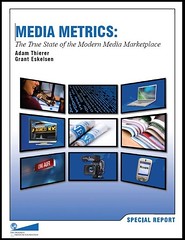 Faithful readers will recall that, several months ago, I penned a 7-part “Media Metrics” series that took a hard look at the health of the media marketplace. Today, the Progress & Freedom Foundation is releasing a greatly expanded version of these essays that I have put together with my PFF colleague Grant Eskelsen. In this 100-page special report, “Media Metrics: The True State of the Modern Media Marketplace,” we begin by noting that heated debates about the state of the media marketplace continue to rage in Washington, and opinions seem to range from grim to outright apocalyptic. As we note on pg. 1:
Many people—including a large number of legislators and regulators—argue that America’s media marketplace is in a miserable state. Some claim that citizens lack choice in media outlets and that options are just as scarce as ever. Others believe that media “localism” is dead or that many groups or niches go underserved because of a lack of true “diversity” in media. Others argue that the market is hopelessly over-concentrated in the hands of a few evil media barons who are hell-bent on force-feeding us corporate propaganda. And still others say that the quality of news and entertainment in our society has deteriorated because of a combination of all of the above. It all sounds quite troubling, but is any of it true?
After taking an objective look at the true state of America’s media marketplace, we conclude that such pessimism is unwarranted. Indeed, a careful review of the facts reveals that—contrary to what those media critics suggest—we have more media choice, more media competition, and more media diversity than ever before. Indeed, to the extent there was ever a “golden age” of media in America, we are living in it today. The media sky has never been brighter and it is getting brighter with each passing year.
Continue reading →
Early in 2007, I started penning—but somehow failed to continue—a series of essays about how I was troubled that so many Democrats and liberal intellectuals appeared to be abandoning their First Amendment heritage. As I pointed out at the time:
The idea that the Democrats are the party of free speech and the great protectors of our nation’s First Amendment heritage has always been a bit of a myth. In reality, when you study battles over freedom of speech and expression throughout American history you quickly come to realize that there are plenty of people in both parties would like to serve as the den mothers of the American citizenry. That being said, it is generally true that there have been a few more voices in the Democratic party willing to stand in opposition to governmental attempts to regulate speech in the past.
But I’m starting to wonder where even that handful of First Amendment champions has gone. Sadly, examples of Democrats selling out the First Amendment are becoming so common that I’ve decided to start a new series to highlight recent examples of Dems actually leading the charge for increased government regulation of speech and expression. I want to stress that I’m not trying to pick on Democrats here, rather, I’m just trying to point out that–unless there is a sea change in their approach to these issues by Democrats in coming months and years–both parties now appear to be singing out of the same pro-regulatory hymnal. This constitutes an ominous threat to the future of free expression.
This seems like a good time for me to pick this theme back up because later this fall, the Supreme Court is set to consider
FCC v. Fox Television Stations, which could become the most important First Amendment-related court case since FCC v. Pacifica Foundation, which just turned 30 years old last week.
Amicus briefs are starting to be filed in the matter, and you won’t be surprised to hear that several social conservative, pro-regulatory activist groups have already petitioned the Court to uphold the FCC’s authority to censor broadcast television and radio content. What is surprising, however, is the lack of liberal groups or Left-learning intellectuals engaging in the matter. One would hope that at least a few lefties would file in opposition to over-zealous FCC regulation of speech. Sadly, however, to the extent any liberals have filed so far, it has largely been in an effort to undercut the argument broadcasters are putting forward in defense of their First Amendment rights, or to encourage the Court not to touch other regulatory sacred cows of the political Left—namely the Supreme Court’s 1969 Red Lion decision and FCC’s ambiguous “public interest” authority to comprehensively regulate media markets.
Continue reading →
There’s an interesting discussion going on over at Editor & Publisher in which E&P columnist Steve Outing and Mark Potts of the now-defunct Backfence.com are debating media localism and recent efforts to give dying newspapers a new lease on life by focusing on the “hyper-local” coverage and community services. Potts obviously didn’t take too kindly to Outling saying of Backfence that: “We know from its experience that relying too heavily on non-paid citizen contributors isn’t a winning strategy.” And that the: “content is often of low quality and boring, and dull just doesn’t fly in the hyper-competitive Web environment. In response, Potts suggests that other factors were responsible for the site’s demise and that hyper-localism and user-generated local content is the future of the industry:
It’s also unfair to suggest that hyperlocal content is “of low quality and boring,” as Steve does in his column. Low quality? To a professional editor, maybe, but the fact is that most participants in user-generated sites can communicate very well. It may not be “journalism,” but it’s still quite readable and interesting. And “boring” is in the eye of the beholder. To an outsider, any hyperlocal information is probably boring. It may be to a transient resident, too. But to someone with a stake in the community, kids in the schools, paying taxes, dealing with community services, patronizing local merchants, etc., those arcane town council meetings, zoning disputes, tips on finding good pizza and kids’ sports scores are incredibly important — more so than just about anything a lot of us think of as journalism.
I think they both make some interesting points, [and there is a running exchange going here] but I want to add a few other frequently overlooked points about the whole “media localism” debate, which continues to stir up so much controversy within the industry and especially here in Washington policy circles. There are two fundamental realities about “localism” that few industry analysts or media critics bother discussing that I want to focus on:
Continue reading →
[Note: This is the fourth in a series of essays about the legacy of the Supreme Court’s FCC v. Pacifica Foundation decision, which celebrates its 30th anniversary on July 3rd. Part 1, presented a general overview of the issue. Part 2 sketched a short history of FCC indecency regulation. Part 3 discussed the misguided logic of the Court’s reasoning in Pacifica as it stood in 1978. This installment will examine why that logic is even more misguided in light of modern developments.]
Whatever legitimacy
Pacifica’s “pervasiveness rationale” might have once had, it has been largely eroded by modern media developments.
First, the pervasiveness rationale for media regulation fails today because new content tailoring technologies make it easier than ever before for parents to manage media in their homes and in their lives of their children. It is impossible to consider video programming an “intruder” in the home when tools exist that can help parents almost perfectly tailor viewing experiences to individual household preferences.
When Justice Stevens argued in
Pacifica that broadcast signals represented an “intruder” in the home, he supported that claim by noting that: “Because the broadcast audience is constantly tuning in and out, prior warnings cannot completely protect the listener or viewer from unexpected program content.” While that may have reflected the state of technology and TV viewing at the time, it is completely at odds with modern realities. In 1978, the viewing experience was a more passive affair and consumers had very few ways to control that experience unless they turned off the television altogether. Today, by contrast, viewers (including parents) have the tools to “tune in and out” at will, and they have abundant “prior warnings” about program content thanks to the existence of ratings, program information, and electronic program guides. These tools help parents restrict or tailor the viewing experience in advance according to their values and preferences.
Continue reading →

 The Technology Liberation Front is the tech policy blog dedicated to keeping politicians' hands off the 'net and everything else related to technology.