Posts tagged as:

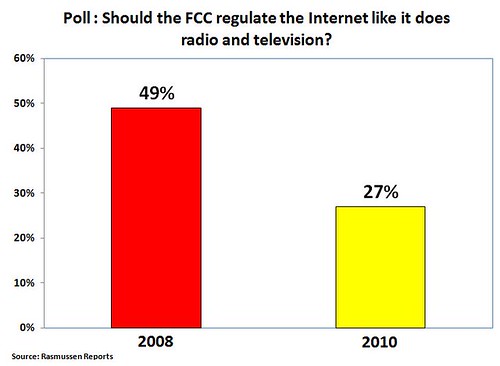
I don’t place a lot of stock in polls… until they confirm what I have long believed, that is! According to this new poll by Rasmussen Reports, 53% of Americans oppose FCC regulation of the Internet. Specifically, in response to the question, “Should the Federal Communications Commission regulate the Internet like it does radio and television?” the breakdown was: 27% =Yes, 53% = No, 19% = Not sure.

But here’s what is more interesting. The 27% of “yes” votes represents a stunning 22-point drop in support for federal regulation of the Internet since a June 2008 poll by Rasmussen, which asked the exact same question. Now, what has changed since 2008 that might have led to such rapidly declining support for Net regulation? Could it have had something to do with the FCC’s ambitious plan to centrally plan broadband markets via its 376-page National Broadband Plan? Or its incessant crusade to impose burdensome Net neutrality regulations, which could decimate investment and innovation?

No, I think what really must be to blame for this sudden public uprising against the FCC was Chairman Julius Genachowski’s alliance with the evil Elmo. People have had enough of the little red demon. That’s my theory and I’m stickin’ to it.  I mean, after all, from what my friends on the Left tell me, the American people are just dying to get Net neutrality regulations on the books and have a massive infusion of taxpayer support for Soviet-style broadband plans and media bailouts.  So clearly those things just can’t be driving this sudden public skepticism about the FCC, right?  It must be Elmo.

Public Wants Less Net Regulation

Several years ago at a conference on universal telecommunications service, one panel moderator noted, “Everything that can be said about universal service has already been said, but not everybody has had a chance to say it, so that’s why we still have these conferences.” After hearings and a study by the Federal Trade Commission, a Federal Communications Commission Notice of Inquiry during the previous administration, the National Broadband Plan, the FCC’s still-open Open Internet proceeding, and Wednesday’s extension of the reply comment period in the Open Internet proceeding, net neutrality is starting to have the same vibe.

That’s why, instead of virtually killing some more virtual trees by writing more lengthy comments and replies, Jerry Brito and I signed onto a declaration by telecommunications researchers which explains that there is no empirical evidence of a systemic problem that would justify net neutrality rules, and these rules might actually ban practices that benefit consumers. Since the world probably doesn’t need another blog post rehashing arguments about this issue, I’ll simply point you to the comment here. It was masterfully written by economist Jeff Eisenach, a veteran of the Federal Trade Commission. (The teeming throngs of humanity who are curious to know whether Jerry and I have any original thoughts to contribute to the issue can read this CommLaw Conspectus article.)

Now that I’ve gotten the shameless self-promotion out of the way, let me MoveOn to a broader point. The debate over net neutrality illustrates how important it is to identify and demonstrate the nature of the problem before trying to solve it.  This applies whether the issue is net neutrality or health care or financial market regulation. Two points in particular bear repeating.

First, ensure that there is empirical evidence of a system-wide problem. The arguments for net neutrality are based on concerns about things the broadband companies might have the ability to do – not empirical proof of widespread abuses that have actually occurred. Less than a handful of famous anecdotes support the argument for net neutrality. Sweeping, systemwide policy changes should only occur when a sweeping, systemwide problem actually exists.

Second, understand the actual nature of the problem. Have a coherent theory of cause and effect that explains why the problem occurs with reasoning that is consistent with what we know about human behavior. Ignoring this point has led to some odd decisions on issues far afield from net neutrality. In 2009, for example, the Department of Energy proposed energy efficiency standards for clothes washers to be used in laundromats and apartment buildings. The justification for the regulation assumed that greedy business owners and landlords willfully ignored opportunities to earn higher profits by investing in energy-efficient appliances! One might argue about whether consumers always identify and act on opportunities to save energy, but assuming that businesses will ignore opportunities to save money is a much bigger stretch.

If you don’t get the problem right, you won’t get the solution right!

Here are two radio programs that took place today discussing the ramifications of this week’s Comcast v. FCC decision. The first was today’s Diane Rehm Show on NPR and it featured Ben Scott of Free Press, Amy Schatz of The Wall Street Journal, and Kyle McSlarrow of the National Cable and Telecommunications Association (NCTA).  I can’t embed it directly here but you can listen to the hour-long show here.

The second program was on KQED – San Francisco’s “Forum with Michael Krasny.” It featured Declan McCullagh of CNET.com, Art Brodsky of Public Knowledge, Eric Klinker, president and CEO of BitTorrent, and me. You can listen to this hour-long debate by clicking below.

http://www.kqed.org/assets/flash/kqedplayer.swf

Well, you got it!  Here’s a essay of mine that The Daily Caller ran today discussing the ramifications of the decision.

___________

Internet freedom got a reprieve Tuesday when the U.S. Court of Appeals for the District of Columbia slapped down a brazen attempt by the Federal Communications Commission (FCC) to ignore the rule of law and begin imposing onerous regulations on broadband network operators. The decision, Comcast v. FCC, deals with arcane matters of regulatory agency jurisdiction, but the stakes were profound and the ramifications for the future of the Internet will reverberate for years to come.

In a nutshell, the FCC argued it had the right to impose so-called “Net neutrality” regulations on a private broadband operator based merely on a handful of principles that the agency had previously said it would not be enforcing as law. Net neutrality regulations would put FCC bureaucrats in the Internet’s driver’s seat and let them determine what was “just and reasonable” of private networks. Critics have rightly feared that Net neutrality sounded all too much a Fairness Doctrine for the Internet since similar language had been used in the broadcast era to justify all sorts of FCC meddling and micromanagement.

Regardless, the FCC’s original position—that its Net neutrality principles were only principles and nothing more—made sense since even a high school civics student can tell you that only Congress can make laws. Moreover, for a brief time, even the FCC seem to realize that laws that would comprehensively regulate such an important sector of the American economy, as Net neutrality rules would, almost certainly require our elected leaders in Congress to reopen and tweak existing statutes like the Telecommunications Act of 1996. After all, Congress had never authorized wide-reaching regulation of the Net or broadband networks, and so, if the agency wanted to extend its regulatory tentacles and wrap them around the Internet it only seems reasonable they get the blessing of lawmakers before doing so. And, for a time, the FCC stuck to a “Hands Off the Net” approach.

Continue reading →

In the wake of yesterday’s ruling in the D.C. Circuit that the FCC had exceeded its authority in attempting to regulate access to the Internet, I did a number of radio interviews and a radio debate with Derek Turner of Free Press, a leading advocate of Internet regulation.

The debate was a brief, fair exchange of views. I was struck, though, to hear Turner refer to the situation as a “crisis.” Sure enough, in a Free Press release, Turner says three times that the ruling creates a “crisis.”

Recall that in 2007 Comcast degraded the service it provided to a tiny group of customers using a bandwidth-hogging protocol called BitTorrent. Recall also that before the FCC acted, Comcast had stopped doing this, relenting to customer complaints, negative attention in news stories, and such.

In the wake of the D.C. Circuit ruling and the crisis it has created, Internet users can expect the following changes to their Internet service:
None.

Wow. With crises like these, who needs tranquility?

“As a result of this decision, the FCC has virtually no power to stop Comcast from blocking Web sites,” the release intones.

That would be worrisome, though still not much of a crisis—except that Comcast would be undercutting its own business by doing that. Did you know also that no federal regulation bars people from burning their furniture in the backyard? That’s the same kind of problem.

As Tim Lee points out in his paper, “The Durable Internet,” consumer pressures are likely in almost all cases to rein in undesirable ISP practices. Computer scientist Lee presents examples of how ownership of communications platforms does not imply control. If an ISP persists in maintaining a harmful practice contrary to consumer demand—and consumers can’t express their desires by switching to another service—we can talk then.

In the meantime, this “crisis” has me slightly drowsy and eager to go outside and enjoy the spring weather.

(Adam beat me to the punch (he’s on East Coast time, after all), but I wanted to make a few preliminary remarks about the FCC loss today anyway.)

The D.C. Circuit Court of Appeals issued its opinion today in Comcast’s appeal of sanctions issued in 2008, rejecting the FCC’s authority to issue the sanctions in the first place.  (Brent Kendall of The Wall Street Journal has already reported the story, see “Court Strikes at Net Neutrality.”)

The ruling punished the cable company’s efforts to throttle peer-to-peer traffic over its network of some customers using the BitTorrent application, a network management principle the FCC said violated its “policy” on open and transparent Internet or “net neutrality.”   Since Comcast agreed to more subtle forms of traffic management and to make such decisions more transparent, the FCC left them with a slap on the wrist.  Comcast appealed nonetheless.  (Appeals of FCC adjudications go directly to the D.C. Circuit.)

I’ve read through the court’s 36-page opinion, which will serve as an important marker in the “net neutrality” debate.  It largely follows the harsh line of questioning taken during the oral arguments for the case back in January, where the panel challenged the FCC to identify a specific statutory provision that gave them authority to impose the neutrality principles—in this case, in an adjudication that Comcast had failed to follow the rules.

Continue reading →

The decision in Comcast v. FCC is out and it’s a resounding defeat for the Federal Communications Commission and the agency’s creative interpretations of “ancillary jurisdiction.”  The U.S. Court of Appeals for the District of Columbia just wasn’t buying the FCC’s claim that it had “ancillary jurisdiction” to enforce amorphous policy principles against Comcast under past case law or, more amazingly, via some deregulatory-minded passages from the Telecommunications Act of 1996. [For all the background on this case and the definitive refutation of the agency’s jurisdictional assertions, see this paper and this filing by my colleague Barbara Esbin. Barbara practically wrote the script for the Court’s decision today through her meticulous debunking of each of the agency’s creative theories of law.]

I’m just working my way through the decision for a second time and will likely have more to say about it in coming days, but I just had to reprint this one passage from the decision on pg. 23-4, in which the Court notes that the FCC is basically asking for “anything goes” authority over all networks and the Internet:

Continue reading →

In the latest PFF TechCast, I discuss the issues considered in the second essay in our ongoing series, “The Wrong Way to Reinvent Media.”  In this 6-minute podcast, PFF’s press director Mike Wendy chats with me about proposals to impose taxes on broadcast spectrum licenses to funnel money to public media or “public interest” content.  In my paper and this podcast, I make the case again socially engineering media choices and outcomes through the tax code.

MP3 file: PFF TechCast #2 – Saving the Media Through Broadcast Spectrum Taxes (4/5/2010)

Broadband Baselines

by on April 1, 2010 · 0 comments

The national broadband plan drafted by Federal Communications Commission staff has a lot of goals in it. Goals for broadband infrastructure deployment include:

  1. Make broadband with 4 Mbps download speeds available to every American
  2. Over the long term, have broadband with 100 Mbps download and 50 Mbps upload speeds available to 100 million American homes, with 50 Mbps downloads available to 100 million homes by 2015
  3. Have the fastest and most extensive wireless broadband networks in the world
  4. Ensure that no state lags significantly behind in 3G wireless coverage
  5. Ensure that every community has access to 1 Gbps broadband service in institutions like schools, libraries, and hospitals

The plan also outlines a number of policy steps that the FCC and other federal agencies could take to help accomplish these goals.

So far, so good. But to truly hold federal agencies accountable for achieving these objectives, we need more than goals, measures, and a list of policy proposals. We also need a realistic baseline that tells us how the market is likely to progress toward these goals in the absence of new federal action, and some way to determine how much the specific policy initiatives affect the amount of the goal achieved.

Here’s what will happen in the absence of a well-defined baseline and analysis that shows how much improvement in the goals is actually caused by federal policies: The broadband plan announces goals. The government will take some actions. Measurement will show that broadband deployment improved, moving the nation closer to achieving the goals. The FCC and other decisionmakers will then claim that their chosen policies have succeeded, because broadband deployment improved.

But in the absence of proof that the policies cause a measurable change in outcomes, this is like the rooster claiming that his crowing makes the sun rise. Scientists call this the ” post hoc, ergo propter hoc” fallacy: “B happened after A, therefore A must have caused B.” (Brush up on your Latin a little more, and you’ll even find out what Mercatus means. But I digress.)

Enough abstractions. Let me give a few examples.

The first goal listed above is to ensure that all Americans have access to broadband with 4 Mbps download speeds. In his second comment on my March 17 “Broadband Funding Gap” post, James Riso notes that the plan acknowledges that 5 out of the 7 million households that currently lack access to 4 Mbps broadband will soon be covered by 4th generation wireless. That means coverage for 83 percent of the households that lack 4 Mbps broadband is already “baked into the cake.” 

Accurate accountability must avoid giving future policy changes credit for this increase in deployment, because it was going to happen anyway.  (Of course, policymakers need to avoid taking steps that would discourage this deployment, such as levying the 15 percent universal service fee on 4th generation wireless.) The relevant question for evaluating future policy changes is, “How do they affect deployment to the remaining 2 million households?”

Similarly, the goal of 50 Mbps to 100 million households by 2015 seems to have been chosen because cable and fiber broadband providers indicate that they plan to cover more than that many homes by 2013 with broadband capable of delivering those speeds (pp. 21-22). Future policy initiatives should get zero credit for contributing toward this goal unless analysis demonstrates that the initiatives increased deployment of very high speed broadband over and above what the companies were already planning.

If you think this point is so basic that it’s not worth mentioning, you haven’t read enough government reports. Post hoc, ergo propter hoc is endemic, and not just on technology-related topics. For example, both sides regularly display this fallacy whenever the unemployment figures get released: “Unemployment increased after Obama’s election, therefore his administration caused the unemployment.” “The recession started when Bush was president, therefore his administration caused the unemployment.” These are at best hypotheses whose truth, untruth, and quantititive significance needs to be established by analysis that controls for other factors affecting the results.

Just take this as an advance warning on reporting results of the national broadband plan: Tone down the triumphalism.  

Note: For those of you who just can’t get enough discussion of the national broadband plan, Jerry Brito and I will have a dialog on other aspects of the plan in a future podcast that will be available here on Surprisingilyfree.com.
Just in case you missed Adam Thierer’s unhinged rant, My Swan Song Moment: I Will Take Elmo Hostage in the Name of First Amendment Freedoms!, you’ll want to go back and read it after watching this:

http://www.youtube.com/v/NUYaHBvVS5o&hl=en_US&fs=1& Not exactly a highpoint in the history of deliberative democracy or rhetoric (in the best sense), but I suppose it beats wading through the 376 page National Broadband Plan… Anyway, given all this talk about increasing funding for the Corporation for Public Broadcasting as a way of “saving media,” I do have to wonder: Just how far will we go in allowing taxpayer-funded muppets to rally public support for this (or future) administration’s policy agenda? I mean, if the White Houe had put Oscar the Grouch on national TV to lobby for health care socialization “reform” by explaining whatever trash-related chronic medial conditions are responsible for making him so darn cranky, I think some folks would rightly have been upset. Yes, I’m trying to be funny here but, seriously, where’s the line between harmless fun and… inappropriate use of taxpayer-funded resources for political purposes? I’m not sure. The administration probably crossed that line last September when President Obama gave a speech to kids and the Department of Education sent a proposed lesson plan to schools nationwide (later withdrawn) suggesting that pre-K-6 teachers have their students “write letters to themselves about what they can do to help the president.” But is Elmo’s meeting with Chairman Genachowski ok as a way of rallying kids—and, more importantly, their parents and everyone else who finds it cute—around a policy agenda? Any thoughts on where this line should be drawn?