Very cool little video here by Jess3 documenting Internet growth and activity. Ironically, Berin sent it to me as Adam Marcus and I were updating the lengthy list of Net & online media stats you’ll find down below. Many of the stats we were compiling are shown in the video. Enjoy!
http://vimeo.com/moogaloop.swf?clip_id=9641036&server=vimeo.com&show_title=1&show_byline=1&show_portrait=1&color=ffffff&fullscreen=1
- 1.73 billion Internet users worldwide as of Sept 2009; an 18% increase from the previous year.
[1]
- 81.8 million .COM domain names at the end of 2009; 12.3 million .NET names & 7.8 million .ORG names.
[2]
- 234 million websites as of Dec 2009; 47 million were added in 2009.
[3] In 2006, Internet users in the United States viewed an average of 120.5 Web pages each day.
[4]
- There are roughly 26 million blogs on the Internet
[5] and even back in 2007, there were over 1.5 million new blog posts every day (17 posts per second).
[6] Continue reading →
If a tree falls in the forest, who cares who hears it?
But when we “publish,” “speak” or “share” online, we often do care who hears it. While millions of users eagerly share huge amounts of information about themselves and their activities by posting status updates, photos, videos, events, etc., nearly everyone would rather limit
some of their sharing to a select circle of contacts. For some users (and in some situations), that circle might be quite small, while it could be very large or unlimited for other users or situations. How public is too public when it comes to what we share about ourselves? Personalizing our audience is something we each have to decide for ourselves depending on the circumstances—what I would call “publication privacy.” (It’s a potentially ambiguous term, I’ll grant you, since “publication” still doesn’t obviously refer to user-generated content in everyone’s mind, but I think it’s more clear than “Sharing Privacy,” since “publication” is a subset of the information we “share” about ourselves.)
For all the talk about the “Death of Privacy“—be that good, bad, or simply inevitable—publication privacy is thriving. Twitter, most famously, offers users only the binary choice of either locking down their entire feed (so that you have to approve requests to “follow” you) or making it public to everyone on the service. But just in the last two months, we’ve seen a sea change in the ability of users to manage their publication privacy.
Facebook’s Publication Controls
First, in December, Facebook began offering users the ability to control access to each and every piece of content they share—like so:
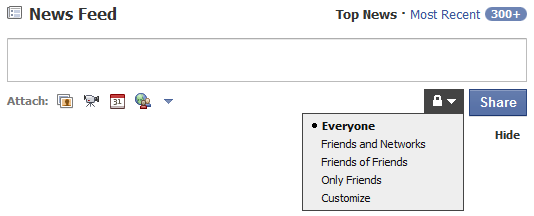 Continue reading →
I’m a big fan of CNET’s “Buzz Out Loud” podcast and often enjoy co-host Molly Wood’s occasional “Molly Rant” but I’m disappointed to see her jumping on the Google-bashing bandwagon with her latest rant: “Google Buzz: Privacy nightmare.” Instead of appreciating the “privacy by design” features of Buzz, she seems to be rushing to privacy paternalism—just as I feared many would when I blogged about the Buzz launch.
Molly’s primary complaint, repeated several times, is that “you automatically follow everyone in your Gmail contact list, and that information is publicly available in your profile, by default, to everyone who visits your profile.” Actually, while Buzz
does automatically follow some users your contact list, it does so only for the ones you chat with most using Gmail (which I believe means only other Gmail users). After that, Buzz simply tells you when other users follow you, and makes it easy to follow them.
So what’s the big deal? Molly’s concern, shared by a number of other bloggers, is that, before a user can start Buzzing, they have to set up Google Profile (another Google product launched last August, which typically appears on the bottom of the first page of Google search results for that name) and the default setting for Google profiles is to “Display the list of people I’m following and people following me.” In this respect, your Google Profile is a lot like your Facebook profile, except that users can decide to hide their followers/followees on their Google profile. (On Facebook, that information is part of the limited bucket of “publicly available information” and can’t be hidden by the user from their profile, but users can opt-out of having their profile accessible at all through search engines or Facebook search.)
There are essentially three ways of dealing with this concern about inadvertent sharing of sensitive contacts: Continue reading →
By Berin Szoka & Adam Thierer
 We learned from The Wall Street Journal yesterday that “Federal Communications Commission Chairman Julius Genachowski gets a little peeved when people suggests that he wants to regulate the Internet.” He told a group of Journal reporters and editors today that: “I don’t see any circumstances where we’d take steps to regulate the Internet itself,” and “I’ve been clear repeatedly that we’re not going to regulate the Internet.”
We’re thankful to hear Chairman Julius Genachowski to make that promise. We’ll certainly hold him to it. But you will pardon us if we remain skeptical (and, in advance, if you hear a constant stream of “I told you so” from us in the months and years to come). If the Chairman is “peeved” at the suggestion that the FCC might be angling to extend its reach to include the Internet and new media platforms and content, perhaps he should start taking a closer look at what his own agency is doing—and think about the precedents he’s setting for future Chairmen who might not share his professed commitment not to regulate the ‘net. Allow us to cite just a few examples:
Net Neutrality Notice of Proposed Rulemaking
We’re certainly aware of the argument that the FCC’s proposed net neutrality regime is not tantamount to Internet regulation—but we just don’t buy it. Not for one minute.
First, Chairman Genachowski seems to believe that “the Internet” is entirely distinct from the physical infrastructure that brings “cyberspace” to our homes, offices and mobile devices. The WSJ notes, “when pressed, [Genachowski] admitted he was referring to regulating Internet content rather than regulating Internet lines.” OK, so let’s just make sure we have this straight: The FCC is going to enshrine in law the principle that “gatekeepers” that control the “bottleneck” of broadband service can only be checked by having the government enforce “neutrality” principles in the same basic model of “common carrier” regulation that once applied to canals, railroads, the telegraph and telephone. But when it comes to accusations of “gatekeeper” power at the content/services/applications “layers” of the Internet, the FCC is just going to step back and let markets sort things out? Sorry, we’re just not buying it. Continue reading →
In case you missed it, the world stopped moving today to witness the birth of another Google product: the much-ballyhooed “Twitter-Killer,” Buzz, which offers much of the functionality of Twitter in a more Facebook-like setting (plus location data) built directly into Gmail. CNET’s Larry Magid started the #GoogSoc (“Google Social”) hashtag for the event, kicking off a discussion about Twitter’s newest competitor on Twitter itself—and he was the first one up to the mic with a question for Google Founder Sergey Brin and his team after their presentation. Larry asked about privacy concerns raised by Buzz and Brin responded, as Larry puts it:
that there are privacy controls built-into both the web and mobile Buzz applications but, by default, much of your information is public. For example, if you don’t specify that a Buzz should only be seen by your friends, it’s made available to everyone and indexed by the Google search engine. Like Facebook, Buzz gives you the ability to create lists so you can have a separate Buzz group for your drinking buddies and another one for people at work. However,as with all privacy tools, the key is how you use them. My concern is that some people might forget to use the privacy tools and send the wrong information to the wrong people.
There are also controls on whether your geo-location is disclosed but, again,
i
t’s up to the user to be careful on how they use them. Imagine sending a post out to your significant other that you’re stuck at work only to accidentally reveal that you’re actually located in a romantic restaurant down the street from the office?
I’m glad that Larry is raising these concern as someone who has done yeoman’s work in educating Internet users, especially kids, about how to “Connect Safely” online (the name of his advocacy group). The fact that companies like Google know they’ll get questions like Larry’s is hugely important in keeping them on their toes to continually plan for “privacy by design.”
But I do worry that those with a political axe to grind will take these same questions and twist them into arguments for regulation based on the idea that if
some people forget to use a tool or just don’t get care as much about protecting their privacy as some self-appointed “privacy advocates” think they should, the government—led by Platonic philosopher kings who know what’s best for us all—should step in to protect us all from our own forgetfulness, carefulness or plain ol’ apathy. After all, consumers are basically mindless sheep and if the government doesn’t look after them, the digital wolves will devour them whole! Continue reading →
Most of you have probably already seen this but Pingdom recently aggregated and posted some amazing stats about “Internet 2009 In Numbers.” Worth checking them all out, but here are some highlights:
- 1.73 billion Internet users worldwide as of Sept 2009; 18% increase in Internet users since previous year.
- 81.8 million .COM domain names at the end of 2009; 12.3 million .NET & 7.8 million .ORG
- 234 million websites as of Dec 2009; 47 million were added in 2009.
- 90 trillion emails sent on the Internet in 2009; 1.4 billion email users worldwide.
- 26 million blogs on the Internet.
- 27.3 million tweets on Twitter per day as of Nov 2009.
- 350 million people on Facebook; 50% of them log in every day; + 500,000 active Facebook applications.
- 4 billion photos hosted by Flickr as of Oct 2009; 2.5 billion photos uploaded each month to Facebook.
- 1 billion videos served by YouTube each day; 12.2 billion videos viewed per month; 924 million videos viewed per month on Hulu in the US as of Nov 2009; + the average Internet user in the US watches 182 online videos each month.
And yet some people claim that digital generativity and online innovation are dead! Things have never been better.
Over at Mashable, Ben Parr has a post (“Facebook Turns to the Crowd to Eradicate Offensive Content“) expressing surprise that Facebook has a crowdsourcing / community policing solution to deal with objectionable content:
Did you know that Facebook has a crack team of employees whose mission is to deal with offensive content and user complaints? Their ranks number in the hundreds. But while most websites have people on staff to deal with porn and violence, none of them have 350 million users to manage… Now the world’s largest social network found a way to deal with this shortage of manpower, though. Facebook has begun testing a new feature called the Facebook Community Council [currently invite-only]. According to a guest post on the Boing Boing blog by one of the council’s members, its goal is to purge Facebook of nudity, drugs, violence, and spam.
The Facebook Community Council is actually a Facebook app and tool for evaluating content for various offenses… The app’s tagging system allows council members to tag content with one of eight phrases: Spam, Acceptable, Not English, Skip, Nudity, Drugs, Attacking, and Violence. If enough council members tag a piece of content with the same tag, action is taken, often a takedown.
What Facebook is doing here is nothing all that new. Many other social networking sites or platforms such MySpace, Ning, and many others, do much the same. Video hosting sites like YouTube do as well. [See my summary of YouTube’s efforts down below]**
No doubt, some will be quick to decry “private censorship” with moves by social networking sites, video hosting sites, and others to flag and remove objectionable content within their communities, but such critics need to understand that:
Continue reading →
Over at Silicon Alley Insider, Gregory Galant has a wonderful post about “18 Awesome Tech Things We Didn’t Have 10 Years Ago.” It serves as another great example of the amazing technological progress we have witnessed over the past decade. He’s asking people for suggestions for what else should be on the list, so head over there and let him know. Seems like wi-fi technologies should be on there somehow. FiOS deserves a shout-out, too. And where’s Firefox & Chrome? Also, I’ll put in a special word for some amazing new home theater technologies: high-def flat-screens and projectors; media servers & Windows Media Center; BluRay; and 3 incredible gaming / media consoles (Wii, PS3, & XBox). Anyway, here’s Galant’s list:
Wikipedia
Gmail
Facebook
YouTube
Twitter
AdWords
Amazon AWS
RSS (started in ‘99 but didn’t catch on till the ’00s)
Meetup
iPod
Google Maps
Podcasts
Mint
Skype/VOIP
iPhone
Google Docs
Creative Commons
Flickr
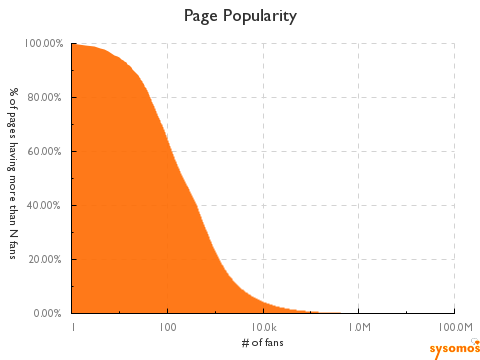 Perfect media equality is impossible. There has never been anything close to “equal outcomes” when it comes to the distribution or relative success of old media: books, magazines, music, movies, book, theater tickets, etc. A small handful of titles have always dominated, usually according to a classic “power law” or “80-20? distribution, with roughly 20% of the titles getting 80% of the traffic / revenue.
But here’s the really interesting thing:
This trend is increasing, not decreasing, for newer and more “democratic” online media. As I pointed out in two previous essays [“YouTube, Power Laws & the Persistence of Media Inequality” & “Cuban on Fragmentation & Attention in the Blogosphere (or Why Power Laws Really Do Govern All Media)”], there is solid evidence that blogs, YouTube, Twitter, and other digital media outlets and platforms not only follow a classic power law distribution but that the distribution is even more heavily skewed toward the “fat head” of the distribution curve, not “the long tail” of it.
The latest evidence of the persistence of power laws across media comes from Facebook. Erick Schonfeld has a new essay up at TechCrunch (“It’s Not Easy Being Popular. 77 Percent Of Facebook Fan Pages Have Under 1,000 Fans“) highlighting some new findings from an upcoming report by Sysomos, a social media monitoring and analytics firm. Here’s the summary from Schonfeld: Continue reading →
The Internet is massive. That’s the ‘no-duh’ statement of the year, right? But seriously, the sheer volume of transactions (both economic and non-economic) is simply staggering. Consider a few factoids to give you a flavor of just how much is going on out there:
- In 2006, Internet users in the United States viewed an average of 120.5 Web pages each day.
- There are over 1.4 million new blog posts every day.
- Social networking giant Facebook reports that each month, its over 300 million users upload more than 2 billion photos, 14 million videos, and create over 3 million events. More than 2 billion pieces of content (web links, news stories, blog posts, notes, photos, etc.) are shared each week. There are also roughly 45 million active user groups on the site.
- YouTube reports that 20 hours of video are uploaded to the site every minute.
- Amazon reported that on December 15, 2008, 6.3 million items were ordered worldwide, a rate of 72.9 items per second.
- Every six weeks, there are 10 million edits made to Wikipedia.
Now, let’s think about how some of our lawmakers and media personalities talk about the Internet. If we were to judge the Internet based upon the daily headlines in various media outlets or from the titles of various Congressional or regulatory agency hearings, then we’d be led to believe that the Internet is a scary, dangerous place. That ‘s especially the case when it comes to concerns about online privacy and child safety. Everywhere you turn there’s a bogeyman story about the supposed dangers of cyberspace.
But let’s go back to the numbers. While I certainly understand the concerns many folks have about their personal privacy or their child’s safety online, the fact is
the vast majority of online transactions that take place online each and every second of the day are of an entirely harmless, even socially beneficial nature. I refer to this disconnect as the “problem of proportionality” in debates about online safety and privacy. People are not just making mountains out of molehills, in many cases they are just making the molehills up or blowing them massively out of proportion. Continue reading →

 The Technology Liberation Front is the tech policy blog dedicated to keeping politicians' hands off the 'net and everything else related to technology.