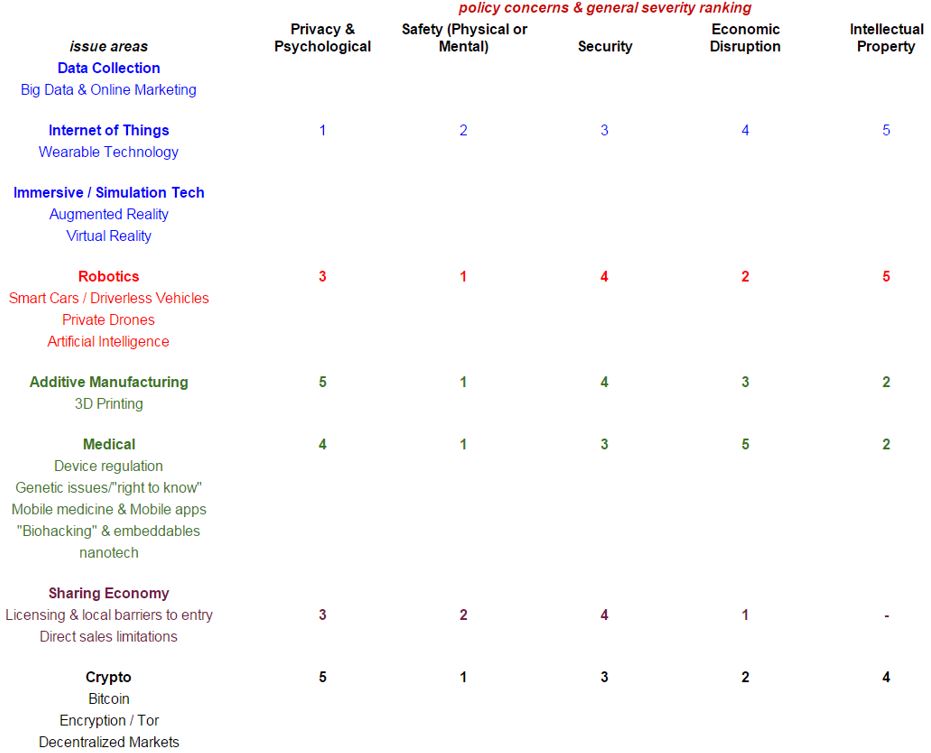
On the whiteboard that hangs in my office, I have a giant matrix of technology policy issues and the various policy “threat vectors” that might end up driving regulation of particular technologies or sectors. Along with my colleagues at the Mercatus Center’s Technology Policy Program, we constantly revise this list of policy priorities and simultaneously make an (obviously quite subjective) attempt to put some weights on the potential policy severity associated with each threat of intervention. The matrix looks like this: [Sorry about the small fonts. You can click on the image to make it easier to see.]
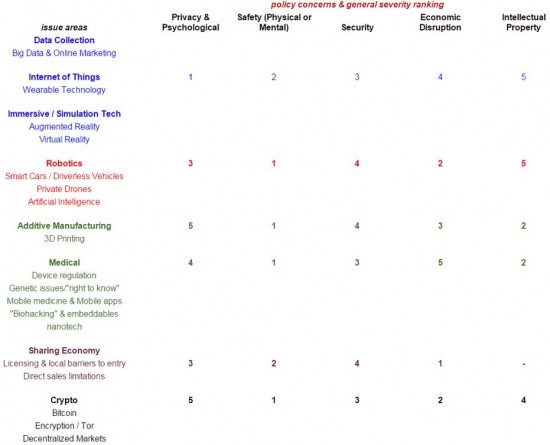
I use 5 general policy concerns when considering the likelihood of regulatory intervention in any given area. Those policy concerns are:
- privacy (reputation issues, fear of “profiling” & “discrimination,” amorphous psychological / cognitive harms);
- safety (health & physical safety or, alternatively, child safety and speech / cultural concerns);
- security (hacking, cybersecurity, law enforcement issues);
- economic disruption (automation, job dislocation, sectoral disruptions); and,
- intellectual property (copyright and patent issues).
Continue reading →
This past week I posted two new essays related to my new book, “Permissionless Innovation: The Continuing Case for Comprehensive Technological Freedom.” Just thought I would post quick links here.
First, my old colleague Dan Rothschild was kind enough to ask me to contribute a post to the R Street Blog entitled, “Bucking the ‘Mother, May I?’ Mentality.” In it, I offered this definition and defense of permissionless innovation as a policy norm:
Permissionless innovation is about the creativity of the human mind to run wild in its inherent curiosity and inventiveness, even when it disrupts certain cultural norms or economic business models. It is that unhindered freedom to experiment that ushered in many of the remarkable technological advances of modern times. In particular, all the digital devices, systems and networks that we now take for granted came about because innovators were at liberty to let their minds run wild.
Steve Jobs and Apple didn’t need a permit to produce the first iPhone. Jeff Bezos and Amazon didn’t need to ask anyone for the right to create a massive online marketplace. When Sergey Brin and Larry Page wanted to release Google’s innovative search engine into the wild, they didn’t need to get a license first. And Mark Zuckerberg never had to get anyone’s blessing to launch Facebook or let people freely create their own profile pages.
All of these digital tools and services were creatively disruptive technologies that altered the fortunes of existing companies and challenged various social norms. Luckily, however, nothing preemptively stopped that innovation from happening. Today, the world is better off because of it, with more and better information choices than ever before.
I also posted an essay over on Medium entitled, ”
Why Permissionless Innovation Matters.” It’s a longer essay that seeks to answer the question: Why does economic growth occur in some societies & not in others? I build on the recent comments of venture capitalist Fred Wilson of Union Square Ventures noted during recent testimony: “If you look at the countries around the world where the most innovation happens, you will see a very high, I would argue a direct, correlation between innovation and freedom. They are two sides of the same coin.” Continue reading →
 I am pleased to announce the release of my latest book, “Permissionless Innovation: The Continuing Case for Comprehensive Technological Freedom.” It’s a short manifesto (just under 100 pages) that condenses — and attempts to make more accessible — arguments that I have developed in various law review articles, working papers, and blog posts over the past few years. I have two goals with this book.
First, I attempt to show how the central fault line in almost all modern technology policy debates revolves around “the permission question,” which asks:
Must the creators of new technologies seek the blessing of public officials before they develop and deploy their innovations? How that question is answered depends on the disposition one adopts toward new inventions. Two conflicting attitudes are evident.
One disposition is known as the “precautionary principle.” Generally speaking, it refers to the belief that new innovations should be curtailed or disallowed until their developers can prove that they will not cause any harms to individuals, groups, specific entities, cultural norms, or various existing laws, norms, or traditions.
The other vision can be labeled “permissionless innovation.” It refers to the notion that experimentation with new technologies and business models should generally be permitted by default. Unless a compelling case can be made that a new invention will bring serious harm to society, innovation should be allowed to continue unabated and problems, if they develop at all, can be addressed later.
I argue that we are witnessing a grand clash of visions between these two mindsets today in almost all major technology policy discussions today. Continue reading →
 I’m pretty rough on all the Internet and info-tech policy books that I review. There are two reasons for that. First, the vast majority of tech policy books being written today should never have been books in the first place. Most of them would have worked just fine as long-form (magazine-length) essays. Too many authors stretch a promising thesis into a long-winded, highly repetitive narrative just to say they’ve written an entire book about a subject. Second, many info-tech policy books are poorly written or poorly argued. I’m not going to name names, but I am frequently unimpressed by the quality of many books being published today about digital technology and online policy issues.
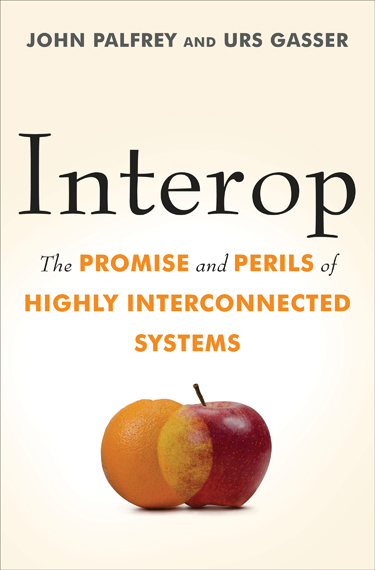
The books of Harvard University cyberlaw scholars John Palfrey and Urs Gasser offer a welcome break from this mold. Their recent books, Born Digital: Understanding the First Generation of Digital Natives, and Interop: The Promise and Perils of Highly Interconnected Systems, are engaging and extremely well-written books that deserve to be books. There’s no wasted space or mindless filler. It’s all substantive and it’s all interesting. I encourage aspiring tech policy authors to examine their works for a model of how a book should be done.
In a 2008 review, I heaped praise on Born Digital and declared that this “fine early history of this generation serves as a starting point for any conversation about how to mentor the children of the Web.” I still recommend highly to others today. I’m going to be a bit more critical of their new book, Interop, but I assure you that it is a text you absolutely must have on your shelf if you follow digital policy debates. It’s a supremely balanced treatment of a complicated and sometimes quite contentious set of information policy issues.
In the end, however, I am concerned about the open-ended nature of the standard that Palfrey and Gasser develop to determine when government should intervene to manage or mandate interoperability between or among information systems. I’ll push back against their amorphous theory of “optimal interoperability” and offer an alternative framework that suggests patience, humility, and openness to ongoing marketplace experimentation as the primary public policy virtues that lawmakers should instead embrace. Continue reading →
Over at his always-informative Spectrum Blog, wireless guru Michael Marcus brings to my attention a new report that will definitely be of interest to everyone here about “The Economic Value Generated by Current and Future Allocations of Unlicensed Spectrum.” It was written by Rich Thanki of Perspective Associates, a UK consulting firm. I haven’t had time to finish the whole thing yet, but it basically lays out the argument for opening up more spectrum, especially “white spaces,” to unlicensed use.
Anyway, Mike Marcus has an much better write-up of the report than I could ever do, so head over there to check out his discussion. One important thing that Mike stresses is the importance of technical flexibility:
But the key issue here is not the presence or absence of a license, the key issue is deregulation. A major reason why unlicensed networks have been so innovative is that the descendants of the FCC Docket 81-413 rulemaking, e.g. Wi-Fi, Bluetooth, and Zigbee have been in spectrum bands with great technical flexibility… If you overregulate unlicensed systems, they can stagnate just as much as licensed one often do.
I think that is an important insight and essential lesson that we should always keep in mind when it comes to spectrum policy, regardless of whether we talking about licensed or unlicensed spectrum. Although I’ve always been a bit torn about how much spectrum should be allocated on an unlicensed (or “commons”) basis versus auctioned (property rights model), as Marcus suggests, flexibility is crucial in either case. In all the heated catfights over licensed and unlicensed spectrum, that point sometimes gets overlooked.
I’ve been quite depressed to witness Bruce Schneier’s ongoing conversion from opponent of government intervention in the high-tech economy (at least on encryption) to vociferous proponent (at least in terms of privacy regulation). Anyway, his latest cheerleading piece for government privacy regulation in The Wall Street Journal includes lots of fear-mongering about private website data collection for, God forbid, purposes of trying to better target advertising and market us products we might actually want.
Schneier uses the term “deceptive” several times in the piece to refer to privacy policies that don’t make it explicitly clear that some of the information you leave on a site, or that is collected preemptively by them, will be used to craft more targeted marketing efforts. Like many other would-be privacy regulators, Schneier seemingly wants companies to fly blimps over your desk as you surf the Net with big signs that basically say: ‘Hey stupid, your info may be used to market you stuff.’ It’s hard to be against more disclosure, of course — and most sites spell out what they do with data in their privacy policies — but it never seems to be good enough for most privacy advocates, who paint consumers out to be mindless sheep who cannot be trusted to make wise decisions for themselves. Sorry, but I just don’t buy it.
Continue reading →
One of the reasons that so many of us here take issue with proposals to expand regulation of communications, broadband, and media markets is because we have studied the horrendous inefficiencies of economic regulation in practice. We oppose regulatory proposals not because of a “blind faith” in free markets, but because we understand that even when markets stumble they correct themselves quicker and more efficiently than regulatory systems do. One can profess the supposed theoretical benefits of enlightened “public interest” regulation all they want, but the facts are the facts. And the facts do not support the proposition that government regulation generally enhances consumer welfare.
In that regard, Tim Lee’s new Net neutrality report for Cato does a nice job of surveying some of the past unintended consequences of regulation. Also, even though it is now 10 years old, I highly recommend “Economic Deregulation and Customer Choice” by Jerry Ellig and Robert Crandall. It’s an outstanding overview of why economic regulation of various industries failed consumers so miserably in the past.
But if you want even more shocking proof of how horrendously inefficient communications regulation can be in practice, then you must read my PFF colleague Barbara Esbin’s two essays this week on the Universal Service Fund (USF): “The High Cost of USF Support,” and “More FCC Support Fund Follies.” In these two essays, Esbin walks the reader through various grim reports and statistics that have been released recently documenting the failures of the USF.
Continue reading →
As TLF readers may know, I took over in July as Chairman of the Board of the Space Frontier Foundation. As I explained in my recent interview on The Space Show, SFF has been the leading citizens’ advocacy group for space commercialization since 1988. Dedicated to promoting Princeton physicist Gerard O’Neill‘s vision of space settlement, as described in his 1976 masterpiece The High Frontier, the Foundation has always argued that “space is a place, not a program.”
We sent out the following press release on October 28, calling for a major transformation of the U.S. government’s space program by which the U.S. government would buy commercial transportation to the International Space Station. We’ll have more to say about this in the coming weeks.
Space Frontier Foundation Finds Funding Source for COTS-D
 The Space Frontier Foundation today called upon Presidential candidates Barack Obama and John McCain to invest the $2 billion in new funds they have promised to NASA for reducing the “Gap” in U.S. human spaceflight (after the Space Shuttle is retired in 2010) to spur innovation and competition in America.
Foundation Chairman Berin Szoka said “It’s time that our national leaders give American entrepreneurs a shot at closing this gap. Let’s take the two billion dollars in the candidates’ plans and fund up to five winners of COTS-D.”
The NASA Authorization Act of 2008, recently signed into law by the President, directs NASA to “issue a notice of intent [by mid-April 2009] … to enter into a funded, competitively awarded Space Act Agreement with two or more commercial entities’ for transporting humans to the ISS”-the “Capability D” of NASA’s Commercial Orbital Transportation Services program (or COTS-D for short). But that directive is not yet funded.
Szoka continued, “Let’s have an American competition in space – to create good jobs, fuel innovation, and close the gap more quickly. With private funds matching government’s investment, we can dramatically leverage the $2 billion to produce breakthroughs in a new American industry – commercial orbital human spaceflight.” Continue reading →
The Federal Circuit significantly limited the patentability of software and business methods today. Mike Masnick at TechDirt summarizes the holding of the case as follows:
the court has said that there’s a two-pronged test to determine whether a software of business method process patent is valid: (1) it is tied to a particular machine or apparatus, or (2) it transforms a particular article into a different state or thing. In other words, pure software or business method patents that are neither tied to a specific machine nor change something into a different state are not patentable.
I’m sure several of my TLF colleagues will have a great deal to say about this. Tim Lee has already written about this on Ars Technica:
The Bilski decision, then, is a clear signal that the pendulum has begun to swing back toward tighter limits on software and business patents. However, it remains to be seen how far the court will go in this direction. Bilski was a relatively easy case. The applicant made little effort to hide the fact that he was seeking to patent a mental process, something the Supreme Court has clearly said is not allowed. Therefore, the Federal Circuit’s rejection of this patent doesn’t tell us how it will rule when confronted with software or business method patents that are tied more directly to a physical machine or a transformation of matter. And indeed, the Federal Circuit reiterated that some software and business method patents are valid, so we are unlikely to return to the near-prohibition on such patents that prevailed until the early 1980s.
Thoughts?
Debates about online privacy often seem to assume relatively homogeneous privacy preferences among Internet users. But the reality is that users vary widely, with many people demonstrating that they just don’t care who sees what they do, post or say online. Attitudes vary from application to application, of course, but that’s precisely the point: While many reflexively talk about the “importance of privacy” as if a monolith of users held a single opinion, no clear consensus exists for all users, all applications and all situations.
If a picture is worth a thousand words, this picture makes the point brilliantly—showing:
locations where [Flickr] users are more likely to post their photos as “public,” which is the default setting, in green. Places where Flickr users are more likely to put privacy controls on their photos show up in red.

Of course, geography is just one dimension across which users may vary in their attitudes about privacy, but the map makes the basic point about variation very well. Seeing what users
actually do in real life says a lot more about their preferences than merely polling them about what they think they care about in the abstract—as my colleagues Solveig Singleton and Jim Harper argued brilliantly in their 2001 paper With A Grain of Salt: What Consumer Privacy Surveys Don’t Tell Us (SSRN).


 The Technology Liberation Front is the tech policy blog dedicated to keeping politicians' hands off the 'net and everything else related to technology.