 I’m excited to announce the release of my latest law review article, “The Pursuit of Privacy in a World Where Information Control is Failing,” which appears in the next edition (vol. 36) of the Harvard Journal of Law & Public Policy. This is the first of two complimentary law review articles that I will be releasing this year dealing with privacy policy. The second, which will be published later this summer by the George Mason University Law Review, is entitled, “A Framework for Benefit-Cost Analysis in Digital Privacy Debates.” (FYI: Both articles focus on privacy claims made against private actors — namely, efforts to limit private data collection — and not on privacy rights against governments.)
The new
Harvard Journal article is divided into three major sections. Part I focuses on some of normative challenges we face when discussing privacy and argues that there may never be a widely accepted, coherent legal standard for privacy rights or harms here in the United States. It also explores the tensions between expanded privacy regulation and online free speech. Part II turns to the many enforcement challenges that are often ignored when privacy policies are being proposed or formulated and argues that legislative and regulatory efforts aimed at protecting privacy must now be seen as an increasingly intractable information control problem. Most of the problems policymakers and average individuals face when it comes to controlling the flow of private information online are similar to the challenges they face when trying to control the free flow of digitalized bits in other information policy contexts, such as online safety, cybersecurity, and digital copyright.
If the effectiveness of law and regulation is limited by the normative considerations discussed in Part I and the practical enforcement complications discussed in Part II, what alternatives remain to assist privacy-sensitive individuals? I address that question in Part III of the paper and argue that the approach America has adopted to deal with concerns about objectionable online speech and child safety offers a path forward on the privacy front as well. Continue reading →
Andrew Orlowski of The Register (U.K.) recently posted a very interesting essay making the case for treating online copyright and privacy as essentially the same problem in need of the same solution: increased property rights. In his essay (“‘Don’t break the internet’: How an idiot’s slogan stole your privacy“), he argues that, “The absence of permissions on our personal data and the absence of permissions on digital copyright objects are two sides of the same coin. Economically and legally they’re an absence of property rights – and an insistence on preserving the internet as a childlike, utopian world, where nobody owns anything, or ever turns a request down. But as we’ve seen, you can build things like libraries with permissions too – and create new markets.” He argues that “no matter what law you pass, it won’t work unless there’s ownership attached to data, and you, as the individual, are the ultimate owner. From the basis of ownership, we can then agree what kind of rights are associated with the data – eg, the right to exclude people from it, the right to sell it or exchange it – and then build a permission-based world on top of that.”
And so, he concludes, we should set aside concerns about Internet regulation and information control and get down to the business of engineering solutions that would help us property-tize both intangible creations and intangible facts about ourselves to better shield our intellectual creations and our privacy in the information age. He builds on the thoughts of Mark Bide, a tech consultant:
For Bide, privacy and content markets are just a technical challenges that need to be addressed intelligently.”You can take two views,” he told me. “One is that every piece of information flowing around a network is a good thing, and we should know everything about everybody, and have no constraints on access to it all.” People who believe this, he added, tend to be inflexible – there is no half-way house. “The alternative view is that we can take the technology to make privacy and intellectual property work on the network. The function of copyright is to allow creators and people who invest in creation to define how it can be used. That’s the purpose of it. “So which way do we want to do it?” he asks. “Do we want to throw up our hands and do nothing? The workings of a civilised society need both privacy and creator’s rights.” But this a new way of thinking about things: it will be met with cognitive dissonance. Copyright activists who fight property rights on the internet and have never seen a copyright law they like, generally do like their privacy. They want to preserve it, and will support laws that do. But to succeed, they’ll need to argue for stronger property rights. They have yet to realise that their opponents in the copyright wars have been arguing for those too, for years. Both sides of the copyright “fight” actually need the same thing. This is odd, I said to Bide. How can he account for this irony? “Ah,” says Bide. “Privacy and copyright are two things nobody cares about unless it’s their own privacy, and their own copyright.”
These are important insights that get at a fundamental truth that all too many people ignore today: At root,
most information control efforts are related and solutions for one problem can often be used to address others. But there’s another insight that Orlowski ignores: Whether we are discussing copyright, privacy, online speech and child safety, or cybersecurity, all these efforts to control the free flow of digitized bits over decentralized global networks will be increasingly complex, costly, and riddled with myriad unintended consequences. Importantly, that is true whether you seek to control information flows through top-down administrative regulation or by assigning and enforcing property rights in intellectual creations or private information.
Let me elaborate a bit (and I apologize for the rambling mess of rant that follows).
Over at Forbes I have posted some thoughts on the new privacy framework (Consumer Data Privacy in a Networked World) that the Obama Administration released today. In my essay, “The Problem with Obama’s “Let’s Be More Like Europe” Privacy Plan,” I hammer home the same point I’ve made here before many times: Regulation is not a costless exercise. No matter how well-intentioned regulatory proposals may be, they can often have unforeseen, unintended consequences. This is equally true for privacy controls. I discuss how a new privacy regulatory regime could drive up prices for services that currently are free or inexpensive, limit new digital services and innovations, create barriers to entry for new entrants and entrepreneurs, negatively impact the competitiveness of existing U.S. Internet operators, and, more generally, increase the horizons of government power over the Internet.
For a more detailed analysis of these issues, I encourage you to check out my big Mercatus Center filing to the FTC last year on privacy and Do Not Track regulation. Also, here are few TLF essays that summarize my skepticism about expanded privacy controls:
Here’s a sharp editorial from The Economist about Internet governance entitled, “In Praise of Chaos: Governments’ Attempts to Control the Internet Should be Resisted.” In the wake of the recent Internet Governance Forum meeting, many folks are once again debating the question of who rules the Net? Along with Wayne Crews, I edited a huge collection of essays on that topic back in 2003 and it’s a subject that continues to interest me greatly. As I noted here last week, many of those who desire greater centralization of control over Net governance decisions are using the fear that “fragmentation” will occur without some sort of greater plan for the Net’s future. I believe these fears are greatly overstated and are being used to justify expanded government meddling with online culture and economics.
The new
Economist piece nicely brings into focus the key question about who or what we should trust to guide the future of the Internet. It rightly notes that the current state of Net governance is, well, messy. But that’s not such a bad thing when compared to the alternative: Continue reading →
It seems peculiar to me that some of the same individuals and groups who so vociferously opposed a “broadcast flag” technological mandate in past years are now in a mad rush to have federal policymakers mandate a “Do Not Track” regulatory regime for privacy purposes. The broadcast flag debate, you will recall, centered around the wisdom of mandating a technological fix to the copyright arms race before digitized high-definition broadcast signals were effectively “Napster-ized.” At least that was the fear six or seven years ago. TV broadcasters and some content companies wanted the Federal Communications Commission (FCC) to recognize and enforce a string of code that would have been embedded in digital broadcast program signals such that mass redistribution of video programming could have been prevented.
Flash forward to the present debate about mandating a “Do Not Track” scheme to help protect privacy online. As I noted in my filing last week to the Federal Trade Commission, at root, Do Not Track is just another “information control regime.” Much like the broadcast flag proposal, it’s an attempt to use a technological quick-fix to solve a complex problem. When it comes to such information control efforts, however, there aren’t many good examples of simple fixes or silver-bullet solutions that have worked, at least not for very long. The debates over Wikileaks, online porn, Internet hate speech, and Spam all demonstrate how challenging it can be to put information back into the bottle once it is released into the digital wild.
To be clear, I am not opposed to technological solutions like broadcast flag or Do Not Track,
but I am opposed to forcing them upon the Internet and digital markets in a top-down, centrally-planned fashion. While I am skeptical that either scheme would work well in practice (whether voluntary or mandated), my concern in these debates is that forcing such solutions by law will have many unintended consequences, not the least of which will be the gradual growth of invasive cyberspace controls in these or other contexts. After all, if we can have “broadcast flags” and “Do Not Track” schemes, why not “flag” mandates for objectionable speech or “Do Not Porn” browser mandates? Continue reading →
Over at MediaFreedom.org, a new site devoted to fighting the fanaticism of radical anti-media freedom groups like Free Press and other “media reformistas,” I’ve started rolling out a 5-part series of essays about “The Battle for Media Freedom.” In Part 1 of the series, I defined what real media freedom is all about, and in Part 2 I discussed the rising “cyber-collectivist” threat to media freedom. In my latest installment, I offer an analytical framework that better explains the major differences between the antagonists in the battle over media freedom.
Understanding the Origins of Political Struggles
 In his many enlightening books, Thomas Sowell, a great economist and an even better political scientist, often warns of the triumph of good intentions over good economics. It’s a theme that F.A. Hayek and Milton Friedman both developed extensively before him. But Sowell has taken this analysis to an entirely differently level in books like A Conflict of Visions: Ideological Origins of Political Struggles, and
The Vision of the Anointed: Self-Congratulation as a Basis for Social Policy
. Sowell teaches us that no matter how noble one’s intentions might be, it does not mean that those ideas will translate into sound public policy. Nonetheless, since “the anointed” believe their own intentions are pure and their methods are sound, they see nothing wrong with substituting their will for the will of millions of individuals interacting spontaneously and voluntarily in the marketplace. The result is an expansion of the scope of public decision-making and a contraction of the scope of private, voluntary action. As a result, mandates replace markets, and freedom gives way central planning.
In his many enlightening books, Thomas Sowell, a great economist and an even better political scientist, often warns of the triumph of good intentions over good economics. It’s a theme that F.A. Hayek and Milton Friedman both developed extensively before him. But Sowell has taken this analysis to an entirely differently level in books like A Conflict of Visions: Ideological Origins of Political Struggles, and
The Vision of the Anointed: Self-Congratulation as a Basis for Social Policy
. Sowell teaches us that no matter how noble one’s intentions might be, it does not mean that those ideas will translate into sound public policy. Nonetheless, since “the anointed” believe their own intentions are pure and their methods are sound, they see nothing wrong with substituting their will for the will of millions of individuals interacting spontaneously and voluntarily in the marketplace. The result is an expansion of the scope of public decision-making and a contraction of the scope of private, voluntary action. As a result, mandates replace markets, and freedom gives way central planning.
Sowell developed two useful paradigms to help us better understand “the origins of political struggles.” He refers to the “constrained” versus “unconstrained” vision and separates these two camps according to how they view the nature of man, society, economy, and politics:
| “Constrained Vision” |
“Unconstrained Vision” |
| Man is inherently constrained; highly fallible and imperfect |
Man is inherently unconstrained; just a matter of trying hard enough; man & society are perfectible |
| Social and economic order develops in bottom-up, spontaneous fashion. Top down planning is hard because planners aren’t omnipotent. |
Order derives from smart planning, often from top-down. Elites can be trusted to make smart social & economic interventions. |
| Trade-offs & incentives matter most; wary of unintended consequences |
Solutions & intentions matter most; less concern about costs or consequences of action |
| Opportunities count more than end results; procedural fairness is key; Liberty trumps |
Outcomes matter most; distributive or “patterned” justice is key; Equality trumps liberty |
| Prudence and patience are virtues. There are limits to human reason. |
Passion for, and pursuit of, high ideals trumps all. Human reason has boundless potential. |
| Law evolves and is based on the experience of ages. |
Law is made by trusted elites. |
| Markets offer benefit of experience & experimentation and help develop knowledge over time. |
Markets cannot ensure desired results; must be superseded by planning & patterned justice |
| Exponents: Aristotle, Adam Smith, Edmund Burke, James Madison, Lord Acton, F.A. Hayek, Ludwig von Mises, Milton Friedman, James Buchanan, Robert Nozick |
Exponents: Plato, Rousseau, William Godwin, Voltaire, Robert Owen, John Kenneth Galbraith, John Dewey, Earl Warren, Bertrand Russell, John Rawls |
As I pointed out here before (see, “And so the Comcast-NBC Merger Hysteria Begins: Help Me Document It!“), every time a media merger is proposed we hear all sorts of silly Chicken Little predictions of impending doom as well as preposterous conspiracy theories about supposed nefarious schemes to take over the media universe and control our minds. For good measure, there’s also plenty of talk of “the death of deliberative democracy,” or efforts to weed out one sort of perspective or another.
As history has shown, it’s all complete bunk. But that doesn’t stop critics from concocting asinine theories about media providers seeking to “silence critics.” Here’s two bits of Chicken Little-ism that I missed in my previous essay documenting this silliness. First, over at Huffington Post, Marvin Ammori tells us that America is about to become Italy or Argentina because of the deal:
Putting so much power in the hands of one company–and, specifically, its executives–is dangerous for a democracy. There is a reason why autocratic regimes control the media–media shape public opinion and define what is “possible” in politics. We have seen the problem of private media consolidation in many countries. In Italy, Silvio Berlusconi used his massive media empire to win elections and is now Prime Minister (Italy’s longest serving ever). In Argentina, the government had to pass a media consolidation law because of the power of one media company that happens to be far smaller than a combined Comcast-NBCU.
And then we have Wade Norris writing about the deal over at the Daily Kos, saying: “If you don’t want to see the progressive voices on MSNBC silenced, then join the ‘no merger’ petition.” Ah yes, another automated “stuff-the-online-complaint-ballot-box” petition. I love those gimmicks. But ignore fake complaints for a moment and focus on the accusations at hand here. The Ammori-Norris theory is: If Comcast and NBCU are allowed to marry (a) progressive voices will be driven off their platforms and (b) Silvio Berlusconi will take over America democracy will somehow suffer. Is there really any truth to this? Continue reading →
What Unites Advocates of Speech Controls & Privacy Regulation? [pdf]
by Adam Thierer & Berin Szoka
The Progress & Freedom Foundation,
Progress on Point No. 16.19
Anyone who has spent time following debates about speech and privacy regulation comes to recognize the striking parallels between these two policy arenas. In this paper we will highlight the common rhetoric, proposals, and tactics that unite these regulatory movements. Moreover, we will argue that, at root, what often animates calls for regulation of both speech and privacy are two remarkably elitist beliefs:
- People are too ignorant (or simply too busy) to be trusted to make wise decisions for themselves (or their children); and/or,
- All or most people share essentially the same values or concerns and, therefore, “community standards” should trump household (or individual) standards.
While our use of the term “elitism” may unduly offend some understandably sensitive to populist demagoguery, our aim here is not to launch a broadside against elitism as
Time magazine culture critic William H. Henry once defined it: “The willingness to assert unyieldingly that one idea, contribution or attainment is better than another.”[1] Rather, our aim here is to critique that elitism which rises to the level of political condescension and legal sanction. We attack not so much the beliefs of some leaders, activists, or intellectuals that they have a better idea of what it in the public’s best interest than the public itself does, but rather the imposition of those beliefs through coercive, top-down mandates.
That sort of elitism—elitism enforced by law—is often the objective of speech and privacy regulatory advocates. Our goal is to identify the common themes that unite these regulatory movements, explain why such political elitism is unwarranted, and make it clear how it threatens individual liberty as well as the future of free and open Internet. As an alternative to this elitist vision, we advocate an empowerment agenda: fostering an environment in which users have the tools and information they need to make decisions for themselves and their families. Continue reading →
 Berin recently encouraged me to re-read Thomas Sowell’s The Vision of the Anointed: Self-Congratulation as a Basis for Social Policy, which I hadn’t looked at since I first read it back in 1995 or 96. I’m glad I did since Sowell’s work has always been profoundly influential on my thinking (especially his masterpiece, A Conflict of Visions) and I had forgotten how useful The Vision of the Anointed was in helping me understand the reoccurring model that drives ideological crusades to expand government power over our lives and economy.
“The great ideological crusades of the twentieth-century intellectuals have ranged across the most disparate fields,” Sowell noted in the book. But what they all had in common, he argued, was “their moral exaltation of the anointed above others, who are to have their different views nullified and superseded by the views of the anointed, imposed via the power of government.” (p. 5) These elitist, government-expanding crusades shared several key elements, which Sowell identified as follows:
- Assertion of a great danger to the whole society, a danger to which the masses of people are oblivious.
- An urgent need for government action to avert impending catastrophe.
- A need for government to drastically curtail the dangerous behavior of the many, in response to the prescient conclusions of the few.
- A disdainful dismissal of arguments to the contrary as either uninformed, irresponsible, or motivated by unworthy purposes.
You can see this model at work on a daily basis today with our government’s various efforts to reshape our economy, but I think this model is equally applicable to debates over social policy and speech control. In particular, the various “technopanics” I have been writing about recently fit this model. (See 1, 2, 3, 4, 5). For example, consider how this plays out in the debate over online social networking:
Continue reading →
[This represents a bit of a departure from the traditional format of my ongoing “Media Deconsolidiation Series,” but you will see how it ties in…]
So, some guy from the (Un)Free Press — the activist group that wants to regulate every facet of the media and broadband universe — has created a scary looking chart about “Information Control” [seen below]. It’s based loosely on the Periodic Table of Elements, you know, to give it the aura of science and fact. In reality, it’s just another silly scare tactic that tells us very little about the true nature of our modern media marketplace.
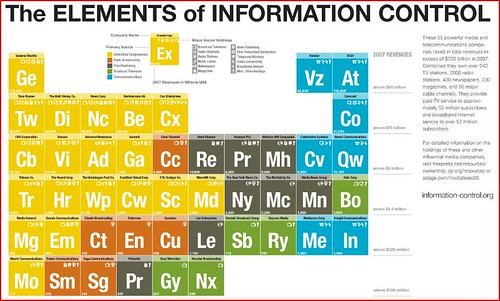
The chart is accompanied by the typical Free Press gloom-and-doom rhetoric about the unfolding media apocalypse. “Nearly everything you see, hear and read that isn’t from a friend — whether on TV, the radio, or even on the Web — comes from a for-profit gatekeeper.” And then comes the obligatory A.J. Liebling quote about how “Freedom of the press belongs to those who own one,” followed quickly by the typical punch line about how just a handful of companies (in this case 55 of ’em) are puppeteering all our thoughts in America today:
Combined, these 55 powerful media and telecommunications companies raked in total revenues in excess of $700 billion in 2007. Together they own over 540 TV stations, 2000 radio stations, 430 newspapers, 230 magazines, and 80 major cable channels in the United States. They provide paid TV service to approximately 52 million subscribers and broadband Internet service to over 57 million subscribers. They’re the bottlenecks through which our news, our entertainment, and our political discourse must travel. What they want to promote becomes prominent; what they suppress stays out of the mainstream. As such, these companies are the elements of information control.
Oh my God! We are all just brainwashed sheep!
Except we’re not. It amazes me how these “information control” and “media monopoly” myths keep getting widespread circulation. But the first thing to note is how the media reformistas can’t get even their story straight when it comes to how many “monopolists” are supposedly out there today. As I noted in my 2005 book, Media Myths: Making Sense of the Debate over Media Ownership, the critics seem to just pull their numbers out of a hat. Some say as few as 3 companies control everything. Others says 5 or 6. Still others say it might be a few dozen. And now this guy says its 55. Hey, that’s progress that even the Free Press should love!
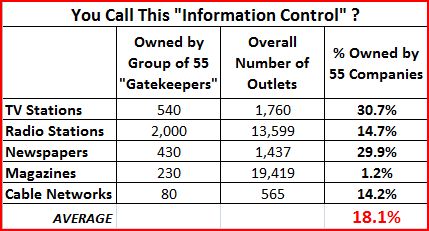
Regardless of the number, does this really represent the totality of our modern media universe? Do those 55 companies really “own most of the 21st-century presses in America” as the “Info Control” website states? Answer: NOT. EVEN. CLOSE. Here are the facts. [I happened to have compiled them for a PFF special report entitled Media Metrics: The True State of the Modern Media Marketplace to debunk myths just like this.]
Continue reading →
 I’m excited to announce the release of my latest law review article, “The Pursuit of Privacy in a World Where Information Control is Failing,” which appears in the next edition (vol. 36) of the Harvard Journal of Law & Public Policy. This is the first of two complimentary law review articles that I will be releasing this year dealing with privacy policy. The second, which will be published later this summer by the George Mason University Law Review, is entitled, “A Framework for Benefit-Cost Analysis in Digital Privacy Debates.” (FYI: Both articles focus on privacy claims made against private actors — namely, efforts to limit private data collection — and not on privacy rights against governments.)
 The Technology Liberation Front is the tech policy blog dedicated to keeping politicians' hands off the 'net and everything else related to technology.