As I mentioned yesterday, James Gattuso and I penned an editorial for National Review this week about the growth of FCC regulation and spending in recent years. In the op-ed, we also noted that, “For whatever reason, a disproportionate number of these [new regulatory proposals] have been aimed at cable television, so much so that press and industry analysts now speak of Chairman Martin’s ongoing ‘war on cable.'”

Today, the editors at National Review have chimed in with an editorial of their own on the issue entitled, “Pulling the Cable on Martin’s Crusade.” Specifically, the editors address what most pundits believe really motivates the Chairman’s crusade against cable: His desire to force cable companies to offer consumers channels on “a la carte” basis in an effort to “clean up” cable TV. “Martin should abandon this particular crusade,” the NR editors argue. “While we are sympathetic to parents’ desire to get the channels they want without having to buy access to racier fare, using economic regulation to restructure an industry is the wrong approach.” They continue:

Continue reading →

Some of the best video on the Interne is Mr. Deity, a blasphemous but wickedly funny series of shorts about religion and politics. It started out as a independent viral video series, but was signed by Sony to promote their new Crackle video-sharing site last year. I was recently excited when they launched their second season; they’ve been releasing a new video every couple of weeks.

But if you click the link above, you’ll be hard pressed to find the latest video. It’s “Mr. Deity and the Voicemail,” Episode 3 of Season 2. It’s inexplicably #7 in the list of the dozen or so episodes released so far. Even more inexplicably, if you search on Google for “mr deity,” you’ll be hard pressed to find either the Crackle Mr. Deity link or a link to the latest episode. The top hit is the pre-Crackle Mr. Deity home page, which hasn’t been updated in month and gives you no hint that the second has started. The next link is a YouTube video of the first episode, with again no hint that a new season has started. Crackle finally makes an appearance in the third slot, but the Mr. Deity home page doesn’t appear on that search page and is way down the list of Google results on Crackle. Finally at #4, we get the unofficial fan blog, which actually gives you one-click access to the latest episode. And at the very bottom of the first page, we see that Digg has pointed to the latest episode. In other words, the only sites that give you ready access to the newest episode are sites not run by Sony or the Mr. Deity team.

The Yahoo results are even worse: Crackle didn’t even crack the top ten. To It’s credit, Microsoft’s Live Search actually does include the Mr. Deity Crackle page as its seventh result.

This is an amazing degree of incompetence. Sony has presumably invested a significant amount of money producing this content, to say nothing of creating their video-sharing website. Yet they can’t even get the official Mr. Deity page to show up on the first page of Google search results for “Mr. Deity.” Compare that to, say, our podcast, which is the top hit for “Tech Policy Weekly” without us having made any explicit efforts to improve our search engine ranking.

You shouldn’t even need SEO help to come up as the top search result for your own product’s name. But if for some reason you’re not coming up as the top result, it’s worth investing a bit of money in making that happen. Especially if the whole point of producing the product was to drive web traffic to your video-sharing site. By the same token, One I get to the Mr. Deity Crackle page, the latest episode should be at the top of the list and prominently marked so I can grab it without having to wade through a long, randomly-organized list of videos.

I really don’t get it. These companies are investing millions of dollars to build these sites, yet they seem unable to get even the most obvious details right. Any halfway competent consultant should be able to point out these problems and explain how to fix them. So why are they so broken?

The Honorable Peter Hoekstra has taken to the august (virtual) pages of National Review to further muddy the waters of the debate over Joe Klein’s column. It would take a lot more time than I’ve got to untangle all the distortions and obfuscations of his arguments, so let me just jump to his particularly egregious concluding paragraphs:

It’s hard to imagine General Eisenhower going to court to ask for permission to conduct the D-Day invasion on the off-chance Americans might be on the beaches of Normandy. Yet this is exactly what Democrats want to force Admiral McConnell to do to conduct terrorist surveillance. At the end of the day, we should be honest that this is not a legal debate, but a political one. It highlights the fact that Democrats believe that lawyering-up foreign intelligence to guard against every imagined or potential civil-liberties concern is more important than ensuring that we have the full capability to conduct quick and effective surveillance of foreign al-Qaeda targets in foreign countries. I’ll welcome that debate anytime.

Now, in the first place, absolutely no one is proposing that the FISA court have jurisdiction over wiretapping activities that occur overseas. If the US Army wants to tap an Iraqi cell phone tower, or if the CIA wants to tap an underseas optical cable outside of the US territorial waters, neither the current FISA law nor any proposed changes would require court oversight of those activities. So the Eisenhower hypothetical is a total non-sequitur. Unless General Eisenhower somehow needed to tap American phone lines in order to carry out the D-Day invasion, none of the bills under consideration would have had any effect on his activities.

He says he’s worried about the ability to “conduct quick and effective surveillance of foreign al-Qaeda targets in foreign countries.” But the only time the Restore Act would require judicial scrutiny of “surveillance of foreign al-Qaeda targets in foreign countries” is when that surveillance requires ordering American telecom companies to install wiretaps on American soil, and when one end of that communication is likely to be on American soil. That’s a tiny fraction of our foreign intelligence-gathering activities, and so the Restore Act would place a correspondingly small burden on the executive branch.

Finally, when Hoekstra talks about “lawyering-up foreign intelligence,” he neglects to mention that every single proposed bill, the Restore Act included, expands the executive branch’s ability to engage in warrantless surveillance and restricts the courts’ oversight role compared to the status quo. Nobody is “lawyering up” anything. The debate is between Democrats who support only modest reductions in judicial oversight and a White House that is demanding the complete emasculation of judicial oversight of domestic-to-foreign eavesdropping.

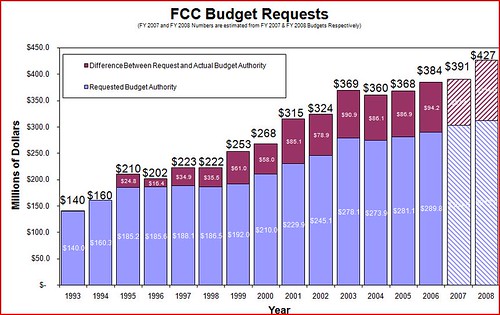
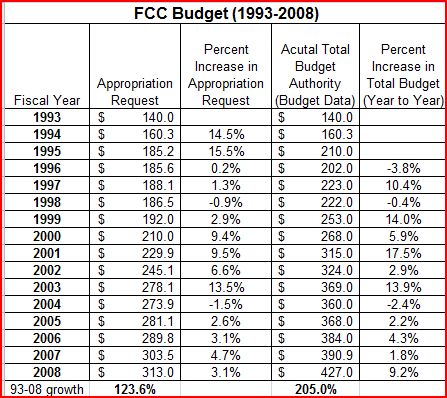
This is just a quick follow-up to the post I made earlier in which I mentioned the new editorial James Gattuso and I penned for National Review about the growth of FCC regulation and spending in recent years. A few people asked me where we got the numbers we used in the piece regarding the growth of the FCC’s budget over time. Here are the relevant numbers and a graph charting that growth. The numbers can all be found in the the FCC’s annual budget reports.

Next time some pro-regulatory advocate says that the agency is engaged in “radical deregulation” or something absurd like that, show them these numbers. There’s still a whole lotta regulatin’ going on over there! FCC Budget Chart FCC Budget Graph

This week in National Review Online, Cesar Conda and Lawrence Spivak ran an editorial entitled “Kevin Martin’s Pro-Market FCC,” arguing that the current FCC has generally been deregulatory and free market-oriented. Today, James Gattuso and I have set the record straight regarding just how off-the-rails this current FCC has really gone…


November 29, 2007

TV Train Wreck Martin, markets, and the potential for regulatory disaster.

By James Gattuso & Adam Thierer

Like cops shooing away onlookers at the scene of an accident, Cesar Conda and Lawrence Spivak argue (“Kevin Martin’s Pro-Market FCC”) that there’s no reason for conservatives to be concerned about the Federal Communications Commission (FCC). Under Chairman Kevin Martin, they say, the FCC has been “characterized by a consistent pro-entry/pro-consumer welfare mandate, the very hallmark of economic conservatism.”

In other words: “Just move along. Nothing to see here.”

Despite Conda and Spivak’s exhortations, however, there is much for the curious crowd to see in the train wreck that is the FCC. The most recent derailment began earlier this month, when Martin leaked plans to invoke an obscure provision of the Communications Act, and to assert nearly unlimited powers to regulate cable television if more than 70 percent of households subscribe to cable.

Continue reading →

Time’s “Correction”

by on November 28, 2007 · 2 comments

Wow. Here, in its entirety, is Time’s “correction” to Joe Klein’s error-ridden column on the Restore Act:

In the original version of this story, Joe Klein wrote that the House Democratic version of the Foreign Intelligence Surveillance Act (FISA) would allow a court review of individual foreign surveillance targets. Republicans believe the bill can be interpreted that way, but Democrats don’t.

Glenn Greenwald gets this exactly right:

Leave aside the false description of what Klein wrote. He didn’t say “that the House Democratic version of the Foreign Intelligence Surveillance Act (FISA) would allow a court review of individual foreign surveillance targets.” He said that their bill “would require the surveillance of every foreign-terrorist target’s calls to be approved by the FISA court” and “would give terrorists the same legal protections as Americans.” But the Editor’s false characterization of Klein’s original lie about the House FISA bill is the least of the issues here.

Continue reading →

I found here a peculiar set of arguments, directed against Solveig the Social Calculator, Solveig the Rampant Utilitarian, Solveig the Anti-Individualist. Who is this Solveig person? Oh, wait, it’s me. I have to wonder if this critique is by the same character who has been going around posting on blogs that I am a defender of Scientology and an erotic model. No, these posts aren’t anonymous.

1) The classical liberal recipe for freedom incorporates the principle that one’s freedom stops where it runs into another’s rights. We may disagree about what those rights ought to look like–and history shows that those rights are likely to change somewhat over time–but if my package differs somewhat from someone else’s, well, sorry, the argument that this makes me a “regulator” is no more to the point than the argument that the someone else is an “anarchist.” Very silly rhetorical flourishes that fail to join the main issue: what should the rights be?

2) There are perfectly respectable utilitarian arguments for free markets and property. This is not a grand venture into social calculus, it’s common sense. How long would freedom, property, and contract be defensible as institutions if there were a better way to raise standards of living, to get more clean water to more people, to generate wealth so that cleft palate babies can have surgery instead of being left in orphanages, so that a musician from Ghana can quit his day job waiting tables and do what he really loves and others can listen to him? No, I do not know what the socially optimal level of created works to be produced is, or grain, or houses. On the whole, people would rather have ground rules that support the creation of such things. If one is going to up-end those ground rules, one’s case against them had better be pretty strong.

3) Concern for enforcement is not an endorsement of “regulation.” Not even arguably. A defense of freedom includes supporting the fair enforcement of contracts, property rights, voting rights, or any other right that has a proper place in an advanced civilization. Again, we may disagree about what those rights are, but that has nothing to do with enforcement. Now, to the details: Is my view that copyright penalties should be lighter “regulatory”? Is the view that it is unfair to single out a few random individuals and let the majority of infringers’ off, and that this is ineffective for deterrence, “regulatory”? No. Not even close.

In short, teach your grandmother to suck eggs. There are arguments to be made here along these general lines about copyright and regulation that would need to be considered more carefully (see Tom Palmer, Tom Bell, Jerry Brito, etc.) … but you ain’t makin’ ’em yet. If there were a fundamental, easy-to-spot disconnect between classical liberal fundamentals and my views on IP, I’d have noticed some time in the last twenty years. The more subtle tensions I’m way ahead of you on. (For the love of pete, I’m on the record on what I think on all these things–enforcement, and how strict, and copyright as regulation, and so on–you don’t need to make up what you think my position is and then critique the lame result).

Recently, there are reports of more compulsory licensing for 20 more drugs in Thailand; and a conference is announced to celebrate this strategy.

Hence this series of links and clips.

On April 11, http://www.africasia.com/services/news reported on a plan that seems to implicitly suggest that African states might set aside an array of patents (sorry, no present link):

“We need to produce (medicines) in Africa. We have the potential, why do we want to take them from outside when we can take it in Africa?” Mamadou Diallo, chief pharmacist in the AU commission’s medical services directorate, told AFP. “The main objective is to identify which kinds of medicines we are going to produce, essential drugs we need for Africa, and who is going to produce these drugs.” Many African countries currently rely on India and China for imports of affordable generic drugs, but both countries are subject to patent laws which threaten Africa’s access to the medicines. According to Diallo, Africa has all the resources and capacity at its disposal to manufacture essential medicines for the opportunistic infections like tuberculosis, malaria and HIV/AIDS which plague the continent.

It is sad that the plan to produce the drugs in Africa apparently does not extend to actually inventing and developing more such drugs in Africa–or then the patents would be important.

Contrast Alec Van Gelder’s article on African medicines:

The UN Economic Commission for Africa endorses fears that “drastic trade liberalization, particularly substantial reductions in tariff, could entail, for instance, loss of tariff revenue hence fiscal difficulties.” The anti-globalisation group Oxfam issued a 128-page document in 2005 called “Why Developing Countries Need Tariffs”, as part of the Trade Justice Movement coalition. All of this means that many religious, aid and international organisations think incomes for bureaucrats matter more than prices for citizens. They also believe that tariffs protect local industries and allow them to grow up into competitive industries. Thus Tanzania imposed on 26 July a 10 per cent tariff on imported medicines, to protect what it called its “infant medicine industries.” What about real infants? The immediate effect of this new tariff will be deadly. “Low income of the majority of the Tanzanian population hinders their accessibility to health services as medicines and other services are unaffordable,” according to the World Health Organisation. The average Tanzanian earns US$744 annually–a 10 % increase in the cost of medicines can make the difference between life and death for the 21.7% of the population that suffers from malnutrition. While few of the world’s poorest–and least healthy–countries have any viable pharmaceutical sectors, a shocking number apply similar taxes and tariffs on medicines. A 2005 American Enterprise Institute study revealed that over 33 countries impose levies higher than the new Tanzanian rate.

Continue reading →

This from Mike Masnick is absolutely brutal:

[Universal Music CEO Doug] Morris is so clueless that he chooses the worst possible analogy to explain his position. Lots of entertainment industry execs have thrown up their hands and ignorantly stated that “you can’t make money from free.” That’s wrong, of course, but Morris takes it one step further up the ridiculous scale, with the following example: “If you had Coca-Cola coming through the faucet in your kitchen, how much would you be willing to pay for Coca-Cola? There you go. That’s what happened to the record business.” Hmm… and what is coming out of your faucet in your kitchen? That’s right… water. And how much are people willing to pay for water? That’s right, billions. In fact, it’s a larger market than (oops) recorded music. Can someone please explain how Morris keeps his job?

Honestly, I don’t get it. Republican presidential candidate Mike Huckabee, former governor of Arkansas, is mounting a strong challenge for the GOP nomination primarily by appealing to the social conservative wing of the party and religious groups. He uses rhetoric like this on the campaign trail: Ric Flair

“Over the past 30 years, a decline in moral character has produced a decline in the character of our society. Everything hinges on the men & women we choose to establish public policy. And their character depends on you. There is something you can do: you can live a God-centered life of high moral character, and you can support candidates who share your Christian standards.”

Ted Nugent Chuck Norris

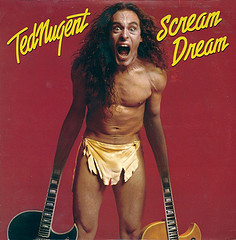
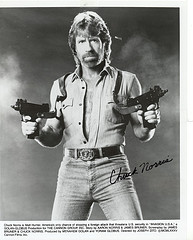
OK, that’s fine, but here’s what I don’t get. Why is Huckabee preaching the gospel of moral decline and cultural disintegration while also playing up endorsements from martial arts expert and actor Chuck Norris, professional wrestler Ric Flair, and rock-and-roll star Ted Nugent? Don’t get me wrong, I spent more time than I care to mention watching Chuck Norris movies and Ric Flair wrestling matches with my Dad growing up, and I used to own all of the Motor City Madman’s (that’s one of Nugent’s many colorful nicknames for you non-fans) albums in the late 1970s.

Continue reading →