To say that copyright does not protect any natural right is not to say that it lacks any moral justification. We naturally frown on unauthorized and misattributed copying. A singer who claims authorship of a song written by another commits a sort of fraud on his listeners. Most of the time, that sort of fraud does not rise to the level of materiality, and thus does not justify litigation. We typically do not rely to any substantial detriment on the accuracy of an expressive work’s description, after all. If we like a work, we like it, regardless of its source. Misdescriptions of authorship can trick us into buying the wrong expressions, however. You might, for instance, buy tickets to a Djelimady Tounkara concert only to find another, lesser guitarist on stage. That would naturally rouse your indignation.
We don’t need copyrights to vindicate that sort of wrong, however; common law and various state and federal statutes already afford many remedies for it. Consumers of misleadingly labeled goods or services can plead fraud under tort law and breach or promissory estoppel under contract law. The licensee of a materially misdescribed work would enjoy a strong contract law defense, one voiding any agreement alleged by the licensor publisher. An author who sees her work sold under another’s name would, as a wronged competitor, have standing to sue for unfair competition under state or federal law. The publisher of such an author might likewise enjoy legal and equitable remedies for passing off. The Federal Trade Commission and its many state counterparts can protect consumers and competitors of falsely labeled expressive works, while various federal and state executive officers can fight such wrongs with the criminal sanctions levied against the many guises of fraud.
Those legal tools give us ample ways to discourage materially harmful misdescriptions of expressive works. We don’t need copyright to satisfy our moral intuitions on that front, and most people’s condemnations against unauthorized copying don’t go much beyond harmful lying.
Continue reading →
The kids are alright. Not only is that the title of one of my favorite songs by The Who, but it also happens to be the theme of much of my public policy research. Specifically, I spend a great deal of time analyzing social trends and media usage in an attempt to show that, contrary to what many media critics claim, the whole world is not going to hell. I’ve touched on these themes before in essays such as “Why hasn’t violent media turned us into a nation of killers?” and my PFF paper about “Fact and Fiction in the Debate Over Video Game Regulation.”
In this research, I try to bring some hard evidence to bear on the question of whether there is any correlation between exposure to violent media and real world acts of violence / aggression. And I also try to show that parents are actually far more involved in raising their kids, and instilling good values in them, than critics care to admit. In essence, parents are parenting! I illustrate that in my ongoing book, Parental Controls & Online Child Protection: A Survey of Tools & Methods.” I keep that publication up to date with as much info as I can find on the subject and plan on issuing new versions of the report every few months. (Version 3.0 is due out early next year.)
Exhibit 1
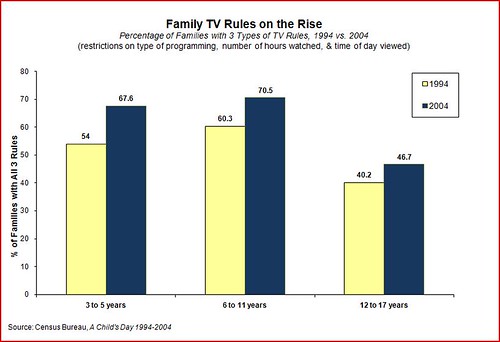
And now I have some more great stats and charts to include in my report thanks to the release of a big batch of new Census Bureau data on child-parent interaction. The Census Bureau data, which is available here, is part of a report entitled A Child’s Day. The last report was conducted in 1994, and the most recent one in 2004, but the data for 2004 was just recently released.
The results are very encouraging and generally show that “Parents are taking a more active role in the lives of their children than they did 10 years ago,” according to the Census Bureau. For example, as Exhibit 1 above shows, parents are crafting more TV rules for the kids today than they were in the past.
Continue reading →
Here’s a column I just wrote on life extension technologies and religion. And here’s a snippet:
Professor Ron Cole-Turner of the Pittsburgh Theological Seminary discussed how life extension could benefit many religious orders. “Technology will inject competition into religion and force religious authorities to clarify what they mean by immortality.” This is important, according to Cole-Turner because “there is currently a lot of evasiveness about what immortality means.”
 During the course of promoting the recent paper I co-wrote with Eli Lehrer, I have come across the same question/complaint from gamers: Why have two adult ratings, both M and AO, when seemingly they perform the same role?
The answer is that they don’t.
The key difference between M and AO is that M is sold in stores like Best Buy and Wal-Mart, while AO is not. This is analogous to movies. While both NC-17 movies and X movies are only available to adults, X rated movies are definitely not sold in Wal-Mart. Though this isn’t an official ESRB stance, most every retailer, large and small will not carry AO games if it sells games to a general audience.
Continue reading →
Poor Stewart Baker. He’s the DHS policy guy who has been pushed forward to argue that signing “MOUs” (memorandae of understanding) with one or two states overcomes the dozen+ states that have passed legislation opposing or rejecting the REAL ID Act.
It’s true that REAL ID has had a good couple weeks. Arizona’s Governor claims to have signed up her state – oh, except for everyone from the ACLU to the John Birch Society saying “Hell NO!”
A DHS announcement says they have released grant money for REAL ID compliance.
The REAL ID Demonstration Grant Program will provide $31.3 million for checking motor vehicle records in other states to ensure that drivers do not hold multiple licenses, and for verification against federal records like immigration status. This grant will help standardize methods by which states may seamlessly verify an applicant’s information with another state and deploy data and document verification capabilities that can be used by all states, while protecting personal identification information.
That’s fully .18% of the $17 billion it will cost to implement REAL ID!
(That’s easy to mock, of course, but even $31.3 million is enough to keep cash-strapped government contractors and other hangers-on lobbying for implementation.)
Since I can’t find the announcement online, I’ll reproduce the whole thing after the break. To see the grant documentation – there’s no permalink – go to www.grants.gov, click on “Find Grant Opportunities” in the navigation, click on “Browse by Agency” in the navigation, click on “Department of Homeland Security,” and skim down. It’s currently on the second page.
Continue reading →
By Drew Clark
I got the news today from an insider: National Journal’s Technology Daily, which covered the tech and information policy on the inside for nearly nine years, is closing down in January.
I’m no longer a part of Technology Daily, having left in August 2006 to pursue another journalistic opportunity. But I was there from November 1998 until last year, serving as a senior writer for the publication and writing more than 2,400 stories for Tech Daily. When something that you’ve been a part of for eight of its nine-year-life dies, that affects you. It’s time for a moment of appreciation.
Blogs of condolences have already been posted by the 463, by Tech Liberation, and by Andy Carvin’s Waste of Bandwidth (which has the e-mail that went out to Tech Daily subscribers last night).
Continue reading →
The Register‘s latest rant against Wikipedia was sent to me by one of the people mentioned in the article. It purports to explain how “the Wikipedia elite [has decided] to take a topic as weighty as the health of US financial markets under its control without informing the public of its decision.” What follows is a long and rambling story about a dispute between Overstock.com head Patrick Byrne and Businessweek reporter Gary Weiss. Weiss, apparently, is the puppetmaster behind a grand conspiracy theory designed to keep the public in the dark about the evils of a practice called naked short selling by preventing a link to Byrne’s PowerPoint presentation on the subject from being linked to from the relevant Wikipedia paget.
Seriously. A guy named Judd Bagley soon got into an edit war over the link with another user. Bagley wanted the link included, the other user didn’t. Bagley thinks the other user is Weiss. Weiss says he’s never edited Wikipedia. The article goes on to explain more disagreements Bagley had with various Wikipedia editors. Not having followed the story, I have no idea if the ban of Bagley was appropriate. But there certainly doesn’t appear to be anything in there that comes close to damning evidence of Wikipedia’s “inner circle.”
Even the Register admits that “There’s no denying that Judd Bagley is, shall we say, overzealous when it comes to Wikipedia.” There’s clearly a lot of personal history here that I don’t know, and so I have trouble getting too worked up over the fact that Wikipedia has been attempting to block him from the site. What the article does not do is provide any evidence that there’s more going on here than a petty personality conflict. There’s a lot of rumor and innuendo, but no specific evidence of wrongdoing by “the Wikipedia elite,” whoever that is. And the Register article has an hysterical tone that makes me extremely skeptical of the scant evidence it does provide. El Reg clearly has an axe to grind, and so I’m not about to take their word for it when they say there’s a grand conspiracy going on.
I’ve concluded that one of the central fault lines in the network neutrality debate is over the extent to which physical ownership of a data pipe gives an owner the practical ability to exert fine-grained control over the use of that pipe. There’s an implicit assumption on the pro-regulation side of the debate that if AT&T owns your DSL line, then it has the physical ability to, say, prohibit you from watching online videos or require you to use their email or VoIP services. Lessig and Lemley, for example, made this point repeatedly in their 2000 paper without ever explicitly justifying it. For example:
Under the design proposed by the cable broadband, AT&T and Time Warner affiliates would have the power to decide whether these particular services would be “permitted” on the cable broadband network. Cable has already exercised this power to discriminate against some services.
This is backed up by a footnote citing various restrictions mentioned in @Home’s terms of service. But as I noted previously, the fact that @Home’s terms of service formally prohibited some category of network activities did not mean that, as a practical matter, users were unable to take advantage of that service. To the contrary, it’s extremely common for users to use their network connections in ways explicitly prohibited in the terms of service, and ISPs have struggled to crack down on those who do so. The fundamental issue is that classifying traffic is a very hard problem, one that almost certainly can’t be solved in the general case. Which means that any automated filtering regime can be circumvented. And of course, having human beings monitor every user’s traffic and impose restrictions on those who violate the terms of service would be far too labor-intensive to be worth the trouble. So ISPs are forced to resort to extremely crude tactics to accomplish their filtering goals, and these tactics, in turn tend to produce both a lot of bad PR and the emergence of new, more sophisticated evasion tools. In the long run, it’s not at all clear to me that this is a battle ISPs could win, even if they had free rein to implement any policies they wanted without fear of regulatory intervention.
Continue reading →

 The Technology Liberation Front is the tech policy blog dedicated to keeping politicians' hands off the 'net and everything else related to technology.