I’m going to be on the road a lot in March and April speaking at or attending some exciting technology-related events. I thought I’d just mention one today since they recently updated their speakers list.
The 2nd annual “Tech Policy Summit” is taking place March 26-28 at the Renaissance hotel in Hollywood. (Here’s a short overview / preview). The list of speakers is very impressive (and not just because I’m on it!) I’ll be speaking on a panel about online child safety issues that features MySpace chief security officer Hemanshu Nigam.
Sounds like it should be a great event.
Art Brodsky’s 4,789-word article about Connect Kentucky and its offspring Connected Nation has been the talk of telecom circles over the past week.
Connected Nation is a non-profit entity that has become one of biggest players in the currently topical field of broadband data. Using their work in Kentucky as a model for mapping out broadband availability nation-wide, the group has become a driving force behind legislation that would provide grants for other states to duplicate these efforts.
Examples of legislation following the Connect Kentucky model are the Senate version of the current farm bill, H.R. 4212, which includes Illinois Democratic Sen. Richard Durbin’s “Connect the Nation Act,” S. 1190. Durbin’s bill would authorize $40 million a year, for five years, to state efforts to map out broadband inventory on the census block level.
The “Broadband Data Improvement Act,” S. 1492, by Senate Commerce Committee Chairman Daniel Inouye, D-Hawaii, takes a similar approach. The goal is, in the identical language of both bills, to “identify and track the availability and adoption of broadband services within each State.”
Continue reading →
In the first installment in this series, I outlined the new project “Media Metrics” project I have undertaken to evaluate the true state of America’s media marketplace. To reiterate: I want to use solid evidence to assess where we stand today relative to the past in terms of media choice, competition, and diversity.
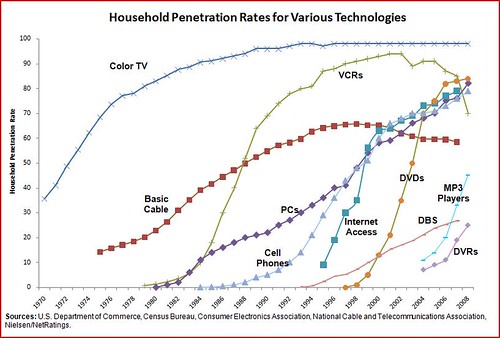
In this brief second installment, I want to provide a quick snapshot of where we stand in terms of household access to various media and communications technologies. Some critics like to wax nostalgic about a mythical golden age of media in the past when the citizenry was supposedly far better informed and more engaged in deliberative democracy.
It’s all poppycock. The fact is that we are better informed as a society today than all of our ancestors were
combined. To the extent there ever was a Golden Age of Media, it is now; we are living in it. Richard Saul Wurman, author of Information Anxiety, has noted that “A weekday edition of the New York Times contains more information than the average person was likely to come across in a lifetime in seventeenth-century England.” And a 1987 report by Susan Hubbard (Information Skills for an Information Society: A Review of Research) estimated that more new information has been produced within the last 30 years than in the last 5,000. And did you know that in 1900, the average newspaper had only 8 pages, according to Benjamin Compaine, co-author of Who Owns the Media? In the year 2000, by contrast, according to the Encarta encyclopedia, “Daily general-circulation newspapers average[d] about 65 pages during the week and more than 200 pages in the weekend edition.” I could go on all day with stats and comparisons like this.
Part of the reason we are better informed, quite obviously, is simply because we have access to more media services and technologies with each passing year. Exhibit 1 illustrates that fact.
Exhibit 1
Continue reading →
[I earlier explained why copyrights do not qualify as natural rights under Locke’s theory of property. Here, I explain why the same holds true under Barnett’s positivist account of natural rights. Both passages come from my draft book, Intellectual Privilege: Copyright, Common Law, and the Common Good.]
Randy E. Barnett justifies natural rights conditionally, basing them on our appreciation of certain social goods. He emphasizes that ”
if we want a society in which persons can survive and pursue happiness, peace and prosperity, then we should respect the liberal conception of justice—as defined by natural rights—and the rule of law.” Not everyone values freedom, harmony, and wealth, of course. Most of us do, though, and together we easily number enough to enjoy the comforts and pleasures of human society.
We live together amicably because we recognize and respect certain natural rights. Which ones? Barnett names private property—including our property rights in our bodies—and freedom of contract. Since property protects both the right to it and the right against trespass, it corresponds to common law’s property and tort rules. Freedom of contract, which includes the right
to contract and to not contract, corresponds to common law’s contract rules. Barnett’s description of natural rights thus matches the protections of persons, property, and promises at the heart of common law.
Barnett expressly includes “physical resources” in his description of property rights. “Such property rights are ‘natural’ insofar as, given the nature of human begins and the world in which they live, they are essential for persons living in society with others to pursue happiness, peace, and prosperity.” Do copyright rights qualify as natural on that description? Probably not.
Continue reading →
Valley rumormonger Valleywag mongs the rumor that PayPal founder and VC/hedge fund manager Peter Thiel is moving to New York to be closer to his current beau. Now read carefully:
An acquaintance of Thiel scoffs at the idea that Thiel would do anything for romantic reasons. Thiel, he says, is an utterly rational thinker. But the heart is capable of its own rationalizations. The mere possibilty that Thiel might maximize happiness, rather than profit, is a comforting thought.
You see thinking of this type again and again in our culture and society – doing things for love is irrational; self-interest is greed – as if there is some wall separating the things we do for ourselves and the things we do for others.
A rational thinker has to fool himself into doing something for love. You really have to be altruistic – irrationally disinterested in yourself – to be a good person.
Au contraire. Doing things for love is part of the rational pursuit of self-interest, and it’s good.
Go ahead, Adam. Say something homophobic. Or lovophobic.
Alex Iskold has a very interesting post about “The Danger of Free” over at the Read Write Web blog. But I think he overstates the case a bit when he asks “is the concept of free taking us down a dangerous road?” He pretty much answers that question in the affirmative:
Marketers long ago figured out the attractiveness of free. For decades companies have been playing tricks using free to lure naive customers. But recently, our obsession with free has given rise to a new phenomenon – where the customer is never asked to pay. How? Because the business makes their money on advertising. Marketers are happy to pay for access to customers, who in turn love not having to pay. So the web plays the glorious role of middle man. Are we heading into dangerous territory? The paths that we are taking lead to confused customers at best; and monopolistic practices at worst. A culture where consumers think that increasingly more and more services should be free is not healthy.
I’m not so sure. I don’t want the digital generation to grow up thinking everything online is one big free-ride, but do they really think that? They still pay for plenty of stuff, after all. (I wish they’d be willing to pay a little something more than zero for copyrighted content, but that’s another story). Generally speaking, this generation is paying for plenty of gadgets and gizmos (think game consoles and games themselves, or iPhones and other mobile devices, or PCs, etc.)
But what’s so bad about them pushing for more and better services at a lower price, or even
no price? They understand there are trade-offs to getting “free” goods or services just like previous generations did when the sat down in front of the boob-tube to watch “free” over-the-air television, or listen to broadcast radio in their cars. As Iskold correctly notes in the conclusion of his essay:
The bottom line is there is no free lunch. When you go on vacation and see a sign that says Free Lunch you know that the timeshare sales pitch is going to accompany it. The free on the web is not free either. We are receiving the services in exchange for our time and attention, in exchange for the opportunity to be advertised to.
Yeah, so what’s the problem again? Most of us understand the trade-offs and that there really are no perfectly free lunches. But the danger of Iskold treating “free” as a problem and going so far as to conclude (incorrectly, I might add) that it leads to “confused customers and monopolistic practices” is that it is just another invitation for government to come and muck things up. Think about it: the logical conclusion of Iskold’s argument is that the government should step in to protect consumers from free goods and services! We truly are a spoiled lot in America.
Well, I’m a bit scared to say this since I will almost certainly incur the wrath of Mike over at TechDirt as well as a host of others who oppose this concept, but I hope there is some truth to the rumor that Time Warner Cable (TWC) is considering a broadband metering experiment down in Texas. (Seriously, go easy on me Mike!)
According to a leaked internal memo posted over on DSL reports:
The introduction of Consumption Based Billing will enable TWC to charge customer based upon usage, impacting only 5% of subscribers who utilize over half of the total network bandwidth. The trial in the Beaumont, TX division will apply to new HSD customer only, will provide a destination for customer to track usage for each month and will enable customers to upgrade from one tier to the next to avoid payment of overage charges. Existing and new subscribers will have tracking capability, however only new subscribers will be charged incrementally for bandwidth usage above the cap. Following the trial, a determination will be made as to whether or not existing subscribers should be charged. Only residential subscribers will be impacted. Trial in Beaumont, TX will begin by Q1.
I don’t want to rehash the whole debate about the relative merits of metered bandwidth–for that, see this, this and this (+ all the comments)–rather, I just think it will be interesting to see the results of a small-market experiment. Will consumers revolt against the idea since it runs counter to the “all-you-can-eat” buffet-style pricing we’ve grown accustomed to? Or will they embrace metering as potential money-saving business model that helps lower monthly bills for light Net users.
Continue reading →
I’ve had an itch for a while now, and this week I finally scratched it.
See, like lots of tech geeks, I depend heavily on RSS feeds for my data intake–whether it’s news, blogs, package tracking, following forum discussions, or keeping up with friends on Facebook or Flickr, I love feeds. One thing was sorely missing, though. I wanted to subscribe to a feed of the FCC’s docket and be alerted each time the Commission issued a new proposed rulemaking or other notice.
The FCC’s website certainly doesn’t offer such a thing, as I’ve previously lamented. Recently, I praised Regulations.gov for finally adding an RSS feed to the site. Unfortunately, it was only one feed, containing every notice from every agency. Not very useful to an individual.
The cool thing about structured data, as I explain in my recent paper on e-transparency, is that independent third parties can take a feed and manipulate it to make it more interesting and useful. So, I took my own advice and threw together a new site, OpenRegulations.org.
Basically it’s an alternative interface to the Regulations.gov database. Stripped down, simple, and (I’d argue) elegant. More importantly, though, it offers RSS feeds for each regulatory agency on an agency-by-agency basis. Here are notices from just the FCC, for example. Check it out and please spread the word.
I have embarked on a major new research project that I am calling “Media Metrics: The True State of The Modern Media Marketplace.” The goal of this project is ambitious: I hope to paint the most thorough and objective portrait of the true state of the modern media marketplace ever constructed. To do so, my PFF colleague Grant Eskelsen and I have spent months collecting and reproducing as many datasets, charts, tables and other information that we can get our hands on. I will be publishing individual installments online–some short, some long–discussing various trends and developments in the media marketplace. Later, I will pull it all together and create a massive online database for the public, the press, and policymakers to use as a resource.
Why am I doing this? For far too long in this country–especially in recent years–debates about the media, and public policies governing the media marketplace, have been based almost entirely on emotion, not evidence. Critics are fond of using a variety of subjective barometers to gauge the health of the media market. In a sense, that’s not really surprising since many of us feel a strong bond with media. It touches our lives in a variety of important ways. It informs and inspires on one hand and shocks and repulses on the other. Consequently, everyone fancies themselves a bit of an armchair critic when it comes to media.
But, in recent years, media criticism has been infused with an unprecedented level of raging emotionalism, so much so that it sometimes borders on mass hysteria. Many people—including a large number of regulators and public policy makers—argue that America’s media marketplace is in a miserable state. Some claim that citizens lack choice in media outlets, and that options are just as scarce as ever. Others believe that “localism” in media is dead, or that many groups or niches go underserved because of a lack of true “diversity” in media. Others argue that the market is hopelessly over-concentrated in the hands of few evil media barons who are hell-bent on force-feeding us corporate propaganda. And still others say that the quality of news and entertainment in our society has deteriorated because of a combination of all of the above.
It makes for good copy, but is any of it true?
Continue reading →


 The Technology Liberation Front is the tech policy blog dedicated to keeping politicians' hands off the 'net and everything else related to technology.