I’m reading Telephone: The First Hundred Years, written in 1975, and I found this passage striking:
The century of invention was at zenith. Robert Fulton’s first commercially successful steamboat dated from 1807, Mcihael Farady’s dynamo from 1831, Samuel F. B. Morse’s telegraph from 1835, the steam-driven electric generator from 1858; in 1875 Thomas A. Edison’s phonograph was three years ahead, his incandescent lamp four years, the skyscraper about a decade, the automobile and the airplane a generation or less. Behind them all was a persuasive idea; as Alfred North Whitehead would write, “The greatest invention of the nineteenth century was the method of invention.” Moreover, the economic rewards of invention under the U.S. patent system were great and well advertised; Bell and others like him knew well enough that the inventor and original backer of the telegraph had become millionaires, and his passion for secrecy about his experiments, along wit his early and intimate association with the Patent Office through Hubbard, suggest how well he realized he might be onto something commercially big. And he was urged on by both his philosophical background and the current social climate in America. The Scottish Calvinism of the nineteenth century made a primary virtue of material success achieved through hard work, and as an example Bell had his countryman Andrew Carnegie, twelve years his senior, who had come to the United States from Scotland in 1848 and by 1875 was already a millionaire in the process of consolidating the largest steel company in the world. As to the social climate, 1875 was the heyday in America of laissez-faire venture capitalism, when men had a kind of savage fury for fame and fortune that the more jaded twentieth century can scarcely conceive of.
I think that last sentence is fascinating, not so much for what it says about the 19th century as for what it says about the late 20th century. I find it hard to imagine someone writing that sentence today. We certainly don’t consider the pursuit of fame and fortune through invention passé these days.
A new paper from the Stockholm Network on developing countries and pharmaceutical patents. In a review of the empirical literature, the report finds, among other things:
Continue reading →
The patent reform debate continues with commentary on Sen.
According to Hal Wegner, the Intellectual Property Owner’s Association reports that
Sen. Patrick Leahy (D-VT) will attempt to pass a revised version of S. 1145 in the Senate in February. Major amendments likely will not be available more than a few days in advance of Senate consideration….If the Senate does pass a bill, it likely will be sent to the House for swift passage by the House without amendments, eliminating the need for a Senate-House conference.
Whether the votes are there is open to question.
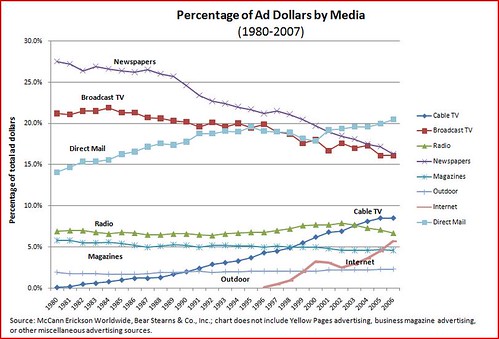
This is the third installment in my ongoing “Media Metrics” series, which aims to evaluate the true state of America’s media marketplace. [See Part 1 for a complete description of the project and the analytical framework I use to research media trends and developments. Part 2 discussed household access to various media technologies]. In this installment, I want to take a look at how various media sectors stack up against each other in terms of advertising support.
You don’t need to have a PhD in media economics to understand the importance of advertising to media companies. “Advertising is the mother’s milk of all the mass media,” Wall Street Journal technology columnist Walt Mossberg has noted. And Harold L. Vogel, author of Entertainment Industry Economics, the definitive textbook for media market analysts, has noted that, “Advertising is the key common ingredient in the tactics and strategies of all entertainment and media company business models. Indeed, it might further be said that advertising has substantively subsidized the production and delivery or news and entertainment throughout the last century.” Mossberg agrees, noting that, “Without ads, most editorial products and other programming would be either unavailable or prohibitively expensive.”
Exhibit 1
Continue reading →
Should Internet service providers block copyrighted material from their networks if “fingerprinting” technology allows them to easily identify it?
Bits, the New York Times’ technology blog, has an excellent copyright discussion featuring Columbia Law Professor Tim Wu and the general counsel of NBC Universal, Rick Cotton. One of the questions is whether ISPs should block copyrighted works? Wu makes a good point,
“Technologies designed to examine what kind of content is passing the network are technologies of censorship. Tolerating the routine inspection of all content, in the search for “forbidden” content, is a fast road to a private police state.”
But I think Wu is glossing over an important point here,
i.e., there is a vast difference between a “private police state” and a real police state: Private entities are vassals of the state; the state answers to no one.
Continue reading →
Today the Cato Daily Digest is pointing people to an essay by David Boaz titled “Parasite Economy Latches onto New Host.” Thus we celebrate the opening of Google’s new policy office here in Washington, D.C.
I celebrated the traditional way also, by attending last night’s party. It was typically Googley, with good food, drinks in glowing glasses with curly straws, etc.
Happily, late in the evening, I got a chance to talk to a Googler very high in the food chain, and delivered (eloquently, I’m sure) the same message I delivered at Wednesday’s AFF forum: If Google wants not to be evil, it should openly and strongly oppose the government’s claimed authority to issue “National Security Letters.”
NSLs are alien to our constitution, of course, but Google has a business interest in ending them as well. Its office strategy is not viable while the government can credibly claim a right to unilaterally access data.
Its interesting, the faraway look people get in their eyes when you tell them what they should do, they know you’re right, and they’re not going to do it.
I spend a lot of time here pondering media industry business models, and I’m particularly interested in how traditional media providers are trying to reinvent their business models in response to new marketplace developments. One of the more interesting models I’ve been waiting to see rolled out is called “MagHound–The Magazine Lover’s Best Friend.” Time Inc. is the creator. I am a magazine lover–my house is practically wallpapered with magazines–and MagHound offers folks like me an intriguing business proposition: Instead of an annual subscription to a magazine, just pay MagHound a small monthly fee and then pick-and-choose which magazines you want each month. Essentially, it’s “Netflix for magazines,” as several other bloggers have already noted.
Unfortunately, the service has just been vaporware for the past few years. A website has been up and running for awhile now, but it doesn’t provide many details. There’s a small blurb about the service on the Time Inc. press releases website that says the service will launched in the second half of 2008 with over 200 magazines being offered. Pricing details were not offered there, but a recent Ad Age article said that the users will get 3 magazines for $4.95 a month, $7.95 a month for five, or $9.95 a month for seven. Again, people can mix and match online according to taste.
Will it work? I’m skeptical that 200 magazines will be enough to draw in a big enough audience to sustain the service. What makes Netflix so great is not just the convenience factor–no need to drive to video stores anymore–but also the huge selection they offer. Every once and awhile I will search for an obscure movie on Netflix and come up empty. But that’s fairly rare. Netflix still has a massive back catalog for movie buffs like me.
Continue reading →
When I stumbled across John Gilmore’s argument against the heavy-handed tactics of the anti-spam cabal a while back, I was surprised to find it pretty compelling. My years as a sysadmin had drilled into my head that Open Relays Are Bad, but this is an awfully good point:
What’s the difference between an “open router” and an “open relay”? An open router takes any packet that you send it, and forwards it toward its destination. An open relay takes any email that you send it, and forwards it toward its destination. They’re the same thing, just operating at different levels of the protocol stack. Should we outlaw open routers? Look at all these evil guys on the Internet backbone, all over companies and campuses, and even in private homes! They’re routing packets without authenticating who sent each one! They’ll accept packets from ANYWHERE ON THE INTERNET, and just send them onward, even if they contain spam or viruses! There oughta be a law!!! If we just shut down all those guys with their big Cisco spam tools, then we wouldn’t get any spam any more. Let’s all black-hole every packet that comes from any ISP that doesn’t authenticate every packet. We have perfectly good standards for authenticating packets (IPSEC — I even funded the free Linux implementation, called FreeS/WAN.) so lack of standards is no excuse. Come on guys, if we apply your rationale about open relays just two levels down in the protocol stack, we ought to shut down the entire Internet. What makes the application-level email service on port 25 so special? (Both sarcasm and logical argument are probably lost on this audience, but I’ll give it a try.)
And…
Continue reading →

 The Technology Liberation Front is the tech policy blog dedicated to keeping politicians' hands off the 'net and everything else related to technology.