A month ago, I wrote here and in a Cato TechKnowledge article about the telling imagery that a company called L-1 Identity Solutions had used in some promotional materials. The cover of their REAL ID brochure featured an attractive woman’s face with her driver license data superimposed over it, along with her name, address, height, eye color, place of birth, political affiliation, and her race. This is where the national ID system advanced by the REAL ID Act leads.
Here’s another example. A group called Family Security Matters has reprinted on its site a blog post supporting the $80 million in grant money that the Department of Homeland Security recently announced, seeking to prop up the REAL ID Act. (I’ve written about it here and here.)
What’s interesting is not that a small advocacy group should support REAL ID, but the image they chose to illustrate their thinking: a man holding his “National Identity Card,” his fingerprint and iris images printed on it, and presumably programmed into it.
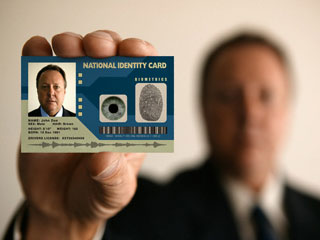
Were there ever any doubt that REAL ID was a national identity system and a step toward cradle-to-grave, government-mandated biometric tracking, Family Security Matters has helped clear that up.
Over at BroadbandCensus.com, my friend Drew Bennett, who has graciously agreed to be a special correspondent for the publication while he is in New York covering the Personal Democracy Forum, has been pumping out the blog entries.
Here are some of his latest… just from today:
NEW YORK, June 24 – Jonathan Zittrain, author of “The Future of the Internet and How to Stop It,” took to the stage at the Personal Democracy Forum to focus “civic technologies:” the personal computer, spreadsheet applications, Wikipedia, even the Internet itself are all examples.
read more
NEW YORK, June 24 – Stanford law professor Lawrence Lessig presented his ‘Declaration For Independence’ to the Personal Democracy Forum here today, fingering this problem in the American political system: the perception of a government disproportionately influenced by the stakeholders that fund political campaigns.
read more
NEW YORK, June 24 – “What happens next?” is the question Andrew Rasiej used to start off the Tuesday morning panel discussion at the Personal Democracy Forum here. read more
The complete index page of articles, blog posts, and press releases on BroadbandCensus.com is available here.
We’re now learning the meaning of a new policy that Americans can’t “willfully” refuse to show ID at airports. The Consumerist has a write-up of one man’s experience with IDless travel. It turns out they do a background check on you using, among other things, your political affiliation.
That’s a nice window onto what identity-based security is all about: giving the government deep access into all of our personal lives. Of course, this type of security is easy to evade, and the 9/11 plot was structured to evade it. Checking ID cannot catch someone who has no history of wrongdoing.
Identity checks at airports require law-abiding American citizens to give up their privacy, including their political affiliations, with essentially no security benefit.
Ars has an interesting interview with the head of Sandvine, the company at the heart of the Comcast Kerfuffle:
What Caputo seems to think he’s doing with Sandvine is enabling “all-you-can-eat” models at reasonable prices. People who argue for network neutrality are “painting the service providers into a corner,” he says in the interview. “If all packets are created equal then it’s equal utility and we should be charging on a per-packet basis, and I don’t think anybody wants to go there.”
Without traffic management, especially of P2P, the idea is that prices would either go up or congestion might reach truly terrible new heights, and Caputo believes that most users would rather just throttle P2P; let it work, but slowly and in the background, so that ISPs don’t need to make expensive infrastructure improvements and everyone can continue eating at the buffet for $30 or $40 a month. We might also see tiers emerge that allow P2P users free rein for, say $70 a month, while non-P2P users could keep paying lower prices. Caputo insists, “it’s going to be laughable in the next two or three years that people used to say all packets should be treated equally.”
This strikes me as seriously misguided. The obvious problem is the issue of evasion. For example, I’ve written before about BitTorrent header encryption, a technique that helps BitTorrent users evade deep packet inspection. No doubt Sandvine is working on finding new ways to detect encrypted BitTorrent packets. And if they do, the BitTorrent hordes will start looking for better evasion strategies. An arms race, and one that Sandvine is unlikely to win.
Continue reading →
Over at the Communications Workers of America’s blog, Speed Matters, the union claims credit for the Federal Communications Commission’s recent order requiring broadband companies to provide the FCC with more information, including data about availability by Census tract.
The blog notes:
The CWA Speed Matters campaign can claim another victory – this time at the FCC. As part of our Speed Matters campaign, CWA called on the FCC to increase its definition of “high speed” – a definition that had not changed for nine years — and to improve its broadband data collection.
Well, it is possible that the FCC’s broadband data collection will be improved. But the public is not likely to benefit from any improvements. Continue reading →
While the Wall Street Journal has noted
one disturbing aspect of Sen. Chris Dodd (D-CN)’s sprawling mortgage industry bailout bill (HR 3221) –the required fingerprinting of mortgage loan “originators”–Sen. Dodd and his Republican colleague Richard Shelby (R-AL) last week introduced an even more disturbing amendment (Subtitle B of S.AMDT.4983) that would require the nation’s payment systems to track, aggregate, and report information on nearly every electronic transaction to the federal government,” as reported by FreedomWorks (and noted briefly by the WSJ).
Specifically, online payment systems such as eBay’s Paypal, Amazon, and Google Checkout (along with banks and credit card networks such as Visa, MasterCard and Discover) would be required to report,
(1) the name, address, and [Taxpayer Identification Number] of each participating payee to whom one or more payments in settlement of reportable transactions are made, and
(2) the gross amount of the reportable transactions with respect to each such participating payee.
This requirement would produce, starting in 2011, a detailed record of information about every “participating payee”–
i.e., anyone receiving at least 200 online payments in a year worth at least $10,000 in total. This record would include entries for not only most online merchants but also the “long tail” of small sellers through sites like eBay who eke out more than $10,000 in revenue (not profit) as well as those who collect donations online, as many non-profits, blogs and other user-supported sites do. Such granular data collection becomes particularly troubling when one considers that, individual payees would be identified by social security number, as would sole proprietors of small businesses who use their own social security number instead of obtaining a separate Employer Identification Number. Continue reading →
 The TLF crowd will converge upon the MCCXXIII Club at 1223 Connecticut Ave in Washington DC from 6-9:30 this Wednesday, June 25 for Alcohol Liberation Front 5.1. Why are we having an ALF event so soon after our last one? And why is only minor build (.1)?
Because we’re crashing blogger and celebrity geek Robert Scoble‘s mini-convention/happy hour for the DC tech community. We’ve been promised an open bar of some sort, though details are still sketchy. Of the turn-out at April’s “TECH Cocktail” is any indication, this could be very well-attended and fun event.
RSVP now on EventBrite (and check out the Facebook event page) and be sure to wear your best capitalist flair. We’ll hope to see you there as we spread the gospel of Technology Freedom to our fellow geeks.
The subject of tiered access to high-speed internet services has been much in the news, with the announcements by Time Warner Cable, and also Cox Communications, that they would roll out tiered services.Well, the news out of NXTcomm08, the telecommunications industry conference last week in Las Vegas, only seems to underscore the prospect that greater control by network providers is on the horizon. According to a survey by Tellabs and research firm IDC, telecommunications professionals are split down the middle on whether increasing bandwidth demands are likely to “break” the Internet.
According to the survey, half of respondents said bandwidth demands would “break” the Internet.
Of greater interest, in my opinion:
Of the 80% who identified a way to deal with internet congestion, 32% think providers address spikes in traffic by prioritizing via packet inspection, while 24% believe that spikes are better handled by charging more for excess bandwidth.
My friend Chris Parente blogged about this development on Saturday, and he was kind enough to ask for my reaction. This is what I said:
Whether or not new bandwidth demands on the Internet cause carriers to offer tiered pricing or to throttle particular applications or protocols, independent monitoring will be crucial. The core purpose of BroadbandCensus.com is to provide bandwidth consumers, both individuals and businesses, with a place to find local information about broadband availability, competition, speeds, prices and quality of service.
URL: http://broadbandcensus.com/blog/?p=49
Targeted by Chairman Kevin Martin’s apparent war on cable, the cable industry has had a tough time at the FCC of late. Being a cable lobbyist at the FCC today is like being a Communist in the State Department in the 1950s. One can just imagine the question: “Are you now, or have you ever been, a user of coaxial technology?”
That said, the cable folks don’t always lose. Just this Friday, they won one – handing a defeat to Martin. The problem is that its one they really should have lost.
The question at hand (addressed ably by Berin Szoka on Friday, and by Adam Thierer earlier) is whether telephone companies should be able to contact customers who have requested that their phone numbers be switched over to a competitor, and try to convince them not to switch. Several cable firms filed a complaint against Verizon over the practice early this year. The practice is anti-competitive, they said, pointing out that Verizon was able to ply customers with “price incentives and gift cards” to convince them not to switch.
In April, the FCC staff said it would side with the telcos on this one. But on Friday the commission voted 4-1 – with Chairman Martin the only ‘no’ vote – to ban the practice.
That is unfortunate. Far from being a threat to competition, being able to fight to keep your customers – and even to ply them with a few incentives – is at the heart of it. The practice is common in other highly competitive industries – just try letting a magazine subscription expire. In fact, as Verizon’s Tom Tauke argues, cable firms have long engaged in similar activity to keep customers from moving to telco video service. Why should it now be wrong for telcos to do the same thing for telephone services?
I don’t say this often, but Chairman Martin was right on this one. Not because cable should lose, but because consumers would win.

 The Technology Liberation Front is the tech policy blog dedicated to keeping politicians' hands off the 'net and everything else related to technology.