 … could be illegal under a proposed Massachusetts (per Boing Boing) law that would make it a crime to “photograph with ‘lascivious intent’ a person over the age of 60 or a person with a disability who has been declared mentally incompetent.” Like the recent prosections of teens for sending nude pictures of themselves on Myspace under child pornography laws, the Massachusetts proposal would criminalize the sharing of “lascivious” photos regardless of the consent of the person being photographed.
Arthur would be turning in her (recently-dug) grave. Dorothy Zbornak (her most famous character) might not have been much of a libertarian—it seems safe to assume she, like most progressive Catholics (however fictional) voted for Mondale—but one can easily imagine how her withering sarcasm would lay bare (no pun intended) the noxious paternalism underlying this proposal: It’s bad enough that the government treats adults like children, assuming we’re all not smart enough to make good decisions for ourselves, but must the State really draw a line in the sand beyond which age (60, in this case) Americans officially lose their status as adults and revert to a second childhood in the eyes of the law?
Dorothy and the other Golden Girls would never stand for it. One can only imagine the rage of aging beauty Blanche Devereaux at the crimp this law would have put in her (previously thriving) sex life.
Those who don’t get the title’s reference to the 1994 classic
Airheads, or who just plain don’t care for the Golden Girls’ geriatric charms, might nonetheless be crestfallen to realize that the bill could also deny the world naughty pics of developmentally disabled sex kittens like Susan Boyle, the surprise star of Britain’s “Got Talent” (essentially American Idol with worse teeth). (Of course, the bill would apply only if Susan were declared mentally incompetent).
Ah, Susan, be still my beating heart!
http://www.youtube.com/v/9lp0IWv8QZY
 Today California is holding a hearing on a bill that would require social networking websites to implement certain technologies and procedures to remove photo images upon notice from a user.
AB 632 would force a broad range of websites to establish mechanisms to remove photos, videos, and even caricature or satiric images of its users. As we know, many if not most online sites are incorporating some sort of social networking functionality. This bill would therefore encompass a number of community events, news, sports, and travel sites in addition to more commonly regarded social networking sites.
Apparently the bill’s sponsor is upset that people can right click on photos, and save them to their computer or email to friends. In addition to takedown mechanisms, she wants websites to disclose to users that uploaded photos may be copied by persons who view the image.
As I detailed in a NetChoice letter, the takedown component is most troubling. It would force thousands of websites to redesign their sites to encompass a number of considerations:
- A specific image must be readily identifiable on a specific page—this is a non-trivial exercise. Photos may be buried deeply in a user’s album containing thousands of other images, and URLs of particular pages often change.
- Sites must determine whether an image is actually of the particular user requesting removal. Otherwise, users could request removal of a number of photos that bear their likeness, but do not actually include them, for a number of political, religious, or abusive reasons. Yet, even trained experts have difficulty identifying persons in photos, as images are affected by lighting, clothing, and changes in hair style or makeup.
- Removal must respect copyright law. Websites would face potential lawsuits from copyright owners if removing their copyrighted images negatively impacted them.
- How to deal with group photos, where the user is just one of many people in the image?
Continue reading →
 Watch out for a bill that will be heard in committee today in the North Carolina General Assembly that could be the first example (that I know) of a tax that on its face discriminates against the Internet. Senate Bill 99 singles-out the Internet ticket resale market for a “privilege tax”, and because it only applies to Internet sales, it violates the federal moratorium on “multiple or discriminatory taxes on electronic commerce.”
The Internet Tax Freedom Act Amendment Acts of 2007 (Public Law No: 110-108) provides a moratorium through November 1, 2014 that bars federal, state and local governments from imposing discriminatory Internet-only taxes such as bit taxes, bandwidth taxes, and email taxes.
It also prohibits the sort of
prima facie discrimination exhibited by SB 99—“Reselling or offering to resell admission tickets on the Internet…”). Because this tax applies to revenues received from Internet transactions but not to offline sales, it clearly violates the Internet Tax Freedom Act.
Here’s where it gets even more interesting — this tax could even be an example of a “multiple” tax. SB 99 imposes a privilege tax on Internet ticket sales that amounts to double taxation. Income earned ticket reselling is already taxed. Companies and individuals that earn revenue from reselling tickets already pay income tax. Moreover, the same ticket could be resold numerous times, resulting in multiple taxation of the same increment over face value.
There are other problems with SB 99 that we lay out in our NetChoice letter, but federal law seems to be clearly against the bill.
As many outlets reported last week, Disney’s ABC Enterprises has bought into Hulu, which had been a joint-venture of NBC Universal, News Corp., and investor Providence Equity Partners. Like other large media platforms before it, Hulu should brace for the possible antitrust implications of its increasing number of content deals—many of them exclusive, at least as it applies to online streaming video—especially considering the Obama’s administration’s stance on antitrust policy.
 Many media commentators are already using the kind of language we associate with past media antitrust cases. Nate Anderson of ArsTechnica predicted Hulu’s forthcoming “lock” on the market saying:
The Disney deal makes it far more plausible that Hulu—mocked when it launched only last year for its name and its business plan—will dominate online streaming of premium content.
Caroline McCarthy of CNET pointed out that the Disney deal has Hulu fraternizing with prior antitrust targets:
Apple CEO Steve Jobs is Disney’s single biggest shareholder, having sold animation studio Pixar to the company in 2006.
McCarthy makes an apt point as Hulu is looking more and more like the iTunes of television, an honor which Mr. Jobs likely hoped would have gone to iTunes itself.
Continue reading →
Once in a while, I indulge in a non-tech rant here, just to be interesting – or in hopes of reaching the world at large with some information they can use.
Well, everyone should know that Bank of America’s “Borrower’s Protection Plan” is a complete scam. It charges a HUGE monthly amount to insure your mortgage payments (for only a year!) in case of adverse events like job loss, disability, etc.
When I refinanced a year ago, I signed up for it casually and inadvertently, in light of a “first-year free” offer. When it occurred to me that they would probably refuse to let go of me at the end of the opening year, I canceled my participation in the plan by telephone. Or so I thought.
It’s a year later and I’m scheduled to begin making payments for this rip-off in my mortgage payment starting on July 1st. Bank of America evidently lied to me about letting me cancel a year ago.
Here’s a Washington Post article on the topic with the usual pro-regulatory angle. This is not a matter for regulators. It’s my job and yours to be better consumers.
I just called my mortgage broker and chewed her out good for getting me involved in this scam. I won’t refinance with Bank of America, and will be moving accounts (in addition to my current mortgage, I have two business accounts at BofA) away from Bank of America to more reputable institutions. I’ll be distributing this post far and wide and I hope you will pass it along too.
Bank of America’s “Borrower’s Protection Plan” is a scam.
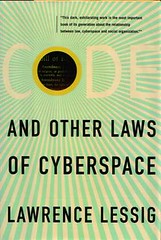 Lawrence Lessig’s Code and Other Laws of Cyberspace turns 10 this year and the folks over at Cato Unbound have put together an online debate about the book and its impact on cyberlaw, which I am honored to be taking part in. The discussion begins today with a lead essay from Declan McCullagh of CNet News and then continues throughout the week with responses from Harvard’s Jonathan Zittrain, myself, and then Prof. Lessig himself.
Declan’s lead essay, “What Larry Didn’t Get,” starts things off with a bang:
[Lessig] prefers what probably could be called technocratic philosopher kings, of the breed that Plato’s The Republic said would be “best able to guard the laws and institutions of our State — let them be our guardians.” These technocrats would be entrusted with making wise decisions on our behalf, because, according to Lessig, “politics is that process by which we collectively decide how we should live.”
Declan goes on to cite a litany of high-profile legislative and regulatory failures that have unfolded over the past decade, calling into question the wisdom of Prof. Lessig’s approach. Declan continues:
One response might be that the right philosopher-kings have not yet been elevated to the right thrones. But assuming perfection on the part of political systems (especially when sketching plans to expand their influence) is less than compelling. The field of public choice theory has described many forms of government failure, and there’s no obvious reason to exempt Internet regulation from its insights about rent-seeking and regulatory capture.
Sounds like it could be a heated discussion! Jonathan Zittrain is up next with an essay due to be posted on Wednesday and then my response will follow on Friday. Prof. Lessig’s response will go up a week from today. I look forward to this exchange and the responses it generates. I encourage readers to head over to the Cato Unbound site and check out the essays as they appear. I’ll post reminders here as the installments go live on the Cato site.
President Obama intends to nominate Mignon L. Clyburn to the Federal Communications Commission. Clyburn is a good pick. She has been a member of the Public Service Commission of South Carolina since 1998. She chaired the South Carolina commission from 2002 to 2004, is a past chair of the Southeastern Association of Regulatory Utility Commissioners and is a respected leader in the National Association of Regulatory Utility Commissioners (NARUC). She is trained in economics and has a reputation for thoughtfulness.
The remaining question is who ought to be the Republican nominee to fill the seat vacated by former chairman Kevin J. Martin (a soon-to-be-vacant seat held by Republican Robert M. McDowell will also need to be filled). By law, two of the commssion’s five members may not be from the President’s political party.
Let’s pretend you’re president. You have to appoint two opponents to the FCC. You don’t need their votes to pass your agenda, because you get to appoint three members from your political party who agree with your views. Do you fill the other two slots with people who hold few clear convictions, who are inclined to compromise and who crave positive feedback? Or do you look for people who are intellectually-engaged and are inclined to debate? If you believe your agenda is radical and you worry it will lead to negative consequences for which you will be blamed, you would want to appoint opponents who can be induced to vote with you. That way, you can claim your agenda had bipartisan support. This is the “cover you ass” approach. Continue reading →
Unlike with wiretaps, law enforcement agents are not required by federal statutes to obtain search warrants before employing pen registers or trap and trace devices. These devices record non-content information regarding telephone calls and Internet communications. (Of course, “non-content information” has quite a bit of content – who is talking to whom, how often, and for how long.)
The Electronic Privacy Information Center points out in a letter to Senate Judiciary Committee Chairman Patrick Leahy (D-VT) that the Department of Justice has consistently failed to report on the use of pen registers and trap and trace devices as required by law:
The Electronic Communications Privacy Act requires the Attorney General to “annually report to Congress on the number of pen register orders and orders for trap and trace devices applied for by law enforcement agencies of the Department of Justice.” However, between 1999 and 2003, the Department of Justice failed to comply with this requirement. Instead, 1999-2003 data was provided to Congress in a single “document dump,” which submitted five years of reports in November 2004. In addition, when the 1999-2003 reports were finally provided to Congress, the documents failed to include all of the information that the Pen Register Act requires to be shared with lawmakers. The documents do not detail the offenses for which the pen register and trap and trace orders were obtained, as required by 18 U.S.C. § 3126(2). Furthermore, the documents do not identify the district or branch office of the agencies that submitted the pen register requests, information required by 18 U.S.C. § 3126(8).
EPIC has found no evidence that the Department of Justice provided annual pen register reports to Congress for 2004, 2005, 2006, 2007, or 2008. “This failure would demonstrate ongoing, repeated breaches of the DOJ’s statutory obligations to inform the public and the Congress about the use of electronic surveillance authority,” they say.
It’s a good bet, when government powers are used without oversight, that they will be abused. Kudos to EPIC for pressing this issue. Senator Leahy’s Judiciary Committee should ensure that DoJ completes reporting on past years and that it reports regularly, in full, from here forward.
I’ve been blathering on about this week’s big Supreme Court decision in FCC v. Fox, [See Parts 1, 2, 3, 4, 5], so I thought I would just wrap this series of essays up with a collection of other articles and views on the decision in case readers are looking for alternative perspectives:
Mainstream Media Stories
Conservative, Religious, & “Family” Groups
Free Speech Advocates or Other Views
I’ve been commenting on yesterday’s Supreme Court decision in FCC v. Fox, and criticizing the logic of the majority’s decision the case, which was driven solely by procedural / admin law considerations. [See Part 3.] I also discussed Justice Thomas’s very interesting concurring opinion, which took a serious look at the constitutional issues in play here and signaled his willingness to potentially overturn Red Lion and Pacifica. [See Part 4.] In this fifth installment, I will briefly outline some of the dissenting arguments.
Justice Stephen Breyer penned a lengthy dissent and was joined by Justices Stevens, Souter and Ginsburg. Like the Scalia majority decision, the Breyer dissent also focused on the procedural / APA-related issues at stake in the case. Breyer, however, was not buying the FCC’s assertion that it had adequately justified its significant expansion of indecency enforcement in recent years. Whereas the majority deferred to the agency and found “no basis in the Act or this Court’s opinions for a requirement that all agency change be subjected to more searching review,” the four dissenting justices saw things quite differently. Breyer noted that while the “law grants those in charge of independent administrative agencies broad authority to determine relevant policy,” it “does not permit them to make policy choices for purely political reasons nor to rest them primarily upon unexplained policy preferences.” He goes on to appropriately note that:
Federal Communications Commissioners have fixed terms of office; they are not directly responsible to the voters; and they enjoy an independence expressly designed to insulate them, to a degree, from “‘the exercise of political oversight.’” [citations omitted] That insulation helps to secure important governmental objectives, such as the constitutionally related objective of maintaining broadcast regulation that does not bend too readily before the political winds. But that agency’s comparative freedom from ballot-box control makes it all the more important that courts review its decision making to assure compliance with applicable provisions of the law — including law requiring that major policy decisions be based upon articulable reasons.
Breyer goes on to restate much of what is already clear from the APA and all that surrounds it. “[A]n agency must act consistently. The agency must follow its own rules,” he notes. Moreover: Continue reading →

 The Technology Liberation Front is the tech policy blog dedicated to keeping politicians' hands off the 'net and everything else related to technology.