As part of a revise-and-resubmit process, I’ve been spending much of my summer upgrading my draft book, Intellectual Privilege: A Libertarian View of Copyright. That effort has led me to revisit copyright’s constitutional foundations. I find them very shaky, indeed. This passage (with footnotes excerpted) explains why modern copyright law often fails “to promote the Progress of Science and the useful Arts”:

What would copyright look like if we took the Constitution at its word, requiring that copyright promote the progress of both science and the useful arts? We would then have to look askance at the current practice of affording copyright protection to such purely artistic creations as songs, plays, novels, paintings, and sculptures. Even supposing that “science” reaches broadly enough to cover all of the humane sciences—a reading that Malla Pollack documents as an original meaning of the term—copyright law today focuses far more on the expressive arts than on the “useful” ones.

Taking “Science and useful Arts” seriously would thus radically narrow the proper scope of copyright. The first Copyright Act, enacted in 1790 by some of the same people who wrote and ratified the Constitution, covered only maps, charts, and books. Permitting copyrights in first two types of works plainly promoted both science and the useful arts. Lawmakers in 1790 probably regarded books, too, primarily as tools rather than diversions. Novels had yet to rise to prominence, after all; the first American one, William Hill Brown’s THE POWER OF SYMPATHY, had appeared only the year before, and even it aimed at practical ends, promising “to Expose the fatal consequences of SEDUCTION.” Judging from the titles in libraries and on sale, fiction made up only a small portion of the books available in late eighteenth century America. The 1790 Copyright Acts moreover excluded such purely artistic expressions as songs, plays, paintings, and sculptures—even though its drafters undoubtedly knew of and appreciated those sorts of works.

It appears, then, that “[t]o promote the Progress of Science and useful Arts” originally meant that that copyrights had to serve practical ends, rather than merely expressive ones. But originalists should not alone embrace that constitutional limitation on copyright’s scope. Given that “Science” now connotes a more technical and specialized endeavor than it did in the eighteenth century, the plain, present, public meaning of the Constitution likewise counsels against extending copyright protection to purely artistic works. Whether we give the Constitution’s text its original meaning or its current one, therefore, copyright should cover little more than maps, charts, non-fiction books, illustrations, documentaries, computer programs, and architecture. Most songs, plays, fictional books, paintings, sculptures, dances, movies, and other artistic works, because they fail to promote the progress of science and the useful arts, would on that reasoning not qualify for copyright protection.

However rigorously logical, that argument against the constitutionality of almost all modern copyright law will, I grant, probably generate more grins than agreement. Courts and commentators have hitherto hardly bothered to distinguish between “Science and useful Arts”; still less have they taken those words to impose real limitations on federal power. Here as elsewhere, acquiescence to long-accepted practices has dulled us to the Constitution’s bracingly straightforward words. We should read them anew and reflect that the Founding generation did not evidently think that granting statutory privileges to such purely artistic creations as romantic operas or pretty pictures would promote the progress of both science and the useful arts. Furthermore, most citizens today would, if presented with the Constitution’s plain language rather than the convoluted arguments of professional jurisprudes, probably say the same thing about pop songs, blockbuster movies, and the like. That is certainly not to say that purely expressive works lack value. They may very well promote such important goals as beauty, truth, and simple amusement. The Constitution requires that copyright promote something else, however—”the Progress of Science and useful Arts”—and a great many works now covered by copyright cannot plausibly claim to do both.

This argument against the constitutionality of most modern copyright relies, by the way, on a prior argument about the structure of the copyright clause; to wit, that “Science and useful Arts” modifies both “authors” and “inventors.” Also, I intend to follow up the above with an analysis of how the Supreme Court in Eldred took a view almost exactly opposite to the text-based one I’ve embraced. (I’d call that an admission, were I not proud to disagree with the Court.)

[[Crossposted at Agoraphilia, TechLiberation Front.]

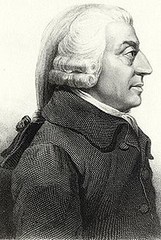
Adam SmithTwo weeks ago, I mentioned here that John Stuart Mill’s On Liberty celebrated its 150th anniversary this year.  This year also marks the anniversary of another classic text: Adam Smith’s The Theory of Moral Sentiments, which turns 250 this year.   Although Smith will always be most closely associated with The Wealth of Nations, some Smith fans (like me) consider The Theory of Moral Sentiments to be his real masterpiece.  First published in 1759, the book is a far more robust theory of life, ethics, human relations, and justice.  Indeed, as Dan Klein and Russ Roberts of George Mason University note in this excellent podcast, The Wealth of Nations is best viewed as an installment in, or an extension of, a much larger project that Smith really brought together more holistically in Theory of Moral Sentiments. [Note: Klein and Roberts have an amazing 6-part podcast series celebrating the 250th anniversary of the book, all of which can be found here].

Rarely has any moral philosopher gotten to his point quicker — namely in the very first line of the first page of the text — than Smith did in Theory of Moral Sentiments.  Smith wanted to show that man is both self-regarding and other-regarding, and that these seemingly contradictory notions were actually quite complementary.  In other words, “self-interest” (properly understood) and empathy for others could be reconciled:

How selfish soever man may be supposed, there are evidently some principles in his nature, which interest him in the fortunes of others, and render their happiness necessary to him, though he derives nothing from it, except the pleasure of seeing it. Of this kind is pity or compassion, the emotion we feel for the misery of others, when we either see it, or are made to conceive it in a very lively manner. That we often derive sorrow from the sorrows of others, is a matter of fact too obvious to require any instances to prove it; for this sentiment, like all the other original passions of human nature, is by no means confined to the virtuous or the humane, though they perhaps may feel it with the most exquisite sensibility. The greatest ruffian, the most hardened violator of the laws of society, is not altogether without it. [Book I, Chap. 1]

These opening lines make it clear why those who have criticized Smith’s theories as based on nothing more that greed or selfishness simply don’t know what they are talking about.  Continue reading →

The new Maine law I blogged about on Sunday is much worse than I thought based on my initial reading. If allowed to stand, it would constitute a sweeping age verification mandate introduced through the back door of “child protection.”

The law, which goes into effect in September, would extend the approach of the Children’s Online Privacy Protection Act (COPPA) of 1998 by requiring “verifiable parental consent” before the collection of kids “personal information” about kids, not just those under 13, but also adolescents age 13-17.  Unlike other state-level proposals in New Jersey, Illinois, Georgia and North Carolina, Maine’s “COPPA 2.0” law would also cover health information, but would only govern the collection and use of  data for marketing purposes (while the FTC has interpreted COPPA to cover to essentially any capability for communicating personal information among users).

But the Maine law would go much further than these proposals or COPPA itself by banning transfer or use of such data in anything other than de-identified, aggregate form. Still I took some comfort in the fact that the Maine law, unlike COPPA or these other proposals, lacked the second of COPPA’s two prongs: (i) collection from kids and (ii) collection on sites that are directed at kids. It’s because of the second prong that COPPA applies not only when a site operator knows that it’s collecting information from kids (or merely allowing them to share information with other users), but also when the operator’s site is (like, say, Club Penguin) targeted to kids in terms of its subject matter, branding, interface, etc. Because I initially concluded that the Maine law would apply only to knowing collection, I supposed that it would be less likely to require age verification of all users, as other COPPA 2.0 proposals would—something that would be unlikely to survive a First Amendment challenge based on the harm to online anonymity.

But I was quite wrong. During the PFF Capitol Hill briefing Adam and I held on Monday, Jim Halpert, one of our panelists, noted that the bill imposed “strict liability.”  Continue reading →

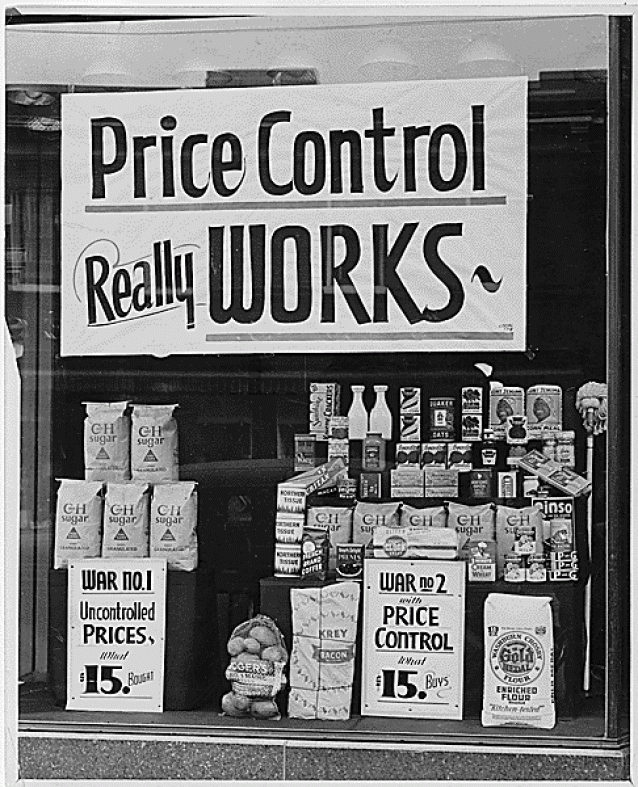
The FCC has less than seven months to complete and submit to Congress a “National Broadband Plan For Our Future.” Last week, CEI filed reply comments with the FCC on the broadband plan. One of our arguments was that network neutrality rules amount to price controls. ArsTechnica quoted our comments in a recent article and expressed skepticism toward our contention about neutrality mandates:638px-World_War_II_Domestic_Price_Controls

“In particular, [neutrality rules] require ISPs to offer content providers a price of zero, and to differentiate prices to consumers only in certain limited ways,” says CEI’s filing. “The disastrous consequences of price controls are all too familiar. And while neutrality may currently align with industry best practices, that fact limits the possible benefits just as much as the possible harm.” Content providers pay for bandwidth on the competitive market, so it’s not clear what the line about “a price of zero” refers to (that money is passed along to other ISPs along the network path through the mechanism of “peering and transit“). But it is clear what groups like CEI want from a broadband plan: nothing at all.

Ars is correct in pointing out that pricing based on usage is already commonplace in the form of the well-established system of peering arrangements and transit pricing. But pricing needn’t be based solely on usage; it could also be based on priority levels or quality of service tiers. Such pricing schemes remain in a nascent stage, yet many of them would be prohibited or restricted by neutrality rules. This is because neutrality rules by definition set the price of many kinds of data prioritization at zero. Thus, even if an effective mechanism for differentiating between data streams at the network level were to gain traction, it would be subject to regulatory burdens if neutrality were to be enshrined into law.

Continue reading →

In response to Professor Jonathan Zittrain’s op-ed in The New York Times last Monday about online privacy and open platforms (which Adam thoroughly refuted last week) I have a letter to the editor in today’s The New York Times:cloud

To the Editor: Re “Lost in the Cloud” (Op-Ed, July 20): In discussing the privacy risks that have accompanied the growth of the Internet, Prof. Jonathan Zittrain rightly bemoans the willingness of governments to violate individuals’ privacy rights. Unfortunately, he proposes new legal restrictions that would stifle online innovation while doing little to enhance consumer privacy. Mr. Zittrain proposes a “fair practices law” that would require companies to release personal data back to users upon request. Such a rule may sound workable, but purging specific data across globally dispersed server farms is no simple endeavor. Who is to pay for the implementation of such privacy procedures — especially for free services like Facebook or Twitter that have yet to turn a profit? A better approach to online privacy is to educate users on safeguarding personal information. Ultimately, however, the only foolproof approach to protecting sensitive data online is to simply not disclose it.

Continue reading →

The Obama administration has been greeted with enthusiasm by scientists who see the potential for “research-based policy.” Reason, not ideology, will govern. The New Scientist, among other zines, headlines “Let Science Rule: the Rational Way to Run Societies.” (May 28, p. 40-43) This is part of a larger theme: Behavioral economics is taking off. Continue reading →

Maine has just enacted a law severely restricting marketing to kids: the Act To Prevent Predatory Marketing Practices against Minors, summarized by Covington & Burling. Adam and I released a major paper in June about such laws: COPPA 2.0: The New Battle over Privacy, Age Verification, Online Safety & Free Speech. Maine is following the lead of several other states that have tried to expand the Children’s Online Privacy Protection Act (COPPA) of 1998 to cover nost just kids under 13 but adolescents as well and potentially all social networking sites. We discussed at length the problems such laws create, particularly the possibility that large numbers of adults would, for the first time, be subject to age verification mandates before accessing (or participating in) the growing range of sites with social networking capabilities.  This, in turn, would significantly “chill” free speech online by undermining anonymity.

Like COPPA 2.0 proposals in New Jersey (simply extending COPPA to cover adolescents) and Illinois (applying COPPA to most social networking sites), the Maine law tries to build on COPPA’s “verifiable parental consent” requirement for the 13-17 audience as well as those under 13.

On the one hand, the Maine law goes much further than these other COPPA 2.0 proposals. While the original bill was limited to the Internet and wireless communications, the final bill’s scope applies to all communications.  The bill also covers “health-related” information (HRI) as well as “personal information” (PI). On the other hand, the Maine law is thus somewhat narrower than other COPPA 2.0 proposals and COPPA itself in that it applies only to “marketing or advertising products, goods or services.” While COPPA is commonly misunderstood to cover only marketing, it actually covers essentially any “collection” (broadly defined) of personal information from kids for any purpose—including merely giving kids access to communications functionality that might let them share personal information with other users (even if the site itself is not “collecting” that information in the commonly understood sense).

Continue reading →

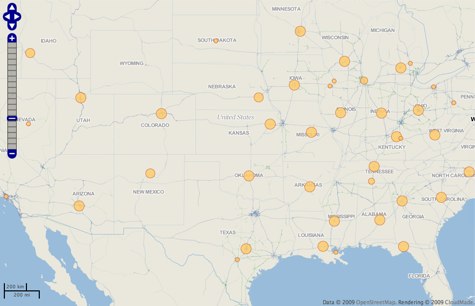
Any time I’ve heard government officials talk about the future of Recovery.gov, I’ve heard them mention maps. Maps that will let you drill down to your neighborhood and see the stimulus spending right around you. Well, the maps were rolled out last Thursday, and there was even a congratulatory press release from Vice President Biden. Tell me if you notice anything interesting in this map of federal grant recipients from Recovery.gov.

recoverymap.jpg

Geography wizzes will recognize that almost all the bubbles on the map, which represent federal grants, neatly coincide with state capitals. Check it out for yourself right here. What this highlights is a deeper problem of stimulus spending data: reporting is only required to go to two levels down. Sure, we can see that the Department of Education gave the state of California (displayed on the map as a bubble in Sacramento) so many millions of grant dollars. And we may even know that California gave a subgrant to the Los Angeles School Board. But what happens after that is missing, and will likely remain missing under the Act’s transparency requirements and OMB guidance.

These maps are great, but I’d rather have deep, meaningful data in a structured format so I can make my own maps.

kids_watching_tvThe Senate Commerce Committee held a hearing yesterday where a number of Senators as well as Julius Genachowski, the new Chairman of the Federal Communications Commission, did a lot of fretting about the state of the modern children’s television programming marketplace.  According to the Wall Street Journal, Senate Commerce Committee Chairman Jay Rockefeller (D-WV):

suggested that a “little red button” be required on TVs so that a child could push the button to find out how a show is rated. Democratic Sen. Mark Pryor of Arkansas agreed that a red button might help since parents often have difficulties figuring out which shows are appropriate for their children to watch.

Well, I have some good news for the Senators: There are already quite a few little buttons on every remote control made today, and at least one of those buttons can pull up an on-screen guide to get more program info! (Another of them can turn the TV off!) Moreover, the ratings for just about every program already appear at the beginning of each show, and sometimes in between. And you can find out plenty more online about every TV show under the sun if you care to look.  So, I’m not sure what that fuss is all about, and we certainly don’t need to mandate “little red buttons” on every TV set when program information can be found in so many other ways.

What is more troubling about all the hand-wringing taking place at the hearing, as well as the talk of reopening the Children’s Television Act of 1990 to potentially impose more content mandates on video programmers and distributors, is that: (1) there doesn’t seem to be much appreciation for just how much wonderful children’s programming is out there today compared to the past, and (2) there doesn’t seem to be much recognition of the serious First Amendment issues at stake when government gets involved in the messy business of regulating video programming.

Continue reading →