Herewith another recent addition to my draft book, Intellectual Privilege: A Libertarian View of Copyright, (inspired, in part, by Berin Szoka’s recent claim, “I just don’t know what the right balance [for copyright] is! I’m glad there are others patient enough to try to figure it out. This is why we have economists and… yes, even lawyers!”):

As an illustration of the public choice pressures that drive copyright policy, consider the fate of the copyright in Steamboat Willie, a 1928 cartoon that the Walt Disney Company cites as establishing its copyright claim in Mickey Mouse. Scholars have made a surprisingly strong case that, because the requisite formalities of the 1909 Copyright Act were not satisfied, Steamboat Willie has fallen into the public domain. The Walt Disney Company has responded to such claims by threatening to bring suit for “slander of title,” demonstrating how seriously it takes its copyright in Steamboat Willie. Let us take that copyright seriously, too, then, so that we might better understand the public choice effects of the Walt Disney Company’s interests.

Copyright Duration and the Mickey Mouse Curve

This video from a puppet maker in Australia has an interesting take on the fear-mongering that often drives public policy for Internet safety. The video does a good job of putting into perspective the real risk to kids of online predation.

For instance, we often hear the scary statistic that “1 in 5 children are sexually solicited online.” This was based on data originally released by the National Center for Missing and Exploited Children (NCMEC). It’s since been updated to 1 in 7, which still sounds bad, but not so bad in perspective — what does solicitation mean, and by whom? Well, “solicitation” is broadly defined to mean “unwanted contact.” In the study, it encompasses any unwanted discussion of a sexual nature. But the real perspective comes from learning 90% of this unwanted contact comes from other peers or young adults! So, it’s rarely the creepy perverted middle-age man in a wife beater t-shirt — even though the messaging from many policymakers focuses almost entirely on this scenario.

http://www.youtube.com/v/9lsnC-iWHJ0

Maybe Obama should invite Google CEO Eric Schmidt and Microsoft CEO Steve Ballmer over to the White House for a beer to settle the two companies’ differences!

http://www.youtube.com/v/Q0umKaGxkkE While he’s at it, Obama might want to invite Apple CEO Steve Jobs, too, since the common cause Apple and Google once made against Microsoft now seems to be giving way to increased rivalry between the two titans of Internet cool. Or how about Facebook CEO Mark Zuckerberg, given Facebook’s growing challenge to Google? Yahoo!’s Carol Bartz seems to get along much better with everyone than the boys in the group, so she’d probably help Obama keep things under control. The Internet industry’s war-of-all-against-all is reminiscent of Tom Lehrer‘s classic 1960s satire “National Brotherhood Week”:

http://www.youtube.com/v/aIlJ8ZCs4jY Continue reading →

I’m listening to the audiobook of Telecosm, George Gilder’s prophetic book about how abundant broadband would revolutionize the planet—which I recommend to everyone. I came across this passage, which reminded me just how good we really have it:

Reported to catalog only 16 percent of web pages, the best Internet search engines are foundering under the load, taking as long as six months to add new content.

If that was Search 1.0, Search 2.0 is great! Today’s search engines will index this post in a matter of minutes and while there are still parts of the “Deep Web” that aren’t crawled, a number of Search 3.0 upstarts are working on solving that problem, too!

CCI’m not sure how I missed this, but someone just pointed out to me that in late July, the city of Amherst, NY, “failed to approve a game license for [Chuck E. Cheese’s] the kids-themed food and entertainment venue… citing concerns about violent video games and bad behavior by patrons that require police intervention.”  That is according to this article by Sandra Tan in The Buffalo News.  Tan reports that the Amherst Town Board deadlocked 3-3 when considering the license for Chuck E. Cheese’s, apparently meaning that the pizza and arcade hot spot for kids will no longer be able to offer games at their Amherst venue. According to her article, game content considerations drove the move:

Council Member Shelly Schratz said she was disturbed by several “action-packed shoot-and-kill games” that were accessible to children as young as 4.  “When I see 6-year-olds, 8-year-olds playing those games, when all the time we’re opening the paper and seeing those stories on youth violence, do we need those games to make money?” she said.  Schratz was one of three board members who voted against renewing the establishment’s game room license, which is necessary for the business to legally run its arcade games, a major draw for families that patronize the chain’s 500-plus locations from coast to coast.

I find the actions of Amherst in this case to be quite troubling. Here are a few quick thoughts about this incident: Continue reading →

Over at Twitter, our TLF blogging colleague Jerry Brito asks a smart question about the Federal Communications Commission’s recently-opened investigation of the Apple-Google spat over Apple’s recent decision to reject the Google Voice app from the iPhone App Store.  Jerry asks: “Maybe I should know this, but what authority does the FCC have to demand that Apple explain anything?”  Good question, Jerry!  But no, I don’t think there’s anything you’re missing.  We might consider this merely the latest chapter of the agency’s rogue operator history: If you can’t find the authority to do something, just assert it anyway and go for broke!  The idea of living within the confines of the law and paying attention to statutory authority seems like an alien concept to the FCC.  As my PFF colleagues Barbara Esbin and Adam Marcus have pointed out in their amazing recent law review article, “The Law Is Whatever the Nobles Do: Undue Process at the FCC,” when all else fails, the agency just asserts “ancillary jurisdiction” and claims that the whole world is their oyster. They argue:

The FCC’s means of asserting regulatory authority over broadband Internet service providers’ (“ISP”) network management practices is unprecedented, sweeping in its breadth, and seemingly unbounded by conventional rules of interpretation and procedure. We should all be concerned, for apparently what we have on our hands is a runaway agency, unconstrained in its vision of its powers.

Of course, even if we ignore the agency’s cavalier attitude about the law and statutory authority, there are other reasons to be concerned about FCC interference in this matter. Continue reading →

Like many others, I’ve wondered whether Yahoo! got less than it should have becuase government antitrust regulators prevented Google from bidding up the value of a deal with Yahoo!.

Carl Icahn, who owns 5% of Yahoo! seems happy enough while others still wonder if Microsoft got the better end of the deal,  BusinessWeek reports. While many observers have howled that Yahoo! gets revenue-sharing instead of cash up front, Yahoo! Carol Bartz notes that a cash deal “would have had significant tax consequences while contributing only $3 million in annual interest to Yahoo’s bottom line.”

Whatever the initial terms of the deal, its value depends on speedy approval without onerous conditions being imposed by antitrust regulators—even if they take the form of “voluntary” concessions. Let’s hope the government gets out of the way to give this new partnership a real chance to go toe-to-toe with Google in search, as I’ve suggested here, here and especially here.

The recently proposed Microsoft-Yahoo deal has rekindled the debate over what role, if any, antitrust regulators should play in the high-tech sector. Adam and Berin have argued that decades-old (sometimes centuries-old) antitrust laws simply cannot keep pace with the relentlessly fast-moving digital economy. And Farhad Manjoo of Slate has concluded that antitrust action against tech companies does more harm than good — even when the facts favor government intervention.

For more on this, check out this excellent column on the future of antitrust enforcement by L. Gordon Crovitz in today’s The Wall Street Journal which quotes my colleague (and fellow TLFer) Wayne Crews:

Markets were so much simpler in the 1890s, when Sen. John Sherman got almost unanimous support in Congress to go after the Standard Oil Co. of Ohio. The Sherman Act and later antitrust laws were supposed to protect consumer interests. That’s not so easy when regulators have to deal with industries as different as oil, with its cartels and long product cycles, and technology, where fast change is a constant necessity for survival… The bottom line is that by the time regulators can assess a technology market, the market has often moved on. Not long ago, Google was the upstart and the search leaders included names like AltaVista and Excite. “Regulatory intervention in the high-tech sector thwarts the natural evolution of the market,” argues Wayne Crews of the Competitive Enterprise Institute. “Worse, it distorts the response of competitors. Antitrust investigations steer the market in unnatural directions, creating instabilities in entire industry sectors.”

Read the rest here.

Regular readers will know that Adam and I have been waging a lonely defensive action in the war on “Free!” (ad-supported) content and services online, pointing out that restrictions on data collection and use for advertising would ultimately hurt consumers by reducing funding for the sites they love (1234). In short, there is no free lunch! I’ve also written a number of posts this past week about the dangers inherent in antitrust regulation—arguing that government efforts to make online markets more competitive through antitrust tinkering generally do more harm than good (1, 23).

These two debates have long shared a common thread: Some have argued that effects on privacy should become a part of antitrust analysis and those who consider Google to be “Big Brother” want Washington both to clamp down on data use (“baseline privacy legislation”) and to ramp up antitrust scrutiny of the company.

Eiffel GoogleBut a French company has opened a much more direct front in the War on “Free.” Bottin Cartographes has sued Google for unfair competition (concurrence déloyale—literally, disloyal competition) and abuse of its market dominance. The case is a little more complicated than English language reports suggest: It’s not just that Google is giving away a product (Google Maps) that Bottin charges, or wanted to charge, for.  Like Google, Bottin charges enterprise users. But Bottin complains that Google doesn’t show ads on the public version of Google Maps. (Neither does Bottin, but maybe that’s part of why they’re upset.) Bottin’s lawyer claims that Google’s “strategy is to capture the market and squeeze out the competition by creating a monopoly for itself.” He goes on to assert that Google is “ruining the market” for mapping services.

Bottin seeks half a million Euros (plus interest) in damages, but their lawyer insists: “It’s not a question of money. Either Google puts advertising on Google Maps or the company must be forced to pay damages and abide by the terms of fair competition.”  The hearing is set for October 16.

This argument, crazy as it sounds, is one Google is likely going to have to fend off repeatedly in the coming years—and not just in Europe, where “unfair competition” is still very much about protecting competitors rather than consumers. Chris Anderson, author of the new book Freerecently addressed this very issue. Anderson’s book describes multiple ways of supporting “Free” content and services.

Continue reading →

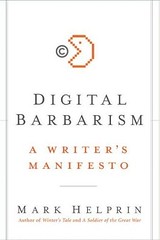
Last month, Digital Barbarism book cover National Review magazine published a review that I penned of Mark Helprin’s new book, Digital Barbarism: A Writer’s Manifesto.  Helprin’s book is both a passionate defense of copyright law as well as a mini-autobiography.  Helprin is one of the great novelists and essayists of the past half-century, and his book A Soldier of a Great War is one of my all-time favorite novels.  I cannot in strong enough words encourage you to read that book; it is profoundly moving. (I almost named my son after the lead character in the book!)

Thus, I was quite excited when I learned that Helprin had penned a defense of copyright and I jumped at the chance to review it when the folks at National Review asked me to do so.  Alas, as you will see in my review, I was terribly disappointed.  I wish Helprin would have stuck with the very reasonable tone he adopted in this excellent podcast interview he did recently with John J. Miller of National Review Online. Unfortunately, he went a different direction in the book, as I make clear in my review:


National Review July 20, 2009

“Man, Machine, and Copyright” a review of Digital Barbarism: A Writer’s Manifesto, by Mark Helprin by Adam Thierer

It would be difficult to think of anyone more ideally suited to pen a passionate defense of copyright law than novelist Mark Helprin.  Helprin has written several of the finest works of modern literature, including his masterpiece, A Soldier of the Great War, a narrative of transcendent beauty. In Digital Barbarism, Helprin sets out to use his formidable gift for the written word to repel the “cyber mob” that has attacked copyright law and called for its curtailment, or even abolition.

Unfortunately, while Helprin occasionally rises to great heights in his defense of copyright, he too often sinks to lamentable lows — by resorting to the same unbecoming rhetorical tactics used by the mob he seeks to condemn. Indeed, his book is filled with gratuitous vitriol and neo-Luddite ramblings about the Internet and Information Age that severely detract from his defense of copyright. This is a shame, because, in places, Digital Barbarism makes a fine case against those critics who wrongly view copyright as an impediment to the creation and diffusion of content. “The availability of information is not and will not be restrained by the copyright system any more than it is or will be restrained by the delivery systems that make it possible,” Helprin argues. Why, he asks, “must ‘content’ be free” when everything else — access to the Internet, digital devices, etc. — costs good money? He notes that the movement that advocates “free,” universal access to all copyrighted material in the name of “openness” and “the public good” would, ironically, “destroy the dream it advocates”: Continue reading →