If I can amplify a bit on a post at the Cato blog earlier today, I want to clarify that I fully agree some of the ISP behaviors that net neutrality proponents have identified as demanding a regulatory response really are seriously problematic. My point of departure is that I’d rather see if there are narrower grounds for addressing the objectionable behaviors than making sweeping rules about network architecture. So in the case of Comcast’s throttling of BitTorrent, which is the big one that seems to confirm the fears of the neutralists, I think it’s significant that for a long while the company was—”lying about” assumes intent, so  I’ll charitably go with “misrepresenting”—their practices. And I don’t think you need any controversial premises about optimal network management to think that it’s impermissible for a company to charge a fee for a service, and then secretly cripple that service. So without even having to hit the more controversial “nondiscrimination” principle Julius Genachoswki proposed on Monday, you can point to this as a failure of the “transparency” principle, about which I think there’s a good deal more consensus. Now, there are bigger guns out there looking for dodgy filtering practices these days, so I’d expect the next attempt at this sort of thing to get caught more quickly, but by all means, enforce transparency about business practices too. Consumers have a right to get the service they’ve bought without having to be 1337 haxx0rz to discover how they’re being shortchanged. But before we get the feds involve in writing code for ISP routers, I’d like to see whether that proves sufficient to limit genuinely objectionable deviations from neutrality. There’s a hoary rule of jurisprudence called the canon of constitutional avoidance. It means, very crudely, that judges don’t decide broad constitutional questions—they don’t go mucking with the basic architecture of the legal system—when they have some narrower grounds on which to rule. So if, for instance, there are two reasonable interpretations of a statute, one of which avoids a potential conflict with a constitutional rule, judges are supposed to prefer that interpretation. It’s not always possible, of course: Sometime judges have to tackle the big, broad questions. But it’s supposed to be something of a last resort. Lawyers and civil liberties advocates, of course, tend to get more animated by those broad principles, whether the First Amendment or end-to-end. But there’s often good reason to start small—to look to the specific fact patterns of problem cases and see whether there are narrower bases for resolution. It may turn out that in the kinds of cases that neutralists rightly warn could harm innovation, it’s not one big principle, but a diverse array of responses or fixes that will resolve the different issues. In a case like this one, perhaps a mix of mandated transparency, consumer demand, and user adaptation (e.g. encrypting traffic) will get you the same (or a better) result than an architectural mandate. Continue reading →

newspapers on fireTwo great articles today about the dangers of government getting too involved in the newspaper business as the industry experiences serious marketplace difficulties. Slate’s Jack Shafer (“Saving Newspapers From Their Saviors“) and Mark Hopkins of Silicon Angle (“Obama Administration ‘Open’ to State Run Newspapers“) both raise concerns about President Obama’s recent comments hinting that he is open to legislation that might grant struggling news organizations tax breaks if they were to restructure as nonprofit businesses.

In a piece for the City Journal back in March entitled “Socializing Media in Order to Save It,” I discussed the specific proposal in question, Senator Benjamin L. Cardin’s (D-MD) bill, S. 673, the “Newspaper Revitalization Act,” which would allow newspapers to become nonprofit organizations in an effort to help them stay afloat. Importantly, however, the measure would also disallow political endorsements on their editorial pages as part of the deal.  In my essay, I pointed out how “If the FCC received grant-making authority to dole out subsidies to media operators… it’s hard to imagine how journalists won’t be expected to surrender something in exchange.”  And that something would be their journalistic independence.

Shafer and Hopkins raise similar concerns in their essays.  Continue reading →

Julius Genachowski, the new FCC chairman, announced that the commission will begin a rulemaking process to formalize and supplement existing network neutrality policy. According to Genachowski,

This is not about government regulation of the Internet. It’s about fair rules of the road for companies that control access to the Internet. We will do as much as we need to, and no more, to ensure that the Internet remains an unfettered platform for competition, creativity, and entrepreneurial activity.

Of course it is about regulation. The formal rulemaking process Genachowski is planning is for the avowed purpose of enshrining network neutrality principles in the Code of Federal Regulations.

Regulation always starts out small, before it grows really big. It has to: Loopholes and other unintended consequences (and opportunities) are always discovered after the “product” launches.

Genachowski unfairly and innaccurately implies that network neutrality opponents want to “abandon the underlying values fostered by an open network, [and] the important goal of setting rules of the road to protect the free and open Internet.” In fact, the existing Internet Policy Statement that would serve as the foundation of a new network neutrality regulatory regime received 2 Republican votes and 2 Democrat votes.

Genachowski is attempting to present a false choice between letting minimally trained politicians and myopic bureaucrats get their hands all over the Internet to remake it as they see fit versus “doing nothing.”

Saying nothing — and doing nothing — would impose its own form of unacceptable cost. It would deprive innovators and investors of confidence that the free and open Internet we depend upon today will still be here tomorrow. It would deny the benefits of predictable rules of the road to all players in the Internet ecosystem. And it would be a dangerous retreat from the core principle of openness — the freedom to innovate without permission — that has been a hallmark of the Internet since its inception, and has made it so stunningly successful as a platform for innovation, opportunity, and prosperity.

Continue reading →

Blogger’s Note: I posted this blog entry over at BroadbandCensus.com earlier in the day. It’s the first of series this week — One Web Week — in which I’m taking a step back to look at the issue of broadband data and broadband transparency from a bit of a longer time frame. And today couldn’t be a more timely day to do so, with Genachowski’s speech highlighting a new sixth principle of Network Neutrality: broadband transparency! -Drew Clark

WASHINGTON, September 21, 2009 – Broadband data is important for the future of our country – and public and transparent broadband data is even more important.

Today, at this moment, new Federal Communications Commission Chairman Julius Genachowski is making a speech in which he is highlighting the vital principle of public and transparent broadband data.

For three years now, this principle has been the core belief animating my efforts as a journalist, and as the entrepreneur founding BroadbandCensus.com. Now, as we enter the fourth year since this saga began, it’s time to take stock and reflect on what BroadbandCensus.com has accomplished.

And with One Web Week having arrived, I’d like to lay out this history from a personal perspective. In this series of blog posts, I’m going to speak about what we’ve been through, who we have worked with to advance the principles of public and transparent broadband data, and what we ultimately aim to achieve at BroadbandCensus.com.

  • Today’s topic: The debate begins, with the Freedom of Information Act lawsuit in 2006.
  • Tomorrow’s topic, on One Web Day: The founding of BroadbandCensus.com in the fall of 2007.
  • Wednesday topic: The Broadband Census for America Conference in September 2008, and our work with the academic community to foster public and transparent broadband data-collection efforts.
  • Thursday’s topic, in advance of the U.S. Broadband Coalition’s report to the Federal Communications Commission: BroadbandCensus.com’s involvement with the National Broadband Plan in 2009.
  • The concluding topic, on Friday morning: The role BroadbandCensus.com and broadband users have to play in the creation of a robust and reliable National Broadband Data Warehouse.

The Beginnings: Why I Sued Kevin Martin’s Federal Communications Commission

BroadbandCensus.com was founded in October 2007 after I spent nearly a year and a half with the Center for Public Integrity, a non-profit investigative journalism organization based here in Washington. But the quest for public and transparent broadband data goes back further.

Continue reading →

The FCC announced today that it will consider adopting net neutrality rules. The announcement comes in a speech by Chairman Julies Genachowski, which you can read here and watch here. Genachowski says,

To date, the Federal Communications Commission has addressed these issues by announcing four Internet principles that guide our case-by-case enforcement of the communications laws. … The principles were initially articulated by Chairman Michael Powell in 2004 as the “Four Freedoms,” and later endorsed in a unanimous 2005 policy statement[.] … Today, I propose that the FCC adopt the existing principles as Commission rules, along with two additional principles that reflect the evolution of the Internet and that are essential to ensuring its continued openness.

By suggesting that they must be codified, Genachowski is implicitly (if not explicitly) conceding that the FCC’s Internet principles are a mere policy statement and not a binding and enforceable rule. I’ve explained why this is the case previously. So, someone should call the D.C. Circuit, considering the Comcast case, and let them know their job just got a lot easier.

Second, Genachowski gives “limited competition” as a reason to consider regulation. However, the best available data from the FCC show that 98% of zip codes have 2 or more broadband providers, 88% of zip codes have 4 or more broadband providers, and 77% of zip codes have 5 or more broadband providers. That said, some have questioned whether the FCC’s data are accurate, and the FCC’s next broadband report is supposed to have data gathered at the census tract level for a more detailed set of speed categories. So, the FCC is proposing a regulation before it has completed an ongoing study to discover whether there is a real problem. It’s almost as if Kevin Martin is still running the place.

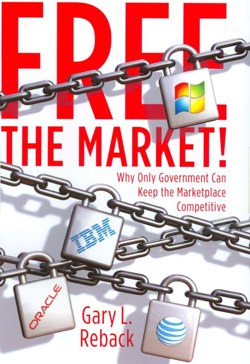
Reback book coverI recently finished reading Free the Market: Why Only Government Can Keep the Marketplace Competitive, a new book by noted antitrust agitator Gary L. Reback. Unsurprisingly, Reback, who led the antitrust jihad against Microsoft during the 1990s, has written a book that reads like an extended love letter to antitrust law. This man loves antitrust the way teenage girls love the Jonas Brothers — gushing, teary-eyed, ‘I-would-just-die-for-you’ sort of love.  In Reback’s world, antitrust seemingly has no costs, no downsides, no trade-offs.  It is our salvation and he serves as its high prophet. Everything good that happened in the world of high-tech over the past few decades?  Oh, you can thank Almighty Antitrust for that.  Anything bad that happened?  Well, then, clearly there just wasn’t enough antitrust enforcement!  That’s this book in a nutshell.

Think I’m kidding?  How about this gem of quote from pg. 247: “Antitrust enforcement spawned Silicon Valley’s software industry as well.”  Wow, who knew!  Of course, that’s utter poppycock and should be somewhat insulting to the many entrepreneurial men and women in the high-tech world who risked everything in an attempt to build a better mousetrap. In Reback’s view of things, however, none of those mousetraps would have ever gotten built without antitrust there to supposedly shelter them from wicked “monopolists” (read: any large company) already operating in the marketplace.   I’m sure many in Silicon Valley will also be surprised to hear Reback’s assertion that, “On closer examination, the Valley looks like one big public welfare project.” (p. 54)  Ah yes, the old myth that government gave us the Net we know and love today. Please. Like many others, Reback spins a revisionist history of how early ARPANET involvement and seed money somehow made the Internet great when, in reality, the Net was stuck in the digital dark ages until it was finally allowed to be commercialized in 1992.

What irks me most about this book, however, is Reback’s perpetuation of the myth that antitrust is somehow not a form of economic regulation.  I hear this tired old argument trotted out time and time again, even by many conservatives. Reback says, for example, that “Antitrust sets the rules of the road, so to speak, but doesn’t tell people where to drive.” By contrast, he argues, “Advocates of regulation want[] continuing government oversight and rule making to produce what would be the beneficial results of a free market… Neither approach works all the time, and decided between them remains difficult.” (p. 19)  Again, this “choice” is largely a fiction since, for many industries, we end up getting both! Continue reading →

In his brilliantly-titled essay, Of Dynamic Media, Steamed Dinners, and Bare Breasts, PFF’s Ken Ferree points out that FCC’s “Janet Jackson case” just continues to wind on and on and on. There is basically no end in sight for this case, CBS Corp. vs. FCC or the other major ongoing broadcast indecency case, FCC v. Fox, even though the incidents that motivated these cases took place years ago (between 2002-2204). As Ken notes:

Can we not all agree that there is something wrong with this process? The media landscape has changed dramatically, even since that fateful day in 2004 when Justin Timberlake pulled the veil from the now senescent Ms. Jackson, and it will likely be unrecognizable by the time any final conclusion in this matter is reached — which could be another ten years hence. The problem is that the wheels of justice turn slowly while the wheels of technology propel the media markets ahead at a blistering pace. We simply can’t go on pretending that broadcasting is what it was in the 1970s, 1980s, or even in the 1990s. The markets have changed, the number of program options has grown, consumers’ usage patterns have become more varied and variable, new delivery platforms have evolved, and the technologies available to manage media on a personal level — especially for parents — have become ever more sophisticated. It is time the “expert” agency recognize the media revolution that has occurred and abandon its holy war on broadcasting.

Ken’s got it exactly right when he notes that “the wheels of justice turn slowly while the wheels of technology propel the media markets ahead at a blistering pace.”  Indeed, Janet Jackson will probably be an old woman living in a Florida nursing home by the time this case winds its way back and forth through the courts and finally comes to a conclusion.

LenoreSkenazyI absolutely adore Lenore Skenazy. As I pointed out in my review of her brilliant new book, Free-Range Kids: Giving Our Children the Freedom We Had Without Going Nuts with Worry, she is rare voice of sanity in modern debates about parenting and child safety issues.  If you are a hyper-concerned helicopter parent who constantly obsesses about keeping your kids “safe” from the world around them, then I beg you to read her book and her outstanding blog of the same name.  It will completely change the way you look at the world and how your go about raising your kids.  It is that good.

Skenazy address and debunks a wide variety of “child safety” myths in her book, including many from the online child safety front that I spend so much time dealing with in my work.  In one of her recent posts, she addresses the rather silly concerns of one elementary school teacher who wanted an author of children’s books to speak to her fourth grade class using Skype.  However, “since the school and the author are 1000 miles apart, the author suggested using the video-chat service Skype. The teacher said no — not unless he could come up with a way the kids could see HIM, but not vice versa.”  When Skenazy pointed out how this concern was likely greatly overblown, one commenter on her site responded: “The teacher is likely (legitimately) concerned that the kids’ faces could end up plastered all over the Internet.”  Skenazy responds to that notion with a rant worthy of a George Carlin monologue, albeit without as much swearing, mind you:

Excuse me? Legitimately concerned that (1) A children’s author she has invited will turn around and take photos of her class and post them without permission?  That that’s what men do all the time? Can’t trust ‘em for a second? (2) That boring photos of a 4th grade class are so exciting that they will take the Internet by storm? (Because, of course, there are so few photos of school children available.) (3) That someone will see this particular photo, obsessively focus on the kid in the third row and move heaven and earth to come find this child and stalk, rape or kill him/her? And that we must keep Third Row Kid safe at all costs? These are insane fantasies! Perfect, text-book examples of the way so many of us now jump to the absolutely WORST CASE SCENARIO and then work backward from it, preventing something harmless or even wonderful from ever taking place just in case. Using this method of risk calculation, a teacher could politely request that from now on, no one serve her students lunch at school. Because what if one of the lunch ladies is secretly a psychopath and she is intent on murdering the kids one by one? It COULD happen, right? Let’s be prepared for the ABSOLUTE WORST! After all, we’re only thinking about the good of the children!

Continue reading →

A terrific Radio Berkman podcast this week on “Adventures in Anonymity” featuring Sam Bayard, a fellow at the Harvard Berkman Center and the Assistant Director of the Berkman Center’s Citizen Media Law Project.  Along with host Daniel Dennis Jones, Bayard discusses the intersection of anonymity, free speech, defamation law, privacy, and more.  In addition to sorting through the sticky legal and ethical issues, their discussion includes some really excellent historical perspectives on anonymous speech.  They also get into the recent “skank” blogger case and the AutoAdmit case.  I discussed those cases and some of these issues more generally in these essays:

My colleague Jim Harper and I have been having a friendly internal argument about Internet privacy regulation that strikes me as having potential implications for other contexts, so I thought I might as well pick it up here in case it’s of interest to anyone else. Unsurprisingly, neither of us are particularly sanguine about elaborate regulatory schemes—and I’m sympathetic to the general tenor of his recent post on the topic. But unlike Jim, as I recently wrote here, I can think of two rules that might be appropriate: A notice requirement that says third-party trackers must provide a link to an ordinary-language explanation of what information is being collected, and for what purpose, combined with a clear rule making those stated privacy policies enforceable in court. Jim regards this as paternalistic meddling with online markets; I regard it as establishing the conditions for the smooth functioning of a market. What do those differences come down to?

First, a question of expectations. Jim thinks it’s unreasonable for people to expect any privacy in information they “release” publicly—and when he’s talking about messages posted to public fora or Facebook pages, that’s certainly right. But it’s not always right, and as we navigate the Internet our computers can be coaxed into “releasing” information in ways that are far from transparent to the ordinary user. Consider this analogy. You go to the mall to buy some jeans; you’re out in public and clearly in plain view of many other people—most of whom, in this day and age, are probably carrying cameras built into their cell phones. You can hardly complain about being observed, and possibly caught on camera, as you make your way to the store. But what about when you make your way to the changing room at The Gap to try on those jeans? If the management has placed an unobtrusive camera behind a mirror to catch shoplifters, can the law require that the store post a sign informing you that you’re being taped in a location and context where—even though it’s someone else’s property—most people would expect privacy? Current U.S. law does, and really it’s just one special case of the law laying down default rules to stabilize expectations.  I think Jim sees the reasonable expectation in the online context as “everything is potentially monitored and archived all the time, unless you’ve explicitly been warned otherwise.” Empirically, this is not what most people expect—though they might begin to as a result of a notice requirement. Continue reading →