By Berin Szoka & Adam Thierer
 We learned from The Wall Street Journal yesterday that “Federal Communications Commission Chairman Julius Genachowski gets a little peeved when people suggests that he wants to regulate the Internet.” He told a group of Journal reporters and editors today that: “I don’t see any circumstances where we’d take steps to regulate the Internet itself,” and “I’ve been clear repeatedly that we’re not going to regulate the Internet.”
We’re thankful to hear Chairman Julius Genachowski to make that promise. We’ll certainly hold him to it. But you will pardon us if we remain skeptical (and, in advance, if you hear a constant stream of “I told you so” from us in the months and years to come). If the Chairman is “peeved” at the suggestion that the FCC might be angling to extend its reach to include the Internet and new media platforms and content, perhaps he should start taking a closer look at what his own agency is doing—and think about the precedents he’s setting for future Chairmen who might not share his professed commitment not to regulate the ‘net. Allow us to cite just a few examples:
Net Neutrality Notice of Proposed Rulemaking
We’re certainly aware of the argument that the FCC’s proposed net neutrality regime is not tantamount to Internet regulation—but we just don’t buy it. Not for one minute.
First, Chairman Genachowski seems to believe that “the Internet” is entirely distinct from the physical infrastructure that brings “cyberspace” to our homes, offices and mobile devices. The WSJ notes, “when pressed, [Genachowski] admitted he was referring to regulating Internet content rather than regulating Internet lines.” OK, so let’s just make sure we have this straight: The FCC is going to enshrine in law the principle that “gatekeepers” that control the “bottleneck” of broadband service can only be checked by having the government enforce “neutrality” principles in the same basic model of “common carrier” regulation that once applied to canals, railroads, the telegraph and telephone. But when it comes to accusations of “gatekeeper” power at the content/services/applications “layers” of the Internet, the FCC is just going to step back and let markets sort things out? Sorry, we’re just not buying it. Continue reading →
In all my work on online child safety issues, I always try to stress how important education and media literacy efforts are. Indeed, technical parental control tools and methods, while important, should be viewed as just one part of a more holistic approach to encouraging digital literacy and digital citizenship. In recent years, many scholars and child development experts such as Nancy Willard of the Center for Safe and Responsible Internet Use, Anne Collier
and Larry Magid of ConnectSafely.org,
Marsali Hancock of iKeepSafe,
Common Sense Media, the Family Online Safety Institute, and many others have worked to expand traditional education and media literacy strategies to place the notion of digital citizenship at the core of their lessons and recommendations.
What does it mean? Anne Collier defines digital citizenship as “Critical thinking and ethical choices about the content and impact on oneself, others, and one’s community of what one sees, says, and produces with media, devices, and technologies.” And Common Sense Media defines digital literacy and digital citizenship as follows:
Digital Literacy programs are an essential element of media education and involve basic learning tools and a curriculum in critical thinking and creativity.
Digital Citizenship means that kids appreciate their responsibility for their content as well as their actions when using the Internet, cell phones, and other digital media. All of us need to develop and practice safe, legal, and ethical behaviors in the digital media age. Digital Citizenship programs involve educational tools and a basic curriculum for kids, parents, and teachers.
Stephen Balkam, CEO of the Family Online Safety Institute, had an excellent essay in
The Huffington Post yesterday on “21st Century Citizenship,” that did a fine job of explaining these concepts in practical terms:
Continue reading →
In case you missed it, the world stopped moving today to witness the birth of another Google product: the much-ballyhooed “Twitter-Killer,” Buzz, which offers much of the functionality of Twitter in a more Facebook-like setting (plus location data) built directly into Gmail. CNET’s Larry Magid started the #GoogSoc (“Google Social”) hashtag for the event, kicking off a discussion about Twitter’s newest competitor on Twitter itself—and he was the first one up to the mic with a question for Google Founder Sergey Brin and his team after their presentation. Larry asked about privacy concerns raised by Buzz and Brin responded, as Larry puts it:
that there are privacy controls built-into both the web and mobile Buzz applications but, by default, much of your information is public. For example, if you don’t specify that a Buzz should only be seen by your friends, it’s made available to everyone and indexed by the Google search engine. Like Facebook, Buzz gives you the ability to create lists so you can have a separate Buzz group for your drinking buddies and another one for people at work. However,as with all privacy tools, the key is how you use them. My concern is that some people might forget to use the privacy tools and send the wrong information to the wrong people.
There are also controls on whether your geo-location is disclosed but, again,
i
t’s up to the user to be careful on how they use them. Imagine sending a post out to your significant other that you’re stuck at work only to accidentally reveal that you’re actually located in a romantic restaurant down the street from the office?
I’m glad that Larry is raising these concern as someone who has done yeoman’s work in educating Internet users, especially kids, about how to “Connect Safely” online (the name of his advocacy group). The fact that companies like Google know they’ll get questions like Larry’s is hugely important in keeping them on their toes to continually plan for “privacy by design.”
But I do worry that those with a political axe to grind will take these same questions and twist them into arguments for regulation based on the idea that if
some people forget to use a tool or just don’t get care as much about protecting their privacy as some self-appointed “privacy advocates” think they should, the government—led by Platonic philosopher kings who know what’s best for us all—should step in to protect us all from our own forgetfulness, carefulness or plain ol’ apathy. After all, consumers are basically mindless sheep and if the government doesn’t look after them, the digital wolves will devour them whole! Continue reading →
I was just reading this interesting Broadcasting & Cable interview with Steven Waldman, senior advisor to FCC Chairman Julius Genachowski, who is heading up the FCC’s new effort on “The Future of Media and the Information Needs of Communities in a Digital Age.” The FCC’s Future of Media website says that “The goal of this project: to help ensure that all Americans have access to vibrant, diverse sources of news and information that will enable them to enrich their families, communities and democracy.” In the interview with B&C, Waldman promises that “we are not in the business of providing bailouts or encouraging bailouts to particular companies or industries,”and that “we can absolutely, definitively say that we have no plans to take over the media, and we have no plans to reinstitute the fairness doctrine while I am at it.” I’m certainly glad to hear that. As I’ve pointed out here many times before (1, 2, 3, 4), the prospect of greater government involvement in the news business raises profoundly troubling implications for an independent press and the First Amendment.
Anyway, I’ll be debating these issues with Mr. Waldman and others next week at this Georgetown Center for Business and Public Policy event on, “The Crisis in Journalism: What Should the Government Do?” It will be held on Wednesday, February 17, 2010 at 9:30am at the Newseum (Knight Conference Center) located at 555 Pennsylvania Ave here in Washington, DC. Breakfast will be served. (You can RSVP please by emailing: cbpp@msb.edustrong>cbpp@msb.edu</strong) Here’s the event description:
Continue reading →
The website ProCon.org has a new debate online laying out the different perspectives about the question: “Do violent video games contribute to youth violence?” It includes citations for a wide variety of studies that come down on both sides of the question. Simply put, there’s a study for everyone out there. Do you want to find a study suggesting that there’s a strong correlation between violently-themed media and aggression? You can find plenty. Or do you want to hear that there’s no correlation between these things? Well, there’s plenty of studies suggesting that, too.
As someone who briefly flirted with a degree in psychology, I find this an interesting intellectual debate. But here’s the thing I can’t get away from —
lab studies by psychology professors and students are not the real-world. I am consistently shocked and disappointed at the lack of scrutiny these studies receive when they are little more than artificial constructions of reality.
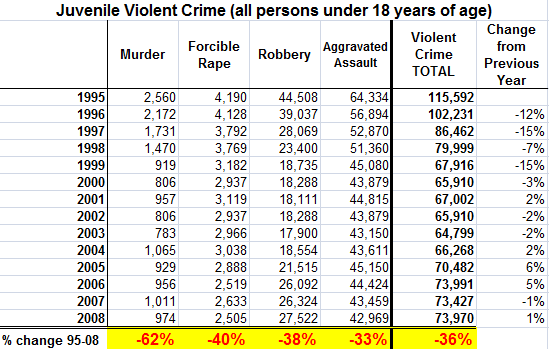
So, how can we determine whether watching depictions of violence will turn us all into killing machines, rapists, robbers, or just plain ol’ desensitized thugs? Well, how about looking at the real world! Whatever lab experiments might suggest, the evidence of a link between depictions of violence in media and the real-world equivalent just does not show up in the data. The FBI produces ongoing Crime in the United States reports that document violent crimes trends. Here’s what the data tells us about overall violent crime, forcible rape, and juvenile violent crime rates over the past two decades: They have all fallen. Perhaps most impressively, the juvenile crime rate has fallen an astonishing 36% since 1995 (and the juvenile murder rate has plummeted by 62%).
Continue reading →
I know, I know… do we really need to listen to another debate over Net neutrality?! I too have grown a bit tired of the issue, which has crowded out so many other important issues in the Internet policy world these days. Net neutrality simply sucks all the oxygen out of the room no matter what topic is being discussed. And it is so highly charged that it has become the equivalent of the abortion issue of the high-tech world; intellectual combatants can get so worked up over the topic that seemingly no rational debate can take place at times.
That being said, I do want to encourage everyone to check out this dynamite debate about “Demystifying Net Neutrality,” a Diffusion Group webinar which took place last week. It’s a very level-headed discussion of the issue that features my colleague Barbara Esbin, a PFF Senior Fellow and the Director of PFF’s Center for Communications and Competition Policy, and Chris Riley, a Policy Counsel at Free Press. You can now download and listen to the debate now from the Diffusion Group website. Barbara also wrote about the discussion over the PFF blog and walks the reader through the discussion. And you won’t be surprised to hear me say I think Barbara gets the better of Chris Riley in the debate!
One thing I found quite interesting in the debate was how Riley struggled to distinguish between “the Internet” versus “Internet access services” for purposes of delineating the proper confines of Net neutrality regulation. Like many other defenders of Net neutrality regulation, (see, most recently, for example, Rob Frieden, “Why the FCC’s Proposed Openness Principles Cannot and Should Not Apply to Internet Application and Content Providers“), Riley and Free Press want us to believe that this distinction is clear-cut and that regulation won’t have unintended consequences. Of course, such distinctions are always easier in theory than reality, and as Berin Szoka and I argued in our recently paper on “high-tech mutually assured destruction,” regulation always spreads. The march of regulation can sometimes be glacial, but it is, sadly, almost inevitable: Regulatory regimes grow but almost never contract.
Anyway, listen to the entire webinar discussion. It’s worth your time.
Just the other day, I complained about the fact that New York Federal district court overseeing the Google Books settlement apparently doesn’t plan to webcast the final public hearing that will take place on February 18 in this hugely important case about the future of digital books and copyright. Now I discover that the 11th Circuit Court of Appeals (which covers Florida, Georgia & Alabama) has issued a decision with even more far-reaching applications—allowing prosecutions for online obscenity distribution according to local “community standards” wherever a user might have downloaded the material—without even publishing the landmark decision!
Adam discussed this obscenity/localism issue in detail back in 2004. Eugene Volokh explains the substance of this decision:
United States v. Little concludes that Internet obscenity distribution prosecutions may rely on the community standard of the place in which the material was distributed — which means the government can try to download the material in the most restrictive community, and prosecute the distributor there.
If left to stand, this decision could essentially amount to a ban on hardcore pornography in the U.S.—with the definition of “obscenity” being left to local puritanical politicians in the country’s most socially traditionalist backwaters, subject only to some general restraint by the courts as to just how far the definition of “obscenity” can be pushed. Volokh continues: Continue reading →
So the proposed Comcast/NBC merger was met with “skepticism” by Washington politicians. Will Comcast charge for content that was once free? Will it ensure that emergency programming gets through? These services and decisions about them are normal offerings that a concerned public expects; a merged entity ignores them at its peril.
The two firms’ CEOs respectively made assurances to lawmakers like 18-term term Chairman Henry Waxman. (Speaking of the lack of choice, this gentleman’s own constituents get to vote for him, but none of the rest of us have any say whatsoever–decade after decade–even though his laws impact us all).
But those assurances about programming aren’t what politicians care about, not really. This proceeding serves to help re-energize the old political campaign against what politicians laughably call “media consolidation.” (Here’s one of my defenses of so-called “media monopoly” in Communications Lawyer so no need to repeat it here now; I’m not an attorney but I play one at a think tank.)
Any antitrust intervention that relieves Comcast/NBC’s competitors of critical market impulses, of the driving need to respond to any potentially new superior service or slate of services, hurts the interests of consumers. These endless proceedings and delays–and before this one, those of Echostar/DirecTV, Sirius/XM and others–all directly harm consumer interests and the communications marketplace. There is too much tolerance of pointless FCC and Congressional interference in today’s media-saturated world, and too much tolerance of media competitors who properly should have no say whatsoever in whether or not a rival’s merger goes forward.
Basically, antitrust is about dismantling what others have created or hope to create, undermining large scale voluntarism and enterprise, and replacing it with even larger scale compulsion or prohibition. The (not “unintended,” as often claimed) result of this is to send the “free” market careening off into a direction it never would have taken, a direction in defiance of shareholder capitalism and market pressures. I wrote about this very problem in a letter in the Wall Street Journal last week.
The emergence of ever-greater competitive alternatives on the media horizon will be damaged by the destruction of wealth entailed in halting a productive merger. The merger, if it goes through, may or may not prove successful for the companies themselves. Regardless, it is precisely the market’s task to respond to this and future deals competitively, not leverage Washington to avoid having to engineer and sweat over such a response. To those rivals that might feel satisfaction at the barriers and future conditions put on this merger if it’s even “approved” (how is that even a term appropriate to free enterprise?): Political disapproval of Comcast/NBC makes it even easier to put others in the crosshairs next time.
 Mashable has reported that “The Internet” has made the list of Nobel Peace Prize nominees this year. This prize has already had its fair share of controversial and sometimes even comical nominees and recipients, but this sort of nomination is disappointing in a whole different way—it ignores the fact that individual human beings actually invented the technology that created the Internet.
The sentiment behind this nomination, popularized by Italy’s version of Wired, is understandable. The Internet has had such an effect on the world in such a short amount of time its impossible to calculate the enormity of its effects on science, the arts, or politics. It has generated a mountainous amount of wealth, exposed the barbarism of tyrannical regimes worldwide, and has made more knowledge accessible to more people than ever before.
But people like Tim Berners-Lee or Roberty Taylor should be considered for the prize given their tremendous contributions to Internet technology. Both Berners-Lee or Taylor have already been recognized for their contributions to technological progress—Berners-Lee has an alphabet soup of honor-related suffixes after his name—but awarding the Nobel Prize isn’t just about accolades, it’s also about money. The 2009 prizes were roughly $1.4 million each, which would be a nice sum for a foundation dedicated to the advancement of Internet technologies, like Berners-Lee’s World Wide Web Foundation. When considering this, its clear that awarding the prize to an individual would do a lot more good than if the concept or idea of the Internet received the prize.
Even so, Web 2.0 evangelists, prominent intellectuals, and even 2003 Nobel Peace Prize winner Shirin Ebadi have backed the notion of the prize being awarded to the Internet itself—a new campaign is calling this “A Nobel for Each and Every One of Us.” While the power of the Internet does indeed flow from its uniting “each and every one of us,” the technology that allowed this miracle to exist was invented by people like Berners-Lee and Taylor who dedicated years of their lives to the advancement of human understanding. Even in this era of wise crowds, social networks, and “collective intelligence,” this sort of individual accomplishment should be recognized.
If you’d like to nominate any other
person involved in the advancement of Internet technology for the Peace Prize, please drop a name in the comments.
The Federal district court handling the Authors Guild’s suit against Google over Google Books has scheduled a hearing on for February 18, 2010 in New York City (after several postponements). The parties, their supporters and the Department of Justice will all get to speak. Twenty-six outside groups will each get five minutes to speak about the deal—21 against and 5 in favor. (If the numbers seem off-balance, note that France is on the “con” side, and if the statist-stasist-centralist-protectionist French are against something tech-related, how bad an idea could it really be?)
Although the settlement is highly arcane, how this issue is resolved will probably do as much, for better or worse, to shape our digital future in the years to come as any tech policy issue currently under discussion. (I’d say only net neutrality, privacy regulation and media socialization would fall into the same tier of such fork-in-the-road decision-points.)
So
of course this profoundly important public hearing is going to be livecasted, right? Unfortunately, I don’t think so. Continue reading →

 The Technology Liberation Front is the tech policy blog dedicated to keeping politicians' hands off the 'net and everything else related to technology.