The DCBar’s  Computer and Telecommunications Law Section section, on whose Steering Committee I sit, is co-hosting a fascinating brown bag lunch on February 22, 12:15 p.m. to 1:45 p.m at the District of Columbia Bar, 1101 K Street N.W., Conference Center, Washington D.C. 20005.

Online content on your television and your mobile handset; cord cutting; televisions that surf the web and store your family photos…. Are we there?  Do we want to be there?  This panel will explore the latest marketplace developments as well as the legal and policy challenges surrounding this convergence of formerly distinct realms.  Among other issues, the panelists will discuss:  how consumers today are experiencing video and how they are likely to do so in the near future; what technical and legal issues will affect these ongoing marketplace developments; and what actions the FCC is likely to take – and should or should not take – to facilitate competition and choice for consumers, including its planned “AllVid” rulemaking. Continue reading →


(HT: Schneier) Here’s a refreshingly careful report on cybersecurity from the Organization for Economic Cooperation and Development’s “Future Global Shocks” project. Notably: “The authors have concluded that very few single cyber-related events have the capacity to cause a global shock.” There will be no cyber-“The Day After.”

Here are a few cherry-picked top lines:

Catastrophic single cyber-related events could include: successful attack on one of the underlying technical protocols upon which the Internet depends, such as the Border Gateway Protocol which determines routing between Internet Service Providers and a very large-scale solar flare which physically destroys key communications components such as satellites, cellular base stations and switches. For the remainder of likely breaches of cybsersecurity such as malware, distributed denial of service, espionage, and the actions of criminals, recreational hackers and hacktivists, most events will be both relatively localised and short-term in impact.
The vast majority of attacks about which concern has been expressed apply only to Internet-connected computers. As a result, systems which are stand-alone or communicate over proprietary networks or are air-gapped from the Internet are safe from these. However these systems are still vulnerable to management carelessness and insider threats.
Analysis of cybsersecurity issues has been weakened by the lack of agreement on terminology and the use of exaggerated language. An “attack” or an “incident” can include anything from an easily-identified “phishing” attempt to obtain password details, a readily detected virus or a failed log-in to a highly sophisticated multi-stranded stealth onslaught. Rolling all these activities into a single statistic leads to grossly misleading conclusions. There is even greater confusion in the ways in which losses are estimated. Cyberespionage is not a “few keystrokes away from cyberwar”, it is one technical method of spying. A true cyberwar is an event with the characteristics of conventional war but fought exclusively in cyberspace.

The hyping of “cyber” threats—bordering on hucksterism—should stop. Many different actors have a good deal of work to do on securing computers, networks, and data. But there is no crisis, and the likelihood of any cybersecurity failure causing a crisis is extremely small.

The deadline for the Google Policy Fellowship is Friday, January 21 (at midnight PST). My new think tank, TechFreedom, just launched yesterday, is participating (as The Progress & Freedom Foundation, my former think tank, did for the last two years)—as are the Competitive Enterprise Institute (home to the TLF’s Ryan RadiaWayne CrewsAlex Harris) and Cato Institute (Jim HarperJulian Sanchez).

The deadline for the Charles G. Koch Summer Fellow Program, run by the Institute for Humane Studies, is Monday January 31. TechFreedom, CEI and Cato are all participating, as are the Pacific Research Institute (Sonia Arrison), the Reason Foundation (Steve Titch) and the Washington Policy Center (Carl Gipson). Descriptions are available here (just select “technology” on the right). Also participating, for the first time, is the Space Frontier Foundation, on whose board I sit and for which I served as Chairman in 2008-2009.

If you look through each of our recent posts, you’ll get a pretty good idea of the diverse array issues we all cover, and who focuses on what. There’s certainly no shortage of interesting technology policy work to be done!

Both programs run 10 weeks and offer stipends. The Koch Program (which I participated in) is specifically geared towards those interested in free market ideas, and includes an excellent retreat, ongoing series of lectures, and group research project. As a “Koch-head” myself (class of 2000), I can attest to the quality of the program and the value of the alumni network. The Google program is in its fourth year and is already developing a valuable alumni network of its own.

Of course, most of our think tanks would probably be happy to have extra help around, so if you’re interested in an internship during the school year or over the summer, don’t hesitate to reach out to one of us. We may not necessarily be able to pay you but, hey, no one ever went into the think tank world to get rich!

At this week’s excellent State of the Net 2011 event, I participated in a panel discussion about the future of the online video marketplace.  Unsurprisingly, a great deal of time was spent discussing the Federal Communications Commission’s (FCC) recent approval of the proposed merger of Comcast and NBC Universal (NBCU). On Tuesday, the agency voted 4-1 to approve the deal with myriad conditions and “voluntary” concessions being attached.  The FCC voted on the matter and issued a short press release and late today issued its final 279-page order.

The Commission’s Comcast-NBCU order represents an unprecedented regulatory shakedown of a company that obviously would have done just about anything to gain approval of the deal.  I believe the conditions the FCC has imposed on the deal, which are to run for seven years, are tantamount to a death by a thousand cuts for the deal and, ultimately, could lead to its failure.  That’s because the requirements placed on the new entity make it practically impossible for Comcast to leverage the content it is acquiring from NBCU and profit from it such that they can recoup the significant costs associated with the deal.

In essence, Comcast-NBCU was forced to preemptively surrender much of its intellectual property rights by agreeing to share most of their content properties with others on terms someone else will determine.  That’s a recipe for disaster.  If Comcast-NBCU doesn’t have the right and ability to cut deals on terms that they find advantageous to the company and its shareholders, then why go through with this deal at all? Isn’t the whole point of such a deal with get some additional in-house content properties — something Comcast almost completely lacked previously — such that it would have some content gems to highlight and leverage in an attempt to attract new customers (or just keep old ones)? If someone else is constantly setting the terms of their deals, it will limit the inherent value of the IP owned by Comcast-NBCU and sap most of the value from the deal. Continue reading →

I reported for CNET yesterday on highlights from the State of The Net 2011 conference.  Though I didn’t attend last year’s event, I suspect much of the conversation hasn’t changed.

For an event that took place nearly a month after the FCC’s “final” vote on net neutrality, the issue seems not to have quieted down in the least.  A fiery speech from Congresswoman Martha Blackburn promised a “Congressional hurricane” in response to the FCC’s perceived ultra vires decision to regulate where Congress has refused to give it authority, a view supported by House and Senate counsel who spoke later in the day. Continue reading →

In the past we’ve commended the FCC and the administration for their support of incentive auctions to move spectrum now held by broadcaster to its best valued use, likely mobile broadband. Now it’s time to applaud the new House leadership for similarly making moves in the right direction.

The Washington Post reports today that “TV broadcasters resist FCC proposal to surrender more airwaves,” and earlier this month Chairman Genachowski expressed uncertainty about whether he would get congressional support for incentive auctions. But now comes word that newly inaugurated House Energy and Commerce Chairman Fred Upton is likely to include spectrum incentive auctions in new broadband rules. It’s great to see Republicans and Democrats coming together on good policy, especially in the face of opposition from a lobby as powerful as the broadcasters.

Moreover, today we also find out that the committee leadership is also considering a commercial auction of the infamous D Block spectrum, which public safety wants simply allocated to them. This puts the E&C leadership at odds with AT&T and Verizon, who oppose auctioning the D Block and would rather see a taxpayer-built built public safety network on the band. (Aside: While I’m all in favor of auction as an allocation method, I am skeptical at solving the public safety interoperability problem by simply throwing money at the existing system.)

So cheers to the new House leadership. Now that everyone’s one the same page (fingers crossed), this should be an easy win for smart policy.

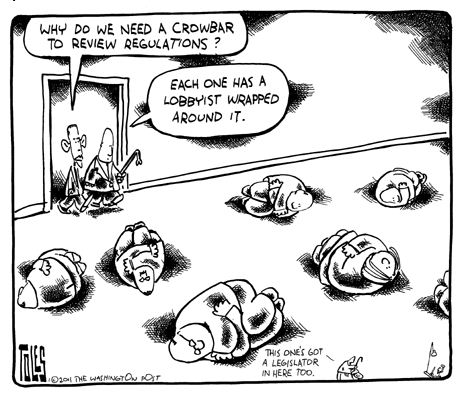
Washington Post cartoonist Tom Toles is certainly no fan of free markets, but his contribution to today’s paper offers us this humorous take on the dangers of regulatory capture, a subject we’ve spent much time documenting here on the TLF.

Today we’re launching both TechFreedom, a new digital policy think tank, and its first publication, The Next Digital Decade: Essays on the Future of the Internet—after the conclusion of the State of the Net conference. Watch the livestream below—12:45-5:30 pm Eastern / 9:45 am – 2:30 Pacific:

http://www.ustream.tv/flash/viewer.swf

Please join the conversation about the book by tweeting about the event using the #NDD hashtag. And follow us at @Tech_Freedom & @Digital_Decade! Check out the agenda below. Continue reading →

On the podcast this week, Don Norman, a former Apple vice-president, co-founder of the Nielsen Norman Group, and one of the world’s most influential designers, discusses his new book, Living With Complexity. Norman talks about differences between complexity, something being complicated, and simplicity, and suggests that people who bemoan “technology” don’t actually seek simplicity. He also discusses differences between designing a product and designing a system, using examples of iPods and iTunes, the Amazon Kindle, and BMW’s Mini Cooper — products whose success depended upon the success of larger systems. Norman also notes the difference between a forcing function and a nudge, explains how complicated rules can weaken security, and comments on sociable design in realspace and on the internet.

Related Links

To keep the conversation around this episode in one place, we’d like to ask you to comment at the web page for this episode on Surprisingly Free. Also, why not subscribe to the podcast on iTunes?

If you’re in for the State of the Net conference this week (or happen to live here), join us for a happy hour among tech policy peeps Tuesday afternoon at 6pm at Johnny’s Half Shell (400 N Capitol St).

We’ll also toast the launch of TechFreedom, the new digital policy think tank we’re launching Wednesday with a half-day symposium for TechFreedom’s first publication: The Next Digital Decade: Essays on the Future of the Internet.

RSVP on Facebook here! (We need an accurate headcount.)