My thanks to both Maria H. Andersen and Michael Sacasas for their thoughtful responses to my recent Forbes essay on “10 Things Our Kids Will Never Worry About Thanks to the Information Revolution.” They both go point by point through my Top 10 list and offer an alternative way of looking at each of the trends I identify. What their responses share in common is a general unease with the hyper-optimism of my Forbes piece. That’s understandable. Typically in my work on technological “optimism” and “pessimism” — and yes, I admit those labels are overly simplistic — I always try to strike a sensible balance between pollyannism and hyper-pessimism as it pertains to the impact of technological change on our culture and economy. I have called this middle ground position “pragmatic optimism.” In my Forbes essay, however, I was in full-blown pollyanna mode. That doesn’t mean I don’t generally feel very positive about the changes I itemized in that essay, rather, I just didn’t have the space in a 1,000-word column to identify the tradeoffs inherent in each trend. Thus, Andersen and Sacasas are rightfully pushing back against my lack of balance.

But there is a problem with their slightly pessimistic pushback, too. To better explain my own position and respond to Andersen and Sacasas, let me return to the story we hear again and again in discussion about technological change: the well-known allegorical tale from Plato’s Phaedrus about the dangers of the written word. In the tale, the god Theuth comes to King Thamus and boasts of how Theuth’s invention of writing would improve the wisdom and memory of the masses relative to the oral tradition of learning.  King Thamus shot back, “the discoverer of an art is not the best judge of the good or harm which will accrue to those who practice it.”  King Thamus then passed judgment himself about the impact of writing on society, saying he feared that the people “will receive a quantity of information without proper instruction, and in consequence be thought very knowledgeable when they are for the most part quite ignorant.”

After recounting Plato’s allegory in my essay, “Are You An Internet Optimist or Pessimist? The Great Debate over Technology’s Impact on Society,” I noted how this same tension has played out in every subsequent debate about the impact of a new technology on culture, values, morals, language, learning, and so on. It is a never-ending cycle. Continue reading →

Filings are due to the Federal Trade Commission (FTC) today as part of its review of the Children’s Online Privacy Protection Act (COPPA) and the COPPA rule that the FTC devised and enforces. I didn’t have time to pen as much as I wanted, but I did submit a short filing to the agency in the matter based on some of my previous work both with Berin Szoka and on my own.  Here’s the executive summary for my filing:

It goes without saying that the Children’s Online Privacy Protection Act (COPPA) is complicated law and rule. When considering the rule and proposals to amend it, it is easy to get lost in the weeds and ignore the bigger picture. That would be a mistake. There are broader, more important questions that need to be asked as part of the Federal Trade Commission’s effort to expand this regulatory regime. These questions involve not only the costs of increased regulation for online business interests, but the impact of expanded regulation on market structure, competition, and innovation. More importantly, these questions cut to the core of whether the public (including children) will be served with more and better digital innovations in the future. There is no free lunch. Regulation—even well-intentioned regulation like COPPA—is not a costless exercise. There are profound trade-offs for online content and culture that must always be considered.

Whatever one thinks about the effectiveness or sensibility of the COPPA regulatory model for the Web 1.0 world, it is clear that the regime is being strained by the unforeseen realities of the Web 2.0 world of hyper-ubiquitous connectivity and user-generated content creation and sharing. The digital genie cannot be put back in the bottle.  While COPPA may continue to have a marginal role to play in this rapidly evolving world, that role will likely be increasingly limited by the inherent realities of the information age.

Entire filing can be found on the Mercatus website, on SSRN, or via Scribd [Also embedded below in a Scribd reader.] Continue reading →

Tis the season to be thankful for a great number of things — family, health, welfare, etc.  I certainly don’t mean to diminish the importance of those other things by suggesting that technological advances are on par with them, but I do think it is worth celebrating just how much better off we are because of the amazing innovations flowing from the information revolution and digital technology.  In my latest Forbes column, I cite ten such advances and couch them in an old fashion “kids-these-days” sort of rant.  My essay is entitled, “10 Things Our Kids Will Never Worry About Thanks to the Information Revolution,” and it itemizes some things that today’s digital generation will never experience or have to worry about thanks to the modern information revolution. They include: taking a typing class, buying an expensive set of encyclopedias, having to pay someone else to develop photographs, using a payphone or racking up a big “long-distance” bill, and six others.

Incidentally, this little piece has reminded me how Top 10 lists are the equivalent of oped magic and link bait heaven. People have a way of fixating on lists — Top 3, Top 5, Top 10, etc — unlike any other literary or rhetorical device. In fact, with roughly 80,000 views and over 900 retweets, I am quite certain that this is not only my most widely read Forbes column to date, but quite possibly the most widely read thing I have done in 20 years of policy writing.  Therefore, henceforth, every column I pen will be a “Top 10” list!  No, no, just kidding. But make no doubt about it, that little gimmick works. In fact, 4 of the top 5 columns on Forbes currently are lists.

By Geoffrey Manne and Berin Szoka

Back in September, the Senate Judiciary Committee’s Antitrust Subcommittee held a hearing on “The Power of Google: Serving Consumers or Threatening Competition?” Given the harsh questioning from the Subcommittee’s Chairman Herb Kohl (D-WI) and Ranking Member Mike Lee (R-UT), no one should have been surprised by the letter they sent yesterday to the Federal Trade Commission asking for a “thorough investigation” of the company. At least this time the danger is somewhat limited: by calling for the FTC to investigate Google, the senators are thus urging the agency to do . . . exactly what it’s already doing.

So one must wonder about the real aim of the letter. Unfortunately, the goal does not appear to be to offer an objective appraisal of the complex issues intended to be addressed at the hearing. That’s disappointing (though hardly surprising) and underscores what we noted at the time of the hearing: There’s something backward about seeing a company hauled before a hostile congressional panel and asked to defend itself, rather than its self-appointed prosecutors being asked to defend their case.

Senators Kohl and Lee insist that they take no position on the legality of Google’s actions, but their lopsided characterization of the issues in the letter—and the fact that the FTC is already doing what they purport to desire as the sole outcome of the letter!—leaves little room for doubt about their aim: to put political pressure on the FTC not merely to investigate, but to reach a particular conclusion and bring a case in court (or simply to ratchet up public pressure from its bully pulpit). Continue reading →

Today, AT&T announced they had abandoned their planned acquisition of T-Mobile after the DOJ sued to block the deal and the FCC published a report sharply critical of the deal. The following statement can be attributed to TechFreedom Fellows Larry Downes, Geoffrey Manne and Berin Szoka:

Nearly two years ago, the Obama FCC declared a spectrum crisis. But Congress has refused to authorize the agency to reallocate underused spectrum from television broadcasters and government agencies—which would take years anyway. The AT&T/T-Mobile merger would have eased this crisis and accelerated the deployment of next-generation 4G networks. The government killed the deal based on formalistic and outdated measures of market concentration—even though the FCC’s own data show dynamic competition, falling prices, and new entry. The disconnect is jarring. Those celebrating the deal’s collapse will wake up to a sober reality: There is no Plan B for more spectrum. All the hand-wringing about “preserving” competition has only denied consumers a strong 4G LTE competitor to compete with Verizon—and slammed the brakes on continued growth of the mobile marketplace. Unfortunately, this is just part of a broader pattern of regulators attempting to engineer technology markets they don’t understand. The letter sent today by the Senate Antitrust Subcommittee urging the Department of Justice to investigate Google’s business practices relies on similar contortions of market definition to conclude that the search market is not competitive. In both cases, regulators are applying 1960s economics to 21st century markets. Ultimately, it’s consumers who will lose from such central planning.

This amazing video gives a few incredible statistics:

  • 70% of Facebook users live outside the U.S.
  • 550,000 Android devices get activated daily
  • Twitter registers 300,000 new users daily — Lady Gaga is by far the most popular human being

And my favorite:

  • 35 hours of video are uploaded to YouTube every minute; that’s 2100 days of video added for every day in real time

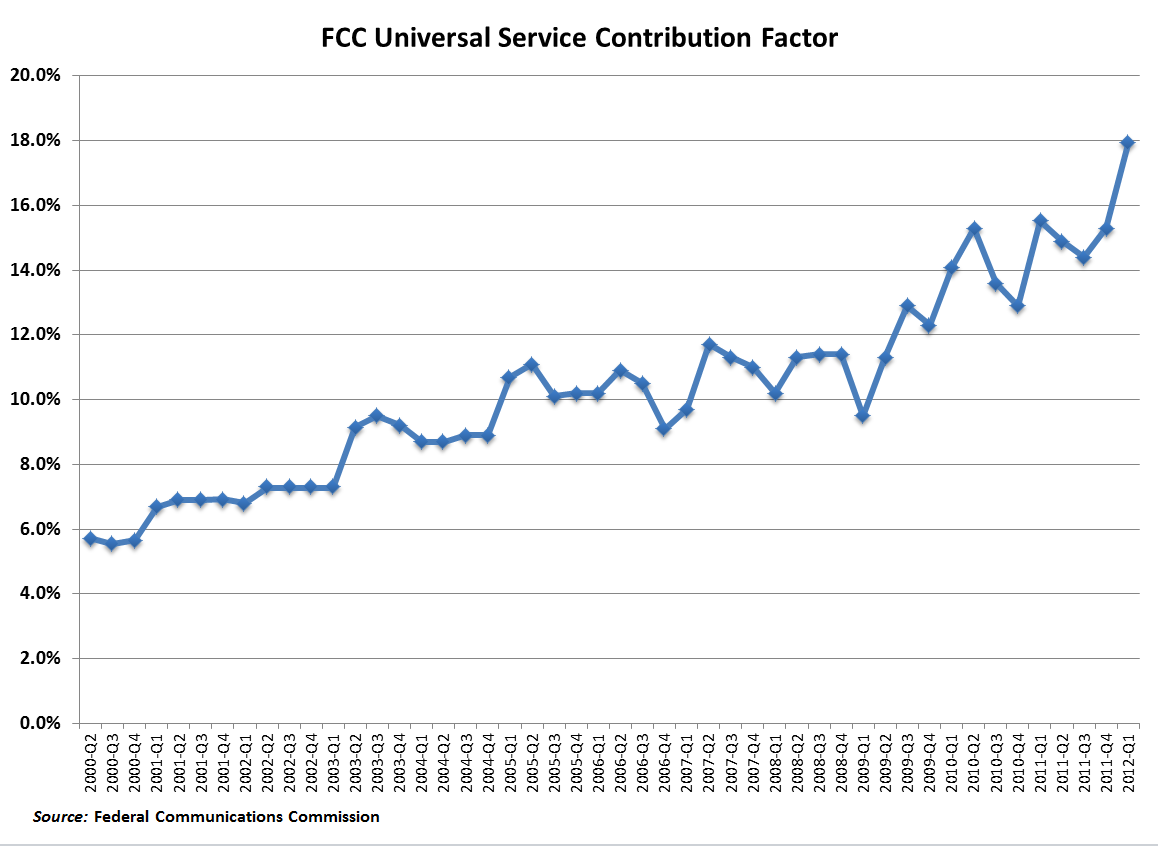
The FCC’s universal service tax is officially out of control. The agency announced yesterday that the “universal service contribution factor” for the 1st quarter of 2012 will go up to 17.9%.  This “contribution factor” is a tax imposed on telecom companies that is adjusted on a quarterly basis to accommodate universal service programs. The FCC doesn’t like people calling it a tax, but that’s exactly what it is. And it just keeps growing and growing. In fact, as the chart below reveals, it has been exploding in recent years. It was in single digits just a few years ago but is now heading toward 20%. And not only is this tax growing more burdensome, but it is completely unsustainable. As the taxable base (traditional interstate telephony) is eroded by new means of communicating, the tax rate will have to grow exponentially or the base will have to be broadened to cover new technologies and services. We should have junked the current carrier-delivered universal service subsidy system years ago and gone with a straight-forward voucher system. A means-tested voucher could have targeted assistance to those who needed it without creating an inefficient, unsustainable hidden tax like we have now. For all the ugly details, I recommend reading all of Jerry Ellig’s research on the issue.

Yesterday, TechFreedom, the Competitive Enterprise Institute, Americans for Job Security, and Americans for Limited Goverment sent a joint letter (pdf) to U.S. House Judiciary Committee Chairman Lamar Smith and Ranking Member John Conyers urging them not to rush deliberations on the Stop Online Piracy Act (SOPA). The Committee is set to hold markup on the bill on Thursday, December 15, less than three days after SOPA’s sponsors released a manager’s amendment containing major changes to the lengthy bill.

In their letter, the free market groups note that members have yet to hear testimony from experts versed in the bill’s implications for cybersecurity, free speech, due process, Internet governance, innovation, and job creation. The letter follows in its entirety:


Dear Chairman Smith and Ranking Member Conyers:

As public interest groups dedicated to free enterprise and property rights, we strongly support legislative efforts to ensure the meaningful protection of copyrights and trademarks. Yet we have also raised serious concerns about the unintended consequences of the Stop Online Piracy Act (SOPA), consistent with our general skepticism of all Internet regulation. While we applaud the manager’s amendment proposed by Chairman Smith, there simply has not been time to properly evaluate its real-world consequences. Although the proposed changes would indeed improve the bill, they leave several legitimate objections unaddressed. Thus, we urge Members of the Committee not to report the bill to the full House until these concerns have been resolved through further hearings and a second markup.

Enforcing copyrights online is an extremely provocative issue: witness the massive grassroots campaign mounted in recent weeks against so-called “Internet censorship,” as allegedly provided for by SOPA. Underlying this opposition to the bill is profound public skepticism about the unintended consequences of enhanced copyright enforcement in terms of collateral damage to legitimate expression and innovation. This skepticism has been galvanized by recent high-profile mistakes involving the improper seizure of innocent websites by federal officials in “Operation In Our Sites.”

If SOPA is ultimately enacted, any public perception that Congress failed to carefully balance the competing interests of copyright enforcement, free speech, due process, and Internet freedom will further erode public support not only for Congress, but also for copyright itself. The erosion of public respect for copyright is a primary factor behind the dramatic increase in infringement in recent years. Even a perfect bill cannot cure this cultural problem, to be sure, but ill-considered legislation can exacerbate it. If the widespread conflation of copyright enforcement with censorship is to be dispelled, SOPA must be refined carefully through a transparent process, with ample time for deliberation and consideration of all relevant expertise. Continue reading →

On Thursday, the House Judiciary Committee is slated to take up the misleadingly named Stop Online Piracy Act, an Internet censorship bill that will do little to actually stop piracy. In response to an outpouring of opposition from cybersecurity professionals, First Amendment scholars, technology entrepreneurs, and ordinary Internet users, the bill’s sponsors have cooked up an amended version that trims or softens a few of the most egregious provisions of the original proposal, bringing it closer to its Senate counterpart, PROTECT-IP. But the fundamental problem with SOPA has never been these details; it’s the core idea. The core idea is still to create an Internet blacklist, which means everything I say in this video still holds true. Continue reading →

The National Transportation Safety Board recommended yesterday that states ban all non-emergency use of portable electronic devices while driving, except for devices that assist the driver in driving (such as GPS). The recommendation followed the NTSB’s investigation of a tragic accident in Missouri triggered by a driver who was texting.

Personally I don’t see how someone can pay attention to the road while texting. (I’m having a hard enough time paying attention to a conference presentation while I’m typing this!) But the National Transportation Safety Board’s recommendation is a classic example of regulatory overreach based on anecdote.  The NTSB wants to use one tired driver’s indefensible and extreme texting (which led to horrific results) as an excuse to ban all use of portable electronic devices while driving – including hands-free phone conversations.  Before states act on this recommendation, they should carefully examine systematic evidence – not just anecdotes — to determine whether different uses of handheld devices pose different risks. They should also consider whether bans on some uses would expose drivers to risks greater than the risk the ban would prevent.