Leave it to the English—famous for their superior fluency in the language that bears their name—to reach unparalleled heights of hysteria in the war of words being waged against Google. The Guardian’s Henry Porter claims that “Google is just an amoral menace: The ever-growing empire produces nothing but seems determined to control everything.”
Porter declares that Google is the world’s “most prominent WWM,” his acronym for the “worldwide monopolies that sweep all before them with exuberant contempt for people’s rights, their property and the past.”
Google is in the final analysis a parasite that creates nothing, merely offering little aggregation, lists and the ordering of information generated by people who have invested their capital, skill and time. On the back of the labour of others it makes vast advertising revenues – in the final quarter of last year its revenues were $5.7bn, and it currently sits on a cash pile of $8.6bn.
Let’s review Google’s 2008 Annual Report. Of Google’s 2008 Revenue ($21.78 billion), two-thirds ($14.41 billion) came from advertising on Google sites and just under one-third ($6.71 billion) came from advertising on Google Content Network (GCN) web sites (made up of publishers that sell their ad space to advertisers through Google AdSense). On this revenue, Google made a net profit of $4.2 billion after taxes. To put these numbers in context, Microsoft (Google’s closest peer) earned three times ($60.42 billion) Google’s revenue and produced 4.21 times ($17.68 billion) Google’s profit. Google’s revenue was just 0.1528% of 2008 U.S. GDP and its net income, 0.0294%.
So what does Google actually
create with all that revenue? The answer is free content and services.
First, Google cross-subsidizes dozens of its own free services—starting with its search engine but also including email, a free browser, YouTube, a word processing suite, IM, maps, news, and much more.
Second, as the world’s leading ad network, Google supports a significant percentage of the free content and services offered by others. In 2008, Google paid out $5.28 billion (24.22% of revenue) to GCN publishers—significantly more than the $4.2 billion Google earned in net income (19.3% of revenue). Continue reading →
Chris Soghoian has responded to my recent post lauding his Targeted Advertising Cookie Opt-Out (or “TACO” – documented and downloadable here). We’re agreed in the main on user empowerment. The interesting stuff is on the margin: He disagrees with me that blocking third party cookies as I do (and he does too) is a satisfactory approach to suppressing tracking by advertisers.
There are a couple of points worth making about the discussion.
The first has to do with our slightly differing objectives. Chris is deeply focused on advertisers and his dislike of being tracked by advertisers. Though it is not absolute, I have a preference against tracking by anyone other than sites that I know, like, and trust. I’m no more worried about advertisers than any entity that would track my surfing – and there are many.
Again, TLF readers, I ask you to try setting your browser to query you before setting cookies. It’s a real insight into the dozens of entities getting a look at you as you surf, including a bunch of social networks and news sites.
If “advertisers” are what you seek to harness, that seems like a group that can be captured through some kind of centralized control mechanism. (I don’t think it actually is.) But if your goal is privacy as against all comers, you don’t attempt to centrally plan or decide who is good and who is bad. Responsibility rests with the end user.
Let the goal be “advertisers,” though. And I ask: Those social networks and news aggregators – are they “advertisers”? If you’re going to require a subset of Web communicators to obey opt-out cookies, you have to be able to define that subset – a problem Chris doesn’t seem to have thought about yet.
Lots of different publishers, sites, and networks have data that is entirely fungible with the tracking data advertisers collect. What do you get if you push down on the “officially advertisers” part of the balloon? Workarounds.
But I’ve backed into the second point – the means to these ends. Chris soft-pedals how he would get at tracking, but as far as I can tell it’s a law that says “advertisers” have to obey opt-out cookies. Continue reading →
What a victory for privacy and personal responsibility is Chris Soghoian’s Targeted Advertising Cookie Opt-Out (or “TACO” – documented and downloadable here). It signals to the 27 ad networks with well-configured opt-out cookies that you don’t want them to track you.
It’s a technical solution that empowers (and places responsibility with) the user to exercise dominion over his or her personal information. No need for law and regulation. No need to go pleading to politicians and bureaucrats for help.
It’s also a little more efficient than my method of controlling tracking, which is to take a glance at cookies as Web sites ask to set them on my computer.
(The answer is usually “no,” but it’s very interesting to see who all wants to get a glance at me when I visit any site. It’s a lot more than just ad networks, btw. I have no idea why people think ad-network tracking is bad and tracking by others is a matter of indifference.)
Now, Chris and I
always find something to disagree about, so for good measure I’ll note that I disagree with his goal of switching targeted advertising from opt-out to opt-in. Continue reading →
Earlier this month, Google made news when it announced that its cloud computing productivity suite Google Docs had suffered a technical glitch that temporarily compromised a subset of users’ shared documents. After becoming aware of this glitch, Google notified its users via email and posted an entry to the Official Google Docs Blog that offered a more detailed explanation of what happened.
It turns out that a bug in Google’s permissions code was causing certain documents that had been shared by their author with other users but subsequently unshared to remain visible to those users. By the time Google notified its users, the bug had already been resolved, and Google estimates that only around 0.05% of all documents were vulnerable due to the glitch. As to how many documents were actually viewed by unauthorized parties, it’s unclear at this point.
All in all, the Google Docs glitch, while troubling, seems relatively minor as far as bugs go. Nevertheless, the Electronic Privacy Information Center’s Mark Rotenberg jumped on the chance to attack Google, as he often does when Google makes news for anything privacy-related. Yesterday, EPIC filed a complaint with the Federal Trade Commission that called on the FTC to investigate Google’s privacy safeguards, order Google to shut down all cloud computing services—including Gmail, which has 26 million users—pending a thorough privacy evaluation, and force Google to pay $5 million to a fund that would be setup for “privacy research.”
Watchdog activist groups like EPIC can play a useful role in the public discourse on privacy, helping to publicize unsavory behavior by companies and educating consumers about keeping data secure. Unfortunately, however, these groups’ admirable focus on protecting privacy sometimes edges on the myopic, causing them to overreact to data breaches and sometimes even call for regulatory interventions that are decidedly
anti-consumer. EPIC’s latest complaint about Google is a classic example of this.
Continue reading →
 As noted in the first installment of our “Privacy Solution Series,” we are outlining various user-empowerment or user “self-help” tools that allow Internet users to better protect their privacy online-and especially to defeat tracking for online behavioral advertising purposes. These tools and methods form an important part of a layered approach that we believe offers an effective alternative to government-mandated regulation of online privacy.
In the last installment, we covered the privacy features embedded in Microsoft’s Internet Explorer (IE) 8. This installment explores the privacy features in the Mozilla Foundation’s Firefox 3, both the current 3.0.7 version and the second beta for the next release, 3.5 (NOTE – The name for the next version of Firefox was just changed from 3.1 to 3.5 to reflect the large number of changes, but the beta is still named 3.1 Beta 2). We’ll make it clear which features are new to 3.1/3.5 and those which are shared with 3.0.7. Future installments will cover Google’s Chrome 1.0, Apple’s Safari 4, and some of the more useful privacy plug-ins for browsers . The availability and popularity of privacy plug-ins for Firefox such as AdBlock (which we discussed here), NoScript and Tor significantly augments the privacy management capabilities of Firefox beyond the capability currently baked into the browser. In evaluating the Web browsers, we examine:
(1)
cookie management;
(2)
private browsing; and
(3)
other privacy features
Continue reading →
I’ve already laid out my own reactions to Google’s roll-out of an “interest based advertising” (IBA) program here. In a nutshell, I applauded Google setting a new “gold standard” in user empowerment by providing:
- Notice in their IBA-targeted ads of who’s paying for the ad and the fact that Google is serving it; and
- A link to a powerful “Ad Preference Manager” that allows users to:
- See and modify the “digital dossier” (to use the fearmonger’s term) of interests associated with the cookie on their computer; and
- Opt-out of tracking for IBA purposes.
But as I predicted, despite these pro-privacy features (and despite the fact that other major companies such as Yahoo! and Microsoft already have IBA programs), a number of privacy advocacy organizations are attacking Google for daring to enter the IBA (or “online behavioral advertising”) business at all. I’ll have much more to say about the criticism of Google’s new Ad Preference Manager soon, especially coming from Marc Rotenberg of EPIC (a “disaster“) and Jeff Chester of CDD—precisely the sort of the “paroxysms of privacy hysteria” I predicted.
But first, the criticism from Ari Schwartz of the Center for Democracy & Technology requires a response today. At its best, CDT plays a vital role in calling corporations to continually raise the bar on privacy. My own think tank, the Progress & Freedom Foundation, works closely with CDT on many issues, such as advocating user empowerment through technological means as a constitutionally “less restrictive” way of protecting children than government censorship.
Here’s what Ari had to say: Continue reading →
Google’s new “Interest Based Advertising” (IBA) program represents the company’s first foray into what is generally called “Online Behavioral Advertising” (OBA): In order to deliver more relevant advertising, Google will begin tailoring ads delivered through AdSense on the Google Content Network (GCN) and YouTube.com (but not Google.com). This tailoring will be based on a profile of each user’s interests created by tracking their browsing activity across sites that use AdSense-but not search queries or other user information. Until now, (i) AdSense has delivered essentially “contextual” advertising by choosing which ad to display on a page based on an algorithmic analysis of keywords on that page; and (ii) Google has tracked users’ browsing only for analytics purposes-to limit the number of times a user sees a particular ad (to prevent overexposure) and to allow sequencing of ads in campaigns where one ad must follow another.
Google is sure to be attacked for crossing a “line in the sand” drawn by some privacy advocates between contextual and behavioral advertising-even though Google’s closest competitor, Yahoo!, already offers a similar program, and the concept in general is hardly new. Google’s position as the leading search engine and third party ad-delivery network will no doubt cause paroxysms of privacy hysteria among those who consider targeted advertising inherently invasive, unfair or manipulative.
But those whose first priority is advancing consumer privacy, not advancing a political or regulatory agenda, should applaud Google for excluding sensitive categories and for putting the new Ad Preference Manager at the core of the company’s new IBA program. The Ad Preference Manager sets a new “gold standard” for implementing the principles of Notice and Choice, which have formed the core of both OBA industry self-regulation and the various regulatory proposals made in recent years. Indeed, Google has done precisely what Adam Thierer and I have called for: giving consumers more granular control over their own privacy preferences by developing better tools.
Continue reading →
By Adam Thierer, Berin Szoka, & Adam Marcus
 As noted in the first installment of our “Privacy Solution Series,” we are outlining various user-empowerment or user “self-help” tools that allow Internet users to better protect their privacy online-and especially to defeat tracking for online behavioral advertising purposes. These tools and methods form an important part of a layered approach that we believe offers an effective alternative to government-mandated regulation of online privacy.
In some of the upcoming installments we will be exploring the privacy controls embedded in the major web browsers consumers use today: Microsoft’s Internet Explorer (IE) 8, the Mozilla Foundation’s Firefox 3, Google’s Chrome 1.0, and Apple’s Safari 4. In evaluating these browsers, we will examine three types of privacy features:
(1)
cookie management controls;
(2)
private browsing; and
(3)
other privacy features
We will first be focusing on the default features and functions embedded in the browsers. We plan to do subsequent installments on the various downloadable “add-ons” available for browsers, as we already did for AdBlock Plus in the second installment of this series. Continue reading →
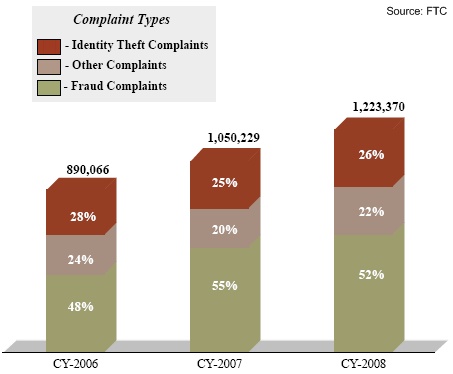
Whenever I pen anything about the dangers of age verification mandates for the Internet and social networking sites, I always point to Federal Trade Commission (FTC) reports about rising identity theft complaints. For the ninth year in a row, identity theft was the number one consumer complaint to the agency.
Now, imagine how much worse this problem could get if government mandated that everyone had to be “verified” before they were allowed to visit a social networking site, however that ends up being defined. Such a mandate would exponentially increase the amount of personal information — especially credit card information — that was available to identity thieves. Age verification advocates often ignore this problem when making the case for regulation.
Worse yet, much of the information that would be made available via such mandates would be personal information about children, which makes for a very attractive target for identity thieves since those records are rarely checked until the kids get much older and start applying for things. At least most adults typically learn they have been the victim of ID theft shortly after it occurs, allowing them to take steps to deal with the situation. With kids, their records could be milked for years by bad guys without them or their parents ever knowing it.


 The Technology Liberation Front is the tech policy blog dedicated to keeping politicians' hands off the 'net and everything else related to technology.
