Philosophy & Cyber-Libertarianism

Jonathan Frieden (who runs the e-commerce law blog) has a nice, pithy summary of Section 230:

If the “essential published content” is willingly provided by a third-party, the interactive computer service provider publishing that content enjoys the full immunity afforded by Section 230.

Amen, brother! I noted Eric Goldman’s excellent outline about Section 230 back in June. As Adam has noted, Section 230 is about more than just protecting online intermediaries bottom line or even about freeing them to provide the content and services we all take for granted.

Section 230 is the very cornerstone of Internet Freedom, the law that makes possible Robert Nozick’s “framework for utopias”: Online communities (“utopias”) can flourish in their infinite variety only because those who build, host or enable access to such communities (social network operators, search engines, aggregators, etc.) do not have to worry about legal liability for user-generated content. The fundamental difference between Web 1.0 and Web 2.0 lies in the movement of online speech away from individual websites where the speaker was operator to online speech platforms where the potential number of speakers is essentially unlimited. This ongoing shift makes Section 230 more important than ever.

Never before has it been so easy for users to “vote with their feet,” sorting themselves into communities of their own choosing, and not since the the 1890 Census declared the American frontier “closed” has it been been so easy for the individual to start entirely new communities if they don’t like their current options.

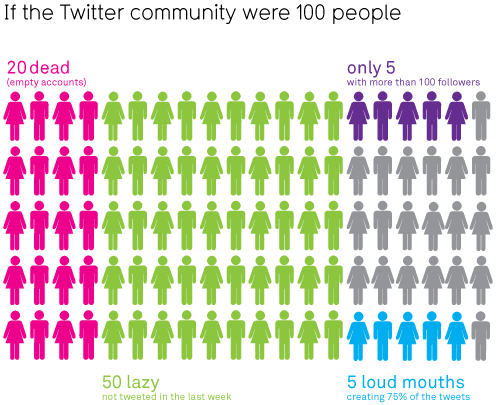
Twitter Power Laws

by on August 17, 2009 · 12 comments

Thanks to Mashable, we clearly see power laws at work on Twitter. While many protest this as evidence of “media inequality,” the “non-tweeting will always be with us” (to paraphrase Jesus’s comment about the persistence of “the poor”)—and this is nothing to get bent out of shape about, as Adam has explained.

Courtesy of Mashable

Courtesy of Mashable, David McCandless

In my last post, I touted an often-ignored benefit of targeted ads: that they directly enhance the browsing experience, compared to seeing dumb ads. This post argues that no one has a “right to her data” that ad-targeting takes away.

“Privacy” is a word of many meanings. The best explanation of the myriad ways the word has been used I’ve seen came from TLF’s own Jim Harper five years ago. People have a right to privacy in some senses, but not in others. They have a justice-based right (a political moral right) to freedom from government intrusion – the broad sense of privacy espoused in cases like Lawrence v. Texas. And they have a justice-based right to not have to give up information about themselves to the government, the sort of right violated by NSA wiretapping and that should be protected by the Fourth Amendment – the kind of right espoused in cases like Katz v. United States.

We do not have any justice-based right, however, to control what is done with those things we voluntarily give away to private individuals. If I sell you or give you my laptop, without any restrictions on your use, I have no rights-based complaint if you use it to do something I find objectionable, such as reading Perez Hilton. Nor do I have a rights-based complaint if you take the information I left on it and use it for your purposes. Even if that information is about me. Continue reading →

libertyby Adam Thierer & Berin Szoka — (Ver. 1.0 — Summer 2009)

We are attempting to articulate the core principles of cyber-libertarianism to provide the public and policymakers with a better understanding of this alternative vision for ordering the affairs of cyberspace. We invite comments and suggestions regarding how we should refine and build-out this outline. We hope this outline serves as the foundation of a book we eventually want to pen defending what we regard as “Real Internet Freedom.” [Note:  Here’s a printer-friendly version, which we also have embedded down below as a Scribd document.]

I. What is Cyber-Libertarianism?

Cyber-libertarianism refers to the belief that individuals—acting in whatever capacity they choose (as citizens, consumers, companies, or collectives)—should be at liberty to pursue their own tastes and interests online.

Generally speaking, the cyber-libertarian’s motto is “Live & Let Live” and “Hands Off the Internet!”  The cyber-libertarian aims to minimize the scope of state coercion in solving social and economic problems and looks instead to voluntary solutions and mutual consent-based arrangements.

Cyber-libertarians believe true “Internet freedom” is freedom from state action; not freedom for the State to reorder our affairs to supposedly make certain people or groups better off or to improve some amorphous “public interest”—an all-to convenient facade behind which unaccountable elites can impose their will on the rest of us.

Continue reading →

What Unites Advocates of Speech Controls & Privacy Regulation? [pdf]

by Adam Thierer & Berin Szoka The Progress & Freedom Foundation, Progress on Point No. 16.19

Anyone who has spent time following debates about speech and privacy regulation comes to recognize the striking parallels between these two policy arenas. In this paper we will highlight the common rhetoric, proposals, and tactics that unite these regulatory movements. Moreover, we will argue that, at root, what often animates calls for regulation of both speech and privacy are two remarkably elitist beliefs:

  1. People are too ignorant (or simply too busy) to be trusted to make wise decisions for themselves (or their children); and/or,
  2. All or most people share essentially the same values or concerns and, therefore, “community standards” should trump household (or individual) standards.

While our use of the term “elitism” may unduly offend some understandably sensitive to populist demagoguery, our aim here is not to launch a broadside against elitism as Time magazine culture critic William H. Henry once defined it: “The willingness to assert unyieldingly that one idea, contribution or attainment is better than another.”[1] Rather, our aim here is to critique that elitism which rises to the level of political condescension and legal sanction. We attack not so much the beliefs of some leaders, activists, or intellectuals that they have a better idea of what it in the public’s best interest than the public itself does, but rather the imposition of those beliefs through coercive, top-down mandates.

That sort of elitism—elitism enforced by law—is often the objective of speech and privacy regulatory advocates. Our goal is to identify the common themes that unite these regulatory movements, explain why such political elitism is unwarranted, and make it clear how it threatens individual liberty as well as the future of free and open Internet. As an alternative to this elitist vision, we advocate an empowerment agenda: fostering an environment in which users have the tools and information they need to make decisions for themselves and their families. Continue reading →

I’ve spent a lot of time here deconstructing and criticizing the proposals set forth by the Free Press, the radical media “reformista” group founded by the prolific Marxist media theorist Robert McChesney.  I have been trying to shine more light on their proposals and activities because I believe they are antithetical to freedom of speech and a free society.  That’s because, as media scholar Ben Compaine has noted, “What the hard core reformistas really want, it seems, is not diversity or an open debate but a media that promotes their own vision of society and the world.”  That’s exactly right and, more specifically, as I argued in my 2005 Media Myths book, the media reformistas want to impose this control by taking the fantasy that “the public owns the [broadcast] airwaves” and extending it to ALL media platforms and outlets.  In other words, McChesney and the Free Press want an UnFree Press.  To cast things in neo-Marxist terms that they could appreciate, they want to take control of the information means of production.  And it begins, McChesney argues, by all of us having to give up this “sort of religious attachment to the idea of a ‘free-press'” from which we all suffer.

Some people accuse me of “red-baiting” or “McCarthyite” tactics when I use the “M-word” (Marxism) or the “S-Word” (socialism) to describe McChesney, the Free Press, and the movement they have spawned.  But these are labels with real meaning and ones that McChesney himself embraces in his work. In his 1999 book Rich Media, Poor Media, he says that “Media reform cannot win without widespread support and such support needs to be organized as part of a broad anti-corporate, pro-democracy movement.” He casts everything in “social justice” terms and speaks of the need “to rip the veil off [corporate] power, and to work so that social decision making and power may be made as enlightened and as egalitarian as possible.”  What exactly would all that mean in practice for media? In his 2002 book Our Media, Not Theirs: The Democratic Struggle against Corporate Media with John Nichols of The Nation, McChesney argues that media reform efforts must begin with “the need to promote an understanding of the urgency to assert public control over the media.” They go on to state that, “Our claim is simply that the media system produces vastly less of quality than it would if corporate and commercial pressures were lessened.”

If you want additional proof of his intentions, then I encourage you to read this lengthy interview with McChesney that appears in the new edition of The Bullet, an online newsletter produced by the Canada-based “Socialist Project.”  (If you ask me, there’s something strangely appropriate about a socialist newsletter named “The Bullet” in light of the millions of people who died while living under socialist tyranny!)  Anyway, let’s ignore that and focus on what neo-Marxist media reform entails according to McChesney.  Because never before has he laid his cards on the table as clearly as he does in this interview. Continue reading →

Adam SmithTwo weeks ago, I mentioned here that John Stuart Mill’s On Liberty celebrated its 150th anniversary this year.  This year also marks the anniversary of another classic text: Adam Smith’s The Theory of Moral Sentiments, which turns 250 this year.   Although Smith will always be most closely associated with The Wealth of Nations, some Smith fans (like me) consider The Theory of Moral Sentiments to be his real masterpiece.  First published in 1759, the book is a far more robust theory of life, ethics, human relations, and justice.  Indeed, as Dan Klein and Russ Roberts of George Mason University note in this excellent podcast, The Wealth of Nations is best viewed as an installment in, or an extension of, a much larger project that Smith really brought together more holistically in Theory of Moral Sentiments. [Note: Klein and Roberts have an amazing 6-part podcast series celebrating the 250th anniversary of the book, all of which can be found here].

Rarely has any moral philosopher gotten to his point quicker — namely in the very first line of the first page of the text — than Smith did in Theory of Moral Sentiments.  Smith wanted to show that man is both self-regarding and other-regarding, and that these seemingly contradictory notions were actually quite complementary.  In other words, “self-interest” (properly understood) and empathy for others could be reconciled:

How selfish soever man may be supposed, there are evidently some principles in his nature, which interest him in the fortunes of others, and render their happiness necessary to him, though he derives nothing from it, except the pleasure of seeing it. Of this kind is pity or compassion, the emotion we feel for the misery of others, when we either see it, or are made to conceive it in a very lively manner. That we often derive sorrow from the sorrows of others, is a matter of fact too obvious to require any instances to prove it; for this sentiment, like all the other original passions of human nature, is by no means confined to the virtuous or the humane, though they perhaps may feel it with the most exquisite sensibility. The greatest ruffian, the most hardened violator of the laws of society, is not altogether without it. [Book I, Chap. 1]

These opening lines make it clear why those who have criticized Smith’s theories as based on nothing more that greed or selfishness simply don’t know what they are talking about.  Continue reading →

Well, here we go again. Harvard’s Jonathan Zittrain has penned another gloomy essay about how “freedom is at risk in the cloud” and the future of the Internet is in peril because nefarious digital schemers like Apple, Facebook, and Google are supposedly out to lock you into their services and take away your digital rights.  And so, as I have done here many times before (see 1, 2, 3, 4, 5 + video!), I will offer a response arguing that Jonathan’s cyber-Chicken Little-ism is largely unwarranted.

Zittrain’s latest piece is entitled “Lost in the Cloud” and it appears in today’s New York Times.  It closely tracks the arguments he has set forth in his book The Future of the Internet–And How to Stop It, which I named the most important technology policy book of 2008, but not because I agreed with its central thesis.  Zittrain’s book and his new NYT essay are the ultimate exposition of Lessigite technological pessimism.  I don’t know what they put in the water up at the Berkman Center to make these guys so remarkably cranky and despondent about the future of of the Internet, but starting with Lawrence Lessig’s Code in 1999 and running through to Zittrain’s Future of the Internet we have been forced to endure endless Tales of the Coming Techno-Apocalypse from these guys.  Back in the late 90s, Prof. Lessig warned us that AOL and some other companies would soon take over the new digital frontier since “Left to itself, cyberspace will become a perfect tool of control.”  Ah yes, how was it that we threw off the chains of our techno-oppressors and freed ourselves from that wicked walled garden hell?  Oh yeah, we clicked our mouses and left! And that was pretty much the end of AOL’s “perfect control” fantasies. [See my recent debate with Prof. Lessig over at Cato Unbound for more about this “illusion of perfect control,” as I have labeled it.]

But Zittrain is the equivalent of the St. Peter upon which the Church of Lessigism has been built and, like any good disciple, he’s still vociferously preaching to the unconverted and using fire and brimstone sermons to warn of our impending digital damnation. In fact, he’s taken it to all new extremes. In Future of the Internet, Jonathan argues that we run the risk of seeing the glorious days of the generative, open Net and digital devices give way to more “sterile, tethered devices” and closed networks. The future that he hopes to “stop” is one in which Apple, TiVo, Facebook, and Google — the central villains in his drama — are supposedly ceded too much authority over our daily lives because of a combination of (a) their wicked ways and (b) our ignorant ones.

Continue reading →

“Liberty upsets patterns.” That was one of the many lessons that the late Harvard philosopher Robert Nozick taught us in his 1974 masterpiece “Anarchy, State, and Utopia.” What Nozick meant was that there is a fundamental tension between liberty and egalitarianism such that when people are left to their own devices, some forms of inequality would be inevitable and persistent throughout society. (Correspondingly, any attempt to force patterns, or outcomes, upon society requires a surrender of liberty.)

No duh, right? Most people understand this today–even if some of them are all too happy to hand their rights over to the government in exchange for momentary security or some other promise.  In the world of media policy, however, many people still labor under the illusion that liberty and patterned equality are somehow reconcilable. That is, some media policy utopians and Internet pollyannas would like us to believe that if you give every man, woman, and child a platform on which to speak, everyone will be equally heard.  Moreover, in pursuit of that goal, some of them argue government should act to “upset patterns” and push to achieve more “balanced” media outcomes. That is the philosophy that has guided the “media access” movement for decades and it what fuels the “media reformista” movement that is led by groups like the (inappropriately named) Free Press, which was founded by neo-Marxist media theorist Robert McChesney.

Alas, perfect media equality remains an illusive pipe dream. As I have pointed out here before, there has never been anything close to “equal outcomes” when it comes to the distribution or relative success of books, magazines, music, movies, book sales, theater tickets, etc.  A small handful of titles have always dominated, usually according to a classic “power law” or “80-20” distribution, with roughly 20% of the titles getting 80% of the traffic / revenue.  And this trend is increasing, not decreasing, for newer and more “democratic” online media.

For example, recent research has revealed that “the top 10% of prolific Twitter users accounted for over 90% of tweets” and  “the top 15% of the most prolific [Wkipedia] editors account for 90% of Wikipedia’s edits.” As Clay Shirky taught us back in 2003 in this classic essay, the same has long held true for blogging, where outcomes are radically inegalitarian, with a tiny number of blogs getting the overwhelming volume of blogosphere attention.  The reason, Shirky pointed out, is that:

Continue reading →

In April 2008, L. Gordon Crovitz, the former publisher of the Wall Street Journal, launched his “Information Age” column with a brilliant piece entitled “Optimism and the Digital World” (which Adam lauded here). Crovitz noted the problem of “information overload,” then creeping into the public consciousness, but was unabashed in his optimism:

My own bias is that as information becomes more accessible, individuals gain choice, control and freedom. Established institutions – governments, large companies and special-interest groups – need to work harder to justify their authority. As information and knowledge spread, financial and human capital become more global and more competitive. The uncertainties and dislocations from new technology can be wrenching, but genies don’t go back into bottles. The First Law of Technology says that “with every change in technology that affects consumer behavior, we always overestimate the impact in the short term, but then underestimate the full impact over the long term.”

Crovitz picks up where he left off in today’s column: “Information Overload? Relax:  We survived copy machines. We’ll survive Twitter.”

Our era in the information age is a transition period of learning how to navigate information abundance. Rather than pitch our BlackBerrys and iPhones into the sea, imagine the benefits once we have figured out how to manage the chaos of endless data and routine multitasking, a process that will help refine our judgment about information and refocus our attention on what’s truly important…. Humans adapt, so we’ll learn how to live with information overabundance. Young people growing up multitasking are already less anxious about using technology and may well cope better than those of us in older generations. They have no choice but to get more sophisticated at separating the important from the unimportant and the authoritative from the unreliable, even while sampling from among many new kinds of information tools… Young people will cope first as we all evolve to become more sophisticated, less anxious users of information.

Crovitz also notes, with approval, GMU economist Tyler Cowen’s new book, “Create Your Own Economy,” which Cord blogged about here. I recently heard Cowen talk about the book and thoroughly enjoyed the talk.