Philosophy & Cyber-Libertarianism

pay-upHey people. You owe me.  All of you.  You owe me free broadband.  I am entitled to it, after all. That seems to be where our current FCC is heading, anyway.  And hey, Finland’s just done it, and the supposed Silicon Valley capitalists at TechCrunch are giddy with delight about it.  We’re apparently all just Scandinavian socialists at heart now.

Thus, I too have decided to throw in the towel on the idea of everyone carrying their own weight and picking up their own tab.  So, get your wallets open and ready for me because I have lots and lots of things that I believe I have an inalienable right to receive free of charge from the government (i.e, “the people”;  i.e., “YOU”).   Please let me know which of the things on my high-tech wish list that you’ll be purchasing for me and I’ll check you off my registry so I don’t have to send the cops to your house to collect:

  • free broadband (fiber, Wi-Max, and whatever else is around the corner);
  • a couple of free new computers (and a really fast ones, thank you very much);
  • 3 new HDTVs for my home (including one of those sweet new DLP projectors that usually cost about $10,000 bucks.  And I’ll need you to pay for someone to help me install it. Or could you just come over and do that for me perhaps?);
  • 3 free new DVRs for each new TV set that you are buying me (and could I get a nice universal remote to control everything, please);
  • a free subscription in my area to either DirecTV, Cox Cable, or Verizon FIOS TV (with all the premium channels and sports packages… and don’t forget the Playboy Channel!);
  • a free lifetime subscription to Netflix (or I guess I would settle for a free Blu-Ray player and some free movies);
  • free new wi-fi router and signal extenders for my home (N-standard please, none of that B or G garbage… too slow for me);
  • free mobile phone service for life + an iPhone + unlimited downloads in their app store (oh, could you have that iPhone autographed by Steve Jobs if you get a chance?);
  • free Playstation or XBox + lots of games (and if I could get one of those driving wheels to play my new Gran Turismo game that would be dandy); and finally,
  • free lifetime tech support when all this crap breaks down.

In closing, I thank you for your generosity.  I mean, look, I know I don’t actually deserve any of this stuff, and that there’s no good reason that you should have to pay for my free-riding ways, and there’s obviously nothing in our Constitution to support all this, but hey… screw all that!  This is my God-given birthright. I am entitled, baby!  Now get busy thinking of how you are all going to start paying for me, you selfish bastards.

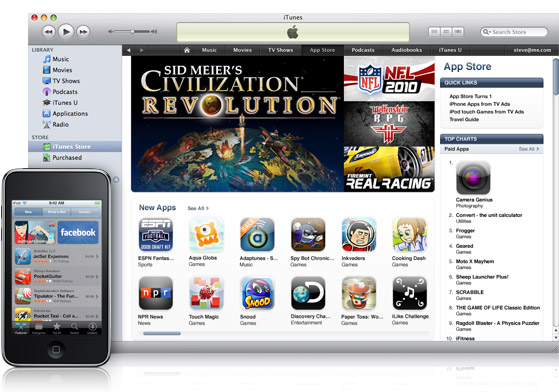
FCC Chairman Julius Genachowski suggested at an FCC field hearing this week that the federal government might create its own “version of iTunes.” Multichannel News reports: Itunes Store

The chairman asked panelists to think about the value of a clearinghouse where best practices could be shared. He suggested that might be a way to spur the spin-off of public-sector apps from private sector initiatives and to prevent reinventing the wheel, rather than tapping into what is already being done. There is not a lot of shared info out there, he said.

If all we’re talking about is a clearinghouse that provides easy access to apps for government-developed apps, Google Code or SourceForge may be a better model than iTunes—though perhaps without the instant name recognition by ordinary consumers. Like SourceForge, Google Code allows hosting and management of open source projects, including Google’s own products. iTunes, by contrast, essentially offers consumers finished apps. Also, iTunes is a stand-alone piece of software, of which the Apps Store is  just one part, while I can’t imagine why Genachowski’s “store” need be anything more than a website.

Whatever the analogy, such a “store” could well be a valuable tool for sharing the benefits of software development by government employees, both with the private sector and among federal agencies as well as state, local and even foreign governments. But what, exactly, Genachowski had in mind for the store remains awfully vague: Multichannel News mentions, as examples, “applications that do everything from monitoring heart rates and blood sugar to checking for greenhouse gas levels.” If the idea ever goes anywhere, it should be based on two principles:

  1. All apps should be open source and available to all users to use as they see fit.
  2. The store should be limited to apps developed by government employees to meet the needs of government agencies.

Continue reading →

Progress Snapshot 5.10 from The Progress & Freedom Foundation

A recent telephone poll conducted by professors at Berkeley and the University of Pennsylvania concluded, “Contrary to what many marketers claim, most adult Americans (66%) do not want marketers to tailor advertisements to their interest.” The study’s authors claim that their poll is the “the first nationally representative telephone (wireline and cell phone) survey to explore Americans’ opinions about behavioral targeting by marketers.” They also assert that the poll indicates that “if Americans could vote on behavioral targeting today, they would shut it down.” Advocates of regulating online data collection have trumpeted this poll as evidence consumers demand legislation to protect their privacy. “This research gives the F.T.C. and Congress a political green light to go ahead and enact effective, but reasonable, rules and policies,” declared Jeff Chester, a leading critic of online advertising.

But what is most surprising about this poll is not that 66% of users said they do not want tailored online ads, but that 34% of users said they did! The key, initial question of “whether or not you want the websites you visit to show you ads that are tailored to your interests,” presents no trade-off. The fact that anyusers said “yes” indicates that many users paused to do the rough mental math about the unarticulated trade-off between the benefits of receiving tailored ads and the costs of that tailoring.

The methodology of opinion polls necessarily affects respondents’ mental calculations, rendering polls not just easily manipulated, but inherently unreliable as indicators of real preferences. Every poll reflects the bias of its authors to some degree by the way questions are worded, the order in which they are asked, the sample surveyed, etc. The easiest way to bias the results of a poll is to omit any mention of the trade-offs at issue. This poll simply buried the issue of trade-offs in a heavily loaded follow-up question: After telling respondents that marketers “often use technologies to follow the websites you visit and the content you look at in order to better customize ads,” the interviewer asked whether the respondent would allow advertisers to “follow [them] online in an anonymous way in exchange for free content.” Only 10% of users said they would allow this voluntary exchange.

What does this tell us about whether, and how, government should further regulate online advertising? Precious little: Not only does this poll overstate the costs of targeted advertising, understate its benefits, and ignore the tools available to users to address their privacy concerns but, like any opinion poll, this one tells us more about the psychology of decision-making under the artificial uncertainty of polls than about the choices users would actually make in the real world. Continue reading →

Adam Thierer and I have warned that neutrality regulation, once imposed on broadband providers, will extend to other Internet services wherever “gatekeepers” are alleged to control access to a platform used by others. In short, the slippery slope of creeping common carriage is real and we’re already heading down it, with cyber-collectivist “luminaries” like Jonathan Zittrain and Frank Pasquale demanding neutrality regulation for devices, application platforms like iTunes and Facebook, and search!

TLF Reader Jim Reardon made a particularly astute observation on my post asking whether Americans really want net neutrality regulation:

Regulation of any service, product or industry is preceded by definition. Once defined, it is subject to taxation. [Net Neutrality regulation] is a prelude to taxation of Internet products and services. It will likely start with telephony services and proceed accordingly to financial services, and continue from there. As such, the activity is essentially neutral insofar as technology innovation is concerned — so long as applicable taxes are paid the government will ensure that the service is not disfavored by the network operators.

Absolutely right! One of the greatest barriers to government regulation and taxation of the Internet today is the lack of clear definitions: The FCC rules will tell you precisely what “cable television” or “commercial radio” mean, but the concepts of “social networking,” “Internet video,” “blogging,” and even “search” are indeterminate and constantly evolving.

Ronald Reagan once quipped:

Government’s view of the economy could be summed up in a few short phrases: If it moves, tax it.  If it keeps moving, regulate it.  And if it stops moving, subsidize it.

Fortunately, government’s ability to implement this view depends—to paraphrase President Clinton—”on what the meaning of the word ‘is’ ‘it’ is”: Allowing “it” to remain beautifully amorphous may be the best way to keep government at bay.

Deposuit potentes de sede, et exaltavit humiles; [The Lord] hath put down the mighty from their seats [of power] and raised up the lowly. – “Magnificat” The Internet continues to humble the mighty in journalism. We hear a lot about the humbling of news outlets like the New York Times, but little about the humbling of news-makers. While the media reformistas would have us believe that dark, shadowy forces control what we hear, see and read, the reality is that it’s becoming increasingly impossible for even the world’s largest companies to “manage” stories because we live in an age of true media abundance. There’s no better sign of this than the fact that Michael Arrington has declared, with good reason, the “news embargo” dead. In the days of media scarcity (which the reformistas like Andrew Keen want to re-create), press releases often declared a story to be “embargoed” until a specific day and time, allowing companies to shape the story by planting releases with the “right” journalists ahead of time. Such embargoes have been breaking down for some time, but now, with the explosion of media abundance, even Google no longer has “the clout to force press to stick to embargoes.” It’s not my favorite recording but this clip of Bach’s “Magnificat” (BWV 243) should sear into your brain the irrepressibility of the Internet as the greatest leveling force since the invention of the printing press. The two are not unrelated: Bach’s Lutheranism was made possible only by the ready availability of the printed word.

From the satirical Book Titles if They Were Written Today:

Then: The Wealth of Nations NowInvisible Hands: The Mysterious Market Forces That Control Our Lives and How to Profit from Them

Funny how empowering consumers to choose for themselves is “manipulative.” Oh, right, I forgot: people are stupid and/or lazy, so so elites should chose for them!

Schumpeter ColumnI’m thrilled to hear that the Economist has just launched a new column about business, innovation and entrepreneurship in honor of Joseph Schumpeter (1883-1950), the brilliant Austrian economist who,

argued that innovation is at the heart of economic progress. It gives new businesses a chance to replace old ones, but it also dooms those new businesses to fail unless they can keep on innovating (or find a powerful government patron). In his most famous phrase he likened capitalism to a “perennial gale of creative destruction”. For Schumpeter the people who kept this gale blowing were entrepreneurs. He was responsible for popularising the word itself, and for identifying the entrepreneur’s central function: of moving resources, however painfully, to areas where they can be used more productively. But he also recognised that big businesses can be as innovative as small ones, and that entrepreneurs can arise from middle management as well as college dorm-rooms.

Schumpeter’s work on the dynamism of high-tech markets (later married with Clayton Christensen‘s concept of “disruptive innovation“) is one of the most persistent themes across cyber-libertarian thinking of all stripes on a wide variety of issues. You can listen to an interview with the new column’s author on the Economist podcast here (MP3). One important point the author makes is that Schumpeter realized that celebrating capitalism did not preclude criticizing individual capitalists when justified and vice versa—something all too often forgotten today.

Forbes.com has just published an editorial that Berin Szoka and I penned about yesterday’s net neutrality announcement from the FCC.

The Day Internet Freedom Died

by Adam Thierer & Berin Szoka

There was a time, not so long ago, when the term “Internet Freedom” actually meant what it implied: a cyberspace free from over-zealous legislators and bureaucrats. For a few brief, beautiful moments in the Internet’s history (from the mid-90s to the early 2000s), a majority of Netizens and cyber-policy pundits alike all rallied around the flag of “Hands Off the Net!” From censorship efforts, encryption controls, online taxes, privacy mandates and infrastructure regulations, there was a general consensus as to how much authority government should have over cyber-life and our cyber-liberties. Simply put, there was a “presumption of liberty” in all cyber-matters.

Those days are now gone; the presumption of online liberty is giving way to a presumption of regulation. A massive assault on real Internet freedom has been gathering steam for years and has finally come to a head. Ironically, victory for those who carry the banner of “Internet Freedom” would mean nothing less than the death of that freedom.

We refer to the gradual but certain movement to have the federal government impose “neutrality” regulation for all Internet actors and activities—and in particular, to yesterday’s announcement by Federal Communications Commission (FCC) Chairman Julius Genachowski that new rules will be floated shortly. “But wait,” you say, “You’re mixing things up! All that’s being talked about right now is the application of ‘simple net neutrality,’ regulations for the infrastructure layer of the net.” You might even claim regulations are not really regulation but pro-freedom principles to keep the net “free and open.”

Such thinking is terribly short-sighted. Here is the reality: Because of the steps being taken in Washington right now, real Internet Freedom—for all Internet operators and consumers, and for economic and speech rights alike—is about to start dying a death by a thousand regulatory cuts. Policymakers and activists groups are ramping up the FCC’s regulatory machine for a massive assault on cyber-liberty. This assault rests on the supposed superiority of common carriage regulation and “public interest” mandates over not just free markets and property rights, but over general individual liberties and freedom of speech in particular. Stated differently, cyber-collectivism is back in vogue—and it’s coming very soon to a computer near you! Continue reading →

If I can amplify a bit on a post at the Cato blog earlier today, I want to clarify that I fully agree some of the ISP behaviors that net neutrality proponents have identified as demanding a regulatory response really are seriously problematic. My point of departure is that I’d rather see if there are narrower grounds for addressing the objectionable behaviors than making sweeping rules about network architecture. So in the case of Comcast’s throttling of BitTorrent, which is the big one that seems to confirm the fears of the neutralists, I think it’s significant that for a long while the company was—”lying about” assumes intent, so  I’ll charitably go with “misrepresenting”—their practices. And I don’t think you need any controversial premises about optimal network management to think that it’s impermissible for a company to charge a fee for a service, and then secretly cripple that service. So without even having to hit the more controversial “nondiscrimination” principle Julius Genachoswki proposed on Monday, you can point to this as a failure of the “transparency” principle, about which I think there’s a good deal more consensus. Now, there are bigger guns out there looking for dodgy filtering practices these days, so I’d expect the next attempt at this sort of thing to get caught more quickly, but by all means, enforce transparency about business practices too. Consumers have a right to get the service they’ve bought without having to be 1337 haxx0rz to discover how they’re being shortchanged. But before we get the feds involve in writing code for ISP routers, I’d like to see whether that proves sufficient to limit genuinely objectionable deviations from neutrality. There’s a hoary rule of jurisprudence called the canon of constitutional avoidance. It means, very crudely, that judges don’t decide broad constitutional questions—they don’t go mucking with the basic architecture of the legal system—when they have some narrower grounds on which to rule. So if, for instance, there are two reasonable interpretations of a statute, one of which avoids a potential conflict with a constitutional rule, judges are supposed to prefer that interpretation. It’s not always possible, of course: Sometime judges have to tackle the big, broad questions. But it’s supposed to be something of a last resort. Lawyers and civil liberties advocates, of course, tend to get more animated by those broad principles, whether the First Amendment or end-to-end. But there’s often good reason to start small—to look to the specific fact patterns of problem cases and see whether there are narrower bases for resolution. It may turn out that in the kinds of cases that neutralists rightly warn could harm innovation, it’s not one big principle, but a diverse array of responses or fixes that will resolve the different issues. In a case like this one, perhaps a mix of mandated transparency, consumer demand, and user adaptation (e.g. encrypting traffic) will get you the same (or a better) result than an architectural mandate. Continue reading →

My colleague Jim Harper and I have been having a friendly internal argument about Internet privacy regulation that strikes me as having potential implications for other contexts, so I thought I might as well pick it up here in case it’s of interest to anyone else. Unsurprisingly, neither of us are particularly sanguine about elaborate regulatory schemes—and I’m sympathetic to the general tenor of his recent post on the topic. But unlike Jim, as I recently wrote here, I can think of two rules that might be appropriate: A notice requirement that says third-party trackers must provide a link to an ordinary-language explanation of what information is being collected, and for what purpose, combined with a clear rule making those stated privacy policies enforceable in court. Jim regards this as paternalistic meddling with online markets; I regard it as establishing the conditions for the smooth functioning of a market. What do those differences come down to?

First, a question of expectations. Jim thinks it’s unreasonable for people to expect any privacy in information they “release” publicly—and when he’s talking about messages posted to public fora or Facebook pages, that’s certainly right. But it’s not always right, and as we navigate the Internet our computers can be coaxed into “releasing” information in ways that are far from transparent to the ordinary user. Consider this analogy. You go to the mall to buy some jeans; you’re out in public and clearly in plain view of many other people—most of whom, in this day and age, are probably carrying cameras built into their cell phones. You can hardly complain about being observed, and possibly caught on camera, as you make your way to the store. But what about when you make your way to the changing room at The Gap to try on those jeans? If the management has placed an unobtrusive camera behind a mirror to catch shoplifters, can the law require that the store post a sign informing you that you’re being taped in a location and context where—even though it’s someone else’s property—most people would expect privacy? Current U.S. law does, and really it’s just one special case of the law laying down default rules to stabilize expectations.  I think Jim sees the reasonable expectation in the online context as “everything is potentially monitored and archived all the time, unless you’ve explicitly been warned otherwise.” Empirically, this is not what most people expect—though they might begin to as a result of a notice requirement. Continue reading →