Economics

I’ve written two articles on the Protect IP Act of 2011, introduced last week by Sen. Leahy (D-Vt.).

For CNET, I look at some of the key differences, better and worse, between Protect IP and its predecessor last year, known as COICA.

On Forbes this morning, I have a long meditation on what Protect IP says about the current state of the Internet content wars.  Copyright, patent, and trademark are under siege from digital technology, and for now at least are clearly losing the arms race.

The new bill isn’t exactly the nuclear option in the fight between the media industries and everyone else, but it does signal increased desperation. Continue reading →

With news today that the Department of Justice is extending its probe of the AT&T – T-Mobile merger, and that the FCC has received thousands of comments on the issue, the FCC’s hopefully soon to be release Wireless Competition Report is taking on even greater importance.

Last year’s report was the first in 15 years not to find the market “effectively competitive.” As a result, expectations are high for the new annual report. How it determines the state of competition in the wireless market could affect regulatory policy and how the Commission looks at mergers.

Join the Mercatus Center at George Mason University’s Technology Policy Program for a discussion of these issues, including:

  • What does a proper analysis of wireless competition look like?
  • What should we expect from the FCC’s report this year?
  • How should the FCC address competition in the future?

Our panel will feature Thomas W. Hazlett, Professor of Law & Economics, George Mason University School of Law; Joshua D. Wright, Assistant Professor of Law, George Mason University School of Law; Robert M. Frieden, Professor of Telecommunications & Law, Penn State University; and Harold Feld, Legal Director, Public Knowledge

When: Wednesday, May 18, 2011, 4 – 5:30 p.m. (with a reception to follow)

Where: George Mason University’s Arlington Campus, just ten minutes from downtown Washington. (Founders Hall, Room 111, 3351 N. Fairfax Drive, Arlington, VA)

To RSVP for yourself and your guests, please contact Megan Gandee at 703-993-4967 or mmahan@gmu.edu no later than May 16, 2011. If you can’t make it to the Mercatus Center, you can watch this discussion live online at mercatus.org.

I’ve written a long article this morning for CNET (See “Privacy panic debate:  Whose data is it?”) on the discovery of the iPhone location tracking file and the utterly predictable panic response that followed.  Its life-cycle follows precisely the crisis model Adam Thierer has so frequently and eloquently traced, most recently here on TLF.

In particular, the CNET article takes a close and serious look at Richard Thaler’s column in Saturday’s New York Times, “Show us the data.  (It’s ours, after all.)” Thaler uses the iPhone scare as occassion to propose a regulatory fix to the “problem” of users being unable to access in “computer-friendly form” copies of the information “collected on” them by merchants.  Continue reading →

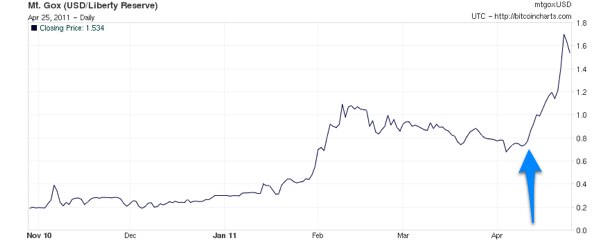
Here is a chart of the Bitcoin-dollar exchange rate for the past six months. The arrow notes the date my column on the virtual currency was published in TIME.com. The day after that piece was published, the Bitcoin exchange rate reached an all time high at $1.19. Yesterday, just over a week later, it was pushing $2.

A wiser fella than myself once said, correlation is not causation, and no doubt my article was just a contributing factor in Bitcoin’s recent run-up. It’s simply getting increasingly mainstream attention, and with that more speculators and speculation about mainstream adoption. The chart above lends a lot of credence to Tim Lee’s bubble critique, so I wanted to make sure I wasn’t giving that argument short shrift.

There may well be a Bitcoin bubble, and it may even be likely. But again, I think that misses the greater point about what Bitcoin represents. Bitcoin may be tulips and the bubble may burst, but the innovation—distributed, anonymous payments—is here to stay. Napster went bust, but its innovation presaged BitTorrent, which is here to stay. Could the Bitcoin project itself go bust? Certainly, but the innovation solving the double-spending problem I’ve been talking about, will be taken up and improved by others, just as other picked up and ran with Napster’s innovation.

I want to start thinking through the practical and legal implications of that innovation. If you don’t think the innovation could ever allow for a useful store of value, then mine is a fool’s errand. I guess I’m betting on the success of a censorship resistant currency.

Consumers are buying more and more stuff from online retailers located out-of-state, and state and local governments aren’t happy about it. States argue that this trend has shrunk their brick and mortar sales tax base, causing them to lose out on tax revenues. (While consumers in most states are required by law to annually remit sales taxes for goods and services purchased out of state, few comply with this practically unenforceable rule).

CNET’s Declan McCullagh recently reported that a couple of U.S. Senators are pushing for a bill that would require many Internet retailers to collect sales taxes on behalf of states in which they have no “nexus” (physical presence).

In his latest Forbes.com column, “The Internet Tax Man Cometh,” Adam Thierer argues against this proposed legislation. He points out that while cutting spending should be the top priority of state governments, the dwindling brick and mortar tax base presents a legitimate public policy concern. However, Thierer suggests an alternative to “deputizing” Internet retailers as interstate sales tax collectors:

The best fix might be for states to clarify tax sourcing rules and implement an “origin-based” tax system. Traditional sales taxes are already imposed at the point of sale, or origin. If you buy a book in a Seattle bookstore, the local sales tax rate applies, regardless of where you “consume” it. Why not tax Net sales the same way? Under an origin-based sourcing rule, all sales would be sourced to the principal place of business for the seller and taxed accordingly.

Origin-based taxation is a superb idea, as my CEI colleague Jessica Melugin explained earlier this month in the San Jose Mercury News in an op-ed critiquing California’s proposed affiliate nexus tax:

An origin-based tax regime, based on the vendor’s principal place of business instead of the buyer’s location, will address the problems of the current system and avoid the drawbacks of California’s plan. This keeps politicians accountable to those they tax. Low-tax states will likely enjoy job creation as businesses locate there. An origin-based regime will free all retailers from the accounting burden of reporting to multiple jurisdictions. Buyers will vote with their wallets, “choosing” the tax rate when making decisions about where to shop online and will benefit from downward pressure on sales taxes. Finally, brick-and-mortar retailers would have the “even playing field” they seek.
Congress should exercise its authority over interstate commerce and produce legislation to fundamentally reform sales taxes to an origin-based regime. In the meantime, California legislators should resist the temptation to tax those beyond their borders. Might we suggest an awards show tax?

Continue reading →

Every year since 1995, the Federal Communications Commission has released a report on the state of competition in the wireless market, and it will soon release the fifteenth. Last year’s report was the first not to find the market “effectively competitive.” As a result, expectations are high for the new annual report. How it determines the state of competition in the wireless market could affect regulatory policy and how the Commission looks at proposed mergers

Join the Mercatus Center at George Mason University’s Technology Policy Program for a discussion of these issues, including:

  • What does a proper analysis of wireless competition look like?
  • What should we expect from the FCC’s report this year?
  • How should the FCC address competition in the future?

Our panel will feature Thomas W. Hazlett, Professor of Law & Economics, George Mason University School of Law; Joshua D. Wright, Assistant Professor of Law, George Mason University School of Law; Robert M. Frieden, Professor of Telecommunications & Law, Penn State University; and Harold Feld, Legal Director, Public Knowledge

When: Wednesday, May 18, 2011, 4 – 5:30 p.m. (with a reception to follow)

Where: George Mason University’s Arlington Campus, just ten minutes from downtown Washington. (Founders Hall, Room 111, 3351 N. Fairfax Drive, Arlington, VA)

To RSVP for yourself and your guests, please contact Megan Gandee at 703-993-4967 or mmahan@gmu.edu no later than May 16, 2011. If you can’t make it to the Mercatus Center, you can watch this discussion live online at mercatus.org.

I’m gratified that my recent writing on the Bitcoin virtual currency project has stirred much conversation and I thought I’d take a moment to continue that conversation.

Tim Lee has written two posts critiquing the viability of Bitcoin from the supply and demand side. Dan Rothschild has responded in part. Tyler Cower also weighed in.

To address Tim I’ll simply say this: Do I think Bitcoin will replace the dollar? No. Might Bitcoin have certain systemic design flaws that might impede its success? Quite possibly. Will Bitcoin become the de facto, manipulation-proof currency of the internet? Who knows. Tim’s posts are a somewhat technical critique of Bitcoin’s long-term feasibility. It’s a great contribution, but since I’m neither a gold bug nor a Bitcoin booster per se, I don’t find it especially interesting.

That all said, what I do think is revolutionary about Bitcoin is that its developers have solved, without the use of a middleman, the double-spending problem faced by virtual currencies. That gives us license to realistically imagine a world without regulable financial intermediaries online.

While Tim overlooks what makes Bitcoin radical, Tom Sydnor groks it viscerally. Writing in a lengthy comment on my post, Tom expresses dismay at what Bitcoin represents and offers what I would, with apologies, characterize as the cyber-conservative response. Continue reading →

Following AT&T’s announcement last month of its planned acquisition of T-Mobile USA, pundits and other oddsmakers have settled in for a long tour of duty. Speculation, much of it uninformed, is already clogging the media about the chances the $39 billion deal—larger even than last year’s merger of Comcast and NBC Universal—will be approved.

Both the size of the deal and previous consolidation in the communications industry lead some analysts and advocates to doubt the transaction will or ought to survive the regulatory process.

Though the complex review process could take a year or perhaps even longer, I’m confident that the deal will go through—as it should. To see why, one need only look to previous merger reviews by the Department of Justice and the Federal Communications Commission, both of which must approve the AT&T deal. Continue reading →

Yesterday the FBI effectively shut down three of the largest gambling sites online and indicted their executives. From a tech policy perspective, these events highlight how central intermediary control is to the regulation of the internet.

Department of Justice lawyers were able to take down the sites using the same tools we’ve seen DHS use against alleged pirate and child porn sites: they seize the domain names. Because the sites are hosted overseas (where online gambling is legal), the feds can’t physically shut down the servers, so they do the next best thing. They get a seizure warrant for the domain names that point to the servers and force the domain name registrars to point them instead to a government IP address, such as 50.17.223.71. The most popular TLDs, including .com, .net, .org, and .info, have registrars that are American companies within U.S. jurisdiction.

Another intermediary point of control for the federal government are payment processors. The indictments revealed yesterday relate to violations of the Unlawful Internet Gambling Enforcement Act, which makes it illegal for banks and processors like Visa, MasterCard and PayPal to let consenting adults use their money to gamble online. According to the DOJ, in order to let them bet, the poker sites “arranged for the money received from U.S. gamblers to be disguised as payments to hundreds of non-existent online merchants purporting to sell merchandise such as jewelry and golf balls.” (PDF)

Now, imagine if there were no intermediaries.

In my TIME.com Techland column today, I write about Bitcoin, a completely decentralized and anonymous virtual currency that I think will be revolutionary.

Because Bitcoin is an open-source project, and because the database exists only in the distributed peer-to-peer network created by its users, there is no Bitcoin company to raid, subpoena or shut down. Even if the Bitcoin.org site were taken offline and the Sourceforge project removed, the currency would be unaffected. Like BitTorrent, taking down any of the individual computers that make up the peer-to-peer system would have little effect on the rest of the network. And because the currency is truly anonymous, there are no identities to trace.

And if a P2P currency can make it so that there is no fiscal intermediary to regulate, how about a distributed DNS system so that there are no registrars to coerce? This is something Peter Sunde of Pirate Bay fame has been working on. These ideas may sound radical and far-fetched, but if we truly want to see an online regime of “denationalized liberalism,” as Milton Mueller puts it, then getting rid of the intermediaries in the net’s infrastructure might be the best path forward.

Again, check out my piece in TIME for a thorough explanation of Bitcoin and its implications. I plan to be writing about it a lot more and devote some of my research time to it.

This week, my colleague Jerry Brito asked me to guest lecture to his George Mason University law school class on regulatory process. He asked me to talk about one of my favorite topics: the sad, sordid history of regulatory capture. Regular readers will recall the compendium I posted here a few months ago [and that I continue to update] of selected passages from books and papers penned by various economists and political scientists who have studied this issue.

Again, it doesn’t make for pretty reading, but the lesson that history teaches is vital: No matter how noble the “public interest” goals of regulatory advocates or their specific proposals, the only thing that really counts is what regulation means in practice.  Regrettably, all too often, regulation is “captured” by various interests and used to their advantage, or at least to the disadvantage of potential competitors, new entrants, and innovation.

While I was gathering some materials for the case study portion of my lecture — which incorporates the history of telecommunications monopolization, broadcast industry regulatory shenanigans, and transportation / airlines fiascos — I figured I had to post a passage from one of my favorite books on regulation of all-time: Thomas K. McCraw’s brilliant Pulitzer Prize-winning 1984 book, Prophets of Regulation. In his chapter on the late great Alfred Kahn, the father of airline deregulation, McCraw recounts the history of the Civil Aeronautics Board (CAB) from its creation in the 1940s up until the time of Kahn’s ascendency to CAB chairman in the Carter Administration (and then the CAB’s eventual deregulation and abolition). Here’s the key passage from that history: Continue reading →