Broadband & Neutrality Regulation

After changing its mind about throttling Bittorrent traffic last month, Comcast has pulled a 180° on network neutrality. Last week, Comcast announced plans to publish a consumers’ “ bill of rights and responsibilities,” detailing what subscribers should expect from their ISP and laying out network management best practices.

Naturally, the “Save the Internet” crowd isn’t satisfied with Comcast’s declaration. Being protocol-agnostic wasn’t enough for them, and neither is a consumer bill of rights. Customers will only be safe from evil ISPs, they say, with aggressive neutrality mandates like Rep. Markey’s proposed legislation .

On one hand, Comcast’s declaration is good news for Bittorrent users, and illustrates the responsiveness of market forces. And as a Comcast subscriber, I’m all for non-discriminatory networks. (Though I seed torrents quite rarely, it’s nice to know the option exists.)

But declaring a consumer “Bill of Rights” is a risky approach. Comcast is ceding key ground to interventionists by implicitly admitting that consumers have some inherent right to unfiltered, unmanaged networks. They don’t—despite what lawmakers like Byron Dorgan have suggested.

Essentially, Comcast is saying “If we have to be neutral, then so should all the other guys. Otherwise, they’re violating consumer rights.”

Yet some ISPs are making just the opposite argument, identifying the benefits of curbing bandwidth-intensive applications.  In comments filed last week, Bell Canada contended that throttling is in the public interest, explaining that 95% of subscribers suffer on account of file sharing. GigaOM posted a story yesterday that lends further credence to claims that peer-to-peer traffic is a major culprit of network congestion.

Perhaps we shall see a competing bill of rights—one holding that customers have the right to affordable broadband access free from file sharing-induced slowdowns.

As bandwidth demand continues to grow, ISPs must make tough choices. Between price increases, bandwidth caps , and protocol discrimination , it is far from clear what’s best for the average user. If AT&T’s prediction is correct that in three years time, 20 typical households will consume as much bandwidth as the entire Internet does today, then carriers will need to invest billions upgrading both the backbone and last-mile. Discouraging investment through regulation poses a far greater threat to the Internet’s future than hypothetical neutrality violations .

If neutrality truly is as virtuous as its proponents suggest (and I suspect it is) then it will ultimately triumph on its own merits, without the need for government intervention. Still, exclusionary, proprietary networks may yet play an invaluable role in propelling connectivity, despite closed systems’ shortcomings.   Who knows what will work out best in the long run? Market experimentation is the only way to find out.

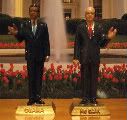
Justine Bateman may have grabbed the headlines, but she wasn’t the only witness from Hollywood at yesterday’s Senate hearing on neutrality regulation.  Nor did she have the most interesting resume.  That honor goes to Patric Verrone, the president of the Writer’s Guild of America, west, whose own writing credits include work for everything from The Simpson’s and Futurama to Rugrats and the Muppets.   As Verrone himself put it, “I am the only panelist to have written a film about a robot poker tournament in space Vegas in the year 3009 so I think my expertise in the area is unquestionable.”

Strangely enough, I first came into contact with Verrone not from his WGA work, or even from 31st century poker tournaments, but from Ebay, where he sells miniature figures of U.S. presidents and other notable individuals.   My six-year old son Peter and I have become avid collectors of the figurines. 


Verrone is no stranger to market power – being the only known vendor of the pricey presidents.  (Although I suspect the demand side is rather thin as well). 

Outside of the tiny figurine world, Verrone is best known for leading Hollywood writers through a 100-day strike, which finally ended in February of this year.  Oddly, however, Verrone, in his testimony, uses that experience as evidence of the need for Internet regulation.  

Continue reading →

What Did He Say?

by on April 18, 2008 · 4 comments

Normally when you quote someone extensively but selectively and you’re making a different (arguably opposite) point, you acknowledge that.

Stanford Law Professor Lawrence Lessig, who got a chance to lecture a captive Federal Communications Commission during a special public hearing on broadband network management this week, began the lesson quoting from remarks Gerald R. Faulhaber, Professor Emeritus of Business and Public Policy at Wharton, made at Stanford on Dec. 1, 2000 when he was chief economist at the FCC.

I think Prof. Lessig is a gifted and well-intentioned scholar and educator. And Prof. Faulhaber framed the issues well, so it’s understandable why Lessig quoted him.

But Faulhaber wasn’t on Lessig’s page.

Continue reading →

cuban2_2.jpgThe always provocative Mark Cuban has an interesting post on his blog today. He writes:

There is a dirty little secret in the cable industry. Its being kept secret not by the cable distributors, but by the big cable networks. End this practice and the United States goes from being 3rd world by international broadband standards, to top of the charts and exemplary. … What is the dirty little secret ? That your cable company still delivers basic cable networks in analog. Why is this such an important issue ? Because each of those cable networks takes up 6mhz. That translates into about 38mbs per second. Thats 38mbs PER NETWORK. … If we want to truly change the course of broadband in this country, the solution is simple. Just as we had an analog shutdown date for over the air TV signals, we need the same resolution for analog delivered cable networks.

Obviously this would entail a government mandate to an industry, which we’re all biased against. If it really were so easy, I would expect to see the cable industry make the move on its own—if nothing else to respond to FIOS. But all that aside, my question to the cable-savvy folks I know read this blog is this: how true is Cuban’s claim? How much “spectrum in a tube” is really potentially available? How difficult would it be to make a digital transition in cable?

Google’s Bids

by on April 8, 2008 · 7 comments

Communications Daily ($) cited my recent post comparing Google’s limited objectives for the 700 MHz auction with the expansive objectives it outlined to the Federal Communications Commission last summer, and it included the following reaction to my comments from Richard Whitt of Google:

Whitt said in response that Haney had misread his company’s comments from last summer. “We consistently have argued that the open access license conditions adopted by the FCC would inject much-needed competition into the wireless apps and handset sectors, but would not by themselves lead to new wireless networks,” he said Monday. “Only if the commission had adopted the interconnection and resale license conditions we also had suggested — which the agency ultimately did not do — would we have seen the potential for new facilities-based competition.”

Another way to look at this is if there wasn’t any potential for new facilities-based wireless competition without the interconnection and resale license conditions Google wanted, why would Google have submitted bids for the spectrum which it might have won and had to pay for?

I do agree that prior to the FCC’s adoption of two of the four open platform principles Google proposed the company consistently premised its commitment to participate in the auction on the FCC adopting all four principles.  I also agree Google was clear that it believed all four principles were necessary to promote competition.

Then it participated in the auction anyway.

Continue reading →

In 1993 Congress substituted auctions for the deplorable practice of giving away valuable spectrum to well-connected commercial entities.

Lawmakers who think spectrum is a valuable public resource for which the taxpayers should be compensated need to wake up for a minute. FCC rulemaking could render the remaining assets worthless, distort wireless competition and contribute to the unfortunate perception of the FCC as a candy store.

Google has made it clear that it plans to weigh in at the FCC as it determines how to re-auction the D-block from the recent 700 MHz auction, and that it wants to open the white spaces between channels 2 and 51 on the TV dial for unlicensed broadband services.

Anna-Maria Kovacs, a regulatory analyst, reported that in the recent 700 MHz auction AT&T Mobility paid an average price of $3.15 per POP in the B-block while Verizon Wireless paid 77 cents per POP in the C-block which was subject to special rules advocated by Google.

Now comes an admission that Google’s main goal was not to win C-block licenses in the auction but to jack up the price just enough so the reserve could be met, according to the New York Times.

“Our primary goal was to trigger the openness conditions,” said Richard Whitt, Google’s Washington telecommunications and media counsel.
This certainly isn’t consistent with the way Google presented the open access proposal to the Federal Communications Commission last summer.

Continue reading →

There’s been quite a bit of discussion on this forum recently about whether vacant television channels — also called “white spaces” — should be licensed or unlicensed. Currently, of course, most of us experience Wi-Fi as a form of unlicensed wireless, as in the 2.4 Gigahertz bands.

Last year, I wrote about the issue of white spaces, mainly in the context of the National Association of Broadcasters:

…[B]roadcasters lost the spectrum wars – or at least the first spectrum war of the 21st Century. In early 2006, Congress said enough: broadcasters weren’t effectively using channels 52 to 69, and certainly wouldn’t need them after the transition to digital television (DTV) was completed. Television stations will be forced off those channels, corresponding to 698-806 MHz, on February 17, 2009. That’s 700 MHz. But what about 500 MHz and 600 MHz? All told, there are 294 MHz of frequencies that broadcasters will continue to occupy ever after the DTV switchover. If more than 85 percent of Americans receive television from cable or satellite, as they do, what sense does it make to reserve these choice frequencies for broadcasters’ exclusive use? Not very much. [more…]

Now, the broadcasters are basically out of the picture, and the battle is shaping up more pointedly: the wireless carriers in the wireless association formerly known as Cellular Telecommunications and Internet Association, and the high-tech titans like Dell, Google, Microsoft, Philips, etc.

Let’s take a step back from the current debate, though.

All of these unlicensed wireless devices in common use today were largely illegal until significant changes were enacted by the Federal Communications Commission the mid-1980s.

While these policy measures unleashing unlicensed have remained largely in the shadows, they’ll be the subject of a half-day conference at the Information Economy Project, at George Mason University School of Law, on Friday, April 4. More information is available at http://iep.gmu.edu.

Continue reading →

Comcast

by on April 3, 2008 · 16 comments

I have said that the threat of regulation is a credible deterrent to prevent unreasonable discrimination by broadband service providers and we don’t need a new regulatory framework with the unintended consequences which always flow from regulation.

And James Gattuso, noting that Comcast and BitTorrent were already working with one another on a solution to their network problems “long before this story broke,” correctly chided me for overlooking how public opinion is also a credible deterrent. James is right, particularly when there is a competitive market. And like it or not, the broadband market is competitive.

A “duopoly,” you say?

Continue reading →

Frustrated by the lack of competition in broadband services? No longer!

Although I’m not sure their deal with BitTorrent Inc. means much (since BT Inc. is a company, not the protocol), I’m glad to see Comcast finally embracing a network management scheme that is reasonable, transparent, and easy to understand:

“In the event of congestion, the half percent of people who are overutilizing an excessive amount of capacity will be slowed down subtly until capacity is restored,” the chief technology officer for Comcast, Tony G. Werner, said. “For the other 99.5 percent, their performance will be maintained exactly as they expect it.

How can anyone argue with that? It sounds vaguely familiar, almost as if I’d made the suggestion five months ago. What took them so long?

That all said, the FCC continues its investigation of the Comcast kerfuffle, having opened an official probe in January. What I’ve been asking myself is, what law or rule exactly does the FCC think they would enforce against Comcast? I certainly can’t think of any.

Well, if a recent letter from Comcast to the FCC (PDF) is any indication, it seems like the Commission might be considering enforcing the Internet Policy Statement. That statement outlines a set of nondiscrimination principles, and was adopt along with (and apart from) the order that classified DSL broadband as an information service in 2005. The Comcast letter makes is clear that the policy statement does not have the force of law and can’t be enforced against the company. Money quote:

[I]t is settled law that policy statements do not create binding legal obligations. It was universally understood, as the contemporaneous statements of [Chairman Martin], Commissioner Copps, and then-Wirelince Bureau Chief Navin all explicitly recognized, that the Internet Policy Statement did not create enforceable rules. Indeed, the Internet Policy Statement expressly disclaimed any such intent.

Boy, so familiar again. Almost as if I’d written the exact same thing in a comment to the FCC’s broadband industry practices proceeding 10 months ago (PDF). Check it out for a detailed explanation of why the Statement is not binding, but it boils down to this: It was not adopted after a notice-and-comment rulemaking; the FCC can’t just issue rules out of thin air.