The Washington, D.C., fight over “net neutrality” in some ways only scratches the surface of what’s really at stake in the question of government regulation of Internet service providers’ treatment of online content. The downside of permitting FCC and Congressional authority over cyberspace “neutrality” is hard to overstate.
A former colleague and friend, now at New Media Strategies, sent me a January 2010 article—“The Splinternet means the end of the Web’s golden age”—about the proliferation of non-compatible devices used online, and th e shielding of much new content behind logins and passwords, like the way News Corp. “hides” Wall Street Journal content behind a paywall, and other perceived insults. The author doesn’t see the trend as reversible, but the tone implies what an ominous development this somehow is, as if all this abundance and customization is negative, and that caution is in order.
But the realities of pay models and splintering—like the fact that some journalists have families to feed and can’t write for free, that Google doesn’t see much of what’s on Facebook, and that I can’t stream your iTunes—have no metaphysical, free speech, or public policy implications. Emergent splintering online represents the beginnings of a groundbreaking expansion of the Web’s basic capabilities, not a curtailment. (Besides, many with pro-neutrality views have been upset with Google lately anyway.)
This hand-wringing and use of the term “splinternet” reminded me of a related speculation I’d made in Forbes nearly 10 years ago about the tailoring of networks and pipes. Disturbed by then-burgeoning calls for regulation of the Internet emerging from various quarters over issues like privacy, spam, porn and cyber-trespass, I called for a “splinternet” mindset then and put it as follows:
The Internet needs borders beyond which users can escape damaging political resolutions of [policy] battles, which are rooted in the Internet’s non-owned, common-property status. Conflicting legislative visions in a cyberspace populated by exhibitionists at one extreme and would-be inhabitants of gated communities on the other, reveal the basic truth that not everybody wants or needs to be connected to everybody else.
Continue reading →
While the FCC considers whether to impose nondiscrimination and transparency regulation to all forms of broadband Internet access, Public Knowledge is proposing to subject broadband services to the same pervasive, overlapping, heavy-handed regulatory framework as century-old telephone service (see this and this) — a framework which a former FCC chairman during the Clinton Administration described as a hopeless “morass.”
PK is worried the U.S. Court of Appeals for the D.C. Circuit might rule in a pending case that the FCC doesn’t have jurisdiction to regulate broadband. The group also is fretting over a recent observation by AT&T that, “with each passing day, more and more communications service migrate to broadband and IP-based services,” leaving the public switched telephone network (“PSTN”) and plain old telephone service (“POTS”) we all grew up with “as relics of a by-gone era.” Continue reading →
At the “State of the Net” conference this morning, Alan Murray of The Wall Street Journal interviewed Brian Roberts, Chairman & CEO of Comcast. Here are some highlights. [You can follow all of my live Tweeting at: @AdamThierer]
- Stresses synergies from combination of Comcast cable channels & NBC broadcast properties (ex: Golf Channel & NBC Sports)
- Program access rules “should give fair amount of comfort” to critics who fear that content will be withheld
- “Businesses have to transform & reinvent themselves all the time” NBC part of that transformation for Comcast
- Internet is more friend than foe; broadband has transformed the business for the better
- Businesses grappling w/ ways to extend traditional services to consumers in new ways & still make $$$ (ex: TV Everywhere)
Panel #2 at this year’s “State of the Net” pre-conference featured a lively debate about net neutrality and investment. It included a debate between Hal Singer of Empiris LLC and Michael Livermore of the New York University Law School. It also featured the comments of Markham Erickson of the Open Internet Coalition and Christopher Yoo of the University of Pennsylvania Law School. The panel was ably moderated by Susan Crawford. Here are some highlights of what proved to be a fun and feisty debate, which began with the comments of Hal Singer:
Hal Singer, Empiris LLC
- FCC wants to constrain pricing flexibility for networks
- Not clear we need price regulation for service delivery in absence of clear market power
- FCC offers novel “collective action” theory to justify regulation, but doesn’t make sense and doesn’t apply here
- Investment at edge of network will not decline in absence of Net neutrality regulation
- Outlawing priority delivery would discourage investment in new networks AND applications
- “Net neutrality would harm the very folks it seeks to protect”; end users will see price hikes
- Investment at core is crucial
Continue reading →
FCC Commissioners Michael Copps and Meredith Attwell Baker kicked off the 2010 Congressional Internet Caucus “State of the Net” conference this afternoon with two brief keynote addresses. Below I’ve summarized the highlights here from my live Tweeting at the event (@AdamThierer):
Commissioner Copps
• “every great challenge this country faces… has a broadband component at its core if it’s going to be successfully dealt with”
• Broadband is the great enabler; Private sector will lead, but national objectives and visionary public policy also have to be at core
• “sins of recent public policy past” got in way of us doing things that needed to get done
• Worries about wider new “divides between us”; have opportunity to close them
• Praises Hillary Clinton’s Internet freedom speech from last week
• Hard to conceptualize the changes that next 5-10 years hold in light of the developments of past 5-10
• Worried about open Internet; “unreasonable discrimination”… doesn’t want to allow “too much latitude” to private operators… says it is threat to “openness” (he never really defines the term, however)
• Passionate views on both sides of Net neutrality debate
• Need big pipes and more spectrum to grow capacity (I certainly agree on that one! But Net neutrality isn’t going to help us much in that regard)
• He fears consolidation
• Says minority and women voices are not getting heard online (he says we should measure it by audience measurements & ad $$ but doesn’t bothering mentioning how much wider the gap was in the old mass media era when none of those voices could get heard at all)
• How do we assure what we’re doing “actually works for democracy” and the “public interest” (but never defines what that means)
• Says media is failing us today; victims are public; investigative journalism is dying (but never discusses how current FCC regulation affects the equation)
• cites Founders (Jefferson, Madison) re importance of media … and then favorably cites McChesney & Nichols new book (ugh, someone needs to tell Commissioner Copps that McChesney is a neo-Marxist who wants to destroy all private media providers!)
Continue reading →
Brad Smith, Microsoft’s Senior Vice President and General Counsel addressed the Brookings Institution earlier this week calling for government to get involved to enhance the safety, security and privacy of the “Cloud.” (Here’s a transcript of his remarks)
Smith alluded to the fact that cloud computing is undergoing a powerful transformation and correctly pointed out that, even though millions of Americans are using cloud computing platforms today (and have been for years), a far majority of them have no real concept of what cloud computing actually is or does — and neither to most policymakers.
This speech was very well timed, given the current Google-China kerfuffle from the past couple of weeks. Essentially, who is in charge of the data in the cloud? How can we guarantee that best practices are being used by providers? And, what role will the federal government play in the regulation of this powerful emerging technology? Continue reading →
No one disputes that a key goal of the FCC is to help foster diversity in, and minority access to, channels of communication. In practice, this all too often has been interpreted to mean ownership limits, set-asides, preferences and other mandates imposed by the Commission. Usually lost in the heated debates is the fact that ill-considered regulation itself can impede minority access and diversity.
In comments filed last week, a group of sixteen minority and civil rights organizations — ranging from the Lawyers’ Committee for Civil Rights Under Law to the National Conference of Black Mayors — argue that net neutrality regulation may do just that. “[T]his proceeding implicates one of the most important civil rights issues of our time,” the comments –written by David Honig of the Minority Media and Telecommunications Council — assert. Continue reading →
Can the Federal Communications Commission (FCC) just do anything it wants? If it wants to bring the entire Internet under its thumb, or regulate any speech uttered over electronic media, can it just do so on a whim? The agency’s recent actions on the Net neutrality and free speech fronts seems to suggest that the agency thinks so.
I don’t need to rehash here what the FCC has been up to on the Net neutrality front. Most everyone is familiar with how the agency has essentially been trying to invent its authority to regulate out of thin air. If you want the whole ugly history of how this charade has unfolded over past few years, I encourage you to read these amazing comments filed today in the FCC’s net neutrality NPRM proceeding by my PFF colleague Barbara Esbin. Barbara simply demolishes the FCC’s argument that it can do anything it wants under the guise of its “ancillary jurisdiction.” As Barbara argues in her comments, the FCC’s position “is akin to saying that the FCC can regulate if its actions are ancillary to its ancillary jurisdiction, and that is one ancillary too many.” She notes that:
The proposed rules regulating the services and network management practices of broadband Internet providers must rest, if at all, on the Commission‘s implied or ancillary jurisdiction and the NPRM fails to provide a basis upon which the exercise of such jurisdiction can be considered lawful.
She shows how farcical it is for the FCC to concoct its supposed authority to regulate from provisions of the Communications Act that have nothing whatsoever to do with Net neutrality or even expanding regulation in general. Specifically, the agency’s reliance on sections 230(b) and 706(a) of the Telecommunications Act of 1996 is completely outlandish. Anyone who knows a lick about telecom law and the nature of those two sections understands they were never intended to serve as the basis of an expansive new regulatory regime for the Internet. As Barbara puts it:
This exercise—searching for snippets and threads of regulatory authority over a communications medium as significant as the Internet in multiple, unrelated statutory provisions—should signal to the Commission that no credible source of authority to regulate Internet services exists.
All I have to say is, thank God for checks and balances. I believe the courts will put a stop to this nonsense, but it will take some time. Until then, I suppose the FCC will continue to act like a rogue agency, hell-bent and tossing the constitution to the wind and concocting asinine theories about why they should be allowed to do anything they want. But there are signs that the courts are ready to start holding the FCC more accountable. Continue reading →
In my researching the wireless competitive picture for my comments on the FCC Network Neutrality NPRM, one of my contacts was kind enough to point me to a Bank of America/Merrill Lynch paper that used the Herfindahl-Hirschman Index (HHI) to compare the market concentration of wireless service providers in the 26 Organization for Economic Co-Operation and Development (OECD) countries. HHI is one of the metrics used by the Department of Justice to determine market concentration. It is calculated by squaring the market share of each firm competing in the market and then summing the resulting numbers. For example, for a market consisting of four firms with shares of 30, 30, 20, 20 percent, the HHI is 2600 (302 + 302 + 202 + 202 = 2600). The higher the number, the greater the market concentration. When the formula is applied to the U.S. wireless market share percentages determined by Bank of America/Merrill Lynch (28.5, 26.7, 18.2. 12.1 and 14.5), the U.S. HHI is the smallest at 2213. This number is substantially less than the HHIs for all the other OECD companies with the exception of the U.K. Otherwise, no other HHI is under 2900.
Here’s the OECD market share data for Q4 2007 as it appears in the Bank of America/Merrill Lynch’s Global Wireless Matrix.
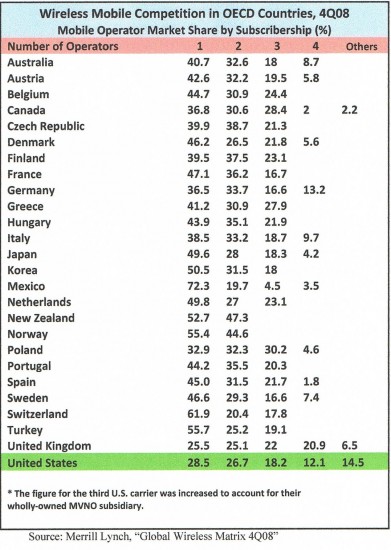 Continue reading →
The Pew Internet & American Life Project recently released new “Internet, broadband, and cell phone statistics” based on surveys conducted in late 2009. The survey, among the most respected industry, reveals the shocking racism of the cell phone industry, which is clearly discriminating against historically disadvantaged European-Americans: 62% of Hispanics and 59% of non-Hispanic blacks are “wireless Internet users” compared to only 52% of white Americans.
Congress must act to correct this clear racial travesty. Since it appears that white Americans still use home broadband at higher rates, the clear answer is to create an “Internet Truth & Reconciliation Commission” responsible for reallocating (by force, if necessary) un-cool home broadband connections to more mobile minority users and much “hipper” wireless connections (which are more popular among the technologically trendsetting 18-29 crowd) to coolness-challenged white users until a perfect numerical parity is reached. Only then will digital Racial Justice be achieved for all Americans.
Continue reading →


 The Technology Liberation Front is the tech policy blog dedicated to keeping politicians' hands off the 'net and everything else related to technology.