Articles by Adam Thierer 
 Senior Fellow in Technology & Innovation at the R Street Institute in Washington, DC. Formerly a senior research fellow at the Mercatus Center at George Mason University, President of the Progress & Freedom Foundation, Director of Telecommunications Studies at the Cato Institute, and a Fellow in Economic Policy at the Heritage Foundation.
Just a reminder that PFF is hosting a panel discussion on “Cable, Broadcast & the First Amendment: Will the Supreme Court End Must-Carry?” this Tuesday (April 27th) from 10:00-11:45 a.m at Hogan & Hartson LLP (555 13th Street NW, Washington, DC). To hold a seat, please RSVP for the event here.
The event features an all-star cast representing all sides (cable, broadcast and programming) of the fight over the FCC’s must-carry rules, which require cable television systems to dedicate some of their channels to local broadcast television stations. The Supreme Court narrowly upheld these “must-carry” rules in the mid-1990s. But last year’s DC Circuit decision striking down the FCC’s 30% cap on cable ownership lead Cablevision to challenge the must-carry rules. The Supreme Court will soon announce whether it will review the Second Circuit’s decision last June upholding the rules. Speakers at our event include:
- Dan Brenner, Partner, Hogan & Hartson LLP; former director of regulatory and legal affairs at the National Cable & Telecommunications Association (NCTA)
- Matt Brill, Partner, Latham & Watkins LLP; counsel for Discovery Communications, amicus in Cablevision case; former Senior Legal Advisor to FCC Commissioner Kathleen Abernathy
- Jack Goodman
, Counsel, WilmerHale; former general counsel of the National Association of Broadcasters (NAB)
- Howard Symons, Member, Mintz Levin; counsel for Cablevision; former Senior Counsel to House Subcommittee on Telecommunications
Berin Szoka and I will co-moderate the session. Hope to see you Tuesday. Register for the event
here.
As mentioned here before, PFF has been rolling out a new series of essays examining proposals that would have the government play a greater role in sustaining struggling media enterprises, “saving journalism,” or promoting more “public interest” content. We’re releasing these as we get ready to submit a big filing in the FCC’s “Future of Media” proceeding (deadline is May 7th). Here’s a podcast Berin Szoka and I did providing an overview of the series and what the FCC is up to.
In the first installment of the series, Berin Szoka and I critiqued an old idea that’s suddenly gained new currency: taxing media devices or distribution systems to fund media content. In the second installment, I took a hard look at proposals to impose fees on broadcast spectrum licenses and channeling the proceeds to a “public square channel” or some other type of public media or “public interest” content. The third installment dealt with proposals to steer citizens toward “hard news” and get them to financially support it through the use of “news vouchers” or “public interest vouchers.”
In our latest essay, “The Wrong Way to Reinvent Media, Part 4: Expanding Postal Subsidies,” Berin and I argue that expanding postal subsidies won’t likely do much to help failing media enterprises, will raise the risk of greater meddling by politicians with the press, and can’t be absorbed by the Postal Service without a significant increase in cost for ratepayers or taxpayers. The entire essay is attached down below.
Continue reading →
By Adam Thierer & Berin Szoka
Opt-in mandates may soon be coming to an Internet near you! Rick Boucher, House Energy & Commerce Committee Chairman, is expected to soon introduce the privacy bill he’s been working on behind closed doors for many months. At the heart of the bill is supposed to be a mandate that websites and services obtain opt-in consent prior to collecting information with users—at least if they plan on sharing that information with any third party or doing with it beyond what a narrow safe harbor would allow.
Boucher is apparently trying to strike the right balance between “protecting privacy” and the benefits to users of advertising and data collection. But there may be significant costs to an opt-in regime that are little appreciated by privacy advocates, who tend to think of opt-out as meaningless and opt-in as the ideal of user empowerment. In their new paper “
Opt-in Dystopias,” Google’s Senior Policy Counsel Nicklas Lundblad and Policy Manager Betsy Masiello provide a sophisticated analysis of the dark side of opt-in. They argue that “mandatory opt-in applied across contexts of information collection is poised to have several unintended consequences on social welfare and individual privacy,” specifically:
• Dual cost structure: Opt-in is necessarily a partially informed decision because users lack experience with the service and value it provides until after optingin. Potential costs of the opt-in decision loom larger than potential benefits,
whereas potential benefits of the opt-out decision loom larger than potential costs.
•
Excessive scope: Under an opt-in regime, the provider has an incentive to exaggerate the scope of what he asks for, while under the opt-out regime the provider has an incentive to allow for feature-by-feature opt-out.
•
Desensitisation: If everyone requires opt-in to use services, users will be desensitised to the choice, resulting in automatic opt-in.
•
Balkanisation: The increase in switching costs presented by opt-in decisions is likely to lead to proliferation of walled gardens.
Lundblad and Masiello discuss each of those concerns in great detail, so read the paper for further elaboration. They do a particularly good good walking the reader through the complexity of even defining what we mean by “opt-in,” which is far trickier than most people imagine.
Continue reading →
My colleague Barbara Esbin, Director of PFF’s Center for Communications and Competition Policy, was recently asked to participate in a conference call to discuss the D.C. Circuit’s recent decision in Comcast v. FCC and its impact on the FCC’s Open Internet (“Net neutrality”) rulemaking proceeding. Yesterday, over at the PFF Blog, she published her working notes and shows exactly what the FCC is up against as it embarks on its radical plan to reclassify the Internet as a crusty old “Title II” common carrier service. Esbin argues:
To impose Title II regulations on the Internet, the FCC would need to establish a rational evidentiary and sound legal basis to bring Internet service providers under its Title II authority through an act of regulatory “reclassification.”
To accomplish this procedurally, the FCC will have to:
- Adopt either a Notice of Inquiry or Notice of Proposed Rule Making proposing that the FCC reverse four of its own prior orders directly on point, one of which has been upheld by the U.S. Supreme Court in NCTA v. Brand X, so that it could declare Internet services to be “telecommunications services.”
- Receive public comment on its proposal creating a record that on balance supports its proposed reclassification.
- Adopt either a Declaratory Ruling or a Report and Order providing a reasoned factual and legal basis for changing the classification and regulatory treatment for Internet services.
Continue reading →
As I’ve mentioned here previously, PFF has been rolling out a new series of essays examining proposals that would have the government play a greater role in sustaining struggling media enterprises, “saving journalism,” or promoting more “public interest” content. We’re releasing these as we get ready to submit a big filing in the FCC’s “Future of Media” proceeding (deadline is May 7th). Here’s a podcast Berin Szoka and I did providing an overview of the series and what the FCC is doing.
In the first installment of the series, Berin and I critiqued an old idea that’s suddenly gained new currency: taxing media devices or distribution systems to fund media content. In the second installment, I took a hard look at proposals to impose fees on broadcast spectrum licenses and channeling the proceeds to a “public square channel” or some other type of public media or “public interest” content.
In our latest essay, “The Wrong Way to Reinvent Media, Part 3: Media Vouchers,” Berin and I consider whether it is possible to steer citizens toward so-called “hard news” and get them to financially support it through the use of “news vouchers” or “public interest vouchers”? We argue that using the tax code to “nudge” people to support media — while less problematic than direct subsidies for the press — will likely raise serious issues regarding eligibility and be prone to political meddling. Moreover, it’s unlikely the scheme will actually encourage people to direct more resources to hard news but instead just become a method of subsidizing other content they already consume.
I’ve attached the entire essay down below.
Continue reading →
Oh yeah, that was me. And a lot of others. Well, we were wrong. The mobile app store market (Apple, Android, etc) is brimming with a bonanza of micro-business opportunities for producers and consumers alike. I am consistently amazing by the range of offerings available today, the vast majority of which remain free of charge. But what is more impressive is the growing array of applications and games available for mere pennies. Sure, some are more than a buck — but not that much more. I was just looking through the 40+ apps that I’ve got on my Droid right now (not really sure how many I’ve downloaded overall since I’ve deleted a lot) and I would guess that I paid for at least 25% of them–many after being “upsold” by first trying the free versions and then buying. Yes, I know there continues to be a debate about what counts as a “micropayment,” but the fact that so many more people are paying just a couple of bucks or less for content in these mobile app stores suggests that its only going to easier for people to pay even smaller sums for content in coming years.
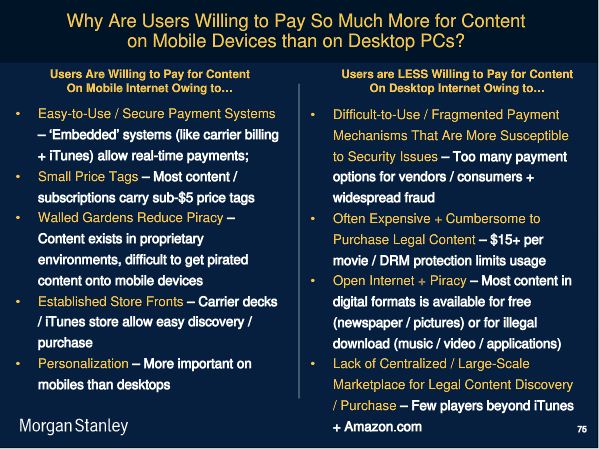
What got me thinking about all this was slide #75 in Mary Meeker’s latest slideshow about Internet trends. The Morgan Stanley web guru notes that users are more willing to pay for content on mobile devices than they are on desktop computers for a number of reasons, but the first of which she listed was: “Easy-to-Use/Secure Payment Systems — embedded systems like carrier billing and iTunes allow real-time payment.” The important point here is that the combination of these slick, well-organized online app stores + secure, super-easy billing systems have combined to overcome the so-called”mental transaction cost problem,” at least to some extent. We’re not nearly as reluctant today to surf away when something says “$0.99” on our screen. Increasingly, we’re hitting the “Buy” button.
 Continue reading →
Sorry for another job board posting, but wanted to see if anyone had any leads for this open position at the Progress & Freedom Foundation. We’re looking to hire a new Vice President of Development & Outreach to help us craft a public policy agenda for the organization and find support for it going forward.
The complete job description can be found online here or down below the fold. Interested candidates should contact me directly.
Continue reading →
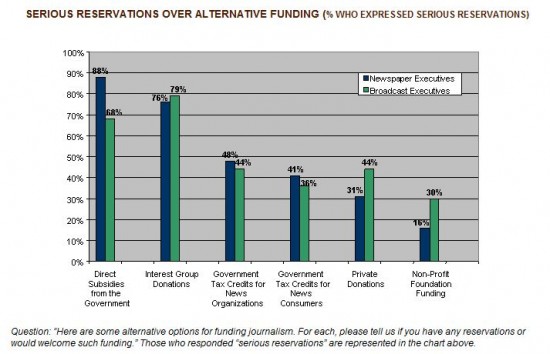
Good to see so many media industry executives expressing skepticism about the idea of government subsidies for the press. Danny Glover brought to my attention this new survey by the Pew Research Center’s Project for Excellence in Journalism in association with the American Society of News Editors (ASNE) and the Radio Television Digital News Association (RTDNA). It revealed that, “Fully 75% of all news executives surveyed—and 88% of newspaper executives—said they had ‘serious reservations,’ or the highest level of concern, about direct subsidies from the government.” A smaller percentage (only 46%) had serious reservations about tax credits for news organizations, then again, only 13% said they “would welcome such funding” and just 6% said they were “enthusiastic” about it.
This is encouraging news as many government officials at the FCC, FTC, and in Congress are currently considering whether government should steps to prop up failing media entities or promote certainly types of content. Berin Szoka and I have been working on a series of essays about the wrong ways to go about reinventing media [see Part 1, Part 2] and plan several more installments leading up to a big filing in the FCC’s “Future of Media” proceeding (the deadline is May 7th).
Here’s a chart from the Pew survey illustrating funding alternatives and the percentage who had “serious reservations” about each option:
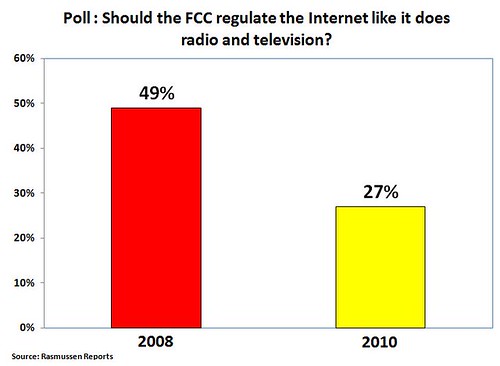
I don’t place a lot of stock in polls… until they confirm what I have long believed, that is! According to this new poll by Rasmussen Reports, 53% of Americans oppose FCC regulation of the Internet. Specifically, in response to the question, “Should the Federal Communications Commission regulate the Internet like it does radio and television?” the breakdown was: 27% =Yes, 53% = No, 19% = Not sure.
But here’s what is more interesting. The 27% of “yes” votes represents
a stunning 22-point drop in support for federal regulation of the Internet since a June 2008 poll by Rasmussen, which asked the exact same question. Now, what has changed since 2008 that might have led to such rapidly declining support for Net regulation? Could it have had something to do with the FCC’s ambitious plan to centrally plan broadband markets via its 376-page National Broadband Plan? Or its incessant crusade to impose burdensome Net neutrality regulations, which could decimate investment and innovation?
No, I think what really must be to blame for this sudden public uprising against the FCC was Chairman Julius Genachowski’s alliance with the evil Elmo. People have had enough of the little red demon. That’s my theory and I’m stickin’ to it. I mean, after all, from what my friends on the Left tell me, the American people are just dying to get Net neutrality regulations on the books and have a massive infusion of taxpayer support for Soviet-style broadband plans and media bailouts. So clearly those things just can’t be driving this sudden public skepticism about the FCC, right? It must be Elmo.
Here are two radio programs that took place today discussing the ramifications of this week’s
Comcast v. FCC decision. The first was today’s Diane Rehm Show on NPR and it featured Ben Scott of Free Press, Amy Schatz of The Wall Street Journal, and Kyle McSlarrow of the National Cable and Telecommunications Association (NCTA). I can’t embed it directly here but you can listen to the hour-long show here.
The second program was on KQED – San Francisco’s “Forum with Michael Krasny.” It featured Declan McCullagh of CNET.com, Art Brodsky of Public Knowledge, Eric Klinker, president and CEO of BitTorrent, and me. You can listen to this hour-long debate by clicking below.
http://www.kqed.org/assets/flash/kqedplayer.swf

 The Technology Liberation Front is the tech policy blog dedicated to keeping politicians' hands off the 'net and everything else related to technology.