Articles by Adam Thierer 
 Senior Fellow in Technology & Innovation at the R Street Institute in Washington, DC. Formerly a senior research fellow at the Mercatus Center at George Mason University, President of the Progress & Freedom Foundation, Director of Telecommunications Studies at the Cato Institute, and a Fellow in Economic Policy at the Heritage Foundation.
Here’s another one to add to the “personal-responsibility-is-dead” file… According to this AP report, a former IBM employee is suing the company for $5 million claiming he is an Internet addict who deserves treatment and sympathy rather than dismissal. Better yet, in the court filing, the guy claims that stress caused him to become “a sex addict, and with the development of the Internet, an Internet addict.” He is also claiming that he’s protected by the American with Disabilities Act because he says he suffers from sexual behavior disorders !!
This clown gets caught using the Net during work hours to check out porn and now he wants to blame it all on (a) the existance of the Internet and (b) the company and society for not stopping him from indulging his desires. Give me a break. Maybe alcoholics can use this theory to sue booze stores as the cause of all their problems.
Fellow TLF-er Jerry Brito has just released an important new study on spectrum policy that is must-reading for those of you who monitor ongoing wireless policy battles. His new Stanford Technology Law Review article is entitled “The Spectrum Commons in Theory and Practice.” In it, he thoroughly deconstructs spectrum commons theory and debunks the myths propagated by Professors Lawrence Lessig, Yochai Benkler and others who believe that a spectrum commons offers us a “Third Way” approach to spectrum management that is both free of government control and highly efficient.
To the contrary, Brito argues, “A commons must be controlled either by private actors or by the government. There is no ‘third way.'” And “there is nothing that will make this new government regulation free from the same protracted and inefficient processes that have thus far plagued decisions about spectrum,” he finds. Brito pinpoints the fundamental flaw in the commons mindset in paragraph 28 of the paper:
Continue reading →
Satellite radio competitors XM and Sirius have announced their intention to merge their companies in a $13 billion deal. The deal will face some obstacles at the Federal Communications Commission (FCC), but I think there are strong reasons for the agency to approve the deal immediately and unconditionally.
What are the consumer benefits that might arise from a satellite radio marriage? First and foremost, the survival of a vibrant and healthy satellite radio competitor is important to consumers.
Continue reading →
Steve Jobs wants to sell you back copies of your own home movies for a $1.99 apiece! Or so declares this humorous Onion parody, (which almost sounds like it might have been secretly penned by our own Tim Lee!)
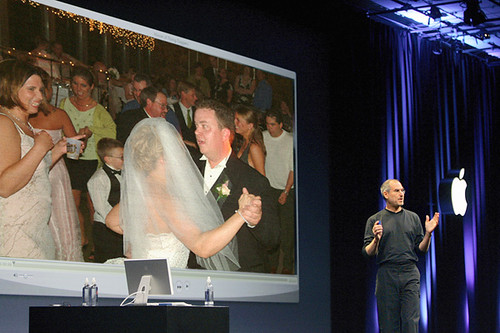
And while you’re over at The Onion site, you might also want to check out this funny take-off on the government’s ongoing lost laptop problems, which I’ve been writing quite a bit about here.
Well, here we go again. Politicians in Washington are talking about regulating “excessive violence” on television, and this time around they plan to sanitize cable and satellite TV while they’re at it. I’ll have more to say about this issue in coming days and weeks as the debate unfolds. For now, I thought I’d just pass along some recommended reading for policy makers who haven’t given enough consideration to the sensibility or constitutionality of this quixotic endevour:
Continue reading →
Celebrities and artists defending the First Amendment is nothing new. After all, they have the most to lose if speech and artistic expression are censored. But when I hear most celebs defend the First Amendment these days, it just makes me cringe. They typically come off sounding like complete morons.
That’s why I miss Frank Zappa so much. When he was with us, he was one of the most passionate and articulate defenders of freedom of speech–not just in the entertainment industry–but in all of America. And this man knew his history. He understood why the First Amendment was so important to America’s founding and why it remains one of the cornerstones upon which all other human liberties rest.
Just check out this amazing performance of his on CNN’s “Crossfire” back in 1986 defending the music industry from would-be censors. He truly was in the crossfire here as all three of the other clowns on the show ganged up on him. But in the end, he blew them away.
(And how about those old “Crossfire” sets! Looks like this was shot in someone’s basement).
http://www.youtube.com/v/8ISil7IHzxc
Terrestrial radio broadcasters and satellite radio operators (XM & Sirius) continue to square off in the marketplace but their battle in the political arena is almost as heated of an affair. Rep. Gene Green (D-TX) and Rep. Chip Pickering (R-Miss.) have reintroduced the “Local Emergency Radio Service Preservation Act of 2007.” (H.R. 983) The legislation would limit satellite radio companies to just national programming and disallow any attempt by them to provide more “localized” content, such as local news, weather, traffic and sports reports.
Supporters of the measure argue that local radio broadcasters offer “services critical to the public,” especially “in times of emergencies or disasters when other means of communications may not be available.” Moreover, because “radio is the most ubiquitous of all mass media, with receivers located in almost every home and automobile in the country” the sponsors argue that “There is a substantial governmental interest in ensuring [the] continuation” of free, over-the-air local radio services. In other words, supporters argue that terrestrial radio broadcasting is somewhat akin to a “life line” service or mass media “carrier of last resort” for some local communities.
In late 2005, I penned a study on “The Future of Radio Regulation” in which I discussed the earlier version of this bill. In my study, I argued that the best way to solve this issue is not through line-of-business restrictions on new players or technologies, but rather though the comprehensive liberalization of the traditional terrestrial radio broadcast sector to give those operators more flexability to compete in the new media marketplace without one arm tied behind their backs. I argued:
Continue reading →
 Many thanks to Jim Lippard for naming the Tech Liberation Front as one of his “5 Blogs that Make Him Think.”
He did so as part of this new “Thinking Blogger Awards” contest. It’s not really a contest per se, rather, you’re just suppose to nominate 5 more blogs that make you think after someone else has already nominated your blog on their list.
So, to keep things going, here are 5 blogs that make me think (and I encourage my TLF colleagues to nominate others):
(1) Nick Carr’s “Rough Type”
(2) Mark Cuban’s “Blog Maverick”
(3) Chris Anderson’s “The Long Tail”
(4) Jay Rosen’s “Press Think”
(5)
Reason’s “Hit and Run“
As I noted in previous installments of this series, our government seems to have a problem keeping tabs on its laptop computers, especially the ones with sensitive information on them.
I know private sector companies lose plenty of laptops too. And sometimes those laptops also contain sensitive information. But there are at least two important qualitative differences between private and public laptop or data losses: (1) While some sensitive data may be lost or compromised when private laptops are lost, almost everything that government collects and stores on laptops is going to be at least somewhat sensitive information, and in other cases very sensitive. And much of that information that government collects about us is gathered without our consent. (2) When private companies lose laptops or data, someone is usually held accountable. Heads roll and lawsuits fly. Not so with the government, at least not most of the time.
That’s why I make such a big deal about government laptop losses. And that’s what makes this new Department of Justice report so disturbing.
Continue reading →
I know that it has become a bit passe to talk about personal responsibility these days. Ours is a “it takes a village to raise a child” world. We’re told that we have to look out for each other in this big village to ensure that no one becomes the village idiot. And so we get laws like this new one from New York that would ban the use of electronic devices such as iPods, BlackBerrys and cell phones while crossing streets in major cities.
According to CNet’s description of the soon-to-be-released bill, “The bill would effectively make it illegal to use any kind of portable electronic device–a music or video player, cell phone, smart phone, gaming device, etc.–while crossing the street in cities such as New York, Albany and Buffalo. Offenders would be slapped with a $100 fine and a criminal court summons. Joggers and bicyclists would have to limit their iPod use to city parks in which no street crossing would be involved.” Apparently the sponsor of the bill became concerned after a 23-year-old Brooklyn man walked into the path of a city bus while listening to his iPod.
That certainly is a tragic story–and I hate to sound cold-hearted about this–but is the problem here the iPod or the guy simply failing to look both ways before he crossed a busy street? Personally, when I’m walking the busy streets of Washington, DC, I am usually listening to my MP3 player and reading a newspaper or magazine at the same time. When I look around, plenty of people around me are doing the same thing. But there’s no epidemic of deaths from us all stumbling into oncoming traffic while in a zombie-like trance from listening to music or reading papers.
Moral of the story: Most of us know how to walk and chew gum at the same time. For the handful of those who don’t I suppose you could make a Darwinian argument: Banning portable media devices on streets isn’t going to stop that crowd from doing stupid things that put their lives in danger anyway.

 The Technology Liberation Front is the tech policy blog dedicated to keeping politicians' hands off the 'net and everything else related to technology.