Articles by Adam Thierer 
 Senior Fellow in Technology & Innovation at the R Street Institute in Washington, DC. Formerly a senior research fellow at the Mercatus Center at George Mason University, President of the Progress & Freedom Foundation, Director of Telecommunications Studies at the Cato Institute, and a Fellow in Economic Policy at the Heritage Foundation.
The video game industry’s string of unbroken First Amendment court victories continued this week with a win in the case of Video Software Dealers Association v. Schwarzenegger. [Decision here.] In this case, the VSDA and the Entertainment Software Association brought a suit seeking a permanent injunction against a California law passed in October 2005 (A.B.1179), which would have blocked the sale of violent video games to those under 18. Offending retailers could have been fined for failure to comply with the law.
The court’s decision overturning the law was written by Judge Ronald Whyte and it echoed what every previous decision on this front has held, namely:
Continue reading →
Do you mean to tell me that muni wi-fi networks will actually cost money? I’m shocked, shocked, I tell you. Where’s the free lunch we were promised?!
[see
San Jose Mercury News story below]
Municipal WiFi: A not-so-free lunch
by Sarah Jane Tribble
Mercury News
08/06/2007
It’s been more than a year since Silicon Valley’s Joint Venture Wireless Project first announced plans to build a regional wireless network, giving millions of local residents free access to the Internet. But that network won’t be so free after all, and the area’s millions of local residents may not really use it.
While initially the project was lauded as a way to give the masses affordable Internet, key organizers have gently shifted the focus of the network from serving residents, for free, to giving businesses and city governments wireless access, for a price. …
But the increasing focus on dollars and cents reflects a trend nationwide: As cities strive to provide wireless Internet service, they’re realizing it can’t truly be free.
[Read the rest here.]
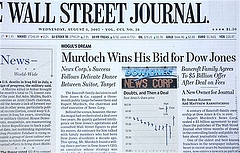 As James points out, there’s already a lot of huffin’-and-puffin’ going on about Rupert Murdoch’s deal for The Wall Street Journal. (Just look at the silly things that presidential candidate John Edwards had to say today about it). The City Journal has just posted an editorial I have written responding to this hysteria…
“Rupert Murdoch, Meet Chicken Little”
by Adam Thierer
8/2/07
Help, the sky is falling! So say the pro-regulation media agitators at Free Press, which fired off what is sure to be the first of many hysteria-ridden press releases about Rupert Murdoch’s successful acquisition of the Wall Street Journal and its parent company, Dow Jones & Co. “This takeover is bad news for anyone who cares about quality journalism and a healthy democracy,” argued Robert W. McChesney, president of Free Press. “Giving any single company—let alone one controlled by Rupert Murdoch—this much media power is unconscionable.”
The argument that the Murdoch–Dow Jones marriage will have a significant impact on American journalism or democracy is absurd. Don’t get me wrong. The Journal is a great paper; in my opinion, it represents the pinnacle of journalistic excellence. Nonetheless, it’s just one of many voices shouting to be heard in today’s media cacophony. Indeed, the modern media marketplace is extraordinarily dynamic, with new outlets and technologies developing constantly. Despite the existence of a handful of very large conglomerates, dozens of other important media companies continue to thrive and fill important niches that the big firms have missed. As Columbia University’s Eli Noam has noted of the modern media marketplace, “While the fish in the pond have grown in size, the pond did grow, too, and there have been new fish and new ponds.”
Read the rest of the piece here.
This week, the Senate Commerce Committee will apparently be considering S. 602, the “Child Safe Viewing Act of 2007,” which was introduced by Sen. Mark Pryor (D-AR) earlier this year. The measure marks an important turning point in the ongoing battle over content regulation in the Information Age–in one way for the better, but in some other ways for the worse.
The measure wisely avoids direct content regulation and instead focuses on empowering families to make media consumption decisions on their own. Unfortunately, the measure seeks to accomplish that goal through government actions that could have potentially troubling regulatory implications, especially because of the First Amendment issues at stake here. Specifically, S. 602 opens the door to an expansion of the FCC’s authority over media content on multiple platforms and threatens to undermine private, voluntary rating systems in the process.
I have just released a brief analysis of the measure discussing these concerns. This 5-page paper can be found online at:
http://www.pff.org/issues-pubs/pops/pop14.17pryorchildsafetyviewingact.pdf
Good piece in the Wall Street Journal yesterday by Dennis Patrick (former FCC Chairman) and Thomas Hazlett (former FCC Chief Economist) on the Fairness Doctrine. In their editorial entitled, “The Return of the Speech Police,” they argue that the Doctrine represented “well-intended regulation gone wrong” and that “re-imposing ‘fairness’ regulation would be a colossal mistake.” The continue:
The Fairness Doctrine was bad public policy. It rested on the presumption that government regulators can coolly review editorial choices and, with the power to license (or not license) stations, improve the quantity and quality of broadcast news. Yet, as the volcanic eruption triggered by repeal amply demonstrated, government enforcement of “fairness” was extremely political.
Evaluations were hotly contested; each regulatory determination was loaded with implications for warring factions. The simple ceases to be easy once government is forced to issue blanket rules. What public issues are crucial to cover? How many contrasting views, and presented by whom, in what context, and for how long? The Fairness Doctrine brought a federal agency into the newsroom to second-guess a broadcaster’s editorial judgments at the behest of combatants rarely motivated by the ideal of “balanced” coverage.
Continue reading →
I don’t know what’s worse: the fact that this guy decided to drive 1,300 miles (from Virginia to Texas) to burn down a guy’s house after the guy called him a “nerd” during an online flame war, or that along the way the moron posted photos online showing the welcome signs at several states’ borders to prove to his Internet friends that he meant business.
Did he not stop to think that those photos might be used as evidence against him later on at trial?!
As Braden mentioned, we were both down in Raleigh, North Carolina this week testifying at a big hearing on mandatory age verification for social networking sites.
It was quite a heated battle. The legislation, SB 132, was supported at the hearing by North Carolina attorney general Roy Cooper, several of his staff attorneys, a couple of NC senate lawmakers, and some folks from Aristotle, a company that claims it has devised a workable age verification solution for social networking purposes. A vote on the proposal was delayed and we’re still awaiting the final outcome.
Down below, I have attached the outline of my remarks in which I argued that age verification mandates would actually make kids
less safe online. Here’s why:
Continue reading →
 PFF has just released Version 2.2 of my book, “Parental Controls and Online Child Protection: A Survey of Tools and Methods.” It can be found online at: http://www.pff.org/parentalcontrols
As promised when we launched book last month, we plan on making ongoing updates available to ensure that the report offers a timely, comprehensive snapshot of the amazingly diverse marketplace of parental control tools and methods, as well as the ongoing state of child safety efforts.
Toward that end, Version 2.2 offers the following updates:
- over 20 new color exhibits or screen captures that highlight the many excellent websites or products on the market to help parents better manage media;
- a new section on how the “power of the purse” and sensible media budgeting can serve as the ultimate parental control strategy;
- a short section of good books on Digital Age parenting and online child safety;
- various other additions, clarifications and improvements to many other sections.
If you have other suggested additions, updates or corrections, please let me know. Version 2.3 of the book is already in the works!
Over on Verizon’s PolicyBlog, Link Hoewing, VZ’s Assistant Vice President – Internet and Technology Issues, has posted an interesting comparison of the US and European mobile markets. He’s put together a side-by-side chart comparing contracts, competition, coverage, prices, new services, and more. He’s asked for input from others, so take a look.
Fresh on the heels of Sen. Jay Rockefeller’s (D-W.Va.) show trial hearing about “violent TV” in the Senate Commerce Committee two weeks ago, Senator Sam Brownback (R-Kan.) has just announced he would be proposing two new amendments that would seriously roll back the clock on broadcast industry regulation. According to a report in today’s Broadcasting & Cable,
“Brownback, a member of the Senate Appropriations committee, said Tuesday that he will offer two amendments to a general government appropriations bill Thursday, July 12, one that would “continue support for the FCC to fine broadcasters who air indecent, profane, or obscene content,” and another that would “fine broadcasters for airing excessively violent content during the hours when children are most likely to be in the audience.”
Before getting into the substance of these measures, a word about the process. I find it more than a little troubling that Senator Brownback is attempting to legislate on sensitive constitutional matters like this through the appropriations process. It seems to me that any measure that cuts to the core of an industry’s First Amendment rights should not be snuck into a bloated spending measure in order to get it passed. But hey, who cares about the Constitution… this is about “protecting children”! Right? Well, actually, it wouldn’t do that either.
Continue reading →

 The Technology Liberation Front is the tech policy blog dedicated to keeping politicians' hands off the 'net and everything else related to technology.