Articles by Adam Thierer 
 Senior Fellow in Technology & Innovation at the R Street Institute in Washington, DC. Formerly a senior research fellow at the Mercatus Center at George Mason University, President of the Progress & Freedom Foundation, Director of Telecommunications Studies at the Cato Institute, and a Fellow in Economic Policy at the Heritage Foundation.
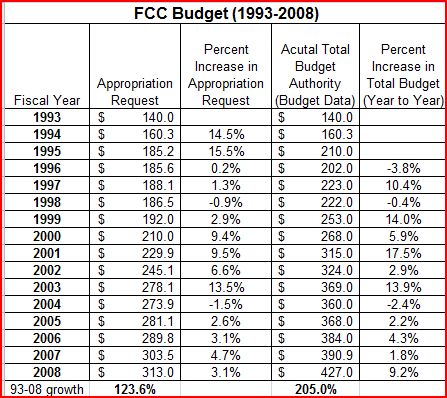
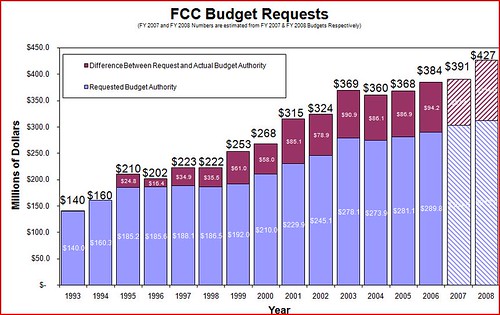
This is just a quick follow-up to the post I made earlier in which I mentioned the new editorial James Gattuso and I penned for National Review about the growth of FCC regulation and spending in recent years. A few people asked me where we got the numbers we used in the piece regarding the growth of the FCC’s budget over time. Here are the relevant numbers and a graph charting that growth. The numbers can all be found in the the FCC’s annual budget reports.
Next time some pro-regulatory advocate says that the agency is engaged in “radical deregulation” or something absurd like that, show them these numbers. There’s still a whole lotta regulatin’ going on over there!
This week in National Review Online, Cesar Conda and Lawrence Spivak ran an editorial entitled “Kevin Martin’s Pro-Market FCC,” arguing that the current FCC has generally been deregulatory and free market-oriented. Today, James Gattuso and I have set the record straight regarding just how off-the-rails this current FCC has really gone…
November 29, 2007
TV Train Wreck
Martin, markets, and the potential for regulatory disaster.
By James Gattuso & Adam Thierer
Like cops shooing away onlookers at the scene of an accident, Cesar Conda and Lawrence Spivak argue (“Kevin Martin’s Pro-Market FCC”) that there’s no reason for conservatives to be concerned about the Federal Communications Commission (FCC). Under Chairman Kevin Martin, they say, the FCC has been “characterized by a consistent pro-entry/pro-consumer welfare mandate, the very hallmark of economic conservatism.”
In other words: “Just move along. Nothing to see here.”
Despite Conda and Spivak’s exhortations, however, there is much for the curious crowd to see in the train wreck that is the FCC. The most recent derailment began earlier this month, when Martin leaked plans to invoke an obscure provision of the Communications Act, and to assert nearly unlimited powers to regulate cable television if more than 70 percent of households subscribe to cable.
Continue reading →
Honestly, I don’t get it. Republican presidential candidate Mike Huckabee, former governor of Arkansas, is mounting a strong challenge for the GOP nomination primarily by appealing to the social conservative wing of the party and religious groups. He uses rhetoric like this on the campaign trail:

“Over the past 30 years, a decline in moral character has produced a decline in the character of our society. Everything hinges on the men & women we choose to establish public policy. And their character depends on you. There is something you can do: you can live a God-centered life of high moral character, and you can support candidates who share your Christian standards.”
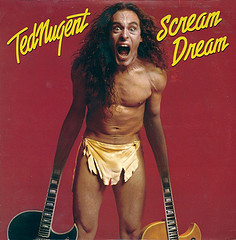
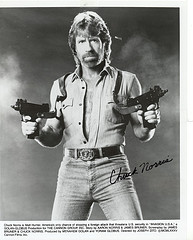
OK, that’s fine, but here’s what I don’t get. Why is Huckabee preaching the gospel of moral decline and cultural disintegration while also playing up endorsements from martial arts expert and actor Chuck Norris, professional wrestler Ric Flair, and rock-and-roll star Ted Nugent? Don’t get me wrong, I spent more time than I care to mention watching Chuck Norris movies and Ric Flair wrestling matches with my Dad growing up, and I used to own all of the Motor City Madman’s (that’s one of Nugent’s many colorful nicknames for you non-fans) albums in the late 1970s.
Continue reading →
New York Times business columnist Joe Nocera penned a lengthy column on the potential dangers of a la carte regulation over the weekend. He summarized why–as we have pointed out here before–despite the best of intentions, a la carte regulation is certain to backfire:
À la carte. It sounds so appealing, doesn’t it? Instead of having to accept — and pay for — all the channels bundled by your cable company, you could pick from a menu and pay for only the ones you watch. … Yet as appealing as the idea might seem at first glance, there is a reason that Congress has not taken the bait and passed an à la carte law. À la carte would be a consumer disaster. For those of you who yearn for it, this is a classic case of “be careful what you wish for.”
Nocera goes on to show that, contrary to what a la carte regulatory advocates believe, prices for most customers would rise in the long-run:
Continue reading →
One of the things I find most interesting about calls to regulate “excessively violent” content on television, in movies, or in video games is the way critics make massive leaps of logic and draw outrageous conclusions based on myopic, anecdotal reasoning. I was reminded of that again today when reading through an interview with Sen. Jay Rockefeller (D-W.Va), one of the most vociferous critics of all sorts of media content and a long-time proponent of regulation to censor such violent content in particular (however it is defined). (I have written about his past regulatory proposals here and here).
Here’s what he recently told the editorial board of The Register-Herald of West Virginia:
Continue reading →
I want join James Gattuso in recommending that you read FCC Commissioner Robert McDowell’s outstanding speech on media policy issues that he delivered at a Media Institute event yesterday. I just want to highlight two of the myths he debunked in his speech, (myths which I had discussed in my 2005 book Media Myths: Making Sense of the Debate over Media Ownership):
Myth #1: The public has not been given a chance to be heard. As McDowell points out, no issue has been more thoroughly studied in the history of the FCC:
In my 17 years of being in and around the FCC, I can’t think of any issue that has been examined more thoroughly. I can’t remember any proceeding where the Commission has solicited as much comment and given the American people as much opportunity to be heard. If anyone knows of an FCC proceeding where there has been more opportunity for debate over an 11-year period, please let me know.
That’s exactly right, but the anti-media zealots like to propagate the myth that the public has somehow been frozen out of the process, or that important constituencies have not been heard from during these debates. It’s nonsense.
Continue reading →
Last week, the big news inside the Beltway was how FCC Chairman Kevin Martin was stepping up what many have labeled his “war on cable” by proposing still more regulations for the cable sector. Craig Moffett, a senior analyst with Sanford Bernstein & Co, summarizes the economic regs currently being proposed: “Over the past year, the Chairman has adopted an almost uniformly anti-cable stance on issues ranging from set-top boxes (CableCards), digital must carry requirements, cable ownership caps, video franchising rules, and the abrogation of exclusive service contracts with [apartment owners].” And in a short PFF paper last week, I also outlined the content / speech regulations that the Martin FCC has proposed for cable (as well as satellite and telco) operators.
As Jon Hemingway’s cover story in this week’s Broadcasting & Cable magazine points out, the FCC’s war on cable appears to now be having an impact in the stock market. Investors are turning against cable operators fearing that the regulatory reign of terror at the FCC will limit cable’s ability to respond to rising competitive threats. Here’s a summary of the bad news from the B&C story:
Continue reading →
EarthLink appears to be getting out of the muni wi-fi business for good. The company is at least is abandoning the major Philadelphia experiment it was in charge of. According to today’s press release:
“After thorough review and analysis of our municipal wireless business we have decided that making significant further investments in this business could be inconsistent with our objective of maximizing shareholder value,” said Rolla P. Huff, EarthLink president and CEO. “Accordingly, at this time, we are considering our strategic alternatives with respect to this business,” Huff added. EarthLink will seek to work closely with the municipalities in which it has operations as it considers these alternatives. The net book value of the assets attributable to EarthLink’s municipal wireless business is approximately $40 million.
A few years ago, many folks were telling us that muni wi-fi was like manna from heaven; the ultimate free lunch that would give us a broadband nirvana. As some of us predicted–reality often proves more complicated. Indeed, one lesson from this experiment is that demand counts. There was always a bit of “if-you-build-it-they-will-come” reasoning behind the Philly deal and other muni wi-fi proposals. But you can’t build a network without a customer base, and recent news reports indicated that demand was lacking.
Continue reading →
Earlier this week, FCC chairman Kevin Martin announced long-promised revisions to America’s media-ownership rules. As I point out in my latest essay for the City Journal, the results were extremely disappointing and could have grave consequences for the long-term viability of struggling media operators.
Media Deregulation Is Dead
The FCC’s toothless reforms are a victory for the status quo.
November 15, 2007
by Adam Thierer
This week, Federal Communications Commission chairman Kevin Martin announced long-promised revisions to America’s archaic, convoluted media-ownership rules. The result: no serious deregulation, just tinkering at the margins. In fact, of the half-dozen rules currently on the books, Martin is proposing to revise only one—the newspaper/broadcast cross-ownership rule. “No changes to the other media-ownership rules [are] currently under review,” Martin’s press release notes tersely, leaving many TV and radio broadcasters wondering when they will ever get regulatory relief.
Continue reading →
[James and Hance already commented on this issue, but here’s my take on the FCC opening another front in its ongoing “war on cable” … ]
Despite steadily increasing video competition and consumer programming choices, the Federal Communications Commission (FCC)–or at least current Chairman Kevin Martin–seems to be pursuing what many journalists and market analysts have described as a “war on cable.” As Craig Moffett, a senior analyst with Sanford Bernstein & Co, says, “Over the past year, the Chairman has adopted an almost uniformly anti-cable stance on issues ranging from set-top boxes (CableCards), digital must carry requirements, cable ownership caps, video franchising rules, and the abrogation of exclusive service contracts with [apartment owners].”
And Moffett is only summarizing the economic regulation that Martin’s FCC is currently pursuing against cable. Chairman Martin has also proposed the unprecedented step of imposing content controls on pay TV providers. He wants to extend broadcast industry “indecency” regulations to cable and satellite operators, even though the constitutionality of those rules is being questioned in court. And Chairman Martin has also suggested that “excessively violent” programming on pay TV should be regulated in some fashion. Finally, he has strong-armed cable operators into offering “family-friendly tiers” of programming even though there was no demand for them and consumers have shown little interest in them now that they have been offered.
And more cable regulation appears to be in the works. According to recent press reports, Chairman Martin is considering breathing new life into a little-known provision of the Cable Communications Act of 1984 known as the “70/70 rule.” Under the 70/70 rule, if the Commission finds that cable service is available to 70% of households and 70% of those homes subscribe, then the FCC can “promulgate any additional rule necessary to provide diversity of information sources.”
Chairman Martin apparently believes that cable has crossed both 70/70 thresholds and that comprehensive regulation of the cable industry is now warranted. What that means in practice remains to be seen, but it could include common carriage-like price controls on cable systems. The Wall Street Journal reports that a significant reduction (perhaps 75%) in the rates cable operators charge programmers for leased access might be the end result. In the long run, an FCC declaration that the 70/70 rule has been triggered could also lead to the imposition of some of the other regulatory proposals mentioned above.
Continue reading →

 The Technology Liberation Front is the tech policy blog dedicated to keeping politicians' hands off the 'net and everything else related to technology.