Articles by Adam Thierer 
 Senior Fellow in Technology & Innovation at the R Street Institute in Washington, DC. Formerly a senior research fellow at the Mercatus Center at George Mason University, President of the Progress & Freedom Foundation, Director of Telecommunications Studies at the Cato Institute, and a Fellow in Economic Policy at the Heritage Foundation.
I’ve been trying to keep tabs on the status of various municipal wi-fi experiments going on across the nation by posting local news reports about them whenever I see them. The results so far have not been encouraging, but this hasn’t been that surprising since those of us who study these issues know that most wireline muni experiments failed too.
And speaking of failed wireline experiments, it appears there’s another one that might soon be added to the list. The Utah Telecommunications Open Infrastructure Agency–or “UTOPIA” as it is known–was created in 2002 by local Utah officials who wanted to bring high-speed Internet access to their communities. Eleven communities pledged roughly $200 million over 20 years to back the bonds needed to finance the construction of advanced fiber-optic facilities. Utilimately, the goal was to ensure inexpensive broadband for the masses at minimal cost to taxpayers.
But there are problems in paradise. According to this recent article by Steve Oberbeck of The Salt Lake Tribune:
[F]our years after 11 Utah cities… pledged to financially back the UTOPIA system, its finances are in shambles. Construction is behind schedule. Its top promoters have quit, and its newest chairman has uttered the unthinkable – that despite promises to the contrary, the cities that pledged their support eventually may have to pony up hundreds of millions in taxpayer dollars to prop up the system.
What went wrong?
Continue reading →
In my 2004 book, Media Myths: Making Sense of the Debate over Media Ownership, I pointed out that mergers and acquisitions represent just one of many strategies media companies utilize to respond to consumer demand and new market challenges. Other strategies include spin-offs and line-of-business divestitures on the one hand, and new technological investments or expanded product or service offerings on the other.
But those other strategies never seem to attract the same amount of attention as mergers and acquisitions even though they are far more common. In fact, as media guru Ben Compaine correctly observes, “Break-ups and divestitures do not generally get front-page treatment.” Such stories usually get buried in papers and magazines, or get a small mention at the bottom a news website, if at all.
That’s why I started this series of “media DE-consolidation series” of essays a few years ago. I wanted to highlight the other side of the story and show how the media marketplace is far more dynamic than critics care to admit. In fact, as FCC Commissioner Robert McDowell noted recently in an excellent speech on the true state of the media market, “Traditional media’s numbers are shrinking,” and “The ironic truth is: in many cases, media consolidation has actually become media divestiture. Companies such as Disney, Citadel, Clear Channel and Belo actually have been shedding properties to raise capital for new ventures.”
That’s exactly right, and the many other entries in this series prove that point. We’re in the midst of a massive wave of media divestitures and downsizing. And today we have another example with News Corp’s announcement that it will be shedding 8 of its Fox-affiliated TV stations in mid-sized markets.
Continue reading →
The kids are alright. Not only is that the title of one of my favorite songs by The Who, but it also happens to be the theme of much of my public policy research. Specifically, I spend a great deal of time analyzing social trends and media usage in an attempt to show that, contrary to what many media critics claim, the whole world is not going to hell. I’ve touched on these themes before in essays such as “Why hasn’t violent media turned us into a nation of killers?” and my PFF paper about “Fact and Fiction in the Debate Over Video Game Regulation.”
In this research, I try to bring some hard evidence to bear on the question of whether there is any correlation between exposure to violent media and real world acts of violence / aggression. And I also try to show that parents are actually far more involved in raising their kids, and instilling good values in them, than critics care to admit. In essence, parents are parenting! I illustrate that in my ongoing book, Parental Controls & Online Child Protection: A Survey of Tools & Methods.” I keep that publication up to date with as much info as I can find on the subject and plan on issuing new versions of the report every few months. (Version 3.0 is due out early next year.)
Exhibit 1
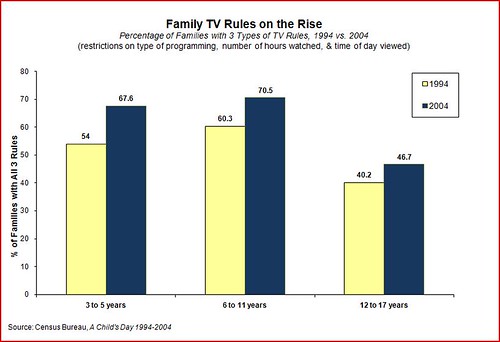
And now I have some more great stats and charts to include in my report thanks to the release of a big batch of new Census Bureau data on child-parent interaction. The Census Bureau data, which is available here, is part of a report entitled A Child’s Day. The last report was conducted in 1994, and the most recent one in 2004, but the data for 2004 was just recently released.
The results are very encouraging and generally show that “Parents are taking a more active role in the lives of their children than they did 10 years ago,” according to the Census Bureau. For example, as Exhibit 1 above shows, parents are crafting more TV rules for the kids today than they were in the past.
Continue reading →
Matt Lasar has put together a very entertaining article illustrating how “Faux Celebrity FCC Filings [are] on the Rise.” What he’s referring to is the fact that just about anyone can file comments with the FCC, even fake celebrities or dead historical figures.
The whole process has become a complete joke. Some of my research on the FCC’s indecency complaint process has illustrated how one group–the Parents Television Council (PTC)–has essentially been able to stuff the complaint ballot box at the FCC by filing endless strings of computer-generated complaints from its website. The PTC then fires off letters to the FCC and Congress that essentially say, “Look! Millions of Americans out outraged by the content on TV and are clamoring for regulation!” In turn, that nonsense gets included in the congressional record when legislation is introduced, and politicians claim “the American people have spoken” and are overwhelming in favor of regulation.
It’s all nonsense, of course, because the vast majority of those “complaints” were just the same PTC form letter. But the same games are at work in the debates over media ownership policy and Net neutrality regulation. Jerry Brito and Jerry Ellig have shown that, in the FCC’s Net neutrality proceeding, “Close to 10,000 comments were submitted to the FCC, yet all but 143 were what the FCC calls “brief text comments,” many of which were form letters generated at the behest of advocacy groups.” The same thing is at work in the media ownership debate. A couple of radical anti-media activist groups stuff the ballot box with computer-generated complaints. And the Washington Post recently ran a piece raising questions about how the public filing process is potentially being abused in the XM-Sirius merger fight.
But Matt Laser documents how truly absurd this process has become when the likes of Paris Hilton, Donald Trump, Joseph Stalin, and even Jesus Christ end up submitting “comments” for the “public record.” Here’s some of the highlights from Lasar’s writeup:
Continue reading →
According to this AP story, Rep. John Conyers, D-Mich., chairman of the House Judiciary Committee…
has expressed concern in a letter to Attorney General Michael B. Mukasey that the Justice Department may “rush through” an approval of Sirius Satellite Radio Inc.’s $5 billion purchase of its rival XM Satellite Radio Holdings Inc. [Conyers] also said he was “dismayed to learn” that Thomas O. Barnett, the head of the department’s antitrust division, may approve the deal “over the objections of department staff.” The Judiciary Committee oversees antitrust issues. Rep. Steve Cabot, an Ohio Republican, also signed the letter. The two members said they haven’t yet taken a position on the transaction, but urged Mukasey to “preserve your ability to personally participate in the department’s deliberations.”
Only in Washington would it be considered “rushed” to take a year to review a proposal. Absurd.
Bravo for Larry Downes of ZD Net who has a smart new column out today entitled “Save Internet Freedom–from Regulation.” Downes is referring to the ominous threat posed to the future of the Internet by the Net neutrality bill that Rep. Edward Markey (D-MA) is likely to introduce shortly. Downes points out that:
The Internet has thrived in large part because it has managed to sidestep a barrage of efforts to regulate it, including laws to ban indecent material, levy sales tax on e-commerce, require Web sites to provide “zoning” tags, and to criminalize spam, file sharing, and spyware. Some of these laws have been overturned by the courts; some died before being passed; and the rest–well, the rest are effectively ignored, thanks to the Internet’s remarkable ability (so far) to treat regulation as a network failure and reroute around the problem.
Exactly right. Why then, Downes asks next, “do the same civil-liberties groups that recognize the value of keeping the government out of Internet content want to open a loophole large enough to drive several Mack trucks through?” GREAT question, and one that we’ve been asking on this site for many years.
Continue reading →
The “Blog Readability Test,” which claims to be able to determine “what level of education is necessary to understand your blog,” says that our Tech Liberation Front blog is just at the “High School” reading level.

I guess the engine behind this thing uses a Flesch-Kincaid Readability Test. That test judges “readability” by examining word length and sentence length. Longer words and sentences decrease “readability.”
I’ve always thought those Flesch-Kincaid tests were silly, but then I would think than since I am the king of the run-on sentence. My TLF blogging colleague Jim Harper is constantly getting on me about that fact since, by contrast, he is the master of brevity. Harper sometimes uses fewer words per sentence than Dr. Suess or EE Cummings.
But I now feel vindicated in some strange way, Jim, because all my run-on sentences may be the only thing keeping our score up at the “High School’ level! Dammit man, start using really big words–like honorificabilitudinitatibus and floccinaucinihilipilification–and make your sentences unnecessarily long like this one, which I am deliberately typing without end in order to shamelessly boost our Blog Readability Test score to the “Genius level” and save us the collective shame of being as easy to read as the Huffington Post!
Garrett M. Graff, an editor at large at Washingtonian magazine–and also the first blogger admitted to a White House briefing–has an excellent op-ed in today’s Washington Post asking the same question many of us on this blog have raised before: Why do we let politicians get away with joking about their tech ignorance? Graff provides many examples of how the President, presidential candidates, and leading members of Congress, often joke about their ignorance of the information technology industry and IT policy issues in general. And then he rightly asks: “So, why is it that we blithely allow our leaders to be ignorant of the force that, probably more than any other, will drive and define the nation’s economic success and reshape its society over the next 20 years? Is it because we’re used to our parents or grandparents struggling to program the VCR (yes, they still use VCRs) so that it doesn’t blink “12:00″ all the time, or because we think it’s cute that they grew up in simpler times?”
It used to be easy to laugh about some of this, but as Graff argues, the time for laughing about tech ignorance is over:
Continue reading →
The big news this week in communications policy circles was the hullabaloo at the FCC over cable regulation. FCC Chairman Kevin Martin suffered a major setback in his attempt expand regulation of the video marketplace when he failed to get the votes he needed to impose new mandates on cable TV operators. Specifically, Chairman Martin was seeking to breath new life into an arcane provision of a 1984 law–the so-called “70/70” rule–that would have given him much greater regulatory authority over the day-to-day dealings of the cable market.
But the war certainly isn’t over. The day after losing that skirmish, Chairman Martin made it clear he would be pursuing other forms of regulation for the cable sector, including an arbitrary 30% ownership cap on the reach of any cable operator. And the Chairman’s crusade for a la carte mandates on cable will no doubt continue since it has been on his regulatory wish list for some time now, and many other groups support his efforts.
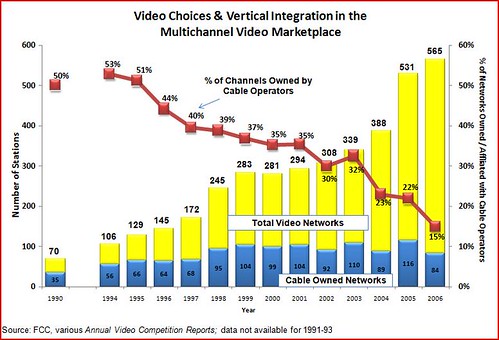
These cable TV regulatory proposals have always been fueled by the same two arguments: (1) cable TV operators have a stranglehold on market entry by new video providers and, (2) because of that, media diversity has suffered. For example, the
New York Times editorial board opined this week that: “Twenty-five years ago, cable carriers promised to provide consumers with a wealth of new programming options. Today, the carriers and their packages of unwanted channels are obstacles to choice.” This is the same logic that animates Chairman Martin’s crusade against cable and the efforts of his pro-regulatory allies, most of whom are radical Leftist media critics.
But that logic is dead wrong.
Continue reading →
As I mentioned yesterday, James Gattuso and I penned an editorial for National Review this week about the growth of FCC regulation and spending in recent years. In the op-ed, we also noted that, “For whatever reason, a disproportionate number of these [new regulatory proposals] have been aimed at cable television, so much so that press and industry analysts now speak of Chairman Martin’s ongoing ‘war on cable.'”
Today, the editors at
National Review have chimed in with an editorial of their own on the issue entitled, “Pulling the Cable on Martin’s Crusade.” Specifically, the editors address what most pundits believe really motivates the Chairman’s crusade against cable: His desire to force cable companies to offer consumers channels on “a la carte” basis in an effort to “clean up” cable TV. “Martin should abandon this particular crusade,” the NR editors argue. “While we are sympathetic to parents’ desire to get the channels they want without having to buy access to racier fare, using economic regulation to restructure an industry is the wrong approach.” They continue:
Continue reading →

 The Technology Liberation Front is the tech policy blog dedicated to keeping politicians' hands off the 'net and everything else related to technology.
